Aardvarks and anteaters look similar because both eat ants and termites, but they are not close relatives. Aardvarks live in Africa, have large ears, strong digging claws, and simple peg-like teeth. Anteaters live in Central and South America, have very long snouts, no teeth, and extremely long sticky tongues. Their similarity is mainly convergent evolution.
Aardvark vs Anteater Summary Table
| Feature | Aardvark | Anteater |
|---|---|---|
| Scientific group | Order Tubulidentata | Suborder Vermilingua, within Pilosa |
| Closest relatives | Related to Afrotherian mammals such as elephants, hyraxes, and tenrecs | Related to sloths and armadillos |
| Geographic range | Africa | Central and South America |
| Best-known species | Aardvark, Orycteropus afer | Giant anteater, tamanduas, and silky anteater |
| Main diet | Mostly ants and termites, especially termites | Mostly ants and termites, depending on species and habitat |
| Teeth | Has simple, peg-like teeth in adults | Has no teeth |
| Snout | Long pig-like snout | Very long, narrow tubular snout in many species |
| Tongue | Long, sticky tongue used to collect insects | Extremely long, sticky tongue, especially in giant anteaters |
| Ears | Large, rabbit-like ears | Usually smaller ears, especially in giant anteaters |
| Tail | Thick, muscular tail | Varies; giant anteaters have large bushy tails, tamanduas have prehensile tails |
| Claws | Strong digging claws for opening termite mounds and burrows | Long curved claws for tearing into nests and defense |
| Activity pattern | Mostly nocturnal | Varies by species; often diurnal or nocturnal depending on habitat and temperature |
What Is an Aardvark?
The aardvark is a medium-sized African mammal with the scientific name Orycteropus afer. Its name comes from Afrikaans and means “earth pig,” a reference to its digging habits and pig-like snout. Despite this nickname, the aardvark is not a pig.
Aardvarks are the only living species in the order Tubulidentata. This makes them evolutionarily unusual. Their closest broader relatives are not anteaters, but other Afrotherian mammals, a group that includes animals such as elephants, hyraxes, elephant shrews, tenrecs, and manatees.
Aardvarks are specialized diggers and insect eaters. They use powerful claws to break into termite mounds and ant nests, then collect insects with a long sticky tongue. They also dig burrows that provide shelter for themselves and many other animals.
What Is an Anteater?
An anteater is a New World mammal specialized for eating ants and termites. Anteaters belong to the suborder Vermilingua, a name meaning “worm tongue.” This group includes the giant anteater, northern and southern tamanduas, and the tiny silky anteater.
Anteaters are related to sloths and armadillos, not aardvarks. They are part of a broader group of mammals called xenarthrans. Their bodies are adapted for finding insect nests, tearing them open, and gathering insects quickly with sticky tongues.
The giant anteater is the most famous species. It has a long narrow snout, no teeth, strong front claws, a large bushy tail, and a distinctive black-and-white shoulder stripe. Tamanduas are smaller and partly tree-dwelling, while silky anteaters are tiny, arboreal, and much less familiar to most people.
Are Aardvarks and Anteaters Related?
Aardvarks and anteaters are not close relatives. Their similar appearance comes from convergent evolution. This means unrelated animals evolved similar traits because they faced similar ecological challenges.
Both animals eat ants and termites. To do this well, they evolved long snouts, sticky tongues, strong claws, and powerful digging or tearing abilities. These similarities can make them look related, but their ancestry is very different.
An aardvark is an African Afrotherian mammal. An anteater is an American xenarthran mammal. They are a classic example of animals that look alike because they live in similar ecological roles, not because they share recent ancestry.
Geographic Range
Aardvarks live in sub-Saharan Africa. They can be found in savannas, grasslands, open woodlands, scrublands, and semi-arid areas where ants, termites, and suitable digging soil are available. They usually avoid dense rainforest and extremely dry deserts where food or digging conditions are poor.
Anteaters live in Central and South America. Different species occupy different habitats. Giant anteaters use grasslands, savannas, wetlands, forests, and open woodland edges. Tamanduas live in forests, dry woodlands, and mixed habitats. Silky anteaters are mostly tree-dwelling and are associated with tropical forests.
The simplest range difference is clear: aardvarks are African, while anteaters are American.
Body Shape and Appearance
Aardvarks have a sturdy body, arched back, long pig-like snout, large upright ears, strong legs, and a thick tail. Their body looks like a mixture of several familiar animals, but they are not pigs, rabbits, or anteaters.
Anteaters vary more because there are several species. Giant anteaters have long narrow heads, very long snouts, strong forelimbs, curved claws, and large bushy tails. Tamanduas are smaller and more tree-oriented, with prehensile tails that help them climb. Silky anteaters are tiny, soft-looking, and arboreal.
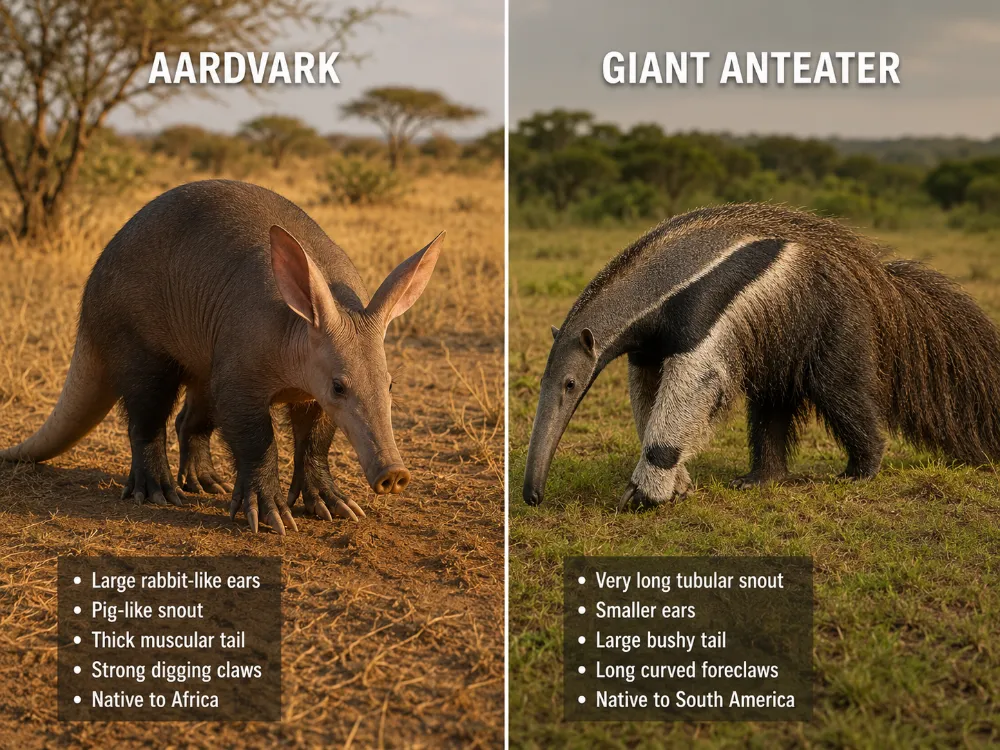
In quick visual terms, aardvarks have bigger ears and a more pig-like snout, while giant anteaters have a longer tubular snout and a more dramatic bushy tail.
Snout Differences
The aardvark has a long, rounded snout that looks somewhat pig-like. It uses this snout for smelling insect nests, pushing through soil, and exploring the ground. Its nostrils can close to keep dust and insects out while digging.
Anteaters, especially giant anteaters, have a much longer and narrower snout. The mouth opening is small, and the skull is shaped around the use of a very long tongue. Their snout looks more like a tube than a pig-like nose.
If the animal has large ears and a rounded pig-like snout, it is likely an aardvark. If it has a very long tube-like snout and small mouth, it is likely an anteater.
Tongue Differences
Both aardvarks and anteaters have long sticky tongues, but anteaters are especially famous for this feature. A giant anteater’s tongue can extend far out of the mouth and flick rapidly in and out to collect ants and termites.
The aardvark also has a long sticky tongue that helps it gather insects inside tunnels and mounds. Its tongue is highly effective, but its feeding anatomy is not identical to that of anteaters.
Both animals use saliva to make the tongue sticky. Insects cling to the tongue and are pulled into the mouth, where they are swallowed quickly.
Teeth Differences
One of the clearest biological differences is teeth. Aardvarks have teeth, although they are very unusual. Adult aardvark teeth are simple, peg-like, and made of many tiny tubules, which explains the name Tubulidentata.
Anteaters have no teeth at all. They do not chew food in the usual mammal way. Instead, they swallow insects and rely on muscular stomach action and swallowed grit or soil particles to help process food.
So the quick rule is: aardvarks have strange simple teeth; anteaters have no teeth.
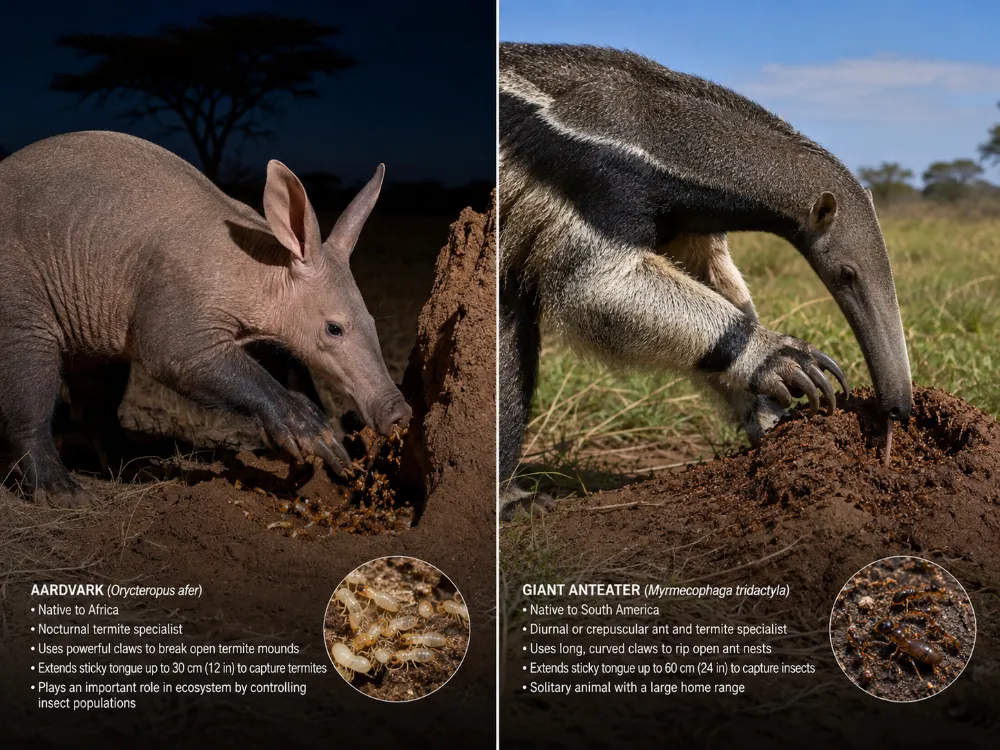
Claws and Digging Ability
Aardvarks are powerful diggers. Their strong claws help them break into termite mounds, dig burrows, and escape danger underground. They can excavate quickly, and their burrows may become important shelters for other animals such as warthogs, porcupines, reptiles, birds, and small mammals.
Anteaters also have strong claws, but their use varies by species. Giant anteaters use their long front claws to tear into ant and termite nests and to defend themselves. Tamanduas use claws for climbing and opening insect nests in trees or on the ground.
Aardvarks are more specialized for digging deep burrows. Anteaters are more specialized for ripping into insect nests and, in some species, climbing.
Diet and Feeding Behavior
Aardvarks mainly eat ants and termites, with termites often being especially important. They move at night, using their strong sense of smell to locate insect colonies. Once they find a mound or nest, they use their claws to open it and their sticky tongue to collect insects.
Anteaters also eat ants and termites, but species differ in feeding habits. Giant anteaters move from nest to nest and usually feed briefly at each one, avoiding over-damaging the colony. Tamanduas may feed in trees or on the ground. Silky anteaters feed mostly in trees.
Both animals are specialized insectivores, but aardvarks are African ground diggers, while anteaters include ground-living and tree-living American species.
Do Aardvarks and Anteaters Eat Only Ants?
Ants and termites make up most of the diet for both animals, but they are not always the only foods. Aardvarks may sometimes eat other small insects and are known to consume certain fruits in some situations. Their diet is still overwhelmingly based on social insects.
Anteaters also focus strongly on ants and termites, but the exact prey depends on species, season, habitat, and availability. They may eat larvae, eggs, and adult insects from colonies.
Neither animal is a general predator like a fox or cat. Their bodies are highly adapted for small colonial insects.
Habitat Differences
Aardvarks need habitats with enough ants and termites and soil suitable for digging. They are common in savannas, grasslands, scrublands, and open woodlands. Their burrows are important for temperature control, sleeping, hiding, and raising young.
Anteaters occupy a wider variety of American habitats depending on species. Giant anteaters may use open grasslands, savannas, wetlands, and forests. Tamanduas often use trees and forest edges. Silky anteaters are highly arboreal and live in tropical forest canopies.
Aardvarks are mostly ground-based burrowers. Anteaters range from ground-dwelling to tree-dwelling forms.
Activity Pattern
Aardvarks are mostly nocturnal. They usually spend the day in burrows and emerge at night to search for termites and ants. Night activity helps them avoid heat and some predators.
Anteater activity depends on species, temperature, habitat, and human disturbance. Giant anteaters may be active during the day in cooler or protected areas, but they may become more nocturnal in hot climates or disturbed landscapes. Tamanduas can be active by day or night. Silky anteaters are mostly nocturnal.
In general, aardvarks are more consistently night-active, while anteaters are more variable.
Defense and Predators
Aardvarks are not aggressive, but they are not defenseless. If threatened, they may flee to a burrow, dig rapidly, or use their strong claws. Their thick skin and powerful limbs can help protect them from predators.
Anteaters also use claws for defense. A giant anteater can rear up on its hind legs and slash with its powerful foreclaws. This defensive posture can be dangerous to predators and should not be underestimated.
Predators of aardvarks may include lions, leopards, hyenas, and large pythons. Predators of anteaters may include jaguars, pumas, large raptors for young individuals, and other large carnivores depending on habitat.
Burrows and Shelter
Aardvarks are famous for burrows. They dig sleeping burrows, escape burrows, and breeding burrows. Some burrows can be large and complex. These burrows become valuable shelter for many other species, making aardvarks ecosystem engineers.
Anteaters do not create burrow systems in the same way. Giant anteaters often rest in shallow depressions, dense vegetation, or sheltered ground areas, sometimes covering themselves with their bushy tails. Tamanduas and silky anteaters may rest in tree hollows, branches, or other elevated shelters.
This is one of the major lifestyle differences: aardvarks dig homes; anteaters usually rest in vegetation, trees, or ground shelters rather than deep burrow systems.
Tail Differences
The aardvark has a thick, tapering tail that helps balance the body while walking and digging. It is muscular but not bushy or prehensile.
Anteater tails vary greatly. The giant anteater has a large bushy tail that can help with camouflage, warmth, and resting cover. Tamanduas have prehensile tails that can grip branches, making them better climbers. Silky anteaters also have prehensile tails for life in trees.
If the animal has a huge bushy tail, it is likely a giant anteater. If it has a thick, plain tail and very large ears, it is more likely an aardvark.
Reproduction and Young
Aardvarks usually give birth to a single young. The baby stays in the burrow at first and depends on the mother for protection and milk. As it grows, it begins to follow the mother and learn how to forage.
Anteaters also usually give birth to one young at a time. A baby giant anteater rides on its mother’s back, where its stripe pattern helps it blend with the mother’s body. This camouflage can help protect the youngster from predators.
Both animals invest heavily in a small number of offspring, rather than producing large litters.
Convergent Evolution
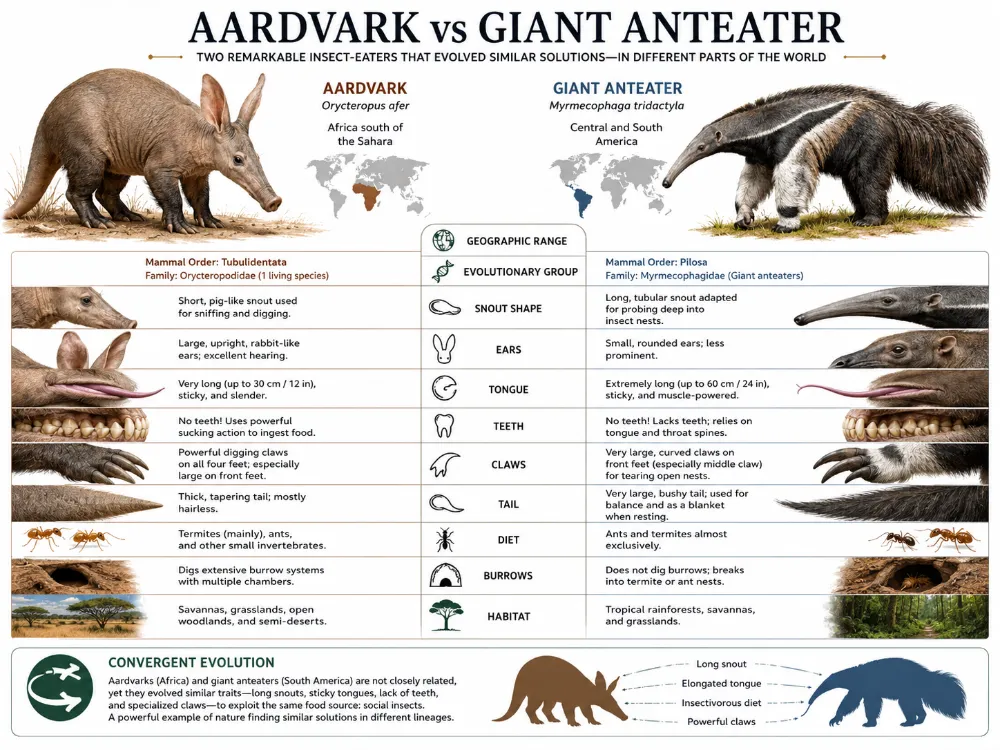
Aardvarks and anteaters are one of the best examples of convergent evolution in mammals. They evolved similar adaptations because they eat similar prey: ants and termites.
Long snouts help them reach into insect nests. Long sticky tongues collect many small insects quickly. Strong claws open mounds and nests. Reduced or absent chewing teeth reflect a diet of small soft-bodied prey.
But these similarities evolved separately. Aardvarks and anteaters are not close cousins; they are separate mammals that arrived at similar solutions to the same feeding challenge.
Aardvark vs Giant Anteater
The giant anteater is the anteater species most often compared with the aardvark. Both are medium to large insect-eating mammals with long snouts, strong claws, and long tongues. However, the giant anteater lives in the Americas, while the aardvark lives in Africa.
The aardvark has large ears, a pig-like snout, teeth, and strong burrowing habits. The giant anteater has a much longer tube-like snout, no teeth, a large bushy tail, and a distinctive black shoulder stripe.
If the animal has huge ears and digs burrows in Africa, it is an aardvark. If it has a bushy tail and long tubular snout in the Americas, it is a giant anteater.
Aardvark vs Tamandua
Tamanduas are smaller anteaters that live in Central and South America. They are partly arboreal and use prehensile tails to climb. They have strong claws and long tongues, but they are much smaller and more tree-adapted than aardvarks.
Aardvarks are heavier, more ground-based, and much stronger diggers. They do not climb like tamanduas and do not have prehensile tails.
Tamanduas may also defend themselves with strong odors from scent glands, which is not a major feature of aardvark defense.
Aardvark vs Pangolin
Aardvarks are also sometimes confused with pangolins. Pangolins are scale-covered mammals found in Africa and Asia. Like aardvarks and anteaters, pangolins eat ants and termites with long sticky tongues.
However, pangolins are covered in hard overlapping scales, while aardvarks have skin and sparse hair. Pangolins can roll into a ball for defense, while aardvarks dig or use claws.
This comparison shows again how many unrelated mammals have evolved ant- and termite-eating adaptations.
Ecological Importance
Aardvarks are important ecosystem engineers because their burrows provide shelter for many other animals. In hot or dry environments, abandoned aardvark burrows can be essential refuges for species that cannot dig such large shelters themselves.
Anteaters help regulate ant and termite populations. By feeding from many nests without necessarily destroying every colony, they can influence insect communities while also serving as prey for larger predators.
Both animals are important parts of their ecosystems, even though they are often secretive and difficult to observe.
Conservation Status and Threats
Aardvarks are not usually considered among the most endangered large mammals, but they can be affected by habitat loss, drought, persecution, road mortality, and changes in termite availability. Because they depend on insect prey and suitable digging conditions, climate and land-use changes may affect local populations.
Anteater conservation varies by species. Giant anteaters face threats from habitat loss, fires, road collisions, hunting, and conflict with dogs or humans. Some tamanduas remain relatively widespread, while habitat loss can still affect local populations. Silky anteaters are harder to study because of their small size and tree-dwelling habits.
Protecting these animals requires conserving the habitats that support their insect prey, shelter, and movement routes.
Common Misunderstandings
One common misunderstanding is that aardvarks are anteaters. They are not. Aardvarks eat ants and termites, but they belong to a completely different mammal group.
Another misunderstanding is that all anteaters are giant anteaters. In fact, anteaters include giant anteaters, tamanduas, and silky anteaters, which differ greatly in size and lifestyle.
A third misunderstanding is that animals with long snouts and sticky tongues must be close relatives. Aardvarks, anteaters, and pangolins show that similar diets can produce similar body plans in unrelated animals.
How to Tell an Aardvark from an Anteater Quickly
Look at location: aardvarks live in Africa; anteaters live in Central and South America.
Look at the ears: aardvarks have very large rabbit-like ears; giant anteaters have smaller ears.
Look at the tail: aardvarks have thick plain tails; giant anteaters have large bushy tails.
Look at the snout: aardvarks have pig-like snouts; anteaters have longer tube-like snouts.
Look at the teeth: aardvarks have simple teeth; anteaters have no teeth.
Look at shelter behavior: aardvarks dig burrows; anteaters usually do not build deep burrow systems.
Aardvark vs Anteater: Final Comparison
Aardvarks and anteaters are similar because they eat similar food, not because they are close relatives. The aardvark is a unique African mammal with large ears, a pig-like snout, powerful digging claws, simple teeth, and strong burrowing behavior. Anteaters are American mammals related to sloths and armadillos, with toothless mouths, long tubular snouts, sticky tongues, and specialized claws.
If you need the fastest difference, remember geography and teeth: aardvarks live in Africa and have teeth; anteaters live in the Americas and have no teeth. Both are remarkable examples of how evolution shapes animals for a life of eating ants and termites.
FAQs About Aardvarks vs Anteaters
Are aardvarks and anteaters the same animal?
No. Aardvarks and anteaters are different mammals. Aardvarks live in Africa and belong to the order Tubulidentata. Anteaters live in Central and South America and are related to sloths and armadillos.
Is an aardvark a type of anteater?
No. An aardvark is not a true anteater. It eats ants and termites, but it belongs to a separate evolutionary group and is not closely related to American anteaters.
Where do aardvarks live?
Aardvarks live in sub-Saharan Africa. They are found in savannas, grasslands, scrublands, open woodlands, and semi-arid habitats where termites and suitable digging soil are available.
Where do anteaters live?
Anteaters live in Central and South America. Depending on the species, they may live in grasslands, forests, savannas, wetlands, woodland edges, or tropical forest canopies.
Do aardvarks have teeth?
Yes. Aardvarks have unusual simple peg-like teeth made of many tiny tubules. Their teeth are very different from the teeth of most mammals.
Do anteaters have teeth?
No. Anteaters have no teeth. They collect ants and termites with long sticky tongues and process food with a muscular stomach.
Which has the longer tongue, an aardvark or an anteater?
Both have long sticky tongues, but giant anteaters are especially famous for an extremely long tongue that can flick rapidly in and out while feeding.
Do aardvarks eat only ants?
Aardvarks mainly eat ants and termites, especially termites, but they may occasionally eat other small insects or certain fruits. Their diet is still highly specialized.
Do anteaters eat only ants?
Anteaters mainly eat ants and termites, but the exact diet depends on species and habitat. They may consume insect eggs, larvae, and adult insects from colonies.
Which animal is bigger, an aardvark or an anteater?
Aardvarks and giant anteaters can be similar in general size, but body proportions differ. Aardvarks are sturdier diggers with large ears, while giant anteaters have longer snouts and large bushy tails.
Can aardvarks climb trees?
Aardvarks are mainly ground-dwelling and are not specialized tree climbers. They are much better at digging than climbing.
Can anteaters climb trees?
Some anteaters can climb very well. Tamanduas and silky anteaters are tree-adapted and use prehensile tails. Giant anteaters are mostly ground-dwelling.
Are aardvarks dangerous?
Aardvarks are not aggressive toward humans, but they have strong claws and can defend themselves if threatened. They are wild animals and should not be handled or cornered.
Are anteaters dangerous?
Anteaters are not usually aggressive, but giant anteaters have powerful claws and can injure predators or people if threatened. They should be observed from a safe distance.
Why do aardvarks and anteaters look alike?
They look alike because of convergent evolution. Both evolved long snouts, sticky tongues, and strong claws for eating ants and termites, even though they are not close relatives.