White chicken eggs and brown chicken eggs are nutritionally very similar. The main difference is shell color, which is controlled mostly by the hen’s genetics and breed. Brown eggs are not automatically healthier, more natural, stronger, or better-tasting than white eggs. Egg quality depends more on the hen’s diet, age, health, housing, freshness, storage, and farming system than on shell color.
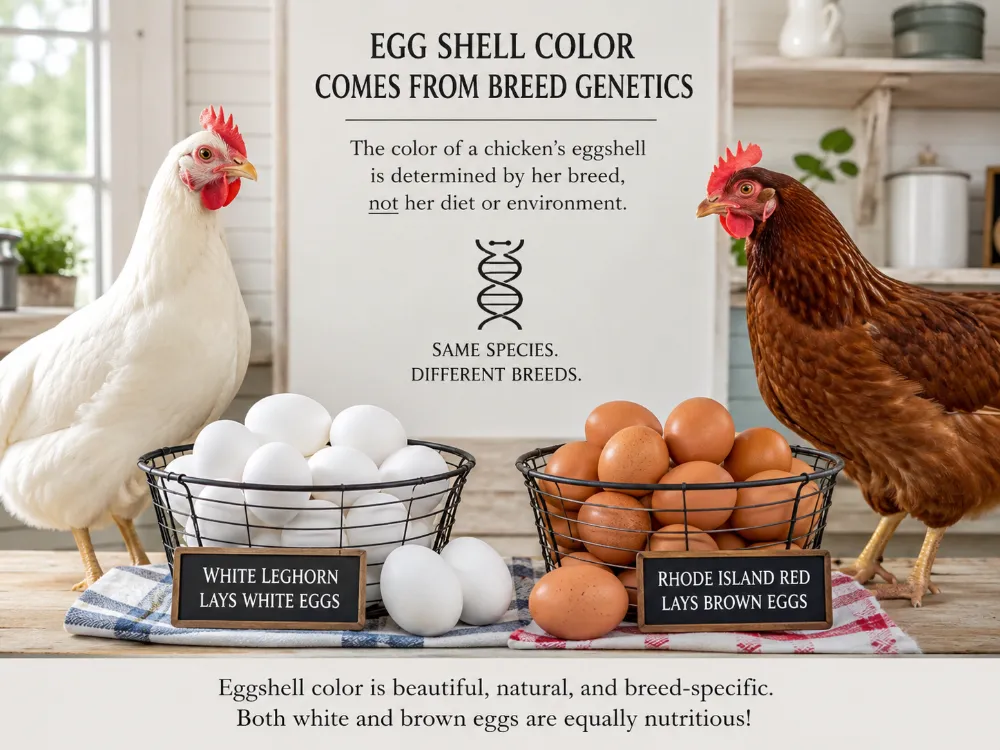
White Chicken Eggs vs Brown Eggs Summary Table
| Feature | White Chicken Eggs | Brown Chicken Eggs |
|---|---|---|
| Shell color | White or cream-white | Light brown to dark brown |
| Main cause of color | Little to no brown pigment deposited on the shell | Brown pigment deposited on the outer shell surface |
| Nutrition | Similar to brown eggs when hens are fed similar diets | Similar to white eggs when hens are fed similar diets |
| Taste | Not determined by shell color | Not determined by shell color |
| Yolk color | Depends mainly on the hen’s diet | Depends mainly on the hen’s diet |
| Shell strength | Depends on hen age, calcium, health, and shell formation | Depends on hen age, calcium, health, and shell formation |
| Common laying breeds | White Leghorn and other white-egg breeds | Rhode Island Red, Plymouth Rock, Sussex, Marans, and many others |
| Price | Often cheaper in large commercial systems | Often more expensive because brown-egg hens may be larger and eat more |
| Freshness | Depends on collection, storage, and age of the egg | Depends on collection, storage, and age of the egg |
| Best use in cooking | Same uses: boiling, frying, baking, scrambling, poaching | Same uses: boiling, frying, baking, scrambling, poaching |
| Common myth | Sometimes viewed as less natural, which is not true | Often viewed as healthier, which is not automatically true |
| Best buying rule | Choose based on freshness, farming system, size, and quality | Choose based on freshness, farming system, size, and quality |
What Are White Chicken Eggs?
White chicken eggs are eggs with white or nearly white shells. They are laid by chicken breeds that deposit little or no brown pigment onto the shell during egg formation. The shell itself is made mostly of calcium carbonate, and the white appearance is the natural color when no strong outer pigment is added.
One of the most famous white-egg breeds is the White Leghorn. Leghorns are widely used in commercial egg production because they are efficient layers, relatively small-bodied, active, and capable of producing many eggs while eating less feed than many heavier breeds.
White eggs are sometimes wrongly seen as less natural or more industrial than brown eggs. In reality, a white egg can come from a backyard hen, a free-range hen, an organic farm, or a large commercial farm. Shell color alone does not tell you how the hen lived.
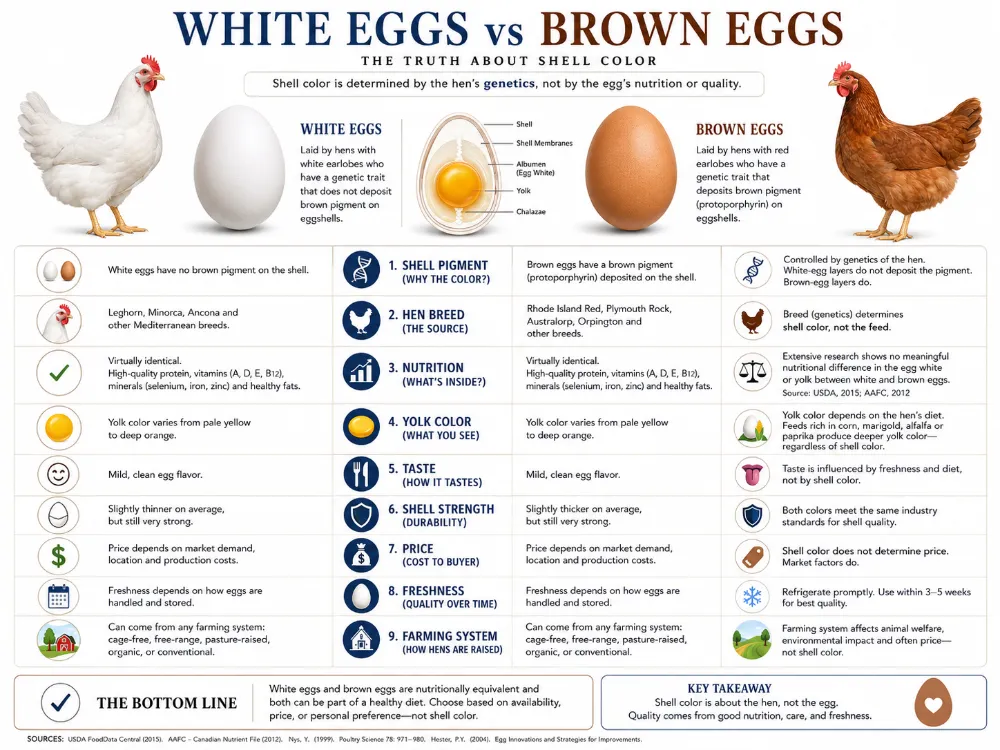
What Are Brown Chicken Eggs?
Brown chicken eggs are eggs with shells ranging from pale tan to deep brown. The brown color comes from pigments deposited on the outside of the shell as the egg passes through the hen’s reproductive tract. The main brown pigment is related to compounds also found in biological pigment systems.
Many familiar chicken breeds lay brown eggs. These include Rhode Island Reds, Plymouth Rocks, Sussex, Orpingtons, Wyandottes, and many hybrid brown layers. Some breeds, such as Marans, are famous for especially dark brown eggs.
Brown eggs are often marketed as more rustic, natural, or farm-fresh, but the shell color itself does not make the egg healthier. A brown egg from a poorly fed hen is not automatically better than a white egg from a well-managed hen.
What Causes Eggshell Color?
Eggshell color is mostly controlled by genetics. Different chicken breeds deposit different pigments on or within the shell. White eggs have little added pigment. Brown eggs receive brown pigment on the outer surface near the end of shell formation.
Some chickens lay blue or green eggs. Blue eggs contain pigment that penetrates deeper into the shell, while green or olive eggs usually result from a combination of blue shell color and brown pigment overlay. This is why chicken eggs can be white, brown, cream, blue, green, olive, or speckled depending on breed genetics.
For white vs brown eggs, the key point is simple: shell color comes from the hen, not from whether the egg is healthier.
Are Brown Eggs Healthier Than White Eggs?
No. Brown eggs are not automatically healthier than white eggs. If two hens are fed similar diets and kept in similar conditions, their eggs will usually have very similar protein, fat, vitamin, and mineral content regardless of shell color.
The nutrition inside the egg is influenced more by diet, hen health, age, environment, and feed formulation. For example, eggs from hens fed omega-3-enriched diets may contain more omega-3 fatty acids. Eggs from pasture-raised hens may differ in some nutrients depending on what the hens eat.
But these differences are not caused by brown shells or white shells. They are caused by feeding and management.
Do Brown Eggs Taste Better?
Brown eggs do not naturally taste better than white eggs. Taste is affected mainly by freshness, storage, hen diet, cooking method, and personal preference. A fresh white egg from a healthy hen can taste excellent. A fresh brown egg can taste excellent too.
Some people believe brown eggs taste richer because they often buy brown eggs from small farms, free-range systems, or backyard flocks. In those cases, the flavor difference may come from freshness, feed variety, or storage time rather than shell color.
If white and brown eggs are equally fresh and produced under similar conditions, most people cannot reliably taste a shell-color difference.
Does Shell Color Affect Yolk Color?
No. Shell color does not determine yolk color. A white egg can have a deep orange yolk, and a brown egg can have a pale yellow yolk. Yolk color depends mainly on the hen’s diet.
Hens that eat feed rich in yellow-orange pigments, such as certain plant materials or natural carotenoids, often produce darker yolks. Hens fed lighter-colored diets may produce paler yolks. Backyard or pasture hens may produce darker yolks if they eat green plants, insects, and varied foods.
Yolk color can make an egg look richer, but it should not be confused with shell color.
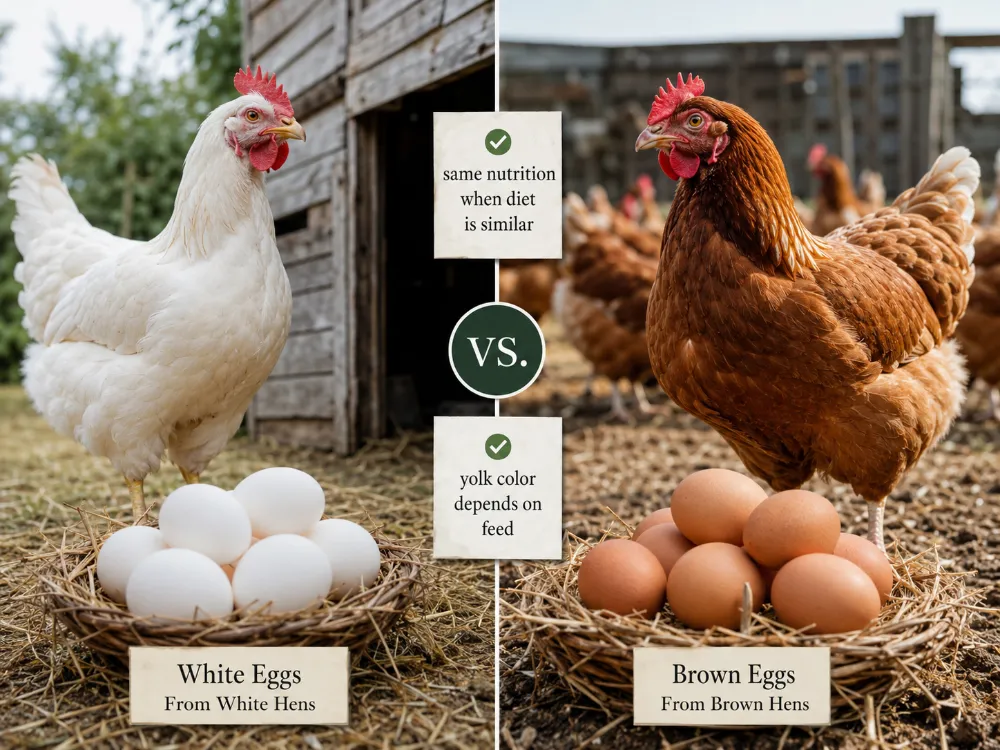
Are Brown Eggshells Stronger?
Brown eggs are not always stronger than white eggs. Shell strength depends on the hen’s age, calcium intake, vitamin D status, health, stress level, genetics, and the time spent forming the shell.
Younger hens often lay eggs with stronger shells. Older hens may lay larger eggs with thinner shells because the same shell material is spread over a bigger surface. Poor nutrition, heat stress, disease, or calcium imbalance can also weaken shells.
Some brown eggs feel stronger because they may come from certain breeds or production systems, but the color itself does not guarantee shell strength.
Why Are Brown Eggs Often More Expensive?
Brown eggs are often more expensive for practical production reasons, not because they are automatically better. Many brown-egg laying hens are larger-bodied than commercial white-egg layers. Larger hens usually eat more feed, and feed is one of the major costs in egg production.
Brown eggs are also often sold in specialty categories such as free-range, organic, pasture-raised, or local farm eggs. This can increase the price because the farming system is different, not because the shell is brown.
In some markets, brown eggs also cost more because consumers perceive them as more natural or premium. Marketing and consumer preference can strongly affect price.
Which Chicken Breeds Lay White Eggs?
Many chicken breeds can lay white eggs, but the best-known commercial white-egg breed is the White Leghorn. Leghorns are efficient layers and are widely used in large egg operations.
Other white-egg breeds may include Ancona, Minorca, Andalusian, Hamburg, Campine, and some Mediterranean-type chickens. These breeds are often active, lighter-bodied birds that lay well.
In general, chickens with white earlobes often lay white eggs, but this rule has exceptions. Earlobe color can be a useful clue in many breeds, but it is not a perfect scientific law.
Which Chicken Breeds Lay Brown Eggs?
Many popular backyard and dual-purpose breeds lay brown eggs. Rhode Island Reds, Plymouth Rocks, Sussex, Orpingtons, Wyandottes, Australorps, and New Hampshire Reds are common examples.
Some breeds lay especially dark brown eggs. Marans are famous for chocolate-brown eggs, while Welsummers and Barnevelders may lay rich brown or speckled eggs. Hybrid brown layers are also common in commercial and backyard flocks.
Brown egg color can vary even within the same breed. A hen may lay darker eggs early in the laying cycle and lighter eggs later as pigment supply becomes more spread out.
Do White Hens Lay White Eggs and Brown Hens Lay Brown Eggs?
Not always. Feather color does not reliably determine egg color. A white chicken may lay brown eggs, and a brown chicken may lay white eggs depending on breed genetics.
For example, White Leghorns are white birds that lay white eggs. But some white-feathered breeds or hybrids may lay brown eggs. Similarly, a dark or reddish hen may lay white, cream, brown, blue, or green eggs depending on ancestry.
Breed is a much better predictor of egg color than feather color.
Does Earlobe Color Predict Egg Color?
Earlobe color is a common clue, but it is not perfect. Many white-earlobed chickens lay white eggs, and many red-earlobed chickens lay brown eggs. This pattern is especially noticeable in many traditional breeds.
However, there are exceptions. Some breeds with unusual genetics do not follow the rule neatly. Blue-egg and green-egg layers also complicate the pattern.
Use earlobe color as a helpful hint, not as a guaranteed answer.
White Eggs vs Brown Eggs in Nutrition
The basic nutritional profile of white and brown eggs is very similar when the hens are raised and fed similarly. Both contain high-quality protein, fat, vitamins, minerals, and important nutrients such as choline.
Differences between eggs are more likely to come from hen diet and farming system. For example, specialty eggs may be enriched with omega-3 fatty acids. Pasture access may influence some nutrients if hens eat insects and green plants. Feed quality can affect yolk color and fatty acid profile.
Shell color by itself is not a nutrition label.
White Eggs vs Brown Eggs in Baking
White and brown eggs work the same way in baking if they are the same size and freshness. A large white egg and a large brown egg provide similar structure, moisture, emulsification, richness, and binding in recipes.
For baking, egg size matters more than shell color. A recipe that calls for large eggs assumes a certain amount of liquid and protein. Using very small or extra-large eggs can change texture more than using white instead of brown.
When baking, choose fresh eggs of the correct size. Shell color does not matter.
White Eggs vs Brown Eggs for Boiling and Peeling
White and brown eggs boil the same way. Shell color does not determine whether an egg will be easy to peel. Peeling is affected more by egg age, storage, cooking method, cooling method, and internal pH changes.
Very fresh eggs can be harder to peel after boiling because the inner membrane may stick more tightly to the egg white. Slightly older eggs often peel more easily.
If your brown eggs peel better than your white eggs, or the reverse, the difference is probably freshness and storage rather than shell color.
White Eggs vs Brown Eggs for Frying and Scrambling
For frying, scrambling, poaching, or making omelets, white and brown eggs perform the same when freshness and size are equal. The visible difference disappears once the shell is cracked.
Flavor and texture are influenced by freshness, yolk quality, cooking temperature, added fat, seasoning, and how long the egg is cooked. Overcooking can make any egg rubbery, regardless of shell color.
Good cooking technique matters more than white vs brown shells.
Freshness Matters More Than Shell Color
Freshness is one of the most important factors in egg quality. Fresh eggs usually have thicker whites, rounder yolks, and better structure. Older eggs tend to have thinner whites and flatter yolks.
A fresh white egg is better than an old brown egg. A fresh brown egg is better than an old white egg. The shell color does not protect the egg from quality decline over time.
Good storage also matters. Eggs should be kept clean, cool, and handled safely according to local food safety guidance.
Does Farming System Matter More Than Egg Color?
Yes. Farming system often matters more than shell color if you are thinking about animal welfare, outdoor access, environmental impact, or feed quality. Labels such as cage-free, free-range, pasture-raised, organic, or local farm eggs describe management systems or production standards, not shell color.
Both white and brown eggs can come from many different systems. A brown egg is not automatically free-range. A white egg is not automatically from a cage system. The label and producer information are more informative than shell color.
If animal welfare is important to you, look at production method, certification, farm practices, and transparency instead of choosing by shell color alone.
Are Brown Eggs More Natural?
No. Brown eggs are not more natural than white eggs. Both are naturally produced by chickens. White eggs are natural for white-egg laying breeds, and brown eggs are natural for brown-egg laying breeds.
The idea that brown means natural likely comes from marketing and the association of brown eggs with farm shops, backyard flocks, and traditional breeds. But white eggs can also come from healthy hens raised in natural or outdoor systems.
Nature produces many egg colors. Brown is only one of them.
Are White Eggs Bleached?
No. White chicken eggs are not white because they are bleached. They are laid with white shells by hens genetically programmed to produce white eggs. The white color is natural.
Commercial eggs may be washed or cleaned according to food safety practices in some countries, but that is not the same as bleaching brown eggs into white eggs. A white egg comes from a white-egg laying hen.
This is one of the most common myths about egg color.
Why Do Some Brown Eggs Have Spots?
Brown eggs may have speckles, freckles, or darker patches because pigment is not always deposited evenly. Some hens naturally lay speckled eggs, and some breeds are known for beautiful spotted shells.
Speckles are usually only pigment variation on the shell surface. They do not mean the egg is bad. However, cracks, unusual odors, leakage, or contamination are different issues and should be treated seriously.
Speckling can make brown eggs visually attractive, but it does not automatically change nutrition or flavor.
Can One Hen Lay Both White and Brown Eggs?
A hen usually lays the same general egg color throughout her laying life because egg color is genetically determined. A brown-egg hen may lay lighter or darker brown eggs over time, but she will not normally switch to pure white eggs.
Egg shade can change with age, stress, season, health, and laying cycle. Brown eggs may become paler as a hen continues laying because pigment is spread over more eggs or shell formation changes.
So a hen may change shade, but not usually the basic color category.
Why Do Brown Eggs Sometimes Look Different Inside?
If brown eggs look different inside, the reason is usually the hen’s diet, freshness, or production system, not the shell color. A farm-fresh brown egg may have a darker yolk because the hen ate more pigment-rich foods. But a white egg from a similar diet could also have a dark yolk.
Egg white thickness, yolk height, and flavor are related to freshness and hen health. These quality traits can occur in both white and brown eggs.
Always compare eggs from similar sources before assuming shell color caused the difference.
Which Eggs Should You Buy?
Choose eggs based on freshness, size, production method, food safety, budget, and personal values. If you want the best flavor, buy fresh eggs and store them properly. If you care about animal welfare, compare labels and farm practices. If you are baking, choose the correct size.
If white eggs are fresher and cheaper, they are a good choice. If brown eggs come from a local farm you trust, they may be a good choice too. The best egg is not defined by shell color alone.
For most people, white vs brown is less important than freshness and responsible production.
Common Myths About White and Brown Eggs
One myth is that brown eggs are healthier. They are not automatically healthier. Nutrition depends more on feed and hen management.
Another myth is that white eggs are bleached. They are not. White eggs are naturally white because of the hen’s genetics.
A third myth is that brown eggs always taste better. Taste depends on freshness, diet, storage, and cooking, not shell color itself.
How to Compare White and Brown Eggs Quickly
Shell color: white eggs have little added pigment; brown eggs have brown pigment on the shell.
Nutrition: nearly the same when hens eat similar diets.
Taste: affected by freshness, diet, and storage, not shell color.
Yolk color: caused mainly by diet, not shell color.
Price: brown eggs often cost more because of hen size, feed costs, production system, or marketing.
Best buying factor: freshness, size, welfare label, and producer quality matter more than color.
White Chicken Eggs vs Brown Eggs: Final Comparison
White chicken eggs and brown chicken eggs are more similar than many shoppers think. The main difference is shell pigment, which is controlled by hen genetics. Brown eggs are not automatically healthier, stronger, more natural, or better-tasting. White eggs are not bleached or inferior.
If the hens are fed and raised similarly, white and brown eggs have very similar nutrition and cooking performance. For the best egg quality, focus on freshness, storage, size, hen diet, welfare standards, and trusted producers. Shell color is mostly a breed trait, not a quality score.
FAQs About White Chicken Eggs vs Brown Eggs
Are brown eggs healthier than white eggs?
No. Brown eggs are not automatically healthier than white eggs. When hens are fed similar diets and raised in similar conditions, the nutritional value is usually very similar.
Why are some chicken eggs brown and some white?
Eggshell color is mostly genetic. Some breeds deposit brown pigment on the shell, while others lay eggs with little or no added pigment, producing white shells.
Do brown eggs taste better than white eggs?
Not because of shell color. Taste depends mainly on freshness, hen diet, storage, and cooking method. A fresh white egg can taste just as good as a fresh brown egg.
Are white eggs bleached?
No. White eggs are not bleached. They are naturally laid white by breeds that do not deposit brown pigment on the shell.
Why are brown eggs more expensive?
Brown eggs often cost more because many brown-egg hens are larger and eat more feed. Brown eggs are also often sold in specialty systems such as free-range, organic, pasture-raised, or local farm production.
Are brown eggs stronger than white eggs?
Not always. Shell strength depends on hen age, calcium intake, health, genetics, and shell formation. Shell color alone does not guarantee strength.
Does shell color affect yolk color?
No. Yolk color depends mainly on the hen’s diet. A white egg can have a dark orange yolk, and a brown egg can have a pale yellow yolk.
Which chickens lay white eggs?
White Leghorns are the best-known white-egg laying breed. Other breeds such as Ancona, Minorca, Andalusian, and Hamburg may also lay white eggs.
Which chickens lay brown eggs?
Many breeds lay brown eggs, including Rhode Island Reds, Plymouth Rocks, Sussex, Orpingtons, Australorps, Wyandottes, Marans, and Welsummers.
Can a brown chicken lay white eggs?
Yes. Feather color does not reliably determine egg color. Eggshell color depends on breed genetics, not simply whether the hen is brown, white, black, or red.
Can one hen lay different colored eggs?
A hen usually lays the same general egg color throughout life, though the shade may become lighter or darker. A brown-egg hen may lay lighter brown eggs over time, but she usually will not switch to pure white eggs.
Are brown eggs more natural?
No. Both white and brown eggs are natural. White eggs are natural for white-egg breeds, and brown eggs are natural for brown-egg breeds.
Which eggs are better for baking?
White and brown eggs work the same in baking if they are the same size and freshness. Egg size matters more than shell color.
Which eggs are easier to peel when boiled?
Peeling depends more on freshness, storage, and cooking method than shell color. Slightly older eggs often peel more easily than very fresh eggs.
What is the best egg to buy?
The best egg depends on freshness, size, production method, food safety, budget, and personal values. Shell color is less important than egg quality and how the hens were raised.