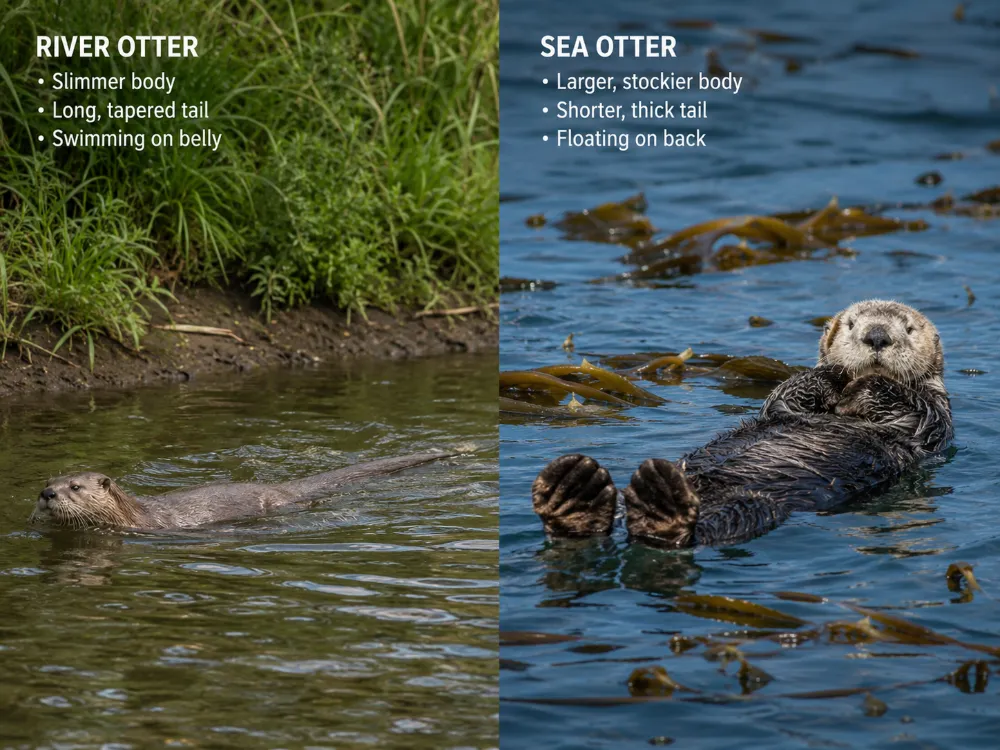
River otters and sea otters are both playful mustelids, but they live very different lives. River otters are slimmer, faster on land, have long tapered tails, and usually live in rivers, lakes, wetlands, and coastal waterways. Sea otters are larger, more marine, have shorter tails, extremely dense fur, and often float on their backs in the ocean while eating shellfish.
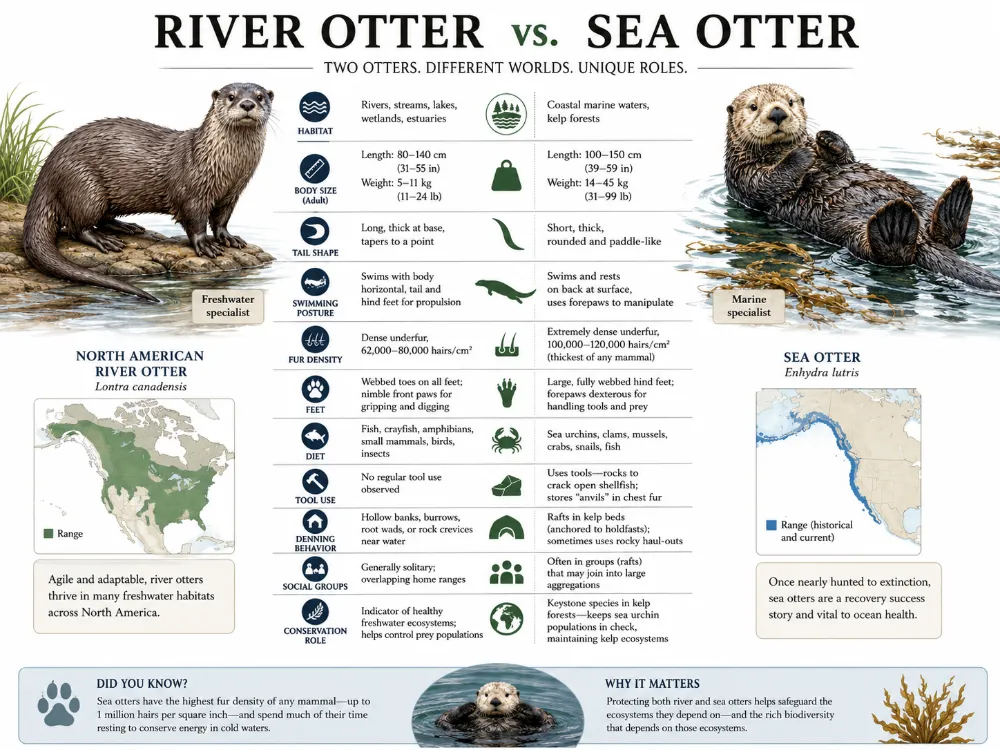
River Otter vs Sea Otter Summary Table
| Feature | River Otter | Sea Otter |
|---|---|---|
| Common meaning | Often refers to the North American river otter, Lontra canadensis, though many river otter species exist | Usually refers to the sea otter, Enhydra lutris |
| Main habitat | Rivers, lakes, marshes, ponds, wetlands, estuaries, and coastal waterways | Cold coastal ocean waters of the North Pacific |
| Land use | Comes onto land often for travel, resting, grooming, and denning | Spends most of its life at sea and rarely comes ashore in many areas |
| Typical body shape | Long, slim, flexible, and streamlined | Stockier, rounder, and more buoyant-looking |
| Tail | Long, thick at the base, muscular, and tapered | Shorter, flatter, and less powerful-looking |
| Swimming posture | Usually swims belly-down and dives actively | Often floats on its back at the surface |
| Feet | Webbed feet suited for swimming and moving on land | Large webbed hind feet; front paws are highly dexterous |
| Fur | Dense waterproof fur, but less extreme than sea otter fur | Exceptionally dense fur, essential for warmth in cold ocean water |
| Main diet | Fish, crayfish, frogs, crabs, insects, small mammals, birds, and aquatic animals | Sea urchins, crabs, clams, mussels, snails, abalone, octopus, and other marine invertebrates |
| Tool use | Not famous for regular tool use | Famous for using rocks to crack open hard-shelled prey |
| Social behavior | Often seen alone, in pairs, or in family groups | May gather in floating groups called rafts |
| Best quick clue | Slim body, long tail, freshwater or shoreline habitat, belly-down swimming | Large furry body, short tail, ocean habitat, floating on back |
What Is a River Otter?
A river otter is a semi-aquatic mammal in the weasel family, Mustelidae. In North America, the name usually refers to the North American river otter, Lontra canadensis. However, “river otter” can also be used more broadly for several otter species around the world that live in rivers, lakes, wetlands, and coastal waterways.
River otters are long, flexible, and highly athletic. They have streamlined bodies, muscular tails, webbed feet, sensitive whiskers, and dense waterproof fur. They are excellent swimmers, but they are also comfortable on land. They may run, slide, roll, groom, rest, travel between waterways, and use dens along banks or shorelines.
River otters are active predators. They usually eat fish and crayfish, but their diet can include frogs, crabs, mollusks, insects, small mammals, birds, reptiles, and other aquatic prey depending on location and season.
What Is a Sea Otter?
The sea otter, Enhydra lutris, is a marine otter found along parts of the North Pacific coast. It is one of the most ocean-adapted members of the weasel family and spends most of its life in saltwater.
Sea otters are famous for floating on their backs, using tools, wrapping themselves in kelp, and grooming their extremely dense fur. Unlike seals and sea lions, sea otters do not rely on a thick blubber layer for insulation. Instead, they depend heavily on their fur, high metabolism, and constant grooming to stay warm in cold water.
Sea otters are important predators in kelp forest ecosystems. By eating sea urchins and other invertebrates, they can help maintain the balance between urchin grazing and kelp forest growth.
Are River Otters and Sea Otters Related?
Yes. River otters and sea otters are related because both belong to the family Mustelidae, the same mammal family that includes weasels, mink, badgers, martens, wolverines, and ferrets. They share traits such as carnivorous teeth, flexible bodies, strong swimming ability, and dense fur.
However, they are not the same animal. River otters and sea otters belong to different genera and have evolved different lifestyles. River otters are more amphibious, moving between water and land. Sea otters are much more marine and spend most of their lives in the ocean.
The easiest way to understand the difference is this: river otters are freshwater and shoreline swimmers; sea otters are ocean specialists.
Habitat Differences
River otters are associated with freshwater and brackish habitats. They may live in rivers, lakes, ponds, swamps, marshes, estuaries, and coastal inlets. They need clean water, adequate prey, shoreline cover, and safe places to rest or den.
Sea otters live in coastal marine waters, especially cold North Pacific habitats with kelp forests, rocky shorelines, bays, and nearshore feeding grounds. They usually remain close enough to shore to dive for prey on the seafloor.
River otters can use marine edges and estuaries, but they still frequently use land and freshwater systems. Sea otters are true marine mammals in lifestyle, even though they are not seals.
Geographic Range
The North American river otter lives across much of North America where suitable aquatic habitat remains. Other river otter species occur in South America, Europe, Asia, and Africa, depending on the species.
Sea otters have a much more limited range. They are found along parts of the North Pacific, including coastal regions of Alaska, western North America, and parts of Russia. Their historic range was larger before heavy hunting reduced their numbers.
If you see an otter in an inland river or lake, it is almost certainly a river otter or another freshwater otter species. If you see an otter floating on its back in the cold Pacific Ocean, it is likely a sea otter.
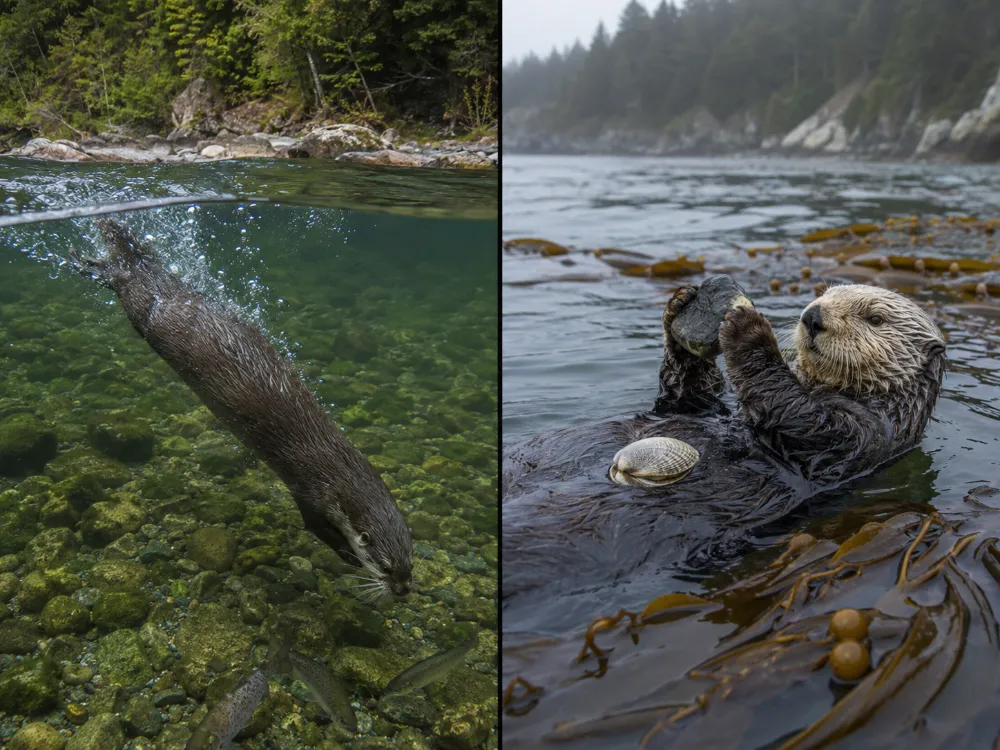
Size and Body Shape
Sea otters are generally larger and heavier than river otters. They have a stockier, rounder body and appear more buoyant at the water’s surface. Their dense fur and air trapped in the coat also add to their fluffy appearance.
River otters are slimmer, longer, and more flexible. Their bodies are built for fast swimming, twisting underwater, and moving efficiently on land. They often look sleek rather than fluffy, especially when wet.
A simple visual rule is useful: river otters look long and athletic; sea otters look larger, rounder, and more buoyant.
Tail Differences
The tail is one of the easiest identification clues. River otters have long, muscular, tapered tails. The tail is thick at the base and helps power them through water. It also helps with balance when they move on land.
Sea otters have shorter tails that look less dominant compared with the body. Their large hind feet provide much of their swimming power, while the tail is not as long or tapered as a river otter’s tail.
If the otter has a long strong tail that clearly follows the body like a rudder, it is likely a river otter. If the tail looks short and the animal floats like a furry raft, it is likely a sea otter.
Swimming Style
River otters usually swim belly-down. They dive actively, twist through the water, chase fish, surface briefly, and often move quickly along shorelines. They may porpoise through the water or slide into rivers from muddy or snowy banks.
Sea otters are famous for floating on their backs. They rest, groom, eat, nurse pups, and sometimes sleep in this position. They dive from the surface to collect prey from the seafloor, then return to the surface to eat while floating belly-up.
Swimming posture is one of the fastest ways to tell them apart. Belly-down swimmer in a river: river otter. Back-floating ocean otter: sea otter.
Feet and Movement
River otters have webbed feet that work well for both swimming and walking. They can travel over land between water bodies and may move surprisingly quickly on shore. Their flexible spine helps them bound, slide, and turn with agility.
Sea otters have large webbed hind feet that act almost like flippers. Their front paws are smaller and highly sensitive, allowing them to handle food, groom fur, and manipulate rocks or shells. On land, sea otters are much less graceful than river otters.
River otters are better land travelers. Sea otters are better surface floaters and marine divers.
Fur and Warmth
Both river otters and sea otters have dense fur, but sea otter fur is extraordinary. Sea otters have one of the densest fur coats of any mammal. This fur traps air and keeps cold seawater away from the skin.
Because sea otters lack the thick blubber layer found in many marine mammals, grooming is essential. If their fur becomes dirty, oily, or damaged, it loses insulating ability. This can be life-threatening in cold water.
River otters also have waterproof fur that helps them swim in cold water, but they can leave the water more often, use dens, and rely less completely on fur insulation than sea otters do.
Diet Differences
River otters eat a wide variety of aquatic and shoreline prey. Fish are often important, but many river otters also eat crayfish, frogs, crabs, mollusks, insects, small mammals, birds, snakes, turtles, and amphibians. They usually target prey that is abundant and easy to catch.
Sea otters eat mostly marine invertebrates and some fish. Their diet may include sea urchins, crabs, clams, mussels, snails, abalone, octopus, squid, and other bottom-dwelling animals. Individual sea otters may specialize in different prey types.
In simple terms, river otters are fish-and-crayfish hunters in freshwater and shorelines, while sea otters are shellfish-and-urchin hunters in the ocean.
Tool Use
Sea otters are famous tool users. They may place a rock on their chest and smash clams, mussels, or other hard-shelled prey against it while floating on their backs. Some also use rocks underwater to pry prey loose from surfaces.
River otters are intelligent and playful, but they are not known for regular tool use in the same iconic way. They catch, bite, and manipulate prey with their teeth and paws, but tool use is not a defining feature of their feeding behavior.
If you see an otter floating on its back and cracking shellfish with a stone, you are watching a sea otter.
Social Behavior
River otters may be seen alone, in pairs, or in family groups. Some form playful social groups, especially related individuals. They communicate through scent marking, vocalizations, body language, and latrine sites used repeatedly along shorelines.
Sea otters may gather in groups called rafts. These rafts can include many individuals, often separated by sex in some areas. Sea otters may hold paws or wrap themselves in kelp to reduce drifting while resting.
Both animals can be social, but sea otter rafts are one of the most distinctive social sights in marine mammal watching.
Play Behavior
River otters are famous for play. They slide on mud, snow, or ice, wrestle with each other, chase, roll, and explore objects. Some play behavior helps young otters develop hunting skills, coordination, and social bonds.
Sea otters also appear playful, but much of their surface behavior is practical. Floating, rolling, grooming, and manipulating objects help them eat, clean fur, and maintain body temperature. Young sea otters may play while learning important survival skills.
Both species are intelligent and curious, but river otters are especially known for energetic sliding and land-water play.
Denning and Resting
River otters use dens on land. These may be in riverbanks, old beaver lodges, hollow logs, root systems, or natural cavities near water. They often use multiple resting sites and scent-marked areas within their territory or home range.
Sea otters usually rest in the water. They may float on their backs in kelp beds, wrap themselves in kelp, or gather in protected coastal waters. In some areas, sea otters may haul out on land, but many spend nearly all of their time at sea.
This difference is major: river otters den on land; sea otters often sleep, eat, and nurse at the ocean surface.
Pups and Parenting
River otter pups are born in dens and depend on their mother for milk, warmth, and protection. They are not immediately expert swimmers. Their mother teaches them to swim, hunt, and travel through aquatic habitats.
Sea otter pups are born with extremely buoyant fur. A young pup may float at the surface like a cork while the mother dives for food. The mother carries, grooms, nurses, and protects the pup, often keeping it on her belly while floating.
Sea otter mothers invest enormous energy in pup care because pups require constant grooming and feeding support in cold marine waters.
Grooming Behavior
Grooming is important for both species, but it is absolutely critical for sea otters. A sea otter must keep its fur clean and fluffy so it can trap insulating air. Sea otters spend a large portion of their day grooming, rolling, rubbing, blowing air into the fur, and cleaning the coat.
River otters also groom to maintain waterproof fur, but they can dry off on land, rest in dens, and use land shelters more easily. Their insulation strategy is less extreme than that of sea otters.
If an otter seems to spend a long time floating, rubbing, rolling, and fluffing its coat at sea, it is almost certainly a sea otter.
Role in the Ecosystem
River otters are important freshwater predators. They help shape fish, crayfish, amphibian, and aquatic invertebrate communities. Their presence can indicate healthy waterways, although they can live in a range of aquatic systems if prey and cover are available.
Sea otters are famous keystone predators in kelp forest ecosystems. By eating sea urchins, they can reduce overgrazing pressure on kelp. Healthy kelp forests provide habitat for fish, invertebrates, birds, and other marine life.
Both otters matter ecologically, but sea otters are especially well known for their strong influence on kelp forest food webs.
Predators and Threats
River otters may be preyed on by large carnivores such as coyotes, wolves, bobcats, cougars, alligators, large birds of prey, and other predators, especially when young. They also face threats from pollution, habitat loss, road mortality, trapping, and degraded waterways.
Sea otters face threats from sharks, killer whales in some areas, disease, oil spills, entanglement, boat strikes, pollution, and loss of habitat quality. Oil spills are especially dangerous because oil damages the fur’s insulating ability.
Both animals are vulnerable to human impacts because they depend on healthy aquatic environments.
Conservation Differences
River otter conservation varies by region and species. In some areas, North American river otters have recovered after reintroduction and improved water quality. In other regions, river otters or related species still face pressure from habitat degradation, hunting, pollution, and reduced prey.
Sea otters suffered severe historical declines from the fur trade. Although some populations have recovered, they remain vulnerable because they reproduce slowly, live in limited coastal habitats, and are highly sensitive to oil pollution and ecosystem change.
Protecting river otters means protecting rivers, wetlands, and clean waterways. Protecting sea otters means protecting coastal ecosystems, kelp forests, and marine food webs.
River Otter vs Sea Otter in North America
In North America, the comparison usually means the North American river otter versus the sea otter. The North American river otter can live in inland waterways, coastal marshes, estuaries, and lakes. It is agile both in water and on land.
The sea otter lives along parts of the Pacific coast and is strongly tied to marine habitats. It is larger, more buoyant, and much more likely to be seen floating on its back in kelp-rich coastal waters.
Location alone is often a strong clue. Inland freshwater otter: river otter. Pacific coastal back-floating otter: sea otter.
River Otter vs Sea Otter Tracks and Signs
River otters often leave tracks, slides, scat, and scent-marking sites along muddy or snowy banks. Their slides may appear as smooth paths down slopes into water. Their scat, often called spraint, may contain fish scales, crayfish shells, and other prey remains.
Sea otters leave fewer obvious land signs because they spend so much time in the ocean. Observers are more likely to identify them by surface behavior: floating on their backs, cracking shellfish, grooming, diving near kelp, or resting in rafts.
If the evidence is on a riverbank, it probably belongs to a river otter. If the behavior is at the ocean surface, it is more likely a sea otter.
Can River Otters Live in the Ocean?
Some river otters can use coastal and marine-influenced habitats. North American river otters may live along shorelines, estuaries, islands, and coastal wetlands. They may swim in saltwater and feed on marine prey in some regions.
However, they are still not sea otters. River otters that use saltwater usually come ashore often, den on land, and move with the long-tailed, belly-down swimming style typical of river otters.
Sea otters are much more specialized for life at sea and spend far more time floating, feeding, and resting in marine waters.
Are River Otters or Sea Otters More Playful?
River otters have a stronger reputation for obvious play, especially sliding, chasing, wrestling, and rolling on land or snow. Their flexible bodies and amphibious lifestyle make their play easy for people to observe.
Sea otters also show curious and playful behaviors, especially young individuals. However, many behaviors that look playful, such as rolling and rubbing, are often part of grooming and survival.
Both are intelligent animals, but river otter play is usually more active on land and shorelines, while sea otter behavior is more surface-floating and food-handling focused.
Common Misunderstandings
One common misunderstanding is that any otter seen near the ocean must be a sea otter. This is not always true. River otters can live along coasts and estuaries in some regions.
Another misunderstanding is that sea otters are just larger river otters. Sea otters are a distinct species with specialized marine adaptations, including extremely dense fur, large hind feet, back-floating behavior, and tool use.
A third misunderstanding is that all otters behave the same way. Otters are diverse, and river otters, sea otters, giant otters, small-clawed otters, and other species have different lifestyles.
How to Tell a River Otter from a Sea Otter Quickly
Look at habitat: river otters are common in rivers, lakes, wetlands, and shorelines; sea otters live in coastal ocean waters.
Look at posture: river otters usually swim belly-down; sea otters often float on their backs.
Look at the tail: river otters have long tapered tails; sea otters have shorter tails.
Look at body shape: river otters are slim and sleek; sea otters are larger and fluffier.
Look at food handling: sea otters often eat shellfish while floating at the surface.
Look at land use: river otters come ashore often; sea otters spend much more time at sea.
River Otter vs Sea Otter: Final Comparison
River otters and sea otters are closely related mustelids, but they are adapted to different worlds. River otters are slim, long-tailed, fast, and amphibious. They live in freshwater, wetlands, estuaries, and shorelines, and they move easily between land and water.
Sea otters are larger, more marine, shorter-tailed, and famous for floating on their backs. They rely on extremely dense fur, eat many hard-shelled marine invertebrates, and often use tools. If you remember one simple clue, use posture: a sleek otter swimming belly-down is likely a river otter, while a furry otter floating on its back in the ocean is likely a sea otter.
FAQs About River Otters vs Sea Otters
Are river otters and sea otters the same animal?
No. River otters and sea otters are different species. They are related members of the weasel family, but river otters are more amphibious and freshwater-oriented, while sea otters are marine specialists.
What is the biggest difference between a river otter and a sea otter?
The biggest difference is lifestyle. River otters live in rivers, lakes, wetlands, and shorelines and come on land often. Sea otters spend most of their lives in the ocean and often float on their backs.
Which is bigger, a river otter or a sea otter?
Sea otters are generally larger and heavier than river otters. River otters are slimmer, longer-tailed, and more agile on land.
Do river otters live in the ocean?
Some river otters use coastal waters, estuaries, and islands, but they still come ashore often and behave like river otters. They are not the same as sea otters.
Do sea otters come on land?
Sea otters can come ashore in some areas, but many spend most of their time in the water. They commonly rest, eat, groom, and care for pups at the ocean surface.
Why do sea otters float on their backs?
Floating on the back helps sea otters rest, groom, eat, and care for pups at the surface. It also allows them to use their front paws to handle food and tools.
Do river otters float on their backs?
River otters can roll and float, but they usually swim belly-down and dive actively. Back-floating is much more strongly associated with sea otters.
What do river otters eat?
River otters eat fish, crayfish, frogs, crabs, insects, small mammals, birds, reptiles, and other aquatic prey. Their diet changes with habitat and prey availability.
What do sea otters eat?
Sea otters eat sea urchins, crabs, clams, mussels, snails, abalone, octopus, squid, and other marine animals. They often dive to the seafloor for food.
Do sea otters use tools?
Yes. Sea otters are famous for using rocks to crack open hard-shelled prey such as clams and mussels while floating on their backs.
Do river otters use tools?
River otters are intelligent, but they are not known for regular tool use in the same way sea otters are. They usually catch and eat prey with their teeth and paws.
Why is sea otter fur so important?
Sea otters rely on extremely dense fur for insulation because they do not have the thick blubber layer found in many marine mammals. Clean, well-groomed fur is essential for survival in cold water.
Are river otters dangerous?
River otters usually avoid humans, but they are wild predators with sharp teeth and strong jaws. They should not be approached, fed, or handled.
Are sea otters dangerous?
Sea otters may look cute, but they are wild animals with strong jaws and sharp teeth. People should observe them from a respectful distance and never try to touch or feed them.
Which otter is more endangered?
Sea otters have faced major conservation challenges and remain vulnerable in many areas. River otter status varies by species and region; some populations are stable or recovered, while others face habitat and pollution threats.