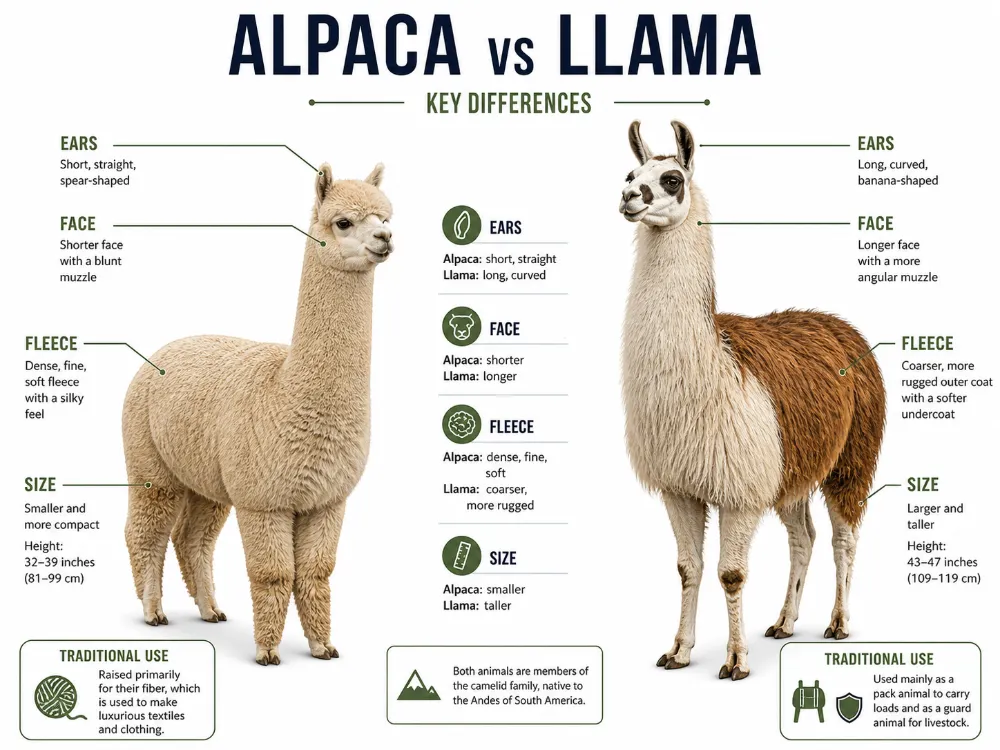
The easiest way to tell an alpaca from a llama is to look at size, face, ears, and coat. Alpacas are usually smaller, fluffier, and shorter-faced, with straight spear-shaped ears and soft fiber raised mainly for fleece. Llamas are usually larger, longer-faced, and less fluffy, with longer banana-shaped ears and a history of being used more often as pack animals and guards. They are close relatives, but they are not the same animal.
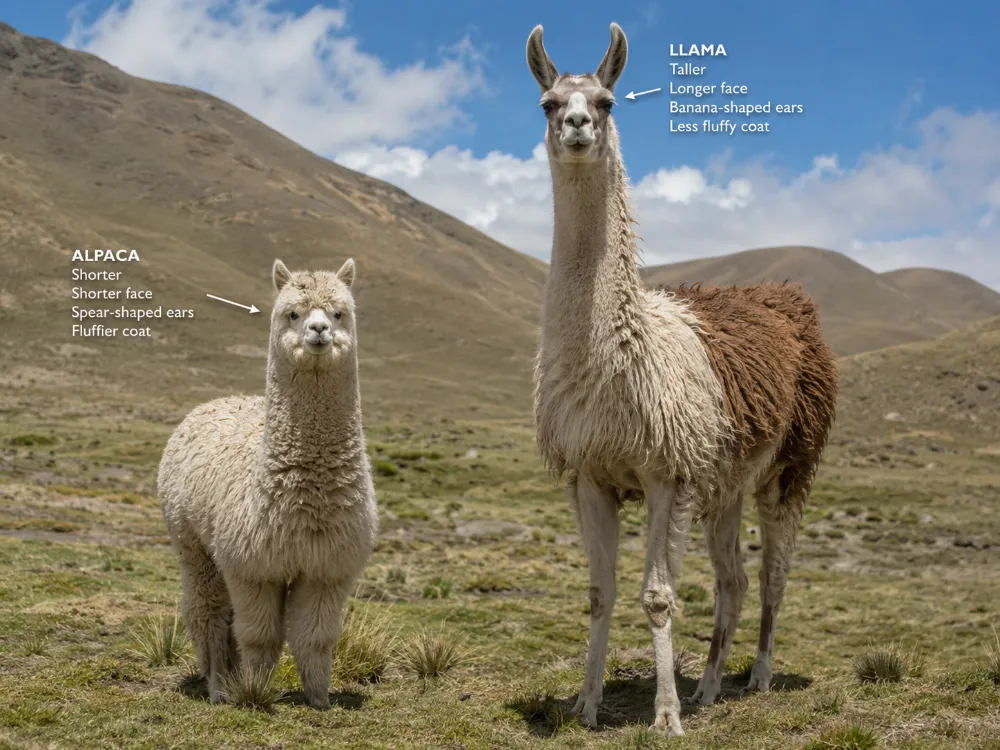
People mix up alpacas and llamas all the time because both are South American camelids with long necks, soft-looking coats, and similar body shapes. If you only see one from a distance, the difference may not seem obvious at first.
In this guide, you will learn the clearest differences between alpacas and llamas, how to identify them quickly, and why each animal has been valued in slightly different ways.
Quick comparison table
| Feature | Alpaca | Llama |
|---|---|---|
| Size | Smaller and lighter | Larger and taller |
| Face | Shorter, rounder, softer-looking | Longer, more angular |
| Ears | Straight, pointed, spear-shaped | Longer, curved, banana-shaped |
| Coat | Usually denser, softer, and fluffier | Usually coarser and less uniformly fluffy |
| Main traditional use | Fiber production | Pack work, guarding, meat, and fiber |
| Temperament | Often more timid and herd-oriented | Often more confident and independent |
| Group behavior | Strongly social, often kept in groups | Social too, but often described as bolder |
| Best quick clue | Small, fluffy, short face | Taller, longer face, curved ears |
They are related, but not the same animal
Alpacas and llamas are both domesticated South American camelids. That means they belong to the same broader family group as camels, but they are distinct animals with different histories of use and different body features.
Because they are close relatives, they share many traits. Both have long necks, split upper lips, padded feet, and the ability to live well in highland environments. Both are also social herd animals that communicate with posture, sound, and ear position.
However, close relation does not mean they are interchangeable. Once you look more carefully, the differences become much easier to see.
Llamas are usually bigger
One of the clearest differences is overall size. Llamas are usually much larger than alpacas. They stand taller, have a longer frame, and often look more powerful and rangy.
Alpacas are smaller and more compact. Their body often looks rounder, softer, and more fleece-covered. If two animals are standing next to each other, the llama usually looks like the larger, longer-legged one.
This size difference is one reason llamas were used more often for carrying loads, while alpacas became especially valuable for fiber.
Alpacas have a shorter, softer-looking face
Facial shape is another very useful clue. Alpacas usually have a shorter, blunter face with a gentler, more rounded expression. Their face often looks small compared with their fluffy body.
Llamas usually have a longer face and a more angular head. Their muzzle is more extended, and the whole head often looks larger and more elongated.
If the animal has a compact, teddy-bear-like face, it is more likely to be an alpaca. If the head looks longer and more horse-like in outline, it is more likely to be a llama.
The ears are one of the best identification clues
If you are unsure whether you are looking at an alpaca or a llama, check the ears. Alpacas usually have shorter, straighter, spear-shaped ears. They point upward in a neat, simple way.
Llamas usually have longer ears with a distinct curve, often described as banana-shaped. These ears can make the llama’s head look more dramatic and expressive.
This is one of the fastest and most reliable field marks, especially when the animals are standing still.
Alpacas are usually fluffier
Alpacas are famous for their fleece. Their coat is usually denser, softer, and more even across the body, especially in animals bred specifically for fiber quality. Many alpacas look very fluffy from head to body, especially before shearing.
Llamas also grow fiber, but their coat is often coarser, less dense, or more variable depending on the individual. Some llamas can look quite woolly, but many still appear less uniformly plush than alpacas.
This difference reflects one of the biggest practical distinctions between the two animals: alpacas have long been raised mainly for fleece, while llamas were historically used more broadly.
Alpaca fiber is a major reason people keep them
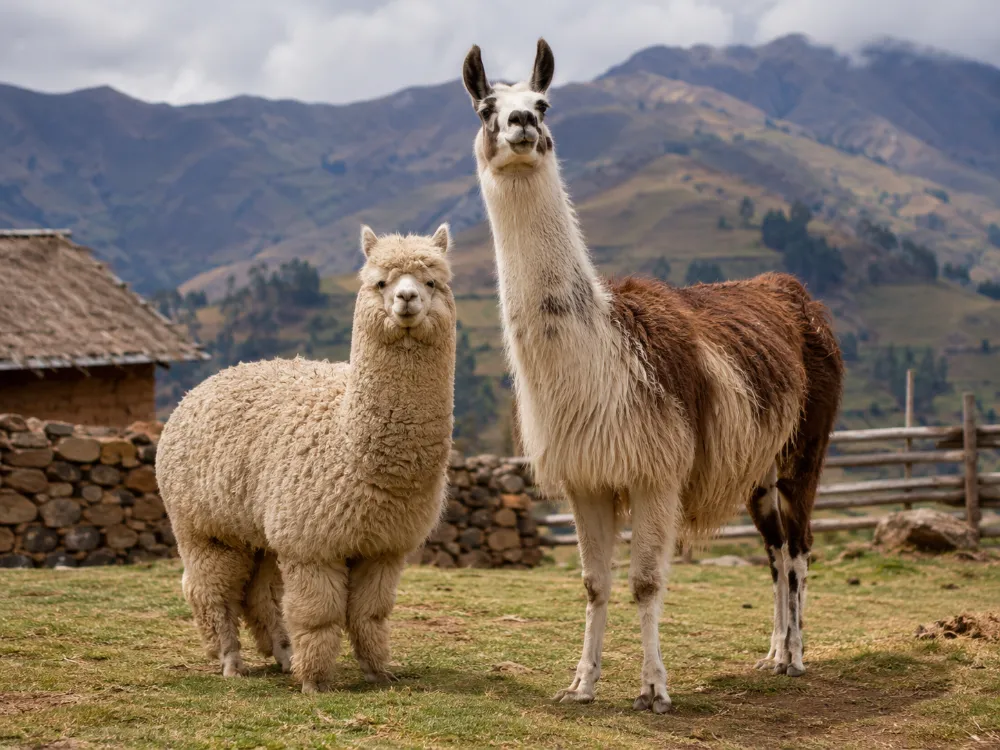
Alpacas are especially valued for fiber production. Their fleece is known for being soft, warm, and useful in textiles. This is one of the main reasons alpacas are raised around the world today.
Because of this, alpaca breeding often emphasizes coat quality, density, texture, and color. The whole animal has, in many ways, been shaped by human interest in fiber.
That does not mean llamas are useless for fiber. Some llamas do produce usable fiber, but alpacas are usually the more famous and specialized fleece animal.
Llamas were more often used as pack animals
Llamas have a long history of being used as pack animals. Their larger size and stronger build make them more suitable for carrying loads than alpacas. In traditional Andean life, this made llamas especially important for transport.
They have also been used for meat, fiber, and, in modern settings, as guard animals for sheep or other livestock. Their size and alert nature often make them better at this role than alpacas.
So while alpacas are strongly associated with fleece, llamas are often associated with work and versatility.
Temperament can feel different
Both alpacas and llamas are social animals, but people often describe their personalities a little differently. Alpacas are often seen as more timid, more reserved, and more strongly dependent on the herd. They may seem gentler and less assertive in everyday handling.
Llamas are often described as bolder, more independent, and more confident around people or other animals. This does not mean every llama is brave or every alpaca is shy, but the general impression is common.
Individual personality still matters a great deal. Training, environment, and handling can shape behavior just as much as species tendencies do.
Both can spit, but context matters
Both alpacas and llamas can spit. This behavior is often used in social conflict, especially around food, dominance, or personal space. It is a normal part of camelid communication.
People sometimes assume spitting means the animal is mean, but that is too simple. Spitting is usually a warning or social signal rather than random aggression. It can happen between herd members much more often than toward humans.
Because llamas are larger and often seem more assertive, people may notice their behavior more, but alpacas are fully capable of spitting too.
They move and stand a little differently
Llamas often look more upright, longer-framed, and more open in posture. Their larger build gives them a stronger, more stretched outline. Alpacas usually look more compact and softer in body shape, especially when their fleece is long.
Even when standing still, a llama often appears taller and more elongated, while an alpaca appears shorter and puffier. This difference becomes especially obvious in side view.
So body outline can help even before you look closely at the face or ears.
Where they come from
Both alpacas and llamas come from South America and are especially associated with the Andes. They were domesticated there and have long been part of Andean agriculture and pastoral life.
They are adapted to upland conditions, open grazing, and herd living. Today, both animals are also kept in many other countries for farming, fiber, education, tourism, and hobby livestock purposes.
Their shared Andean origin is another reason people often assume they must be the same animal.
Can alpacas and llamas interbreed?
Yes, alpacas and llamas can interbreed because they are closely related. Their hybrid offspring are sometimes called huarizos. This is another sign of how closely linked the two animals are.
Even so, the existence of hybrids does not erase the difference between the parent animals. Alpacas and llamas are still distinct types with their own characteristics and traditional uses.
For most everyday identification, you are still usually looking at either an alpaca or a llama rather than a hybrid.
Why people confuse them so often
People confuse alpacas and llamas because both have long necks, woolly bodies, and a similar general silhouette. If you see them only briefly, especially in a farm setting, they can appear almost identical.
Popular media often adds to the confusion by labeling one as the other or using the words loosely. Many people also remember that one is bigger and one is fluffier, but forget which is which.
Once you learn the size, face, ears, and fleece clues, however, the difference becomes much easier to spot.
How to tell them apart quickly
If you need a fast identification guide, use these clues together:
Alpaca: smaller body, shorter face, dense fluffy fleece, straight spear-shaped ears
Llama: larger body, longer face, less uniformly fluffy coat, long curved banana-shaped ears
No single clue is perfect every time, but this combination works very well in most cases.
Which one is better?
There is no single biological answer to which animal is better. It depends on what you want the animal for. If the goal is soft fiber production, alpacas are usually the stronger choice. If the goal is carrying, guarding, or handling a larger, more versatile pack-type animal, llamas often fit that role better.
From a purely scientific point of view, they are simply adapted and selected for somewhat different human uses. One is not the upgraded version of the other.
They are different animals with different strengths.
Final takeaway
The main difference between an alpaca and a llama is that alpacas are smaller, fluffier, shorter-faced animals raised mainly for soft fiber, while llamas are larger, longer-faced, longer-eared animals historically used more often for carrying loads and other practical work. Both are closely related South American camelids, and both are social, intelligent, and distinctive, but once you know the key clues, it becomes much easier to tell them apart.
FAQs
Is an alpaca the same as a llama?
No. They are close relatives, but alpacas and llamas are different animals.
Which is bigger, an alpaca or a llama?
A llama is usually bigger and taller than an alpaca.
How can I tell an alpaca from a llama fast?
Look at the ears and face. Alpacas usually have short straight ears and a shorter face, while llamas usually have long curved ears and a longer face.
What are alpacas mainly used for?
Alpacas are mainly valued for their soft fleece, while llamas have historically been used more often as pack animals and guards.