The short answer is that a hornet is a type of wasp, but not every wasp is a hornet. Hornets are usually larger, heavier-bodied social wasps with broader heads and more robust bodies, while the word wasp covers a much wider group of insects that includes many species with different sizes, colors, and lifestyles. So the real difference is not hornet versus wasp as two separate insect worlds, but hornet as one specific kind of wasp.
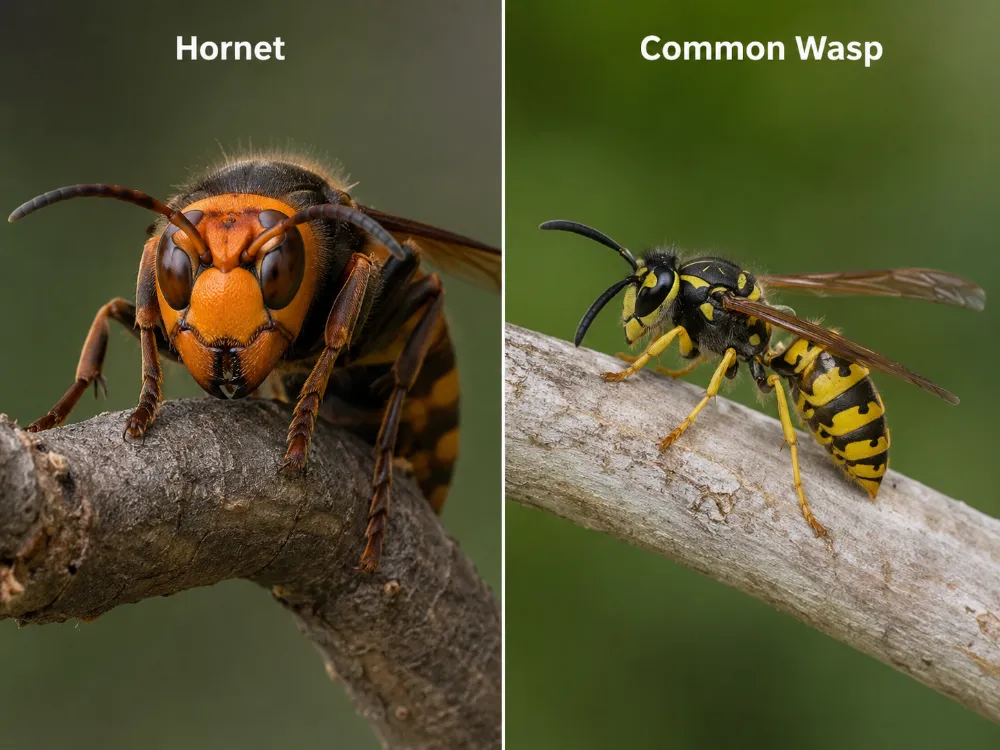
People often use the two words as if they mean completely different insects, especially when they see a large striped stinging insect near the garden or house. In practice, the confusion comes from common language. “Wasp” is the broader term, while “hornet” is a narrower one.
In this guide, you will learn what makes a hornet different from other wasps, how to tell them apart, how dangerous they really are, and why they matter in the ecosystem.
Quick comparison table
| Feature | Hornet | Wasp |
|---|---|---|
| Basic meaning | A type of wasp | A broad group of many species |
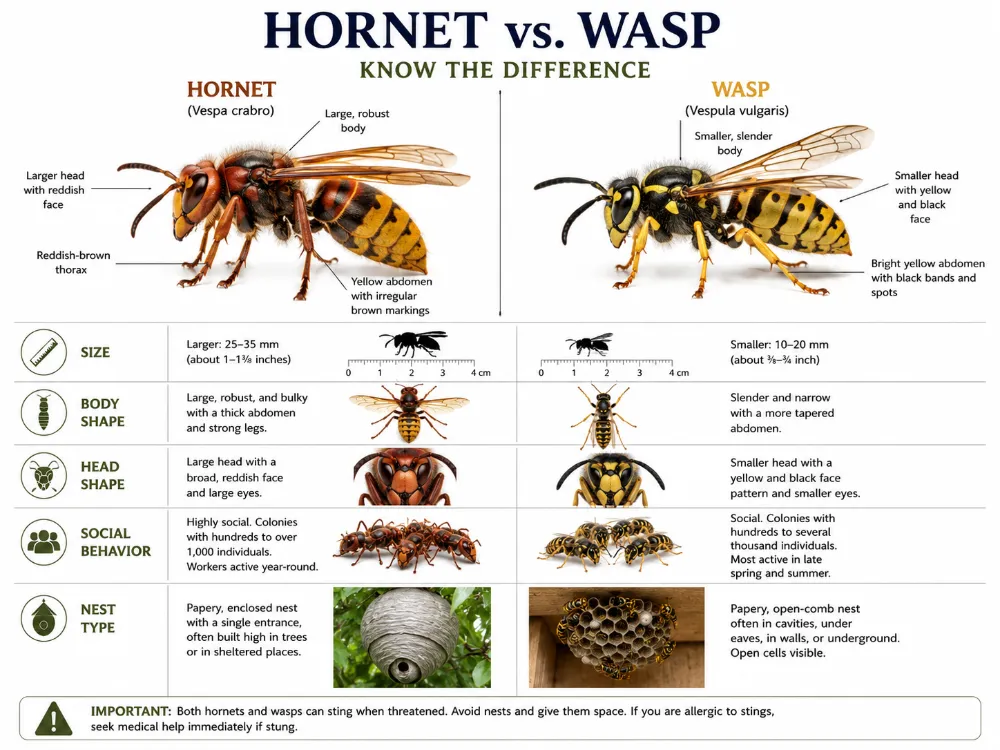
| Typical size | Usually larger and heavier-bodied | Often smaller or more slender, depending on species |
| Body shape | More robust, thick-bodied | Often slimmer with a more obvious narrow waist |
| Head shape | Usually broader and more massive | Often narrower and less heavy-looking |
| Social behavior | Usually social nest-builders | Can be social or solitary |
| Nest type | Often large papery nests | Varies widely by species |
| Sting | Painful sting, mainly defensive | Also capable of stinging, depending on species |
| Important fact | All hornets are wasps | Not all wasps are hornets |
What is a wasp?
A wasp is a broad term for a large group of insects in the order Hymenoptera. Wasps include many different kinds of species, from social yellowjackets and paper wasps to solitary hunting wasps that never form big colonies.
Most people picture a wasp as a narrow-bodied, fast-moving, yellow-and-black stinging insect, but the real wasp world is much more diverse than that. Some wasps are tiny parasitoids, some are mud nest builders, some hunt caterpillars or spiders, and some live in large social colonies.
So when someone says “wasp,” they may be referring to a very wide range of insects rather than one exact type.
What is a hornet?
A hornet is a particular kind of large social wasp. In general usage, hornets are usually the bigger, more heavy-bodied wasps that build substantial paper nests and defend them strongly when disturbed.
This means hornets are not outside the wasp group. They are inside it. The easiest way to think about it is this: every hornet is a wasp, but many wasps are not hornets.
That is why “hornet vs wasp” is a little misleading as a strict comparison. It is really a comparison between one subgroup and the wider group it belongs to.
Hornets are usually larger
One of the clearest differences is size. Hornets are often larger than the wasps people commonly notice around picnics, gardens, or house eaves. They tend to look longer, thicker, and more substantial overall.
That larger size often makes people assume hornets are a completely different kind of insect. In reality, their size is one reason they stand out so strongly from smaller social wasps and paper wasps.
If the insect looks unusually large and heavy for a wasp, hornet becomes more likely, though size alone is not always enough for perfect identification.
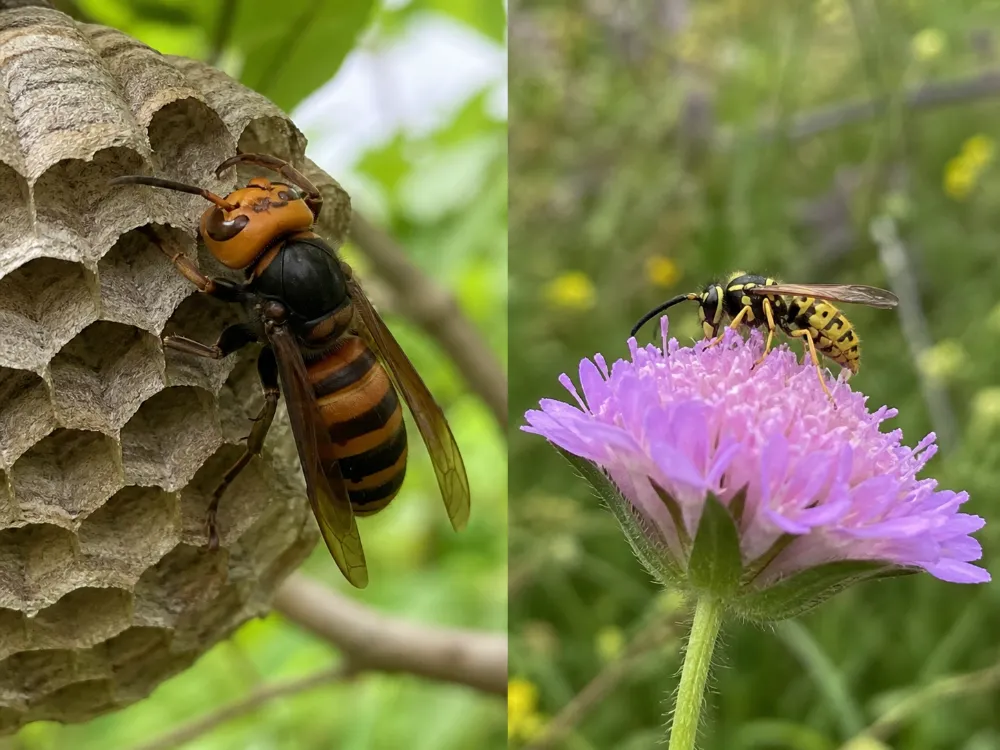
Hornets usually have a heavier body
Hornets often look thicker and sturdier than many other wasps. Their body does not always have the extremely narrow, stretched look that people associate with classic paper wasps.
Many wasps appear slim and sharply waisted, while hornets often look more solid and muscular. The abdomen, thorax, and head may all appear more robust.
This heavier body shape is one of the easiest visual clues when comparing a hornet with a more typical slender wasp.
The head is often broader in hornets
Hornets usually have a broader, more substantial head than many smaller wasps. This gives them a more powerful look, especially when seen from the front or side.
In many wasps, the head appears smaller relative to the body, while hornets often look more massive in the face and jaw area. This can make them seem more intimidating even when they are simply moving normally around a nest or food source.
When combined with body size, this broad-headed look is a useful hornet clue.
Not all wasps are social, but hornets usually are
One of the biggest biological differences is that wasps as a whole include both social and solitary species. Some wasps live in colonies with queens and workers, while others live alone and never form a large nest.
Hornets are usually social wasps. They build colonies, care for young, defend a nest, and show organized group behavior. This makes them more similar to yellowjackets and some paper wasps than to solitary hunting wasps.
So if you are comparing hornets with the entire wasp category, hornets represent the social colony-building side of that wider world.
Nest style can be different
Hornets often build large papery nests made from chewed wood fibers mixed with saliva. These nests may be aerial, hidden in cavities, or attached to trees, shrubs, roofs, or sheltered structures depending on the species.
Other wasps vary enormously in nest style. Paper wasps make open comb nests. Mud daubers build mud tubes. Solitary wasps may use holes in wood or soil. Some social wasps also make enclosed paper nests, which is why nest shape alone does not solve every identification problem.
Still, a large enclosed paper nest with a robust colony often fits what many people associate with hornets.
Color does not always solve the problem
People often expect all hornets to look one certain way, usually bright yellow and black, but color can vary by species. Some hornets are reddish-brown and yellow, some are darker, and some appear more muted than the classic “warning stripe” image people imagine.
Wasps as a whole also vary greatly in color. Many are yellow and black, but others can be reddish, brown, metallic blue, or nearly black.
That means color can help, but it is less reliable than size, body shape, head shape, and nesting behavior.
Are hornets more aggressive than other wasps?
Hornets are often described as more intimidating because of their size, but the truth is more specific. Hornets can be very defensive if their nest is disturbed, and a colony may respond quickly when it senses a threat nearby.
However, that does not mean hornets are always flying around looking for people to sting. Like many social wasps, they usually sting in defense rather than as a random attack behavior.
Some smaller social wasps can also be extremely defensive, especially around nests. So the better rule is not “hornets are always more aggressive,” but rather “large social wasps of any kind should be respected around their nest.”
Hornet stings and wasp stings
Both hornets and many other wasps can sting. Because wasps do not leave the stinger behind the way honey bees often do, they may sting more than once if the threat continues.
Hornet stings are often described as especially painful, partly because the insects are large and because people tend to remember the encounter more vividly. But other wasps can also deliver painful stings, and the seriousness depends on the species, the number of stings, and the individual person involved.
The greatest medical danger is usually not the name hornet or wasp itself, but allergic reaction, multiple stings, or stings near sensitive areas.
Do hornets and wasps hunt other insects?
Yes. Many hornets and wasps are predators or scavengers, and this is one reason they are ecologically important. They may catch caterpillars, flies, spiders, and other insects to feed their larvae.
Adult hornets and wasps may also feed on nectar, sweet liquids, fruit juices, or sugary food sources, while bringing animal protein back to the colony. This mixed feeding strategy helps explain why they are found both on flowers and around prey-rich areas.
So even though people notice them mainly because of stings, they also play a real role in controlling insect populations.
Why people confuse hornets and wasps
People confuse the two because hornets are wasps, and many social wasps already look broadly similar. If an insect is striped, fast, stinging, and papery nest-building, it is easy to lump everything together.
Common names make the confusion worse. In some places, insects are called hornets even when they are not true hornets in the strict sense. One famous example is the bald-faced “hornet” of North America, which is actually a type of aerial yellowjacket rather than a true hornet.
This means common language is not always as precise as zoology.
Hornet vs wasp in simple terms
If you reduce the difference to one sentence, it is this: a hornet is a larger, more robust type of social wasp, while the word wasp includes many different insects, both social and solitary.
So when someone says “hornet vs wasp,” the most accurate response is not that they are opposites, but that one belongs inside the bigger category of the other.
This is the key idea most people miss.
How to tell them apart quickly
If you need a fast identification guide, use these clues together:
Hornet: usually larger, heavier-bodied, broader-headed, social, often associated with large paper nests
Wasp: broader category, often smaller or slimmer, may be social or solitary, nest style varies widely
If the insect looks especially large and solid for a wasp, hornet becomes more likely. If it is slim, smaller, or behaving like a solitary hunter, it is more likely another kind of wasp.
Are either one useful in nature?
Yes. Both hornets and other wasps are important parts of ecosystems. They help control insect populations, recycle animal matter, and in some cases even contribute to pollination while visiting flowers.
Although they are often disliked because of their sting, they are not useless pests by definition. Many of them are active predators of insects that humans might otherwise consider more troublesome.
From an ecological perspective, they are working animals of the insect world, even if people do not always appreciate them.
When should people worry?
People should be careful when a nest is close to areas of regular human activity, especially if children, pets, or people with insect-sting allergies are nearby. Disturbing a nest is one of the most common ways to trigger defensive stinging.
Single foraging individuals away from the nest are often less of a problem than an active nest under a roof edge, inside a wall, or near a doorway. The biggest risk usually comes from colony defense, not from simply seeing one insect on a flower.
So the level of concern should depend on location, nest presence, and personal medical risk.
Final takeaway
The main difference between a hornet and a wasp is that a hornet is one type of wasp, usually larger, heavier-bodied, and social. Wasps as a whole include many different insects, from big colony-building species to small solitary hunters. In everyday life, hornets tend to stand out because of their size and nest defense, but biologically they are still part of the wider wasp world. The most important fact to remember is simple: all hornets are wasps, but not all wasps are hornets.
FAQs
Is a hornet a wasp?
Yes. A hornet is a type of wasp.
What is the main difference between a hornet and a wasp?
Hornets are usually larger, heavier-bodied social wasps, while the term wasp covers a much wider range of species.
Are hornets more dangerous than wasps?
Hornets can be very defensive around nests, but many wasps can also sting painfully. The biggest risk usually depends on nest disturbance, sting number, and allergy.
Do hornets make paper nests?
Yes. Hornets often build large papery nests, though other social wasps may also build paper nests in different forms.