The short answer is that buffalo and bison are not the same animal. True buffalo include the African buffalo and the Asian water buffalo, while bison include the American bison and the European bison. Bison usually have a large shoulder hump, a heavy shaggy forequarters, and a massive head, while buffalo generally have a flatter back and different horn and body shapes. The confusion is common, especially in North America, where the American bison is often casually called a buffalo.
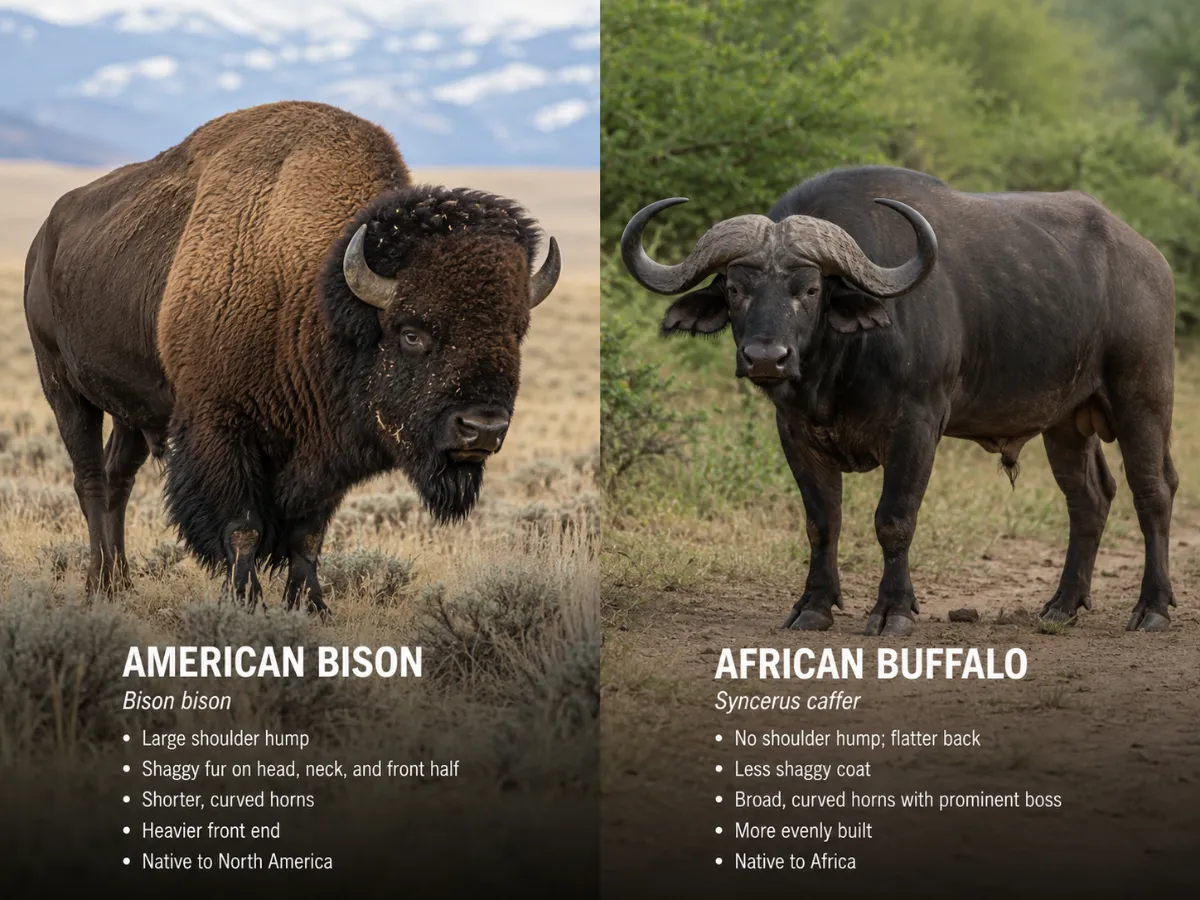
People use the words buffalo and bison interchangeably all the time, but biologically they refer to different animals. They are all large hoofed mammals in the cattle family, yet they belong to different branches and evolved in different parts of the world.
In this guide, you will learn the clearest differences between buffalo and bison, how to identify them quickly, and why the names became mixed up in everyday language.
Quick comparison table
| Feature | Bison | Buffalo |
|---|---|---|
| Main examples | American bison, European bison | African buffalo, water buffalo |
| Main range | North America and Europe | Africa and Asia |
| Shoulder hump | Large and obvious | Usually absent or much less pronounced |
| Head and shoulders | Heavy, shaggy, and strongly built | Usually smoother-backed and less hump-backed |
| Coat | Often thick and shaggy, especially in front | Usually shorter and less shaggy |
| Horns | Shorter and more curved upward in many individuals | Often broader, longer, or more outward-spreading depending on species |
| Cold adaptation | Strongly adapted to colder climates | Many species better suited to warmer climates |
| Common language confusion | American bison often called “buffalo” | True buffalo are separate animals |
They are related, but not the same animal
Buffalo and bison both belong to the cattle family, Bovidae, so they are related. However, they are not just two names for the same species. Bison belong to the genus Bison, while the best-known true buffalo belong to other genera, including the African buffalo and the Asian water buffalo.
This means they share a broad bovine ancestry, but they evolved along different lines and developed different body shapes, behaviors, and environmental adaptations.
So while both are large powerful hoofed mammals, they should not be treated as identical animals.
Bison have a large shoulder hump
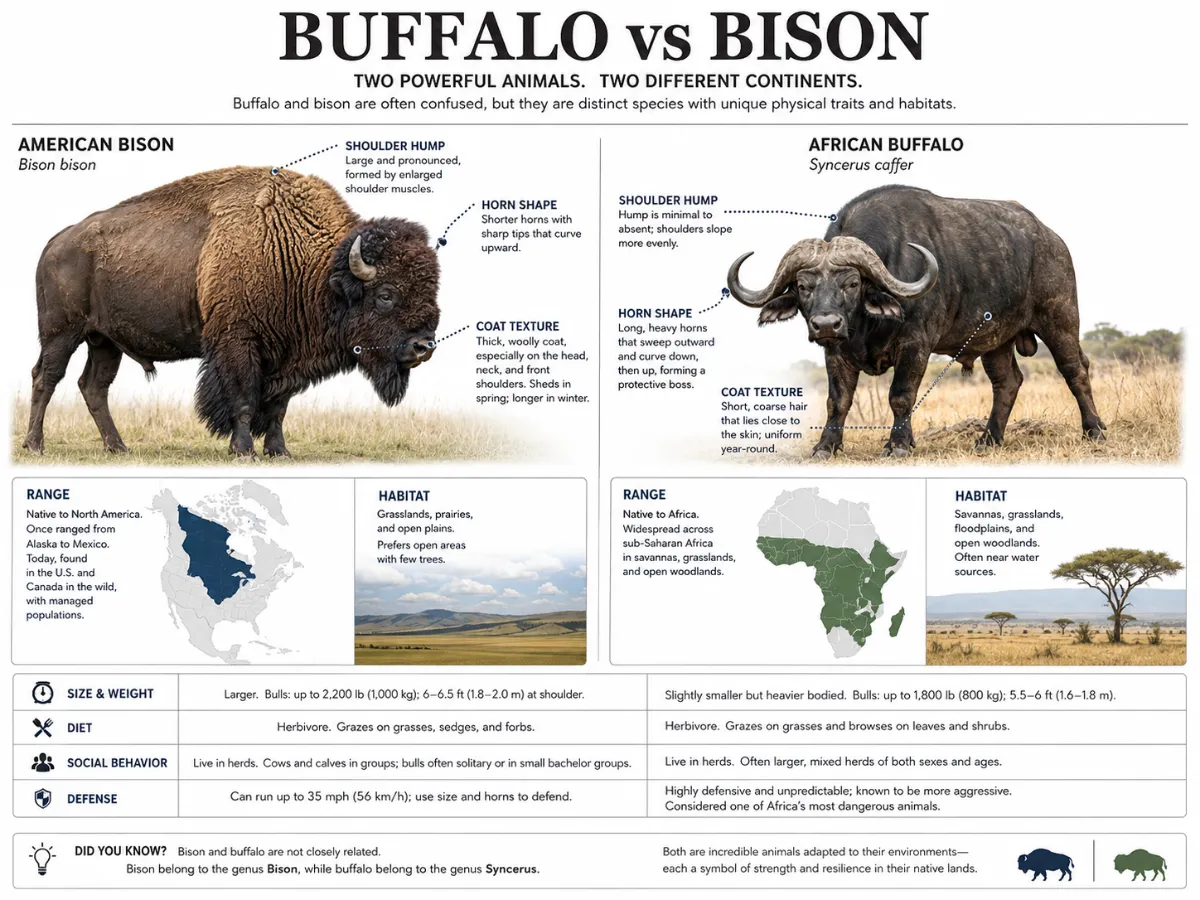
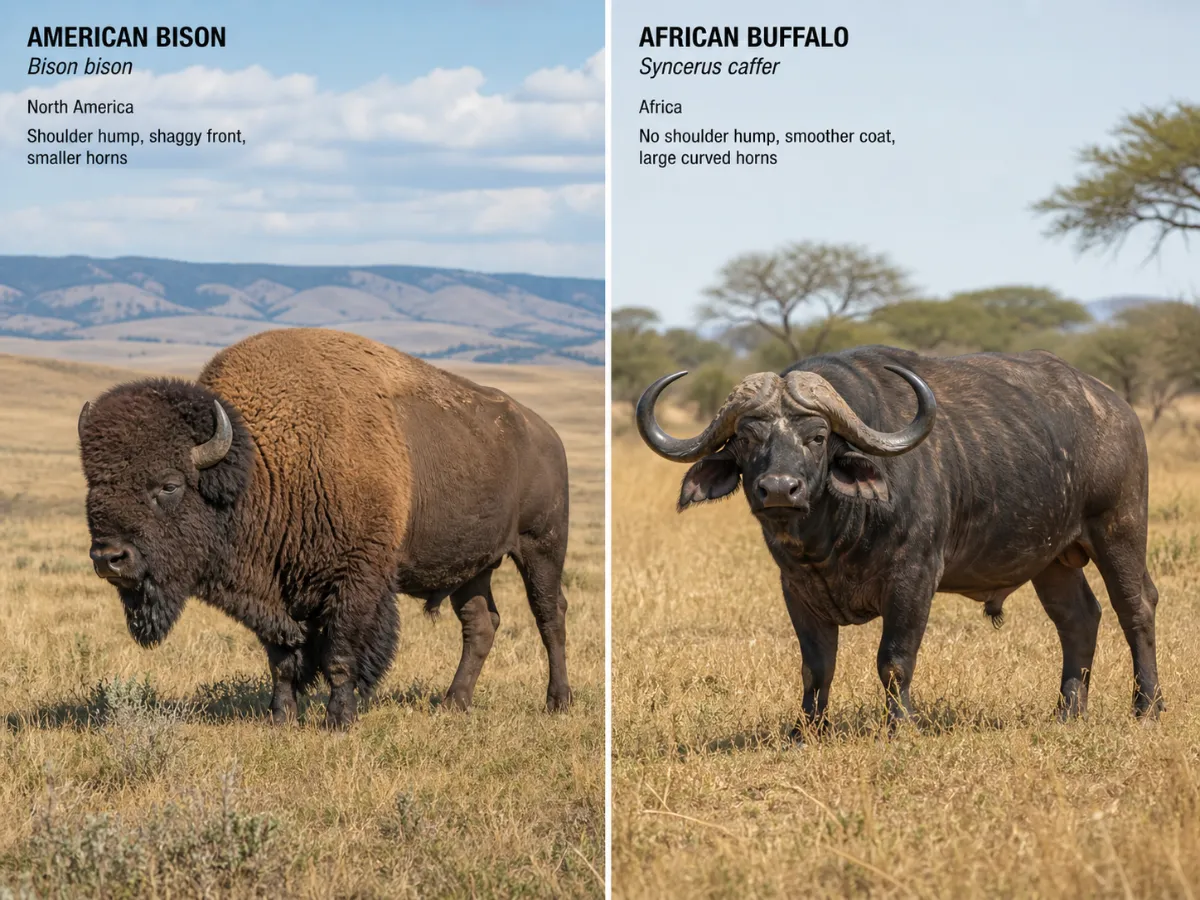
One of the easiest ways to tell a bison from a buffalo is the hump. Bison have a large, muscular hump over the shoulders. This hump is one of the most recognizable features of the animal and gives the body a high front end and a sloping back.
Buffalo do not usually show this same dramatic shoulder hump. Their backs are generally flatter or more evenly profiled, depending on the species.
If the animal looks front-heavy with a big hump and a raised shoulder area, it is much more likely to be a bison.
Bison usually look shaggier
Bison, especially the American bison, usually have a thick shaggy coat around the head, shoulders, and front legs. This heavy fur helps protect them in colder environments and adds to their massive appearance.
Buffalo are usually less shaggy overall. Their coat is often shorter, smoother, and more suited to warmer climates. Some buffalo may still look rough or heavy-bodied, but they do not usually have the dramatic shaggy forequarters of a classic bison.
This fur difference is one reason bison often look more “wild and woolly” at first glance.
The head shape is different
Bison often have a very large, heavy head carried low in front of the shoulder hump. Their neck and forequarters look especially powerful, giving the animal a compact but muscular front end.
Buffalo heads vary by species, but many true buffalo look longer-backed and less hump-dominated. The head may still be broad and formidable, but the whole front half of the body usually looks less bulky than that of a bison.
So if the animal looks especially massive in the head and shoulder region, with a front-heavy silhouette, bison becomes the more likely answer.
Horn shape can help
Horns are another useful clue, although the exact shape depends on the species and sex. Bison usually have relatively shorter horns that curve upward and inward from the sides of the head. They are solid and noticeable, but they often do not dominate the silhouette the way buffalo horns can.
Buffalo horns can be more dramatic. African buffalo often have broad, thick horns that sweep outward and curve upward, sometimes forming a heavy shield-like base across the forehead in mature males. Water buffalo often have long sweeping horns that spread outward and back.
If the horns are very broad, wide-spreading, or especially dominant, the animal is more likely to be a true buffalo.
Where they live is a major clue
Geography helps a lot. Bison are associated with North America and Europe. The American bison is native to North America, while the European bison, also called wisent, belongs to Europe.
True buffalo are associated with Africa and Asia. The African buffalo lives in sub-Saharan Africa, while water buffalo are native to parts of Asia and have also been domesticated and introduced elsewhere.
So if you are talking about a large wild bovine in Yellowstone or the Great Plains, it is a bison, not a true buffalo. If you are talking about a wild bovine in African savanna or an Asian water buffalo in wet tropical landscapes, that is true buffalo territory.
Buffalo and bison are adapted to different climates
Bison are especially well adapted to colder climates and open plains. Their heavy front fur, compact powerful build, and seasonal coat changes suit them to harsh winters and exposed grasslands.
Many buffalo species are better suited to warmer environments. African buffalo thrive in tropical and subtropical Africa, while water buffalo are strongly associated with wetter, warmer habitats and often use mud or water to cool themselves.
This environmental difference is reflected in their appearance. Bison look built for wind, snow, and prairie winters. Buffalo often look better suited to heat, wetlands, or warm savanna conditions.
American bison are often called buffalo
One of the biggest reasons people get confused is that the American bison is very often called “buffalo” in North America. This is why you hear phrases like “buffalo herd,” “buffalo range,” or “buffalo nickel,” even though the animal is technically a bison.
This naming habit goes back a long way and is deeply rooted in culture, travel writing, and everyday speech. So even though it is not scientifically precise, it remains very common.
That is why the phrase “buffalo vs bison” can feel confusing: in ordinary language, many people use buffalo for an animal that is actually a bison.
What is a true buffalo?
When zoologists talk about true buffalo, they usually mean animals such as the African buffalo and the Asian water buffalo. These are not bison and do not belong to the genus Bison.
The African buffalo is a powerful wild bovine of Africa and is well known for its strong build, impressive horns, and unpredictable temperament. The water buffalo, by contrast, includes both wild and domesticated forms and is strongly associated with wetlands, rice agriculture, and tropical or subtropical landscapes.
So a true buffalo is not just any large horned animal. It refers to specific bovines from Africa or Asia.
What is a true bison?
A true bison belongs to the genus Bison. Today, the two best-known species are the American bison and the European bison. Both are large, powerful grazing mammals, but the American bison is the better-known symbol in popular culture.
Bison are especially associated with grasslands, plains, and open country, although they can also use woodland and mixed habitats depending on the species and region.
If you want the scientifically correct word for the classic huge shaggy “buffalo” of North American plains, that word is bison.
Which one is bigger?
There is no single easy answer because size varies by species, population, sex, and habitat. American bison can become extremely large and heavy, especially mature bulls. Some buffalo species are also very large and powerful, but the build is different.
Bison often look larger in front because of the hump, heavy head, and shaggy forequarters. Buffalo may appear longer-bodied or more horn-dominant depending on the species.
So the better answer is that both can be very large, but they look large in different ways. Bison often look bulkier in the shoulders, while buffalo may look broader-horned or longer-framed.
Behavior is not exactly the same
Bison are powerful herd animals that can be fast, unpredictable, and dangerous when threatened. Even though they often appear calm while grazing, they are still wild animals capable of sudden bursts of speed and force.
Buffalo are also formidable, and some, especially African buffalo, have a reputation for being highly dangerous when cornered or threatened. Water buffalo behavior varies more because many are domesticated, but wild forms are still large powerful animals.
So neither should be treated casually. The important difference is not that one is harmless and the other dangerous. It is that they come from different evolutionary and ecological backgrounds.
Why the confusion continues
The confusion continues because common language and biology are not always the same. In North America, the word buffalo became deeply attached to the American bison long before scientific naming mattered to most people.
At the same time, both buffalo and bison are large horned bovines, so people who are not looking closely may treat them as interchangeable. Movies, sports team names, tourism language, and casual conversation all reinforce the mix-up.
Once you learn the key differences, though, it becomes much easier to separate them.
How to tell them apart quickly
If you need a fast field guide, use these clues together:
Bison: large shoulder hump, shaggy front, massive head, shorter curved horns, North America or Europe
Buffalo: flatter back, less shaggy coat, often broader or longer horns, Africa or Asia
No single feature is perfect every time, but this combination usually works very well.
Buffalo vs bison vs ox
People also sometimes confuse buffalo and bison with oxen. An ox is not a separate wild species in the same way. The word ox usually refers to a domesticated bovine, often a trained cattle animal used for work.
So while buffalo and bison are wild bovine types, an ox is usually a domestic working animal term rather than a direct species comparison.
This matters because many large bovines get grouped together in casual speech even when they mean very different things biologically.
Final takeaway
The main difference between buffalo and bison is that they are different animals from different parts of the world. Bison live in North America and Europe and are easy to recognize by their large shoulder hump, shaggy forequarters, and heavy front end. True buffalo live in Africa and Asia and usually have a flatter back, less shaggy coat, and often more dramatic horn shapes. The confusion is common because the American bison is often casually called a buffalo, but scientifically the two are not the same.
FAQs
Is a bison a buffalo?
Not scientifically. A bison is a different animal from a true buffalo, although American bison are often casually called buffalo.
What is the main difference between buffalo and bison?
The main differences are species, range, body shape, shoulder hump, coat, and horn structure.
Why do people call American bison buffalo?
It is a long-standing cultural naming habit in North America, even though the scientifically correct name is bison.
Which is more dangerous, a buffalo or a bison?
Both can be dangerous wild bovines. The exact risk depends on the species, the situation, and whether the animal feels threatened.