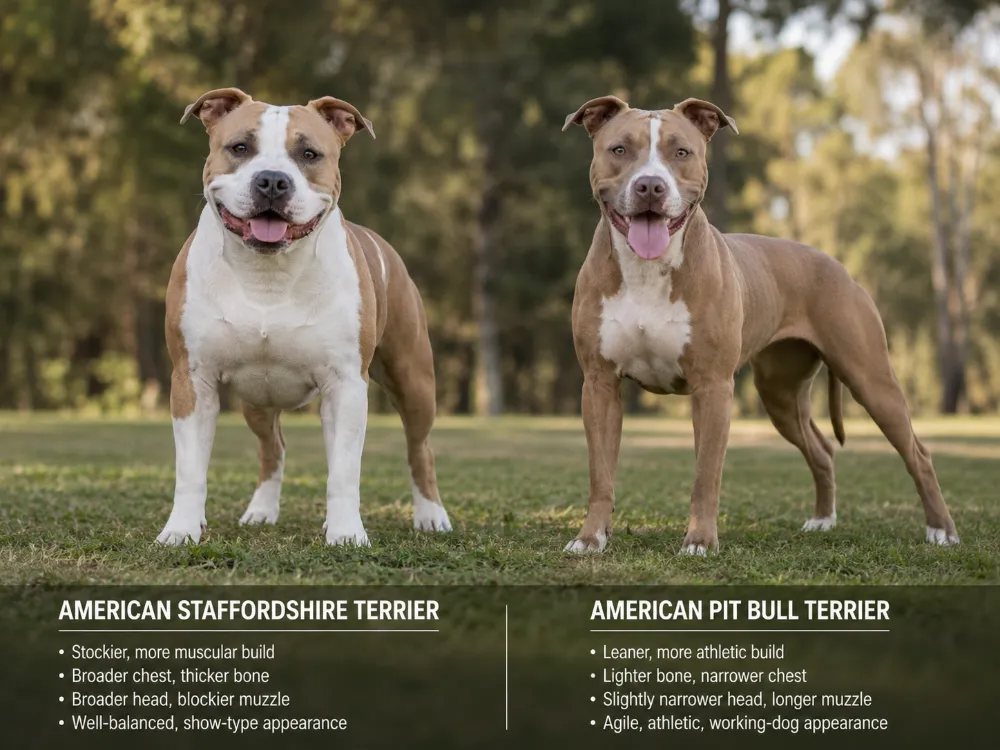
An American Staffordshire Terrier is a recognized dog breed, while “pitbull” is usually an informal umbrella term, not one single breed. It may refer to the American Pit Bull Terrier, American Staffordshire Terrier, Staffordshire Bull Terrier, or similar mixes. AmStaffs are often stockier and show-bred, while American Pit Bull Terriers are often more athletic and working-bred, but individual dogs vary greatly.
American Staffordshire Terrier vs Pitbull Summary Table
| Feature | American Staffordshire Terrier | Pitbull / Pit Bull-Type Dog |
|---|---|---|
| Breed status | A recognized breed, often called AmStaff | Usually an umbrella term, not one single breed |
| Common meaning | Usually refers specifically to the American Staffordshire Terrier | May refer to American Pit Bull Terrier, AmStaff, Staffordshire Bull Terrier, American Bully, or mixed dogs |
| Body type | Muscular, compact, broad-headed, and stocky | Varies widely; some are lean and athletic, others are heavy and broad |
| Typical build | Often more show-type and balanced | Depends on breed or mix; American Pit Bull Terriers are often more athletic |
| Head shape | Broad skull, strong cheeks, medium-length muzzle | Varies; many have broad heads and strong jaws, but shape depends on ancestry |
| Temperament | Often confident, affectionate, people-oriented, and energetic | Varies widely; often loyal, energetic, strong, and people-focused when well bred and socialized |
| Energy level | Moderate to high | Moderate to very high depending on breed line and individual dog |
| Training needs | Needs early socialization, structure, impulse control, and positive training | Same; especially important because of strength and public misunderstanding |
| Dog-dog sociability | Can vary; careful socialization and management are important | Can vary greatly; some are social, some are selective, some need careful management |
| Family fit | Can be a loving family dog with responsible ownership | Can be excellent in the right home, but needs training, exercise, and supervision |
| Common misunderstanding | Often incorrectly treated as identical to every “pitbull” | Often used too broadly for many unrelated or mixed dogs |
| Best quick explanation | A specific breed | A broad label for several breeds and mixes |
What Is an American Staffordshire Terrier?
The American Staffordshire Terrier, often called the AmStaff, is a muscular, medium-sized terrier breed known for strength, confidence, and affection toward people. It has a broad head, strong neck, deep chest, short coat, and powerful but balanced body.
AmStaffs developed from bull-and-terrier type dogs. Over time, they became a distinct breed with a focus on stable temperament, conformation, companionship, and athletic ability. A well-bred American Staffordshire Terrier should be confident, alert, friendly with familiar people, and physically powerful without being oversized or clumsy.
Like many terriers, AmStaffs can be energetic, determined, and strong-willed. They benefit from consistent training, early socialization, daily exercise, and clear household rules. They are not a low-effort breed, but in responsible homes they can be loyal and affectionate companions.
What Does Pitbull Mean?
“Pitbull” or “pit bull” is usually not one precise breed name. In everyday language, it is an umbrella term used for several muscular, short-coated dogs with bull-and-terrier ancestry or similar appearance.
The term may refer to the American Pit Bull Terrier, American Staffordshire Terrier, Staffordshire Bull Terrier, American Bully, or mixed-breed dogs that look similar. This is why the phrase can be confusing. Two people may say “pitbull” and mean different dogs.
If someone is comparing “American Staffordshire Terrier vs pitbull,” the most accurate question is usually: “American Staffordshire Terrier vs American Pit Bull Terrier.” But because the public uses “pitbull” broadly, the article must separate the specific breed from the general label.
Is an American Staffordshire Terrier a Pitbull?
In common speech, many people would call an American Staffordshire Terrier a pitbull-type dog. However, scientifically and breed-wise, the American Staffordshire Terrier is its own recognized breed.
This means both statements can appear in different contexts. In casual conversation, an AmStaff may be included under the pitbull umbrella. In formal breed identification, an American Staffordshire Terrier is not simply “any pitbull”; it is a specific breed with its own breed standard and breeding history.
The confusion comes from shared ancestry and similar appearance. AmStaffs and American Pit Bull Terriers are closely related, but modern breeding goals have often emphasized different traits.
American Staffordshire Terrier vs American Pit Bull Terrier
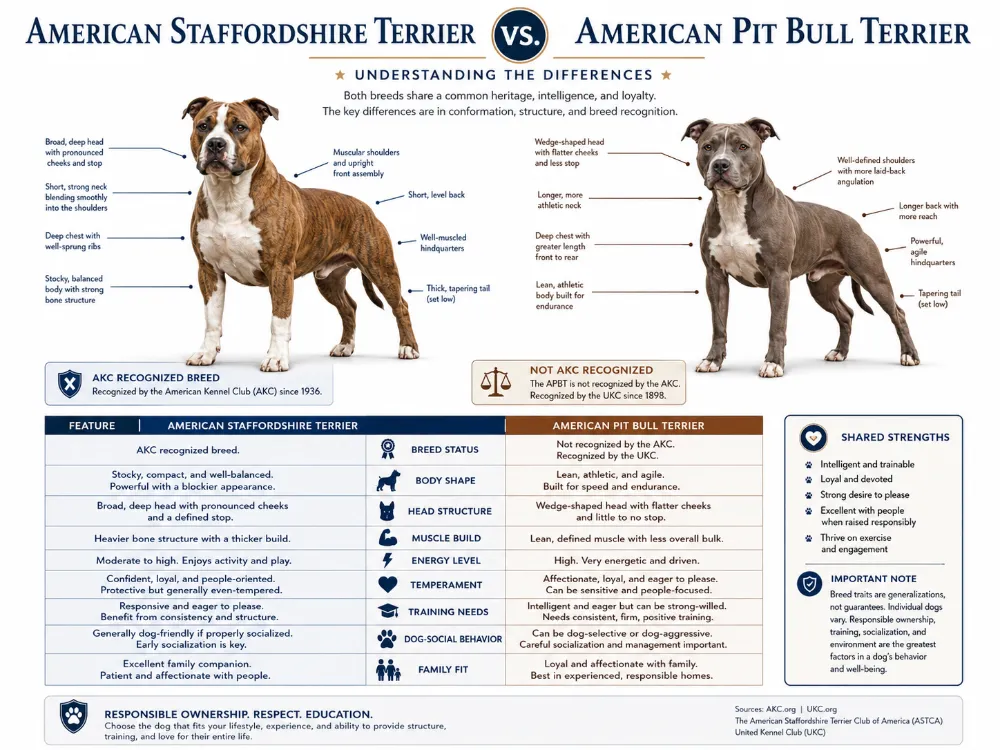
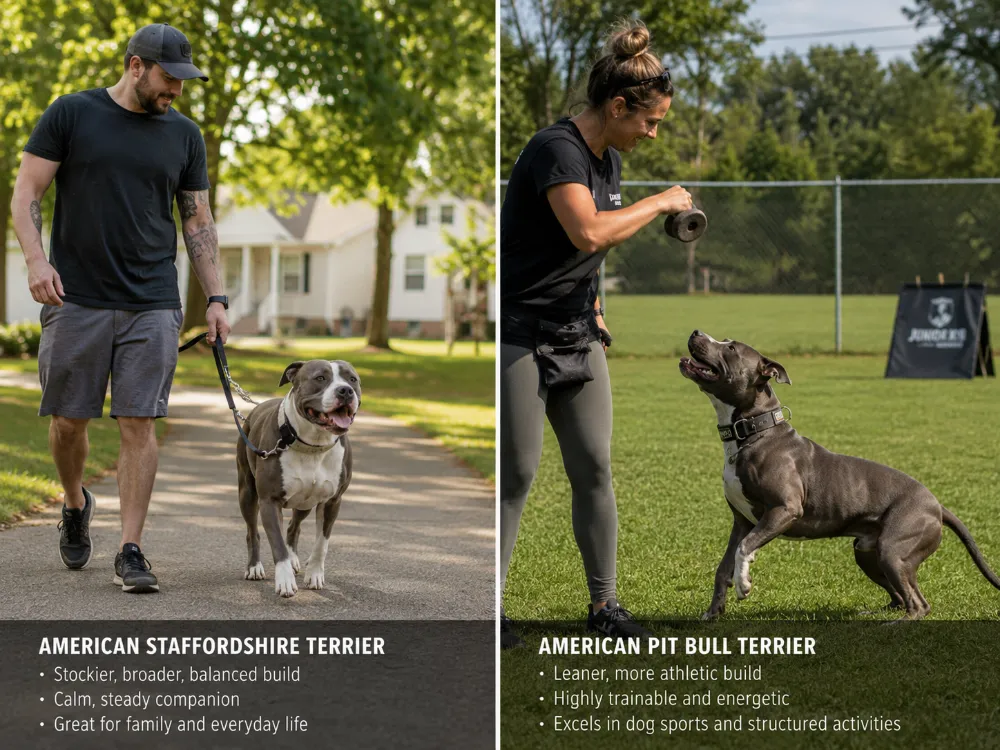
When people say “pitbull,” they often mean the American Pit Bull Terrier. Compared with the American Staffordshire Terrier, the American Pit Bull Terrier is often described as slightly leaner, more athletic, and more working-oriented. The AmStaff is often more stocky, balanced, and show-oriented.
However, there is major overlap. Some AmStaffs are athletic and lean. Some American Pit Bull Terriers are broad and heavy. Without pedigree information, visual identification can be difficult and sometimes unreliable.
The safest way to explain it is this: the American Staffordshire Terrier is a specific registered breed; the American Pit Bull Terrier is another closely related breed; “pitbull” is often a broad public label that may include both.
Body Shape and Appearance
American Staffordshire Terriers are usually compact, muscular, and broad. They often have a deep chest, strong shoulders, well-developed cheeks, and a sturdy body. Their appearance should suggest strength and agility rather than extreme bulk.
Pitbull-type dogs vary much more. If the dog is an American Pit Bull Terrier, it may be more athletic, lean, and leggy than a typical AmStaff. If the dog is an American Bully or mixed breed, it may be heavier, wider, or shorter. Because “pitbull” is a broad label, appearance is not consistent.
A simple rule: AmStaffs are a defined breed type, while pitbull-type dogs can range from lean and athletic to broad and heavy depending on ancestry.
Head, Muzzle, and Ears
The American Staffordshire Terrier typically has a broad head, strong cheek muscles, a medium-length muzzle, and a confident expression. The ears may be natural or cropped depending on country, law, and owner choice, though natural ears are increasingly preferred by many welfare-minded owners.
Pitbull-type dogs may have similar head features, but the details vary. American Pit Bull Terriers often have strong but somewhat less exaggerated heads than some heavily built bully-type dogs. Mixed dogs may show a wide range of muzzle lengths, skull widths, and ear shapes.
Head shape can help describe a dog, but it should not be used as the only way to identify breed. Many mixed-breed dogs are misidentified based on head shape alone.
Size and Weight
American Staffordshire Terriers are medium-sized but very muscular dogs. They are not giant dogs, but they can feel powerful because of their dense muscle and low center of gravity.
Pitbull-type dogs vary widely in size. An American Pit Bull Terrier is often medium-sized and athletic. An American Bully may be shorter, wider, and heavier. A mixed pitbull-type dog may fall anywhere between these forms.
Because of this variation, weight alone does not prove whether a dog is an AmStaff, American Pit Bull Terrier, or another pitbull-type dog.
Coat and Colors
American Staffordshire Terriers have short, smooth coats. They can come in many colors and patterns, including black, blue, fawn, brindle, red, brown, white, and combinations of these. The coat is easy to groom but still sheds.
Pitbull-type dogs also usually have short coats and come in many colors. Color does not separate an AmStaff from a pitbull-type dog. A blue, red, brindle, black, or white dog could belong to several related breeds or mixes.
Coat color is one of the least reliable identification features.
Temperament and Personality
A well-bred American Staffordshire Terrier is usually confident, affectionate, people-oriented, and energetic. Many are deeply attached to their families and enjoy physical closeness, play, and training. They can be enthusiastic, expressive, and eager to interact with people.
Pitbull-type dogs are also often people-focused, athletic, and loyal, but temperament varies widely because the label includes many breeds and mixes. Some are calm and gentle. Others are intense, high-drive, or reactive if poorly bred, under-socialized, or mishandled.
Breed type can influence tendencies, but it does not determine an individual dog’s entire personality. Genetics, early life, socialization, training, health, and owner responsibility all matter.
Are They Naturally Aggressive?
No dog should be judged by a simple stereotype. American Staffordshire Terriers and pitbull-type dogs are not automatically aggressive toward humans. Many are affectionate, friendly, and stable when bred responsibly and raised well.
However, they are strong, muscular dogs with terrier determination. Some individuals may show dog-selective or dog-aggressive behavior, especially without careful socialization or management. This does not mean every dog is dangerous, but it does mean responsible ownership is essential.
The best approach is balanced: do not demonize the dog, but do not ignore strength, drive, training needs, or safety responsibilities.
Dog-Dog Sociability
American Staffordshire Terriers can vary in their relationships with other dogs. Some live peacefully with other dogs, especially when raised with them and managed carefully. Others may be selective, intolerant of rude dogs, or reactive in certain situations.
Pitbull-type dogs also vary widely. Because many were historically selected for strength and determination, owners should not assume every individual will enjoy dog parks or rough group play. Some do well with carefully chosen canine companions, while others are happier as the only dog.
Socialization helps, but it does not erase genetics or personality. Responsible owners monitor body language, avoid risky situations, and do not force dog interactions.
Training Needs
American Staffordshire Terriers need early training, structure, and positive reinforcement. They are intelligent and often eager to please, but they can also be strong, excitable, and persistent. Training should focus on leash manners, recall, impulse control, calm greetings, drop-it, leave-it, and relaxed behavior around distractions.
Pitbull-type dogs need the same foundation. Because they are powerful, training is not optional. A small untrained dog may be annoying; a strong untrained dog can become a serious management problem even without bad intentions.
Harsh training methods can increase fear, stress, or defensive behavior. Clear, consistent, reward-based training is usually safer and more effective.
Exercise and Mental Stimulation
American Staffordshire Terriers are active dogs. They need daily walks, play, training, chewing outlets, and mental challenges. Many enjoy tug, fetch, flirt pole games, scent work, obedience, hiking, and structured sports.
Pitbull-type dogs also tend to need regular exercise. Their needs depend on age, health, build, and drive. A young athletic American Pit Bull Terrier may need much more activity than a calmer middle-aged companion dog.
Exercise should be controlled and safe. Because these dogs are muscular and enthusiastic, owners should avoid overexertion in hot weather and protect growing puppies from excessive jumping or impact.
Family Life and Children
American Staffordshire Terriers can be loving family dogs in responsible homes. Many are affectionate with children and enjoy family life. However, no dog of any breed should be left unsupervised with young children.
Pitbull-type dogs can also be excellent family companions, but they need training, socialization, and management. Their strength means that even playful jumping or rough excitement can knock over a child.
Children should be taught to respect dogs: no climbing on them, pulling ears, disturbing food, waking them suddenly, or approaching when the dog wants space. Good family dogs are created through both good temperament and good supervision.
Are They Good for First-Time Owners?
An American Staffordshire Terrier can be suitable for a first-time owner who is committed, active, responsible, and willing to train. However, it is not the best choice for someone who wants a low-effort dog with minimal structure.
Pitbull-type dogs can also be good first dogs in the right circumstances, especially if the individual dog has a stable temperament and the owner has support from trainers, veterinarians, and responsible rescue or breeder guidance.
For first-time owners, an adult dog with a known temperament may be easier than a high-energy puppy from unknown lines.
Health and Lifespan
American Staffordshire Terriers are generally strong, athletic dogs, but they can be prone to certain health issues. These may include hip dysplasia, elbow problems, skin allergies, thyroid issues, heart disease, and inherited neurological or eye conditions depending on lineage.
Pitbull-type dogs may share many of the same concerns, especially skin allergies, joint problems, and certain inherited conditions. Mixed ancestry can change risk, but it does not guarantee perfect health.
Responsible breeding, veterinary care, weight control, exercise, dental care, and early treatment of skin or ear problems are important for both AmStaffs and pitbull-type dogs.
Grooming and Coat Care
American Staffordshire Terriers are easy to groom compared with long-haired breeds. Their short coat needs regular brushing, occasional bathing, nail trimming, ear checks, and dental care.
Pitbull-type dogs usually have similar grooming needs. The short coat can still shed, and some dogs with sensitive skin may react to harsh shampoos, fleas, food ingredients, or environmental allergens.
Because skin issues are common in many bully-type dogs, owners should watch for itching, redness, hot spots, hair loss, or recurring ear infections.
Legal and Housing Issues
One practical difference between owning these dogs and many other breeds is public perception. American Staffordshire Terriers and pitbull-type dogs may be affected by breed-specific laws, housing restrictions, insurance limitations, airline rules, and landlord policies in some areas.
These rules may apply even when a dog is friendly and well trained. Sometimes they apply based on appearance rather than verified breed. This can create serious problems for owners who move, rent, travel, or need insurance coverage.
Before adopting or buying an AmStaff or pitbull-type dog, owners should check local laws, rental rules, insurance policies, and community restrictions.
Common Myths
One myth is that pitbull-type dogs have “locking jaws.” They do not. Their jaws are strong, but they do not have a special locking mechanism.
Another myth is that all pitbull-type dogs are dangerous. This is too broad and not scientifically fair. Individual behavior depends on genetics, socialization, training, environment, health, and owner responsibility.
A third myth is that love alone is enough. Affection is important, but strong dogs also need training, management, exercise, and safe handling.
Responsible Ownership
Responsible ownership matters for every dog, but it is especially important with strong, muscular breeds. Owners should provide early socialization, basic obedience, leash control, secure fencing, proper exercise, veterinary care, and safe introductions to people and dogs.
Food, toys, and resting spaces should be managed carefully if a dog shows guarding tendencies. Owners should learn dog body language and avoid situations that push the dog beyond its comfort level.
A well-managed AmStaff or pitbull-type dog can be a wonderful companion. Poor management can create problems in any powerful breed.
How to Tell an American Staffordshire Terrier from a Pitbull-Type Dog
Check the terminology: American Staffordshire Terrier is a specific breed; pitbull is usually a broad label.
Look at pedigree: papers or verified ancestry are more reliable than appearance alone.
Compare body type: AmStaffs are often stockier and show-balanced; American Pit Bull Terriers are often leaner and more athletic.
Do not rely on color: both can come in many colors and patterns.
Consider behavior carefully: individual temperament matters more than the label.
Remember the overlap: many dogs visually identified as pitbulls are mixed breeds.
Which Dog Is Better for You?
An American Staffordshire Terrier may be a good choice if you want a strong, affectionate, people-oriented companion and are ready to provide training, structure, and exercise. It may suit owners who appreciate a muscular, confident dog with a defined breed type.
A pitbull-type dog may also be a wonderful companion, but the right match depends on the individual dog’s breed background, temperament, age, energy level, and social behavior. Because “pitbull” is broad, choosing based on personality and history is especially important.
For either type, choose a responsible breeder or rescue, meet the dog carefully, ask about health and behavior, and be honest about your lifestyle and experience.
American Staffordshire Terrier vs Pitbull: Final Comparison
The American Staffordshire Terrier is a specific recognized breed. “Pitbull” is usually a general label for several related breeds and mixed dogs with similar appearance. If “pitbull” means American Pit Bull Terrier, then the AmStaff is often stockier and more show-oriented, while the American Pit Bull Terrier is often leaner and more working-oriented.
Neither label tells the whole story. These dogs are strong, intelligent, affectionate, and energetic, but they need responsible ownership. The best dog is not the one with the most popular label, but the one with a stable temperament, good health, proper training, and the right match for the owner’s lifestyle.
FAQs About American Staffordshire Terriers vs Pitbulls
Is an American Staffordshire Terrier the same as a pitbull?
An American Staffordshire Terrier is a specific breed. In casual speech, it may be included under the pitbull umbrella, but formally it is not the same as every dog called a pitbull.
What breeds are usually called pitbulls?
The term pitbull may refer to the American Pit Bull Terrier, American Staffordshire Terrier, Staffordshire Bull Terrier, American Bully, or mixed dogs with similar muscular, short-coated appearance.
Is a pitbull a real breed?
“Pitbull” is usually not one precise breed name. The American Pit Bull Terrier is a specific breed, but the word pitbull is often used broadly for several breeds and mixes.
Which is bigger, an American Staffordshire Terrier or a pitbull?
It depends on what “pitbull” means. Compared with many American Pit Bull Terriers, AmStaffs are often stockier and heavier-looking. Compared with American Bullies, AmStaffs may be smaller or less bulky.
Which is more muscular?
Both can be very muscular. AmStaffs often have a compact, broad, show-type build. American Pit Bull Terriers are often leaner and more athletic. American Bullies may be heavier and more exaggerated in build.
Are American Staffordshire Terriers aggressive?
They are not automatically aggressive. Many are affectionate and people-oriented. However, they are strong dogs that need training, socialization, exercise, and responsible management.
Are pitbulls dangerous?
Pitbull-type dogs are powerful and require responsible ownership, but they should not be judged only by stereotypes. Individual behavior depends on breeding, socialization, training, health, environment, and owner responsibility.
Do pitbulls have locking jaws?
No. Pitbull-type dogs do not have locking jaws. They have strong jaws, but there is no special locking mechanism.
Are American Staffordshire Terriers good family dogs?
They can be excellent family dogs in responsible homes. They need supervision around children, consistent training, exercise, and proper socialization like any strong breed.
Are pitbull-type dogs good with other dogs?
Some are good with other dogs, some are selective, and some need careful management. Dog-dog sociability varies by individual and should not be assumed.
Which is easier to train?
Both AmStaffs and pitbull-type dogs are intelligent and trainable. They respond best to clear, consistent, reward-based training. The individual dog’s temperament matters more than the label.
Do American Staffordshire Terriers need a lot of exercise?
Yes. They usually need daily walks, play, training, and mental stimulation. Without enough activity, they may become bored, excitable, or destructive.
Can pitbull-type dogs live in apartments?
Yes, some can live well in apartments if they receive enough exercise, training, enrichment, and calm routines. Owners must also check rental rules and local breed restrictions.
How can I identify an American Staffordshire Terrier?
Appearance can help, but pedigree or reliable records are best. AmStaffs are usually muscular, broad-headed, compact, and balanced, but many mixed dogs can look similar.
Which is better: American Staffordshire Terrier or pitbull?
Neither is automatically better. The best choice depends on the individual dog’s temperament, health, energy level, social behavior, and how well it fits the owner’s lifestyle.