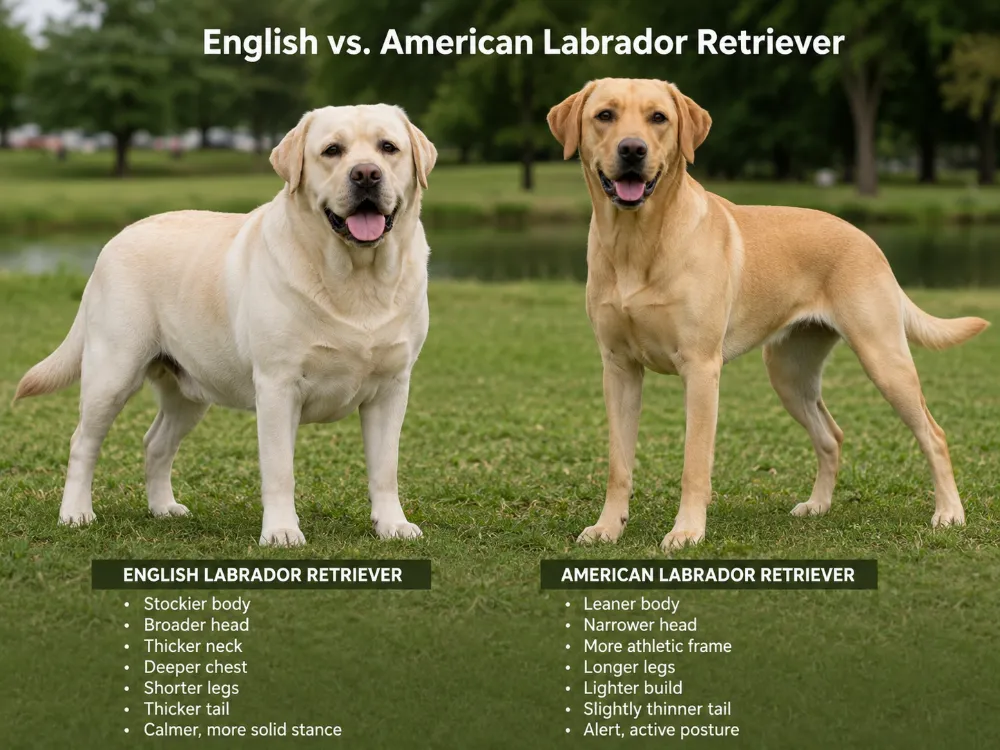
English Labs and American Labs are both Labrador Retrievers, not separate breeds. “English Lab” usually means a stockier show-type Labrador with a broader head, thicker body, and calmer temperament. “American Lab” usually means a leaner field-type Labrador with longer legs, higher energy, and stronger working drive. English Labs often suit relaxed family homes, while American Labs often suit active owners, field work, and sport training.
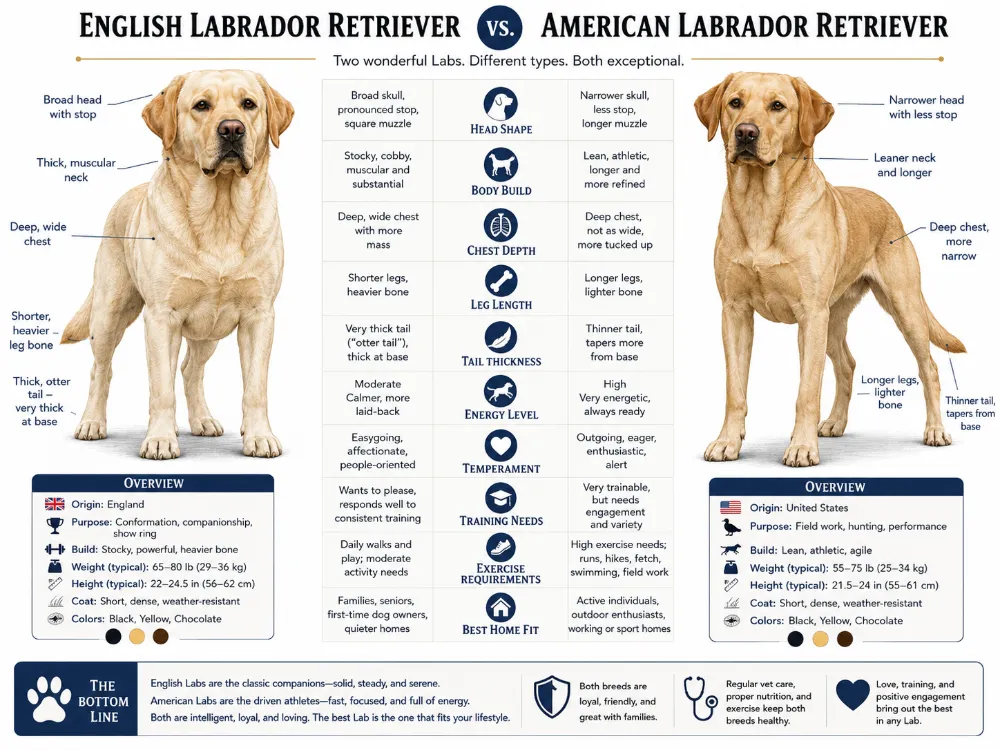
English Lab vs American Lab Summary Table
| Feature | English Lab | American Lab |
|---|---|---|
| Breed status | Labrador Retriever, usually show-type or bench-type | Labrador Retriever, usually field-type or working-type |
| Official separate breed? | No | No |
| Body shape | Stockier, broader, heavier-looking | Leaner, more athletic, longer-legged |
| Head | Broader head, shorter muzzle, more blocky appearance | Narrower head, longer muzzle, more streamlined appearance |
| Chest and body | Deep chest, thick neck, heavier bone | Slimmer body, lighter frame, more endurance-oriented |
| Tail | Thick “otter tail,” often very noticeable | Usually thinner-looking but still strong |
| Energy level | Moderate to high, often calmer indoors | High to very high, often needs more intense exercise |
| Temperament | Often gentle, steady, sociable, and relaxed | Often driven, intense, alert, and highly active |
| Training style | Usually eager and food-motivated; may be easier for average families | Very trainable but needs structure, work, and mental challenges |
| Best suited for | Families, companionship, show homes, therapy-type temperaments | Hunting, field trials, agility, scent work, active homes, sport training |
| Common challenge | Weight gain, lower fitness, stubbornness if undertrained | Overexcitement, restlessness, destructive behavior if under-exercised |
| Coat colors | Black, yellow, and chocolate | Black, yellow, and chocolate |
What Is an English Lab?
An English Lab is a Labrador Retriever from lines often associated with show, bench, or conformation breeding. The name “English Lab” is common in everyday dog discussions, but it does not mean the dog is a separate breed from the Labrador Retriever.
English Labs are usually bred to match the classic show-ring Labrador appearance. They tend to have broader heads, thicker necks, deeper chests, heavier bone, shorter legs, and a more compact body. Their expression is often soft and friendly, with a strong, blocky look.
In temperament, English Labs are often described as calmer and more settled than American Labs. They still need exercise, training, and mental stimulation, but many are less intense than field-line Labradors. This makes them popular family dogs when bred and raised responsibly.
What Is an American Lab?
An American Lab is a Labrador Retriever from lines often associated with field work, hunting, sport, and performance. Like the English Lab, the American Lab is not a separate breed. It is a field-type Labrador Retriever.
American Labs are usually leaner, taller-looking, and more athletic. They often have longer legs, a narrower head, a longer muzzle, a lighter frame, and a body built for speed, stamina, and retrieving work. Their appearance is less blocky and more functional for long days in the field.
In behavior, American Labs often have higher energy, stronger drive, and more intense focus on retrieving, running, swimming, and working with a handler. They can be excellent companions, but they usually need more daily exercise and structured training than many English Labs.
Are English Labs and American Labs Separate Breeds?
No. English Labs and American Labs are both Labrador Retrievers. The terms describe different breeding styles or lines, not separate breeds. Both can be registered as Labrador Retrievers, and both share the same basic breed ancestry.
The difference is mostly between show-type and field-type Labradors. English Labs are usually closer to the show or bench type. American Labs are usually closer to the working or field type.
Because these are informal labels, individual dogs can vary. Some English Labs are energetic, and some American Labs are calm. Genetics, breeder selection, training, age, health, and environment all matter.
Body Shape Differences
The most obvious difference is body shape. English Labs usually look heavier and more compact. They often have a broad chest, thick neck, wide skull, strong bones, and a shorter, stockier frame. Their legs may look shorter in proportion to the body.
American Labs usually look more athletic and streamlined. They tend to have longer legs, a narrower body, a lighter build, and a more agile outline. They are often bred for running, swimming, retrieving, and endurance rather than show-ring structure.
A simple visual rule is useful: English Labs look more blocky and powerful, while American Labs look leaner and more athletic.
Head and Face Differences
English Labs often have a broader head with a more defined stop, shorter muzzle, and fuller cheeks. Their face may look softer, rounder, and more classic in the show Labrador style.
American Labs usually have a narrower head, longer muzzle, and more refined face. Their head shape often looks more streamlined, matching their field-bred body type.
Head shape is helpful, but it is not perfect. Some Labradors fall between the two types, especially if show and field lines are mixed.
Size and Weight Differences
English Labs often look heavier than American Labs because of their broader body, deeper chest, and thicker bone. They may not always be taller, but they often appear more substantial.
American Labs may look taller and lighter because of their longer legs and leaner build. They often carry less bulk and more visible athletic shape when kept fit.
Weight depends heavily on sex, diet, exercise, genetics, and body condition. A well-conditioned English Lab should not be overweight, and a lean American Lab should not be underfed. Body condition is more important than the label.
Coat and Color
Both English and American Labs have the same accepted Labrador coat colors: black, yellow, and chocolate. Yellow can range from pale cream to fox red. Coat color does not tell you whether a Labrador is English or American.
Both types should have a short, dense, water-resistant double coat. This coat helps protect them while swimming and retrieving in wet conditions. Seasonal shedding is normal, and many Labs shed more than new owners expect.
The difference between English and American Labs is not color. It is mainly body type, working drive, and temperament tendency.
Energy Level Differences
Both types are active dogs, but American Labs are usually higher-energy. Field-line Labradors are often bred to work for long periods, respond quickly, retrieve repeatedly, and stay motivated in demanding outdoor conditions.
English Labs are often calmer by comparison. They still need walks, play, training, and enrichment, but many are more relaxed indoors after exercise. This can make them easier for families who want a friendly companion rather than a high-drive working dog.
However, “calmer” does not mean lazy. An under-exercised English Lab can still become overweight, bored, noisy, or destructive.
Temperament and Personality
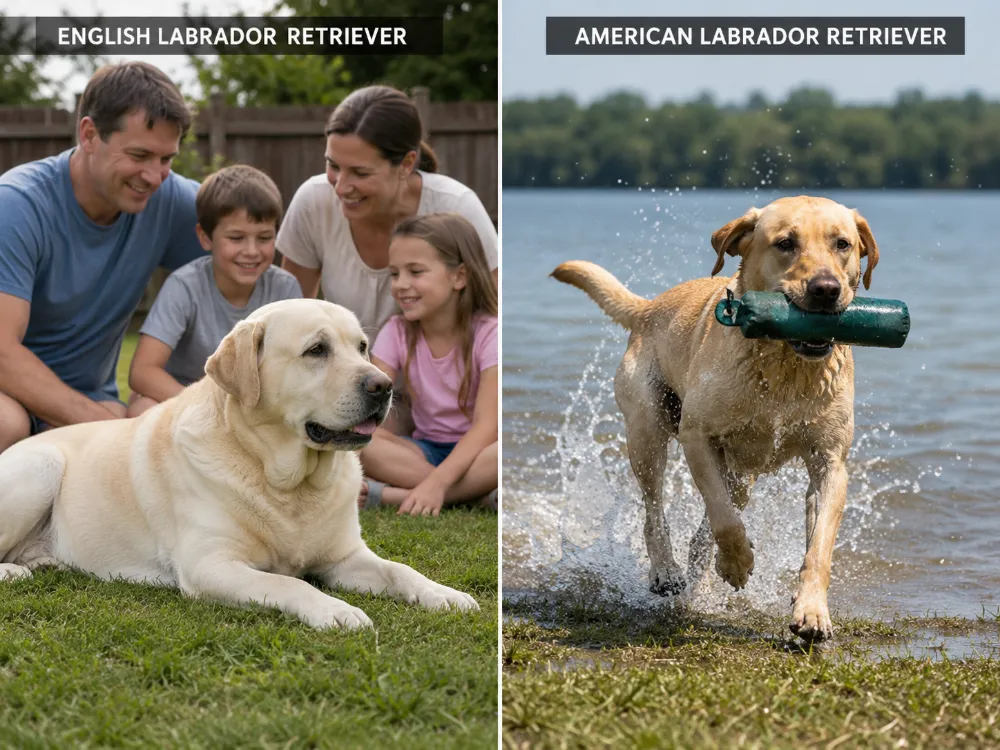
English Labs are often described as steady, affectionate, gentle, and people-oriented. Many are friendly with children, visitors, and other pets when properly socialized. Their calmer temperament makes them popular for family companionship and therapy-style work.
American Labs are often described as intense, eager, responsive, and highly driven. They may have stronger retrieving instincts and may be more focused on activity than lounging. This can make them outstanding working dogs but more challenging for low-activity homes.
Both types can be loving, loyal, intelligent, and social. The difference is usually intensity, not friendliness.
Training Differences
Both English and American Labs are highly trainable. They are intelligent, food-motivated, and usually eager to work with people. This is one reason Labrador Retrievers are widely used as guide dogs, detection dogs, therapy dogs, hunting dogs, and family companions.
English Labs may be more forgiving for first-time owners because many have a steadier pace and lower intensity. They still need basic obedience, leash manners, impulse control, and early socialization.
American Labs often learn quickly but need more structure. A smart, energetic American Lab without training may invent its own activities, such as chewing, jumping, digging, counter-surfing, or chasing. They thrive when given jobs, games, retrieving work, or sport training.
Exercise Needs
An English Lab generally needs daily exercise, but many can be satisfied with walks, fetch, swimming, training games, and family activities. They should not be allowed to become inactive, because Labradors are prone to weight gain.
An American Lab usually needs more intense physical and mental exercise. Long walks may not be enough for a young field-line Lab. Many do best with retrieving sessions, swimming, hiking, scent work, obedience drills, agility, field training, or other structured outlets.
If an American Lab is under-exercised, it may become restless, vocal, destructive, or difficult to manage indoors. Matching energy level to lifestyle is one of the most important parts of choosing the right Lab.
Working Ability and Hunting Drive
American Labs are often bred for field work. They may have strong marking ability, high retrieving drive, excellent stamina, strong water confidence, and fast response to training. These traits are valuable in hunting, field trials, search work, and high-level sport training.
English Labs can also retrieve, swim, and work well, but many show-line dogs are bred more for structure, temperament, and appearance than maximum field intensity. Some English Labs still have excellent working ability, especially from breeders who value both form and function.
If the main goal is serious hunting or field competition, an American Lab may be the better fit. If the main goal is a calmer family companion, an English Lab may be easier to live with.
Family Life
English Labs are often excellent family dogs because they tend to be sociable, affectionate, and relatively steady indoors. They usually enjoy being close to people and may be patient with children when properly trained and supervised.
American Labs can also be wonderful family dogs, but they may be more intense. A young American Lab may jump, mouth, run, retrieve constantly, or demand activity. Families with active outdoor lifestyles may love this energy, while quieter households may find it overwhelming.
No Labrador should be expected to train itself. Both types need boundaries, exercise, socialization, and consistent positive training.
Which Lab Is Better for First-Time Owners?
For many first-time owners, an English Lab may be easier because of its generally calmer temperament and lower working intensity. A well-bred English Lab can be a good match for families who want a friendly, trainable dog without extreme exercise demands.
An American Lab can also work for first-time owners if they are active, committed, and ready to train. The challenge is not intelligence; American Labs are very smart. The challenge is providing enough structure, exercise, and mental work.
The best choice depends less on the label and more on the specific puppy, breeder, parents, and owner lifestyle.
Health and Lifespan
English and American Labs share many of the same health concerns because they are the same breed. Common Labrador health issues may include hip dysplasia, elbow dysplasia, obesity, ear infections, exercise-induced collapse, eye conditions, allergies, and certain inherited diseases.
English Labs may be more prone to weight gain if they are overfed or under-exercised. Their stockier build can make excess weight harder to notice at first. American Labs may be more prone to injuries related to intense activity if conditioning, surfaces, and recovery are not managed well.
Responsible breeding, health testing, proper diet, regular exercise, and veterinary care are more important than whether a Lab is called English or American.
Weight Gain and Food Motivation
Labradors are famous for loving food. Both English and American Labs can become overweight if owners overfeed them, give too many treats, or fail to provide enough exercise.
English Labs may look naturally thick, but that should not be confused with obesity. A healthy Lab should have a visible waist from above and ribs that can be felt under a light layer of fat.
Food motivation is useful for training, but it must be managed carefully. Use part of the daily food allowance for training rewards rather than adding unlimited extra treats.
Grooming and Shedding
Both English and American Labs have short double coats that shed. Regular brushing helps remove loose hair and keeps the coat healthy. During seasonal shedding, brushing may need to be more frequent.
Labs do not usually need complicated grooming, but they do need nail trimming, ear checks, dental care, and occasional bathing. Because many Labs love water, their ears should be monitored for moisture and infection.
Grooming needs are similar between English and American Labs. The bigger differences are exercise and body type.
English Lab vs American Lab Puppies
As puppies, both types can be playful, mouthy, curious, and energetic. English Lab puppies may develop a stockier body earlier, while American Lab puppies may look longer-legged and more athletic.
Temperament testing and parent behavior are often more useful than appearance alone. A puppy from calm, stable parents is more likely to become a manageable adult than a puppy selected only for looks.
Good breeders should explain their breeding goals clearly. Ask whether their dogs are bred for show, field work, service work, companionship, or a balanced combination.
English Lab vs American Lab for Apartments
An English Lab is often more suitable for apartment living than an American Lab, but only if the owner provides enough daily exercise. A calm English Lab can live well in a smaller home if it gets outdoor activity, training, and attention.
An American Lab may struggle in an apartment if its exercise needs are not met. It may bark, pace, chew, or become frustrated without enough physical and mental work.
The home size matters less than the owner’s routine. A high-energy dog in a large house can still be unhappy if ignored, while a well-exercised Lab in an apartment can be content.
English Lab vs American Lab for Hunting
American Labs are usually the better choice for serious hunting and field trial work because they are often bred for speed, stamina, drive, marking, and retrieving intensity.
English Labs can still be capable hunting companions, especially if they come from lines that preserve working ability. Some owners prefer a slightly calmer dog that can retrieve in the field and settle quietly at home.
For hunting, the individual dog’s training, drive, water confidence, and pedigree matter more than the label alone.
English Lab vs American Lab for Service or Therapy Work
English Labs may be especially suitable for therapy-style roles because many have steady temperaments, gentle social behavior, and a calmer presence. However, not every English Lab is calm enough for therapy work.
American Labs can be excellent service or working dogs when their energy and intelligence are directed properly. Their focus, drive, and trainability can be valuable in detection, search work, assistance tasks, and advanced obedience.
The best service or therapy dog is selected by temperament, health, nerve stability, trainability, and handler needs, not simply by English or American type.
Common Misunderstandings
One common misunderstanding is that English Labs are lazy. They are not. They are still Labrador Retrievers and need exercise, training, and enrichment. They are often calmer, but they are not couch ornaments.
Another misunderstanding is that American Labs are hyper or difficult. A well-bred, well-trained American Lab can be focused, obedient, and deeply rewarding. Problems usually appear when a high-drive dog is placed in a low-activity home.
A third misunderstanding is that one type is always better. The better dog is the one that fits the owner’s lifestyle, experience, and goals.
How to Tell an English Lab from an American Lab Quickly
Look at the body: English Labs are usually stockier; American Labs are usually leaner.
Look at the head: English Labs often have broader, blockier heads; American Labs often have narrower heads.
Look at the legs: English Labs may look shorter and heavier; American Labs often look longer-legged.
Look at the energy: English Labs are often calmer; American Labs are often more intense and driven.
Look at the purpose: English Labs are often show or companion lines; American Labs are often field or working lines.
Do not use color: both types can be black, yellow, or chocolate.
Which Lab Should You Choose?
Choose an English Lab if you want a friendly, sturdy, often calmer Labrador for family life, companionship, show interests, or a more relaxed home environment. This type may be easier for many families, especially if they want a sociable dog with moderate exercise needs.
Choose an American Lab if you want an athletic, driven, high-energy Labrador for hunting, field work, sport, hiking, running, advanced obedience, or an active outdoor lifestyle. This type can be a brilliant partner for owners who enjoy training and activity.
In both cases, choose a responsible breeder who health-tests breeding dogs, raises puppies carefully, and matches puppies to homes based on temperament rather than color alone.
English Lab vs American Lab: Final Comparison
English Labs and American Labs are two common types of Labrador Retriever. English Labs are usually stockier, broader-headed, calmer, and more associated with show or companion lines. American Labs are usually leaner, longer-legged, more energetic, and more associated with field or working lines.
Neither type is automatically better. The English Lab often fits relaxed family homes more easily, while the American Lab often fits active owners and working roles. The best Labrador is healthy, well-bred, well-trained, and matched to the owner’s real lifestyle.
FAQs About English Labs vs American Labs
Are English Labs and American Labs different breeds?
No. English Labs and American Labs are both Labrador Retrievers. The terms describe different breeding styles, usually show-type and field-type, not separate breeds.
What is the main difference between an English Lab and an American Lab?
The main difference is body type and energy level. English Labs are usually stockier, broader, and calmer. American Labs are usually leaner, longer-legged, and more energetic.
Which Lab is calmer?
English Labs are often calmer than American Labs, especially indoors. However, individual temperament varies, and all Labs need exercise, training, and mental stimulation.
Which Lab is better for hunting?
American Labs are usually better suited for serious hunting and field work because they are often bred for drive, stamina, speed, and retrieving ability. Some English Labs can also hunt well, especially from balanced working lines.
Which Lab is better for families?
English Labs are often easier for many families because they tend to be steadier and less intense. American Labs can also be excellent family dogs, but they usually need more activity and training.
Are American Labs hyper?
American Labs are not automatically hyper, but they are often high-energy and high-drive. Without enough exercise and training, they may become restless or destructive.
Are English Labs lazy?
No. English Labs are usually calmer, but they are still active Labrador Retrievers. They need daily walks, play, training, and weight control.
Do English Labs and American Labs come in different colors?
No. Both types can be black, yellow, or chocolate. Color does not determine whether a Lab is English or American.
Which Lab is bigger?
English Labs often look heavier and broader, while American Labs may look taller and leaner. Actual size varies by sex, genetics, diet, and body condition.
Which Lab sheds more?
Both types shed. English and American Labs have short double coats that shed year-round and often more heavily during seasonal coat changes.
Which Lab is easier to train?
Both are very trainable. English Labs may be easier for average owners because they are often calmer. American Labs may learn very quickly but usually need more structure and activity.
Can English Labs do field work?
Yes. Some English Labs can retrieve, swim, and work in the field. However, American Labs are usually more strongly bred for high-level field performance.
Can American Labs be good house dogs?
Yes, if they receive enough exercise, training, and mental stimulation. A tired, well-trained American Lab can be a wonderful house dog, but an under-exercised one may be difficult indoors.
How do I choose the right Labrador puppy?
Choose based on breeder quality, health testing, parent temperament, puppy personality, and your lifestyle. Do not choose only by color, size, or the English/American label.