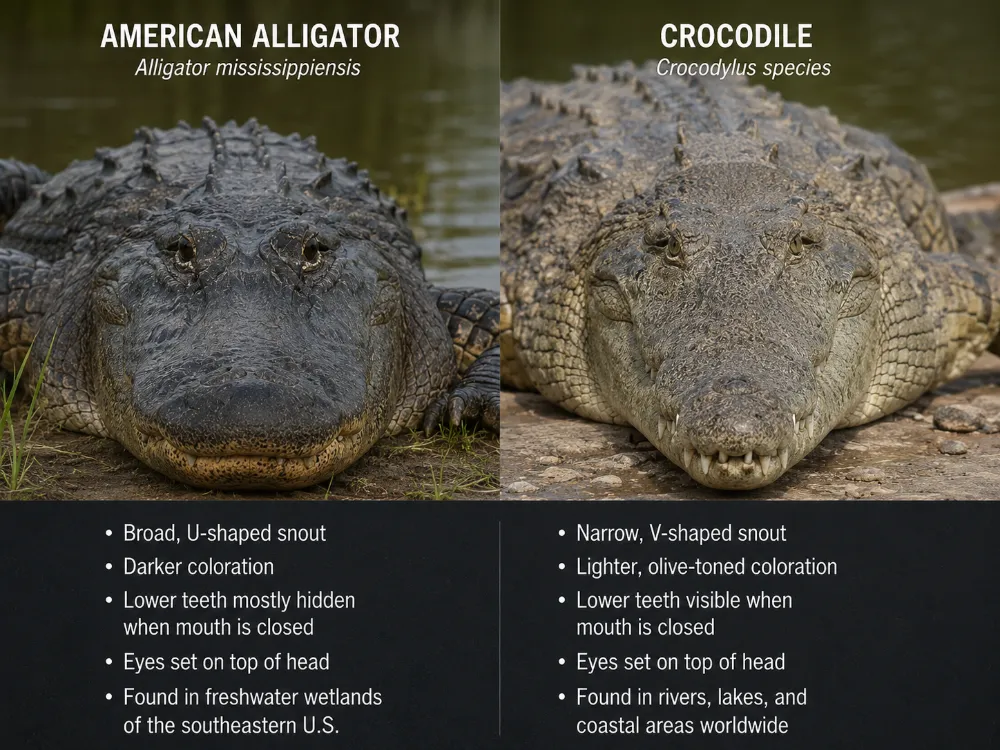
“Gator” means alligator, while “croc” means crocodile. Gators usually have a broad U-shaped snout, darker color, hidden lower teeth, and prefer freshwater. Crocs usually have a narrower V-shaped snout, visible lower teeth, lighter color, and tolerate saltwater better. Crocodiles are generally more widespread, more marine-adapted, and often more aggressive than alligators, but both are powerful wild predators.
Gator vs Croc Summary Table
| Feature | Gator | Croc |
|---|---|---|
| Full name | Alligator | Crocodile |
| Scientific family | Alligatoridae | Crocodylidae |
| Snout shape | Broad, rounded, U-shaped snout | Narrower, pointed, V-shaped snout |
| Teeth when mouth is closed | Lower teeth are usually hidden | Lower teeth are often visible, especially the fourth lower tooth |
| Color | Usually dark gray, blackish, or very dark olive | Often olive, tan, brownish, gray-green, or lighter overall |
| Habitat | Mainly freshwater swamps, marshes, lakes, ponds, and slow rivers | Freshwater, brackish water, estuaries, mangroves, lagoons, and coastal areas |
| Saltwater tolerance | Lower; can enter brackish water but prefers freshwater | Higher; some species travel through coastal and marine waters |
| Geographic range | Mostly southeastern United States and eastern China | Africa, Asia, Australia, the Americas, and many tropical regions |
| Typical size | Large, but usually smaller than the largest crocodiles | Some species are the largest living reptiles |
| Behavior around humans | Often more shy, but still dangerous | Often more aggressive, depending on species and situation |
| Cold tolerance | Generally better at surviving cooler seasonal conditions | Mostly tropical and subtropical; many species are less cold-tolerant |
| Quick ID clue | Wide snout, dark body, hidden lower teeth | Narrow snout, lighter body, visible lower teeth |
What Does Gator Mean?
“Gator” is an informal short word for alligator. In most English-language animal articles, it usually refers to the American alligator, Alligator mississippiensis. This is the large alligator found in the southeastern United States, especially in Florida, Louisiana, Georgia, South Carolina, Alabama, Mississippi, and nearby regions.
There is also a Chinese alligator, Alligator sinensis, but it is much smaller, rarer, and restricted to a small area of eastern China. When people casually say “gator,” they are usually talking about the American alligator.
Gators are semi-aquatic reptiles with strong jaws, armored bodies, muscular tails, and excellent ambush-hunting ability. They are most closely associated with freshwater wetlands.
What Does Croc Mean?
“Croc” is an informal short word for crocodile. Crocodiles are members of the family Crocodylidae. They include well-known species such as the Nile crocodile, saltwater crocodile, American crocodile, mugger crocodile, Morelet’s crocodile, freshwater crocodile, and several others.
Crocs are found across warm regions of the world, including parts of Africa, Asia, Australia, Central America, South America, the Caribbean, and southern North America. Many species live in rivers and lakes, while others also use estuaries, mangrove swamps, brackish wetlands, and coastal waters.
Crocodiles are usually more salt-tolerant than alligators, and the largest species can grow bigger than any living alligator.
Are Gators and Crocs the Same Animal?
No. Gators and crocs are related, but they are not the same animal. Both belong to the reptile order Crocodylia, which also includes caimans and gharials. They share a similar body plan because both are aquatic ambush predators.
However, alligators and crocodiles belong to different families. They differ in snout shape, tooth visibility, saltwater tolerance, geographic range, color, behavior, and sometimes size.
The confusion is understandable because both have long bodies, armored skin, powerful tails, eyes on top of the head, and strong jaws. But once you know the key traits, they are easier to tell apart.
Snout Shape Difference
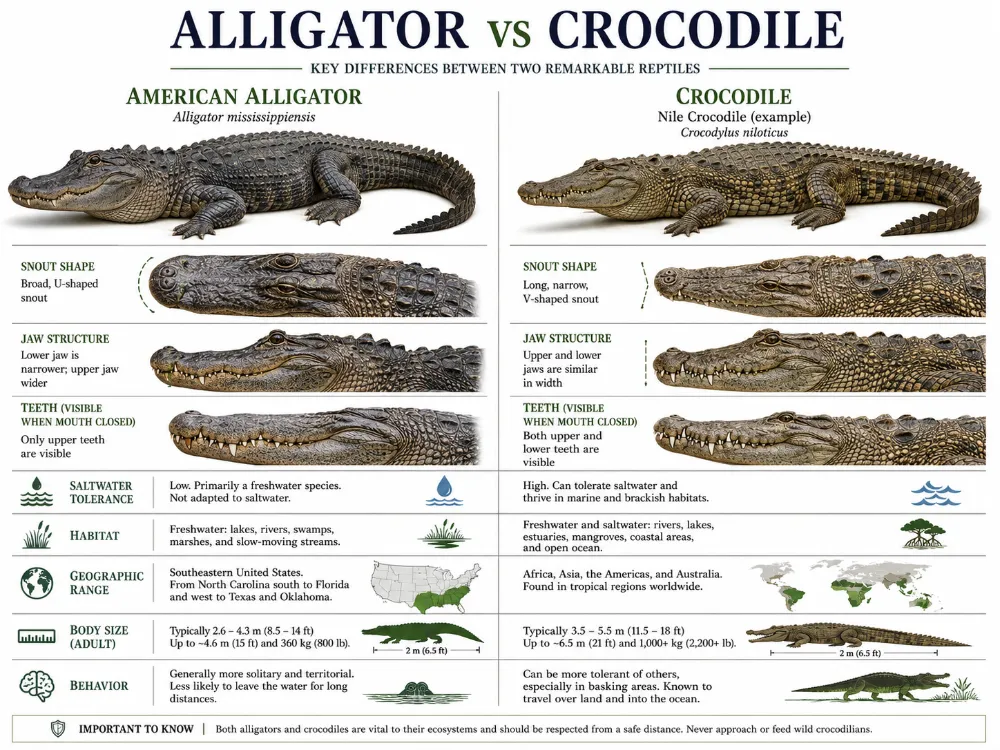
The snout is the most famous difference between a gator and a croc. A gator usually has a broad, rounded, U-shaped snout. It looks wider and more shovel-like, especially when viewed from above.
A croc usually has a narrower, more pointed, V-shaped snout. The head often looks longer and more triangular. This difference is one of the fastest ways to identify them in photos or from a safe distance.
A simple rule is: gator equals wide U-shaped snout; croc equals narrow V-shaped snout.
Teeth Difference
Teeth are another strong clue. When a gator closes its mouth, the upper jaw usually covers the lower teeth. This means most of the lower teeth are hidden when the mouth is shut.
When a croc closes its mouth, the upper and lower teeth often interlock. The large fourth tooth on the lower jaw is often visible from the side, even when the mouth is closed.
If the animal has a closed mouth and you can clearly see lower teeth sticking up, especially one large lower tooth, it is more likely a croc.
Color Difference
Gators are usually darker than crocs. American alligators often look blackish, dark gray, or very dark olive. This dark color helps them blend into swamp water, shaded marshes, mud, and dense wetland vegetation.
Crocs are often lighter in color. Many appear olive, tan, brownish, gray-green, or pale compared with gators. This can help them blend into tropical rivers, muddy banks, coastal lagoons, mangroves, and sandy shorelines.
Color is useful, but it should not be the only clue. Mud, lighting, age, water conditions, and species differences can all affect appearance.
Habitat Difference
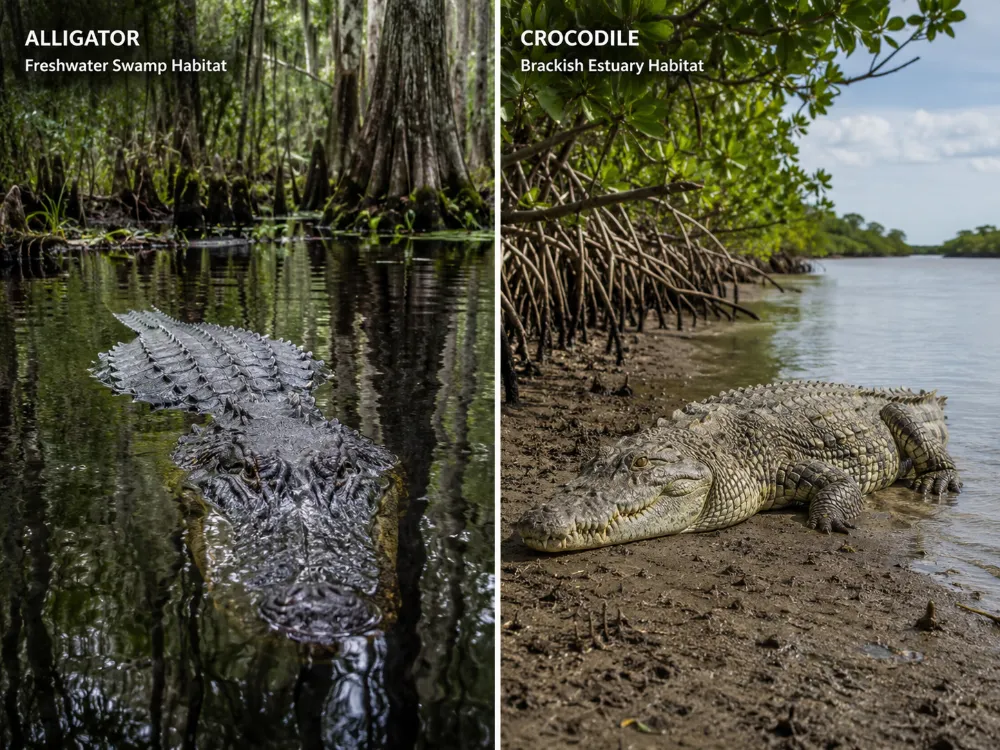
Gators are mostly freshwater animals. They are commonly found in swamps, marshes, ponds, lakes, canals, reservoirs, and slow-moving rivers. They can enter brackish water for short periods, but they are not as well adapted to long-term saltwater life as many crocs.
Crocs use a wider range of water habitats. Depending on the species, they may live in freshwater rivers, lakes, wetlands, estuaries, mangroves, coastal lagoons, brackish water, and sometimes marine-influenced environments.
In simple terms, gators are more strongly linked to freshwater wetlands, while crocs are more flexible around saltier coastal habitats.
Saltwater Tolerance
Crocs generally tolerate saltwater better than gators. Many crocodiles have more effective salt-excreting glands on the tongue. These glands help remove excess salt from the body, allowing some crocs to spend time in brackish or coastal waters.
Gators also have salt glands, but they are less effective. This is why alligators usually stay in freshwater and only occasionally move into brackish areas.
The saltwater crocodile is the most famous example of a croc adapted to coastal and marine travel. It can move through estuaries and ocean water far more effectively than a gator.
Size Difference
Both gators and crocs can grow large, but the biggest crocs are larger than the biggest gators. The saltwater crocodile is the largest living reptile, and large Nile crocodiles can also reach impressive sizes.
American alligators are still powerful reptiles. Large males can exceed 3.5 meters in length, and exceptional individuals may grow even larger. Females are usually smaller than males.
If you compare the largest species, crocs win. If you compare average individuals, size depends on species, age, sex, food supply, and habitat quality.
Bite Force and Jaw Power
Both gators and crocs have extremely powerful bites. Their jaws are built to grab, crush, hold, and drag prey. The muscles that close the jaws are very strong, while the muscles that open the jaws are much weaker.
Large crocodiles, especially saltwater and Nile crocodiles, can overpower large prey at the water’s edge. Gators also have powerful jaws and can take fish, turtles, birds, mammals, and other reptiles.
Neither animal should ever be approached or fed. Even a smaller crocodilian can cause severe injury.
Behavior Difference
Gators are often more shy around humans than many large crocs. In many areas, alligators avoid people unless they have been fed, cornered, surprised, or are defending a nest. However, “less aggressive” does not mean safe.
Crocs vary by species, but some are more aggressive and more likely to attack large animals, including humans, in certain regions. Nile crocodiles and saltwater crocodiles are especially known for serious attacks where people live or work close to crocodile habitat.
Both animals are wild predators. Their behavior depends on species, size, season, hunger, breeding condition, past experience, and human behavior.
Geographic Range
Gators have a much smaller range than crocs. American alligators live mainly in the southeastern United States. Chinese alligators live in a very limited region of China.
Crocs have a much wider global range. They occur in parts of Africa, Asia, Australia, Central America, South America, the Caribbean, and southern North America. Different species occupy different river systems, wetlands, lakes, estuaries, and coasts.
If you are in Florida or Louisiana, you are more likely to see a gator. If you are in northern Australia, many parts of Africa, or tropical Asia, you are more likely to encounter crocs.
Gators and Crocs in Florida
Florida is one of the few places where gators and crocs naturally live in the same general region. The American alligator is widespread in Florida’s freshwater habitats. The American crocodile is much more limited and is mainly found in southern Florida, especially in coastal, brackish, and mangrove habitats.
This makes Florida unusual. In most of the world, people do not have to distinguish between wild alligators and crocodiles in the same area.
In Florida, a dark reptile in a freshwater pond is often a gator. A lighter reptile with a narrower snout in a southern coastal or brackish habitat may be an American crocodile.
Diet and Hunting Style
Gators and crocs are carnivorous ambush predators. Young individuals eat insects, small fish, frogs, crustaceans, and other small animals. As they grow, they can take larger prey such as fish, turtles, snakes, birds, mammals, and carrion.
Gators often hunt in freshwater wetlands. They may wait near the edge of water, then strike quickly when prey comes close. They are especially important predators of fish, turtles, birds, and mammals in swamp ecosystems.
Crocs use similar ambush tactics, but some large species can take bigger prey. Nile crocodiles and saltwater crocodiles may prey on large mammals that come to drink or cross rivers.
Swimming and Movement
Both gators and crocs are excellent swimmers. Their powerful tails push them through the water, while their limbs stay close to the body during fast swimming. They can move quietly with only the eyes and nostrils above the surface.
On land, both can walk, crawl, and make short fast movements. They are not built for long-distance running, but they can move quickly over short distances when necessary.
Their real advantage is not chasing prey on land. It is stealth, patience, camouflage, and explosive power from water.
Eyes, Nostrils, and Ambush Adaptations
Gators and crocs have eyes and nostrils positioned high on the head. This allows them to see and breathe while most of the body remains hidden underwater. This is one reason they are such effective ambush predators.
They also have strong sensory abilities. They can detect movement, vibration, and pressure changes in water. Their armored bodies, muscular tails, and stealthy behavior make them perfectly adapted for life between land and water.
These features are shared by both gators and crocs because they come from a long evolutionary history of aquatic predation.
Cold Tolerance
Gators are generally more cold-tolerant than many crocs. American alligators can survive seasonal cold spells by reducing activity and using special behaviors, such as keeping the nostrils above freezing water while the body remains below the surface.
Most crocs are more strongly associated with warm tropical and subtropical climates. They are less common in places with cold winters, although tolerance varies by species.
This is one reason alligators can live farther into temperate regions of the southeastern United States, while crocodiles are mostly concentrated in warmer areas.
Nesting and Parental Care
Gators and crocs both lay eggs and show parental care, which is unusual compared with many reptiles. Female gators often build mound nests from vegetation, mud, and plant material. As the vegetation decays, it produces heat that helps incubate the eggs.
Crocs may build mound nests or dig hole nests depending on the species. Many female crocodiles guard the nest and may help hatchlings reach the water.
Young gators and crocs call from inside the egg or nest, and the mother may respond. This shows that crocodilians are more socially complex than many people assume.
Sounds and Communication
Gators and crocs are not silent animals. They use hisses, bellows, grunts, growls, jaw slaps, body postures, and water vibrations. Male alligators are especially known for deep bellows during the breeding season.
Crocs also vocalize, especially during courtship, territorial behavior, and communication between mothers and hatchlings. Young crocodilians may make high-pitched calls when threatened or ready to hatch.
These sounds help them communicate size, location, dominance, stress, and reproductive condition.
Which Is More Dangerous?
Crocs are generally considered more dangerous to humans, especially large species such as the Nile crocodile and saltwater crocodile. These crocs are larger, more aggressive in some situations, and more likely to treat large mammals as prey.
Gators can also be dangerous. Large alligators can injure or kill people, especially if humans swim in gator habitat, feed them, approach nests, or allow pets near the water’s edge.
The safest rule is simple: never approach, feed, tease, swim near, or try to handle any gator or croc.
Common Misidentification Problems
The biggest mistake is using only color or size. A young croc may be smaller than a large gator. A muddy gator may look lighter than usual. A wet croc may look darker than expected.
The best identification method combines several clues: snout shape, tooth visibility, color, habitat, location, and saltwater tolerance.
If you see a broad-snouted dark reptile in a freshwater swamp, it is probably a gator. If you see a narrow-snouted reptile with visible lower teeth in an estuary or tropical river, it is probably a croc.
Gator vs Croc vs Caiman
Caimans are another group of crocodilians. They are closer to alligators than to true crocodiles and also belong to the family Alligatoridae. Most caimans live in Central and South America.
Caimans may look like small alligators, but they are not the same as American alligators. Some species, such as the black caiman, can grow very large. Others are much smaller.
If you are comparing gator vs croc, remember that caimans are a third related group, not just baby alligators or small crocodiles.
How to Tell a Gator from a Croc Quickly
Look at the snout: gators usually have a broad U-shaped snout; crocs usually have a narrow V-shaped snout.
Look at the teeth: gators usually hide lower teeth; crocs often show lower teeth when the mouth is closed.
Look at the color: gators are often darker; crocs are often lighter olive, tan, or gray-green.
Look at the habitat: gators prefer freshwater; crocs tolerate brackish and saltwater better.
Look at the location: gators have a limited range; crocs occur across more tropical regions worldwide.
Look at size carefully: the largest crocs are bigger, but size alone is not enough for identification.
Gator vs Croc: Final Comparison
Gators and crocs are close relatives, but they are not the same animal. A gator is an alligator, usually dark, freshwater-loving, broad-snouted, and less salt-tolerant. A croc is a crocodile, usually lighter, narrower-snouted, more salt-tolerant, and more widely distributed across tropical regions.
If you need the fastest identification clue, look at the snout and teeth. A wide U-shaped snout with hidden lower teeth usually means gator. A narrow V-shaped snout with visible lower teeth usually means croc. Both animals are impressive predators, and both should always be observed from a safe distance.
FAQs About Gators vs Crocs
What is the difference between a gator and a croc?
A gator is an alligator, while a croc is a crocodile. Gators usually have broad U-shaped snouts, darker bodies, hidden lower teeth, and prefer freshwater. Crocs usually have narrower V-shaped snouts, visible lower teeth, lighter bodies, and tolerate saltwater better.
Are gators and crocs the same species?
No. Gators and crocs are related crocodilians, but they belong to different families. Alligators are in Alligatoridae, while crocodiles are in Crocodylidae.
Which is bigger, a gator or a croc?
The largest crocs are bigger than the largest gators. Saltwater crocodiles and Nile crocodiles can grow larger than American alligators. However, size varies by species, age, sex, and food supply.
Which is more dangerous, a gator or a croc?
Crocs are generally more dangerous, especially large Nile crocodiles and saltwater crocodiles. Gators can also be dangerous and should never be approached, fed, or disturbed.
Can gators live in saltwater?
Gators can enter brackish or salty water for short periods, but they are mainly freshwater animals. They are not as salt-tolerant as many crocs.
Can crocs live in the ocean?
Some crocs can travel through coastal and marine waters. The saltwater crocodile is especially well adapted to estuaries, coasts, and ocean travel, although it also uses rivers and wetlands.
Why do crocs show more teeth than gators?
Crocs have upper and lower jaws that are more similar in width, so the teeth interlock when the mouth closes. In gators, the upper jaw usually covers the lower teeth.
Are gators black and crocs green?
Gators are often darker, appearing blackish or dark gray. Crocs are often lighter olive, tan, brown, or gray-green. However, color can vary, so snout shape and teeth are better clues.
Do gators and crocs fight each other?
They rarely meet in most regions because their ranges and habitats often differ. In southern Florida, American alligators and American crocodiles can occur in the same general area, but direct fights are not common.
Are baby gators and baby crocs easy to tell apart?
They can be harder to identify than adults because size and proportions are still developing. Snout shape, tooth visibility, markings, location, and habitat can help, but young crocodilians can be confusing.
Do gators and crocs eat humans?
They do not normally hunt humans as a preferred food, but large crocodilians can attack and kill people under certain conditions. Large Nile and saltwater crocodiles are especially dangerous in areas where people live close to waterways.
Can gators and crocs run fast on land?
They can move quickly in short bursts, but they are not built for long-distance running. Their main hunting strategy is ambush from water, not chasing prey over long distances on land.
Do gators and crocs care for their babies?
Yes. Both gators and crocs show parental care. Females may guard nests, respond to hatchling calls, and help young reach water.
What should you do if you see a gator or croc?
Keep a safe distance, never feed it, keep pets away from the water, and do not swim in areas where large crocodilians are present. Follow local wildlife warnings and safety rules.