Ants and termites are both social insects, but they are not the same animal. Ants belong to the order Hymenoptera and are related to bees and wasps. Termites belong to the cockroach lineage and are often classified within Blattodea. Ants usually have narrow waists, elbowed antennae, and unequal wings. Termites usually have broad waists, straight antennae, equal-sized wings, and soft pale bodies.
Quick Comparison Table
| Feature | Ants | Termites |
|---|---|---|
| Animal group | Social insects related to bees and wasps | Social insects related to cockroaches |
| Order | Hymenoptera | Blattodea, formerly often treated as Isoptera |
| Body shape | Narrow pinched waist | Broad, straight waist |
| Antennae | Elbowed or bent antennae | Straight or bead-like antennae |
| Wings on swarmers | Front wings larger than hind wings | Four wings roughly equal in size |
| Typical worker color | Black, brown, red, yellow, or mixed colors | Often pale, creamy, white, or light brown |
| Body texture | Harder, more armored exoskeleton | Softer, more delicate bodies |
| Main diet | Highly varied: insects, seeds, nectar, honeydew, fungi, dead animals, human food | Mainly cellulose from wood, plant fiber, leaf litter, grass, or soil organic matter |
| Wood damage | Carpenter ants excavate wood but do not eat it | Many termites eat cellulose and can consume wood from inside |
| Social structure | Queen, workers, males, sometimes soldiers depending on species | Queen, king, workers, soldiers, reproductive swarmers |
| Best identification clue | Pinched waist and elbowed antennae | Thick waist and equal-length wings in swarmers |
What Are Ants?
Ants are social insects in the family Formicidae. They belong to the order Hymenoptera, the same major insect order that includes bees and wasps. Ants are among the most successful animals on Earth, with thousands of species living in forests, deserts, grasslands, cities, farms, wetlands, and tropical ecosystems.
Most ants live in colonies with a queen, workers, and reproductive males and females. The workers are usually wingless females. They gather food, defend the nest, care for larvae, build tunnels, and communicate using chemical signals called pheromones.
Ants vary widely in size, color, diet, and behavior. Some are tiny sugar ants in kitchens. Some are large carpenter ants in wood. Some are aggressive fire ants. Others are leafcutter ants that farm fungus. This diversity is one reason ants are so ecologically important.
What Are Termites?
Termites are social insects best known for feeding on cellulose, the main structural material in wood and many plants. Although termites are sometimes called “white ants,” they are not ants. Modern biology places termites within the cockroach lineage, making them closer relatives of cockroaches than of ants.
Termites live in colonies with workers, soldiers, reproductive adults, and usually both a queen and a king. This is different from ants, where the adult male usually has a short reproductive role and does not remain as a long-term colony partner.
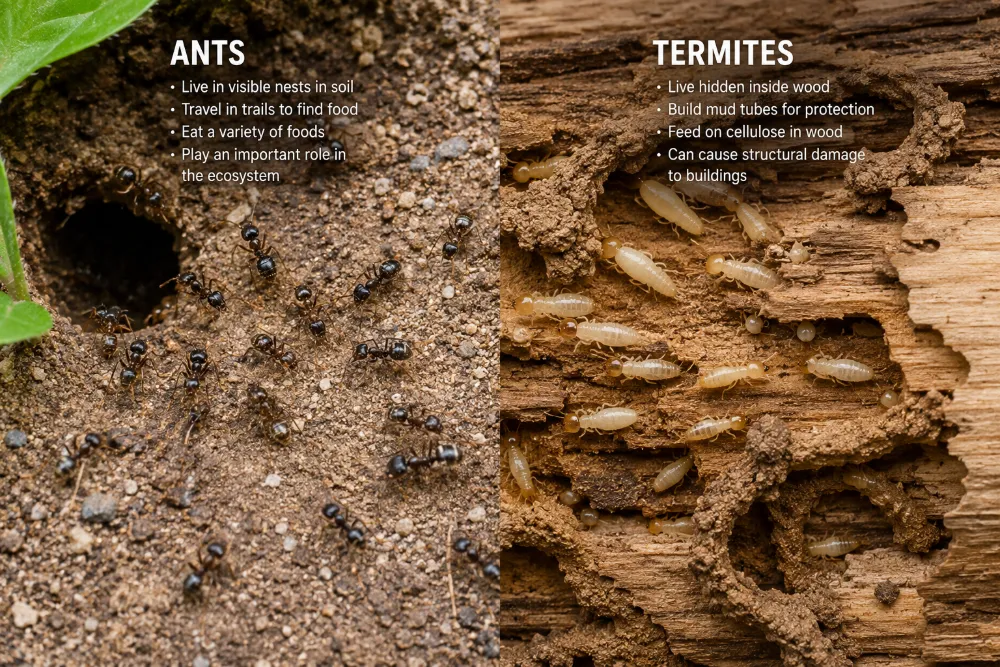
Many termites live hidden inside soil, wood, leaf litter, mounds, or underground tunnels. Their ability to digest cellulose depends partly on microbes in their gut. These microbes help break down tough plant material that many animals cannot digest.
The Main Difference Between Ants and Termites
The main difference is evolutionary identity. Ants are hymenopteran insects related to bees and wasps. Termites are cockroach-related insects adapted to social life and cellulose feeding.
Visually, ants usually have a narrow waist, bent antennae, and harder bodies. Termites usually have a broad waist, straight antennae, and softer bodies. When winged adults swarm, ant wings are unequal in size, while termite wings are usually equal in size.
Ecologically, ants are highly varied feeders and predators, while termites are especially important decomposers of wood and plant fiber.
Body Shape: Pinched Waist vs Broad Waist
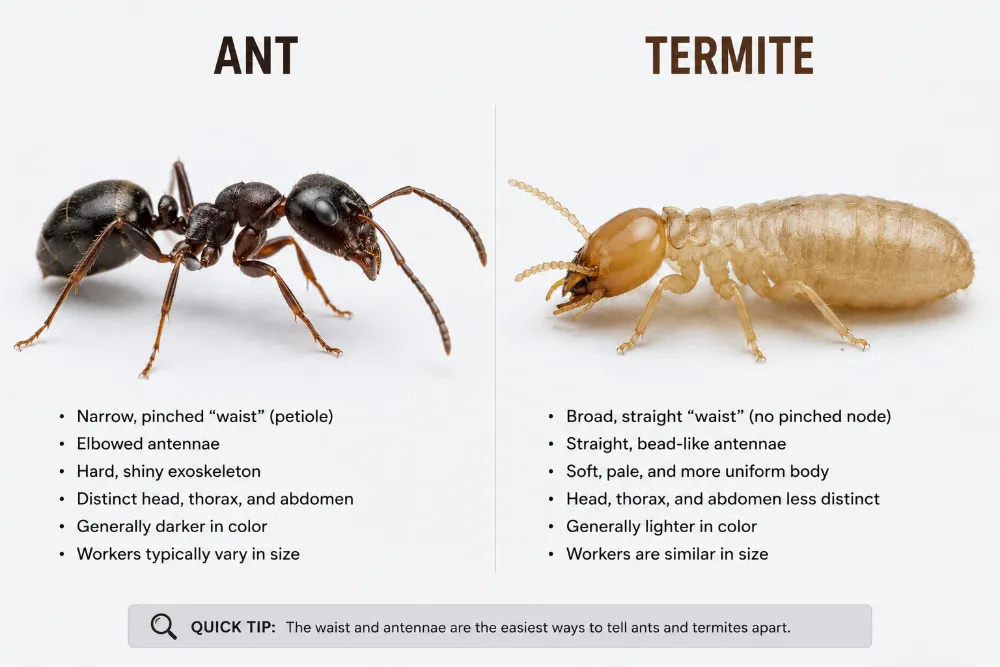
Body shape is one of the easiest ways to tell ants from termites. Ants have a clearly pinched waist between the thorax and abdomen. This narrow connection gives many ants a segmented, wasp-like appearance.
Termites do not have the same pinched waist. Their bodies look more straight-sided or thick through the middle. A termite’s thorax and abdomen are not separated by a dramatic narrow waist, so the insect often looks more tube-shaped.
A simple visual rule is: narrow waist means ant; broad waist means termite.
Antennae: Elbowed vs Straight
Ants have elbowed antennae. Each antenna bends sharply, giving it a jointed or crooked shape. Ants use these antennae to smell, touch, communicate, follow pheromone trails, recognize nestmates, and explore their surroundings.
Termites have straighter, bead-like antennae. They may look like a string of tiny round segments. Their antennae do not have the strong elbowed bend seen in ants.
If you can see the antennae clearly, this is one of the most reliable identification clues.
Wings: How to Identify Swarmers
Many people confuse winged ants with winged termites during swarming season. These winged reproductive insects are often called alates. They leave mature colonies to mate and start new colonies.
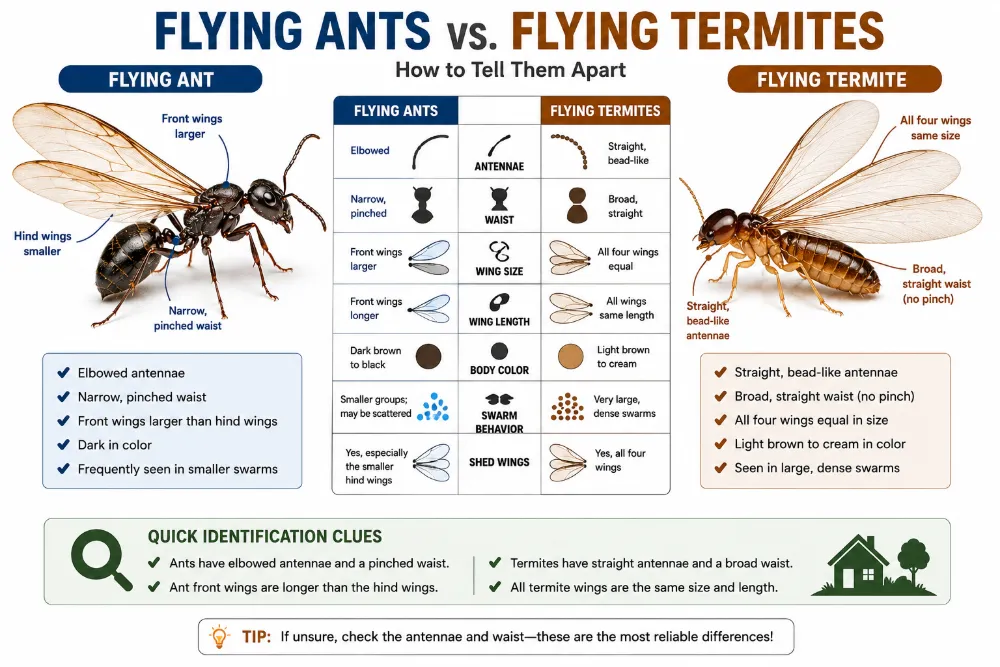
Winged ants usually have front wings that are larger than the hind wings. Their wings are unequal in length, and the body still shows the narrow ant waist. Their antennae are also elbowed.
Winged termites usually have four wings that are roughly equal in size and much longer than the body. Their wings are fragile and may fall off easily after swarming. Their bodies have broad waists and straight antennae.
Color and Body Texture
Ants can be black, brown, red, yellow, orange, or mixed in color. Their bodies are usually harder and more visibly armored than termites. Many ants move quickly in open air and can tolerate more exposure to light and dry conditions.
Worker termites are often pale, cream-colored, white, or light brown. Their bodies are soft and vulnerable to drying out. This is why many termites stay hidden inside soil, wood, or mud tubes where humidity remains high.
However, color alone is not enough. Some ants are pale, and some termite soldiers or swarmers can be darker. Use body shape, antennae, wings, and location together.
Diet: What Do Ants Eat?
Ant diets are extremely diverse. Some ants eat other insects. Some gather seeds. Some drink nectar. Some feed on honeydew produced by aphids and scale insects. Some scavenge dead animals. Some invade kitchens for sugar, grease, meat, crumbs, or pet food.
Carpenter ants are often confused with termites because they are associated with wood. However, carpenter ants do not eat wood as food. They excavate galleries in wood to create nesting space, then push out sawdust-like material called frass.
Because ants have many feeding strategies, finding ants in a home does not automatically mean wood is being eaten. The species and nest location matter.
Diet: What Do Termites Eat?
Termites are famous for eating cellulose. Cellulose is found in wood, paper, cardboard, dead leaves, grass, plant stems, and many other plant materials. Some termites feed on sound wood, some prefer damp or decaying wood, and others feed in soil or on grasses.
Termites can digest cellulose with help from gut microbes. This partnership allows them to turn tough plant fiber into usable energy.
This feeding habit makes termites ecologically valuable in nature, where they recycle dead plant material. In buildings, however, the same ability can make them destructive pests when they feed on wooden structures.
Wood Damage: Ants vs Termites
Wood damage is one of the most important practical differences. Carpenter ants tunnel into wood to make nests, but they do not eat the wood. Their galleries are often clean, smooth, and may contain piles of frass outside the nest.
Termites eat cellulose, so many species actually consume wood from the inside. Their galleries may contain soil, mud, fecal material, or packed debris. Subterranean termites often build mud tubes to travel between soil and wood while staying moist and protected.
If you see clean sawdust-like piles, carpenter ants may be involved. If wood sounds hollow, contains mud-like material, or is being consumed from inside, termites may be more likely.
Nests and Colony Structure
Ant nests vary enormously. Some ants nest in soil mounds, logs, leaf litter, tree cavities, wall voids, acorns, or underground chambers. Leafcutter ants build complex nests and farm fungus. Carpenter ants nest in wood. Army ants may form temporary living nests with their own bodies.
Termite nests also vary. Some live underground. Some build large mounds. Some live inside dry wood. Some build nests in trees. Subterranean termites often connect soil to feeding sites through mud tubes.
Both ants and termites are highly social, but termite colonies usually include a long-lived king and queen pair. Ant colonies usually center on one or more queens, while males are generally short-lived after mating.
Workers, Soldiers, Queens, and Kings
Ant colonies usually include a queen, workers, and males. In some ant species, there are also specialized soldier workers with large heads or strong jaws. Workers are female and perform most colony tasks.
Termite colonies often include workers, soldiers, a queen, a king, and winged reproductives. Termite soldiers may have large jaws or chemical defenses. Workers feed the colony, care for young, build tunnels, and maintain the nest.
A key difference is that termite kings remain in the colony with queens for long periods, while ant males usually die soon after mating.
Swarming Behavior
Both ants and termites swarm when mature colonies produce winged reproductive adults. Swarming usually happens under specific weather conditions, often after rain or during warm humid periods.
Ant swarmers may emerge from nests in soil, walls, pavement cracks, logs, or other locations. After mating, queens lose their wings and search for places to start new colonies.
Termite swarmers often emerge in large numbers and may shed piles of wings near windows, doors, lights, or wooden structures. Finding many equal-sized discarded wings indoors can be a warning sign of a termite colony nearby.
Behavior Around Humans
Ants are often visible because they forage openly. They may form trails across counters, floors, walls, tree trunks, sidewalks, or garden beds. Many ants are annoying but not structurally destructive. Some bite or sting, and some can contaminate food.
Termites are usually less visible. They may feed silently inside walls, floors, beams, or foundations for a long time before damage is noticed. Their hidden lifestyle makes them more difficult to detect early.
In short, ants are often obvious; termites are often secretive.
Are Ants Dangerous?
Most ants are not dangerous to humans, but some species can bite, sting, or cause allergic reactions. Fire ants, harvester ants, bullet ants, and some other species have painful stings. Carpenter ants can damage wood by nesting in it, though they do not eat wood like termites.
Many household ants are mainly nuisance pests. They enter homes looking for food, water, or shelter. They can contaminate food surfaces and may be difficult to eliminate if the colony is not addressed.
Ecologically, ants are highly beneficial. They aerate soil, disperse seeds, control pests, recycle nutrients, and serve as food for many animals.
Are Termites Dangerous?
Termites are usually not dangerous in the sense of biting or stinging people. They are not aggressive toward humans. The main danger is structural and economic: many termites can damage wooden buildings, furniture, fences, flooring, and other cellulose-based materials.
Termite damage can be expensive because it often happens out of sight. By the time visible signs appear, the colony may have been feeding for months or years.
In nature, termites are extremely beneficial decomposers. They recycle dead wood and plant material, improve soil, and support many ecosystems. The problem begins when they treat human structures as food.
Carpenter Ants vs Termites
Carpenter ants are the ants most often confused with termites. Both can be found in wood, and both may indicate moisture or structural problems. But their relationship with wood is different.
Carpenter ants excavate wood to make galleries. They prefer damp, decaying, or softened wood, although large colonies may expand into sound wood. They leave behind clean tunnels and may push out frass that looks like sawdust mixed with insect parts.
Termites eat wood. Their galleries are often rougher and may contain mud, soil, or fecal material. Subterranean termites need moisture and often create mud tubes. Drywood termites may leave small pellet-like droppings.
Flying Ants vs Flying Termites
| Feature | Flying Ant | Flying Termite |
|---|---|---|
| Waist | Narrow and pinched | Broad and straight |
| Antennae | Elbowed | Straight or bead-like |
| Wing size | Front wings larger than hind wings | All four wings about equal size |
| Wing length | Usually proportional to body | Often much longer than body |
| Discarded wings | Can occur, but less often seen in large equal piles | Often found in piles after swarming |
| Concern level indoors | May indicate an ant nest nearby | May indicate termite activity and should be inspected |
Why Termites Are Not “White Ants”
Termites are sometimes called white ants because pale worker termites can resemble small pale ants. This nickname is misleading. Termites are not ants, and the two groups have different evolutionary histories, body structures, diets, and colony biology.
Calling termites “white ants” can also lead to mistakes in pest identification. Treating termites as if they were ants may miss serious wood-feeding activity.
The correct approach is to identify them as termites: broad waist, straight antennae, equal wings in swarmers, soft bodies, and cellulose-feeding behavior.
Ecological Importance of Ants
Ants are major ecosystem workers. They turn soil, move seeds, prey on pest insects, clean up dead animals, and influence plant communities. In some ecosystems, ants are among the most important soil animals.
Seed-dispersing ants carry seeds to their nests, where seeds may be protected and later germinate. Predator ants help control populations of other insects. Scavenger ants recycle organic matter.
Although ants can be pests in homes, their ecological value in natural systems is enormous.
Ecological Importance of Termites
Termites are among the most important decomposers in many ecosystems, especially tropical and subtropical regions. They break down dead wood, grass, leaf litter, and other plant material that would otherwise accumulate.
Termite activity helps build soil, recycle nutrients, improve water movement, and support food webs. Termite mounds can create microhabitats used by plants, reptiles, birds, mammals, and other insects.
In nature, termites are not villains. They are essential recyclers. Their bad reputation comes mainly from their ability to damage human buildings.
How to Tell Them Apart at Home
Start with body shape. A narrow waist suggests ants. A broad waist suggests termites. Then check the antennae. Elbowed antennae suggest ants; straight bead-like antennae suggest termites.
If the insects have wings, compare wing size. Unequal wing pairs suggest flying ants. Four equal-length wings suggest termites. Also look for piles of shed wings near windows, doors, lights, or baseboards.
Finally, check the damage signs. Sawdust-like frass and visible foraging ants may suggest carpenter ants. Mud tubes, hollow wood, blistered paint, or equal shed wings may suggest termites.
When to Get Professional Identification
Professional identification is important when insects are found in walls, floors, wooden beams, foundations, or structural areas. Mistaking termites for ants can allow serious damage to continue.
It is also wise to seek expert help if you see repeated swarms indoors, piles of wings, mud tubes, hollow-sounding wood, bubbling paint, damaged floors, or soft wood that breaks easily.
For ordinary outdoor ants or termites in dead logs, professional action may not be needed. Insects in natural habitats often play beneficial roles. The concern rises when they are inside or damaging human structures.
Common Myths About Ants and Termites
Myth: Termites are a type of ant
This is false. Termites are not ants. They are social insects related to cockroaches, while ants are related to bees and wasps.
Myth: All ants damage wood
This is false. Most ants do not damage wood. Carpenter ants may excavate wood for nesting, but they do not eat it.
Myth: Termites only eat houses
This is false. In nature, termites feed on dead wood, leaf litter, grass, and other plant material. They become pests when they feed on wooden structures.
Myth: Flying insects indoors are always ants
This is false. Winged termites can look like flying ants. Wing size, antenna shape, and waist shape are important clues.
Myth: If you cannot see termites, there is no problem
This is false. Many termites live hidden inside wood, soil, or walls. Damage can occur long before insects are visible.
Simple Identification Checklist
| Question | Likely Ant | Likely Termite |
|---|---|---|
| Is the waist narrow and pinched? | Yes | No |
| Are the antennae elbowed? | Yes | No, usually straight or bead-like |
| Are the wings equal in size? | No, front wings are usually larger | Yes, all four wings are roughly equal |
| Is the worker pale and soft-bodied? | Usually no | Often yes |
| Does it eat wood? | Usually no; carpenter ants excavate but do not eat wood | Many species consume cellulose in wood |
| Are there mud tubes? | No | Common in subterranean termites |
| Best quick clue | Pinched waist and bent antennae | Broad waist and equal wings |
Final Verdict: Ants vs Termites
Ants and termites are both social insects, but they are very different animals. Ants are related to bees and wasps, have narrow waists, elbowed antennae, and varied diets. Termites are related to cockroaches, have broad waists, straight antennae, equal-sized wings in swarmers, and are specialized for feeding on cellulose.
The fastest identification rule is simple: ants have pinched waists and bent antennae; termites have thick waists and straight antennae. If winged insects or wood damage appear indoors, accurate identification matters because termites and carpenter ants require different responses.
FAQs About Ants and Termites
Are termites ants?
No. Termites are not ants. Termites are social insects related to cockroaches, while ants are related to bees and wasps.
Why are termites called white ants?
Termites are sometimes called white ants because pale worker termites can look ant-like. However, the name is misleading because termites are not ants.
What is the easiest way to tell ants from termites?
Look at the waist and antennae. Ants have narrow pinched waists and elbowed antennae. Termites have broad waists and straight or bead-like antennae.
How can you tell flying ants from flying termites?
Flying ants have unequal wings, with front wings larger than hind wings. Flying termites have four wings that are roughly equal in size and often longer than the body.
Do ants eat wood?
Most ants do not eat wood. Carpenter ants tunnel into wood to make nests, but they do not digest wood as food.
Do termites eat wood?
Yes. Many termites eat cellulose in wood, paper, cardboard, dead plants, and other plant materials.
Which is worse for a house, ants or termites?
Termites are usually more serious for structural wood damage because they eat wood. Carpenter ants can also damage wood by excavating nests, especially in damp or softened wood.
Do termites bite humans?
Termites are not usually a biting threat to humans. Their main concern is damage to wood and cellulose materials.
Do ants bite or sting?
Some ants bite, and some sting. Fire ants, harvester ants, and several other species can cause painful stings or bites.
Are ants beneficial?
Yes. Ants aerate soil, disperse seeds, recycle nutrients, prey on pests, and serve as food for many animals.
Are termites beneficial?
Yes, in natural ecosystems. Termites recycle dead wood and plant matter, build soil, and support food webs. They become a problem when they damage buildings.
What should I do if I find winged termites indoors?
Winged termites indoors may indicate a nearby colony. Save a sample or photo if possible and contact a qualified pest or termite inspection professional for identification.