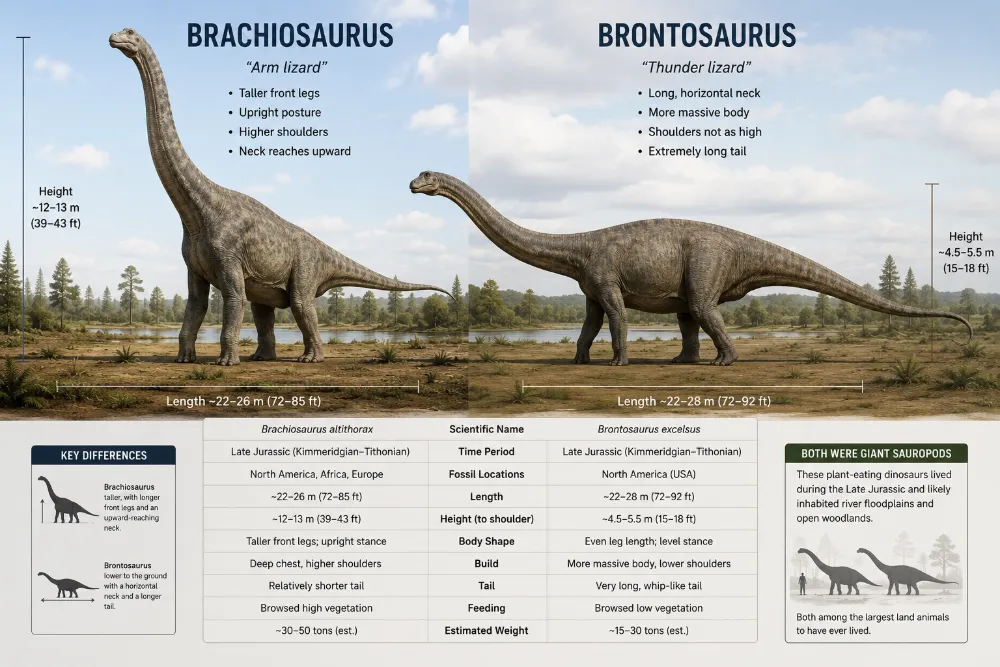
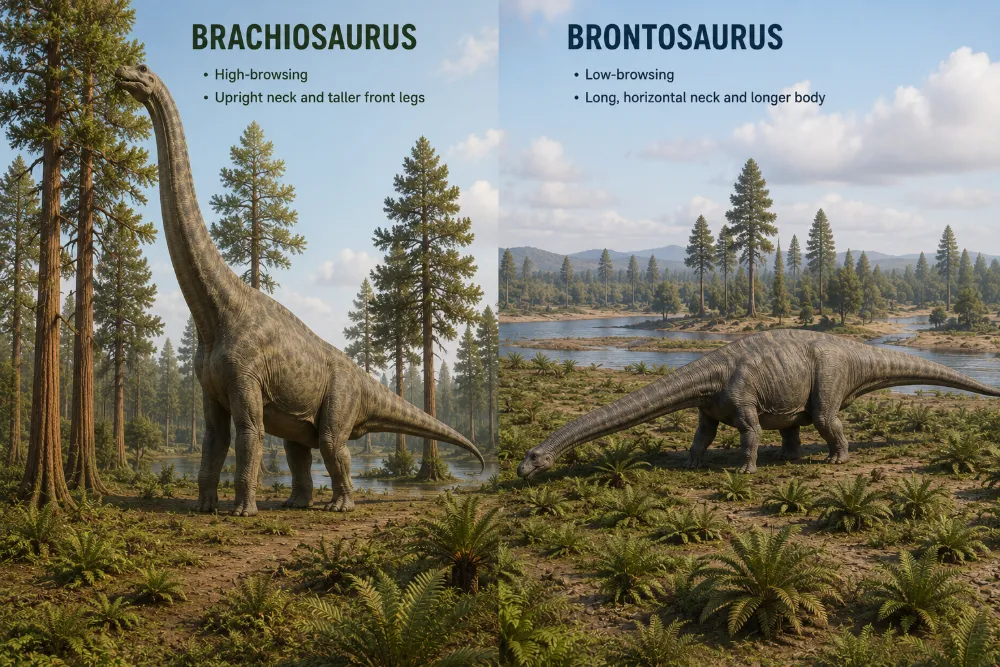
Brachiosaurus and Brontosaurus were both huge plant-eating sauropod dinosaurs, but they had very different body shapes. Brachiosaurus had longer front legs than hind legs, giving it a high-shouldered, giraffe-like profile. Brontosaurus had a longer, lower body, a very long tail, and a more horizontal posture. The fastest way to tell them apart is this: Brachiosaurus was tall in front; Brontosaurus was long and low.
Quick Comparison Table
| Feature | Brachiosaurus | Brontosaurus |
|---|---|---|
| Scientific name | Brachiosaurus altithorax | Brontosaurus excelsus and related species |
| Dinosaur group | Sauropod, macronarian | Sauropod, diplodocid |
| Name meaning | “Arm lizard” | “Thunder lizard” |
| Time period | Late Jurassic | Late Jurassic |
| Known from | Western North America | Western North America |
| Body posture | High-shouldered, front-heavy, more upright-looking | Long, low, more horizontal |
| Front legs | Longer than hind legs | Not taller in front like Brachiosaurus |
| Neck | Very long and rising from high shoulders | Long but generally carried from a lower body profile |
| Tail | Relatively shorter compared with diplodocids | Very long, whip-like tail |
| Feeding style | Likely browsed higher vegetation | Likely fed more broadly on low to mid-level plants |
| Best identification clue | Long front legs and tall shoulders | Long low body and extremely long tail |
What Was Brachiosaurus?
Brachiosaurus was a giant sauropod dinosaur from the Late Jurassic of western North America. Its name means “arm lizard,” referring to its unusually long front limbs. This feature gave Brachiosaurus one of the most recognizable profiles among all dinosaurs.
Most sauropods had hind limbs that were longer than, or roughly comparable to, their forelimbs. Brachiosaurus was different. Its front legs were longer, its shoulders were high, and its neck rose from the body in a way that made it look more vertical than many other long-necked dinosaurs.
Brachiosaurus was a herbivore. It probably used its height to feed on leaves, shoots, and conifer branches that many lower-feeding herbivores could not easily reach. It was not a dinosaur version of a giraffe in every detail, but its body plan suggests it was well suited for browsing high vegetation.
What Was Brontosaurus?
Brontosaurus was another large sauropod dinosaur from the Late Jurassic of western North America. Its name means “thunder lizard,” a dramatic name inspired by its enormous size. Brontosaurus belonged to the diplodocid sauropods, the same broader family that includes Diplodocus, Apatosaurus, and related long-bodied dinosaurs.
Brontosaurus had a long neck, a massive body, four pillar-like legs, and a very long tail. Compared with Brachiosaurus, its body was lower and more horizontal. It did not have the same high-shouldered build or dramatically long forelimbs.
Brontosaurus has a famous scientific history. For much of the 20th century, many paleontologists treated it as a synonym of Apatosaurus. More recent research has supported the idea that Brontosaurus can be recognized again as a separate genus, although the history of the name remains one of the best-known taxonomy stories in paleontology.
The Main Difference Between Brachiosaurus and Brontosaurus
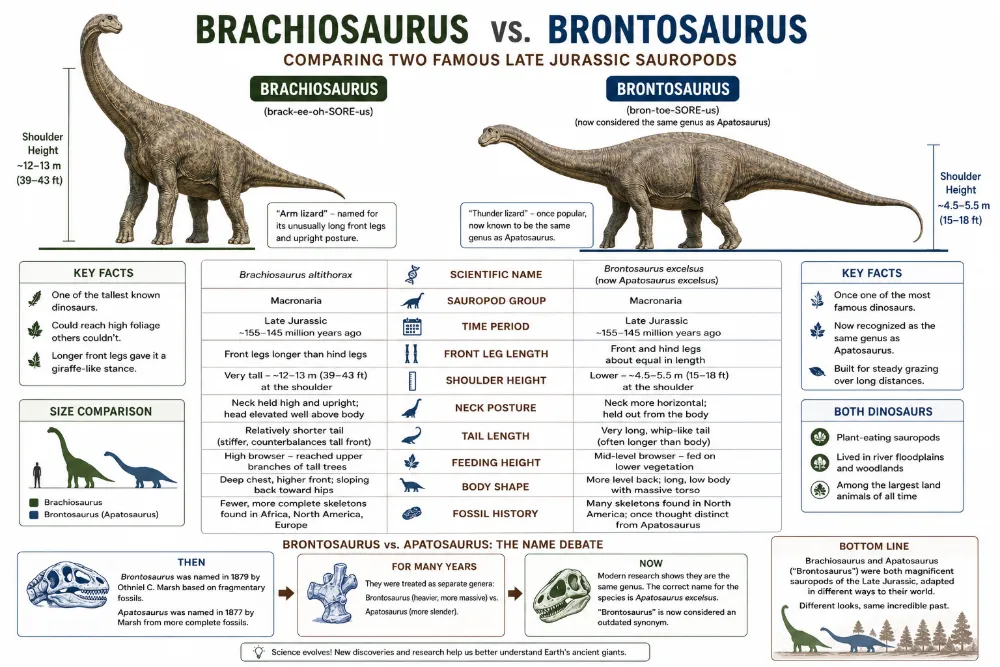
The main difference is body shape. Brachiosaurus was built upward, with long front legs and high shoulders. Brontosaurus was built more horizontally, with a long neck, long body, and very long tail.
Brachiosaurus belonged to a different sauropod branch than Brontosaurus. Brachiosaurus was a macronarian sauropod, a group that includes several high-browsing giants. Brontosaurus was a diplodocid, a group known for long bodies, long tails, and relatively lower body profiles.
A simple rule is: Brachiosaurus looked tall and front-raised; Brontosaurus looked long and low.
Size Comparison
Both dinosaurs were enormous, but they were enormous in different ways. Brachiosaurus was especially tall because of its long forelimbs and elevated shoulders. Its head could reach high into trees, making it one of the more vertically impressive sauropods.
Brontosaurus was also huge, but its size was expressed more through length and body mass than height. It had a long neck and an even longer tail, giving it a stretched, horizontal silhouette.
Size estimates for extinct dinosaurs vary because fossils are incomplete and paleontologists must reconstruct missing parts. In general, Brachiosaurus was likely taller at the shoulder and may have been heavier, while Brontosaurus was a long, heavy diplodocid with a powerful body and tail.
Neck Posture and Feeding Height
Brachiosaurus is often shown with a high neck and elevated head. While exact neck posture is still debated for many sauropods, Brachiosaurus clearly had anatomical features that raised the front of its body. This likely gave it access to higher vegetation than many other herbivores.
Brontosaurus had a long neck too, but its body profile was not high-shouldered like Brachiosaurus. It may have fed across a wide horizontal range, sweeping its neck to browse ferns, cycads, horsetails, conifers, and other Jurassic plants.
This difference may have helped both dinosaurs share ecosystems without feeding in exactly the same way. Brachiosaurus may have focused more on higher browsing, while Brontosaurus may have been better suited to lower or mid-level feeding.
Front Legs and Body Posture
The front legs are the clearest skeletal clue. Brachiosaurus had front limbs longer than its hind limbs. This made the back slope downward from the shoulders toward the hips and gave the animal a distinctive tall-fronted body shape.
Brontosaurus did not have this same body plan. Its forelimbs and hind limbs supported a more level, horizontal body. Its neck and tail extended forward and backward from this long body frame.
If you see a sauropod with shoulders higher than the hips and a very elevated chest, think Brachiosaurus. If the animal is long, low, and balanced by a long tail, think Brontosaurus or another diplodocid.
Tail Differences
Brachiosaurus had a tail, of course, but it was not as extreme as the tails of diplodocid sauropods. Its overall body design emphasized height, deep chest structure, and long forelimbs.
Brontosaurus had a very long tail, typical of diplodocid sauropods. This tail may have helped balance the long neck and body. Diplodocid tails are often described as whip-like, although exactly how they were used is still debated.
The tail is one of the easiest visual differences in restorations. A shorter-looking tail with tall front limbs suggests Brachiosaurus. A long sweeping tail attached to a horizontal body suggests Brontosaurus.
Skull and Teeth
Brachiosaurus likely had a skull suited for browsing plant material from branches and higher vegetation. Brachiosaur skulls are often associated with relatively robust jaws and spoon- or pencil-like teeth depending on the species and related forms.
Brontosaurus, like other diplodocids, had a relatively small head compared with its body. Diplodocid teeth were generally simple and placed toward the front of the jaws, useful for stripping vegetation rather than chewing.
Neither dinosaur chewed food the way mammals do. Like other sauropods, they swallowed plant material and relied on their huge digestive systems to process large amounts of vegetation.
Diet and Feeding Strategy
Both Brachiosaurus and Brontosaurus were herbivores. They lived in Jurassic ecosystems filled with plants unlike modern flowering forests. Their food likely included conifers, cycads, ginkgoes, ferns, horsetails, and other ancient vegetation.
Brachiosaurus likely fed higher in the vegetation column. Its body design would have allowed it to reach branches unavailable to many other herbivores.
Brontosaurus may have fed across lower and middle levels, using its long neck to cover a wide feeding area without moving its entire body constantly. This kind of feeding could be efficient for a giant herbivore that needed enormous amounts of plant matter.
Habitat and Environment
Both dinosaurs are associated with Late Jurassic ecosystems of western North America, especially environments represented by the Morrison Formation. This ancient landscape included floodplains, river systems, forests, fern-covered areas, and seasonally changing habitats.
The Morrison ecosystem supported many famous dinosaurs, including sauropods, stegosaurs, theropods, and smaller herbivores. Brachiosaurus and Brontosaurus were part of a diverse sauropod community, not isolated giants.
The fact that several giant herbivores lived in the same broad region suggests they may have used different feeding heights, food types, or habitat zones to reduce direct competition.
Fossil History
Brachiosaurus was named in the early 20th century from fossils found in North America. Its unusual limb proportions immediately made it stand out from many other sauropods.
Brontosaurus was named earlier, in the late 19th century, during the famous period of intense dinosaur discovery in North America. Later, scientists decided it was too similar to Apatosaurus and merged it under that name. For decades, museums and books often corrected “Brontosaurus” to “Apatosaurus.”
In the 21st century, detailed studies of diplodocid fossils supported separating Brontosaurus again from Apatosaurus. This made Brontosaurus one of the rare dinosaur names to disappear from formal use and later return as scientifically valid.
Brontosaurus vs Apatosaurus: Why the Name Matters
The Brontosaurus name is famous because it shows how science changes. When paleontologists first named Brontosaurus, they believed it was distinct. Later, it was grouped with Apatosaurus because the known fossils seemed too similar.
More recent anatomical analysis found enough differences to support recognizing Brontosaurus as its own genus again. These differences involve details of the skeleton, especially in the neck, shoulders, and related bones.
This does not mean earlier scientists were foolish. It means fossil science improves as more specimens are discovered, more comparisons are made, and better analytical tools become available.
Were Brachiosaurus and Brontosaurus Related?
Yes, but not closely in the way many people imagine. Both were sauropods, meaning they belonged to the great group of long-necked, four-legged, plant-eating dinosaurs. However, they belonged to different branches within Sauropoda.
Brachiosaurus was a macronarian sauropod. Brontosaurus was a diplodocid. These groups shared a distant sauropod ancestry but evolved different body plans.
This is why they both had long necks and giant bodies, yet looked so different in posture and proportions.
Could Brachiosaurus and Brontosaurus Have Met?
Possibly, or at least their close relatives lived in similar Late Jurassic North American ecosystems. Both are associated with the Morrison Formation region, although exact overlap depends on species, locality, and geological age.
The Morrison Formation covered a large area and represents a long span of time, so not every dinosaur from it necessarily lived in the same place at the same exact moment.
Still, it is reasonable to imagine Brachiosaurus and Brontosaurus as members of broadly similar Late Jurassic dinosaur communities, alongside other sauropods and large predators such as Allosaurus.
Which Dinosaur Was Taller?
Brachiosaurus was taller. Its long front legs and high shoulders gave it a major height advantage. It likely held its body in a way that allowed the neck and head to reach high vegetation.
Brontosaurus was tall compared with most animals, but it was not built like a high-browsing tower. Its body was more horizontal, and its height at the shoulders was lower than Brachiosaurus.
If the question is vertical reach, Brachiosaurus wins.
Which Dinosaur Was Longer?
Brontosaurus may appear longer in many reconstructions because of its long body and very long tail. Brachiosaurus was also long, but its body design emphasized height more than stretched horizontal length.
Exact length depends on the individual, species, and fossil reconstruction. However, as a visual comparison, Brontosaurus usually gives the impression of a longer, lower animal, while Brachiosaurus gives the impression of a taller, more upright one.
Which Dinosaur Was Heavier?
Brachiosaurus was likely heavier in many comparisons, especially because of its deep chest, massive forequarters, and giant body. Some estimates place large brachiosaurids among the heaviest known dinosaurs.
Brontosaurus was still extremely heavy. It was not a lightweight animal. But diplodocids often had long bodies and tails with relatively different proportions from the heavier, high-shouldered brachiosaur body plan.
Because sauropod mass estimates vary, it is best to say that Brachiosaurus was probably the heavier and taller animal, while Brontosaurus was long, powerful, and horizontally built.
Defense Against Predators
Neither Brachiosaurus nor Brontosaurus was a predator. Their main defenses were enormous size, strong bodies, herd behavior in some contexts, and possibly tail use.
Adult sauropods may have been too large for many predators to attack safely. Young individuals, however, would have been much more vulnerable to theropods and other dangers.
Brontosaurus, with its long tail, may have had a more obvious tail-based defensive tool. Brachiosaurus, with its height and mass, may have relied heavily on sheer size and strength.
Common Myths About Brachiosaurus and Brontosaurus
Myth: Brachiosaurus and Brontosaurus are the same dinosaur
This is false. They were both sauropods, but they belonged to different groups and had very different body shapes.
Myth: Brontosaurus never existed
This is outdated. For many years, Brontosaurus was treated as Apatosaurus, but more recent research supports Brontosaurus as a valid genus.
Myth: All long-necked dinosaurs looked alike
This is false. Sauropods varied greatly in neck length, tail length, leg proportions, skull shape, body mass, and feeding strategy.
Myth: Brachiosaurus lived in swamps because it was too heavy for land
This is an old idea. Modern paleontology treats sauropods as land animals capable of supporting their own weight on strong pillar-like limbs.
Myth: Brontosaurus dragged its tail on the ground
This is unlikely. Modern reconstructions usually show sauropod tails held off the ground rather than dragged like dead weight.
Simple Identification Checklist
| Question | Likely Brachiosaurus | Likely Brontosaurus |
|---|---|---|
| Are the front legs longer than the hind legs? | Yes | No |
| Is the shoulder higher than the hips? | Yes | Not in the same dramatic way |
| Is the body long and low? | Less so | Yes |
| Is the tail extremely long? | Less extreme | Yes |
| What sauropod group? | Macronarian | Diplodocid |
| Best quick description | Tall high-browser | Long thunder lizard |
Final Verdict: Brachiosaurus vs Brontosaurus
Brachiosaurus and Brontosaurus were both giant Jurassic sauropods, but they were not interchangeable dinosaurs. Brachiosaurus had longer front legs, high shoulders, a deep chest, and a body plan suited to reaching higher vegetation. Brontosaurus had a longer, lower body, a very long tail, and the classic diplodocid shape.
The fastest rule is simple: Brachiosaurus was the tall, high-shouldered “arm lizard”; Brontosaurus was the long, low “thunder lizard.” Both were spectacular herbivores, and together they show how diverse long-necked dinosaurs really were.
FAQs About Brachiosaurus and Brontosaurus
Is Brachiosaurus the same as Brontosaurus?
No. Brachiosaurus and Brontosaurus were different sauropod dinosaurs. Brachiosaurus had longer front legs and high shoulders, while Brontosaurus had a longer, lower diplodocid body shape.
Which was bigger, Brachiosaurus or Brontosaurus?
Brachiosaurus was probably taller and often heavier, while Brontosaurus was very long and massive. Exact estimates vary, but Brachiosaurus generally had the more towering body plan.
Which dinosaur was taller?
Brachiosaurus was taller because its front legs were longer than its hind legs, raising the shoulders and neck.
Which dinosaur had the longer tail?
Brontosaurus had the longer, more whip-like tail, typical of diplodocid sauropods.
Did Brachiosaurus and Brontosaurus live at the same time?
Both are associated with the Late Jurassic of western North America, so they lived in broadly similar time periods and ecosystems, though exact overlap depends on location and species.
What did Brachiosaurus eat?
Brachiosaurus was an herbivore and likely fed on high vegetation such as conifer branches, shoots, and other Jurassic plants.
What did Brontosaurus eat?
Brontosaurus was also an herbivore. It likely ate ferns, horsetails, cycads, conifers, and other plants available in Late Jurassic environments.
Why is Brontosaurus famous?
Brontosaurus is famous partly because of its dramatic name, “thunder lizard,” and partly because it was long treated as Apatosaurus before being recognized again by many paleontologists as a valid genus.
Why is Brachiosaurus called “arm lizard”?
The name refers to its long front limbs. Unlike many sauropods, Brachiosaurus had front legs longer than its hind legs.
Which dinosaur looked more like a giraffe?
Brachiosaurus looked more giraffe-like because of its high shoulders, long forelimbs, and elevated neck.