Hippos and rhinos are both huge herbivorous mammals, but they are very different animals. Hippos are semi-aquatic, barrel-bodied animals with enormous jaws and tusk-like canine teeth. Rhinos are mostly terrestrial grazers or browsers with thick skin, powerful shoulders, and one or two keratin horns. A hippo is usually more aggressive around water, while a rhino relies more on charging power and its horn for defense.

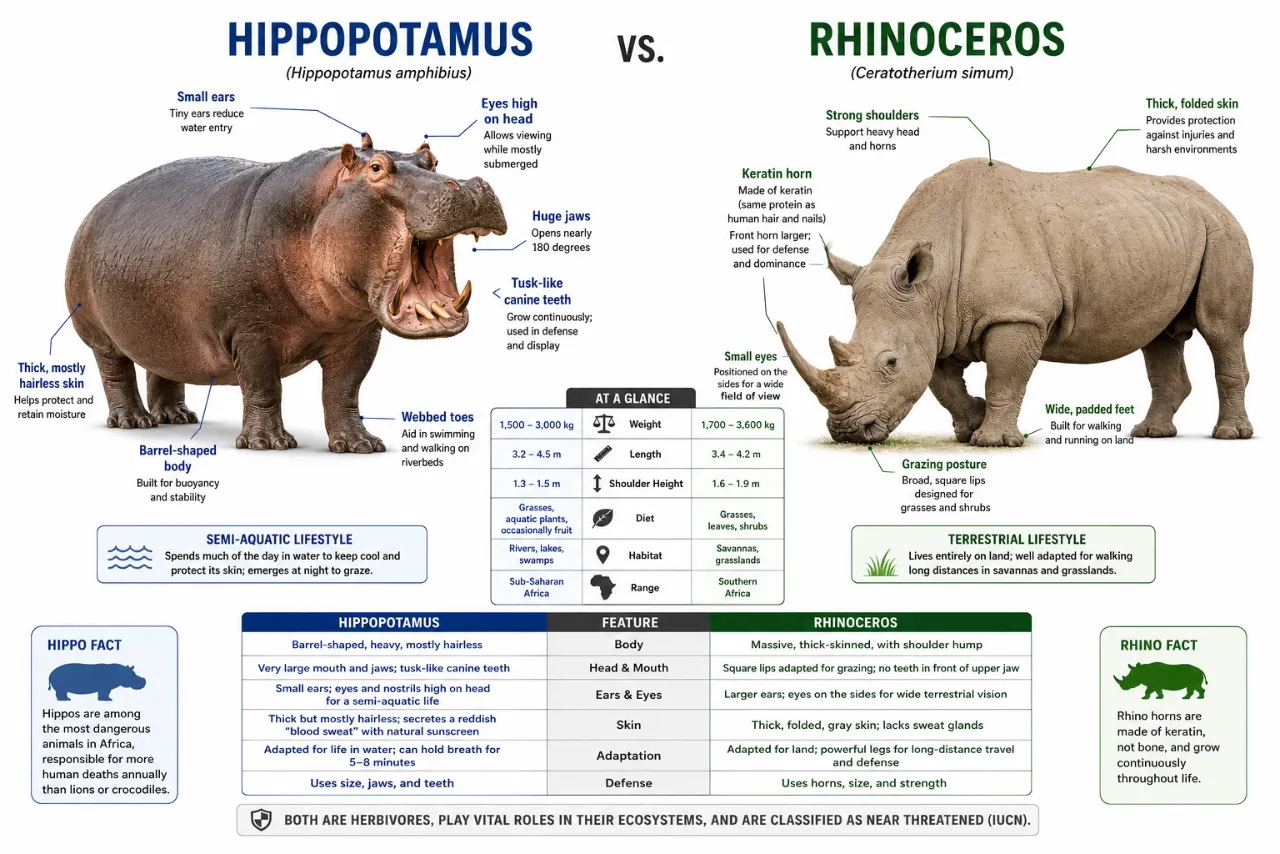
Hippo vs Rhino Summary Table
| Feature | Hippo | Rhino |
|---|---|---|
| Scientific group | Family Hippopotamidae | Family Rhinocerotidae |
| Main living species | Common hippopotamus and pygmy hippopotamus | White, black, Indian, Javan, and Sumatran rhinos |
| Typical habitat | Rivers, lakes, wetlands, and nearby grasslands | Savannas, grasslands, forests, floodplains, and scrublands |
| Body type | Rounded, barrel-shaped, short-legged | Large-bodied, high-shouldered, more armored-looking |
| Main weapon | Huge jaws and long canine teeth | Horn, body mass, and charging force |
| Diet | Mostly grass | Grass, leaves, shoots, branches, and aquatic plants depending on species |
| Behavior | Highly territorial in water | Often solitary or loosely social, defensive when threatened |
| Speed | Can run surprisingly fast over short distances on land | Can charge rapidly over short distances |
| Most obvious difference | No horn, huge mouth, semi-aquatic lifestyle | One or two horns, terrestrial lifestyle, heavier shoulder area |
What Is a Hippo?
The common hippopotamus is a large, semi-aquatic mammal native to sub-Saharan Africa. Its name comes from Greek words meaning “river horse,” but the hippo is not closely related to horses. In evolutionary terms, hippos are more closely related to whales and dolphins than to rhinos, elephants, or horses.
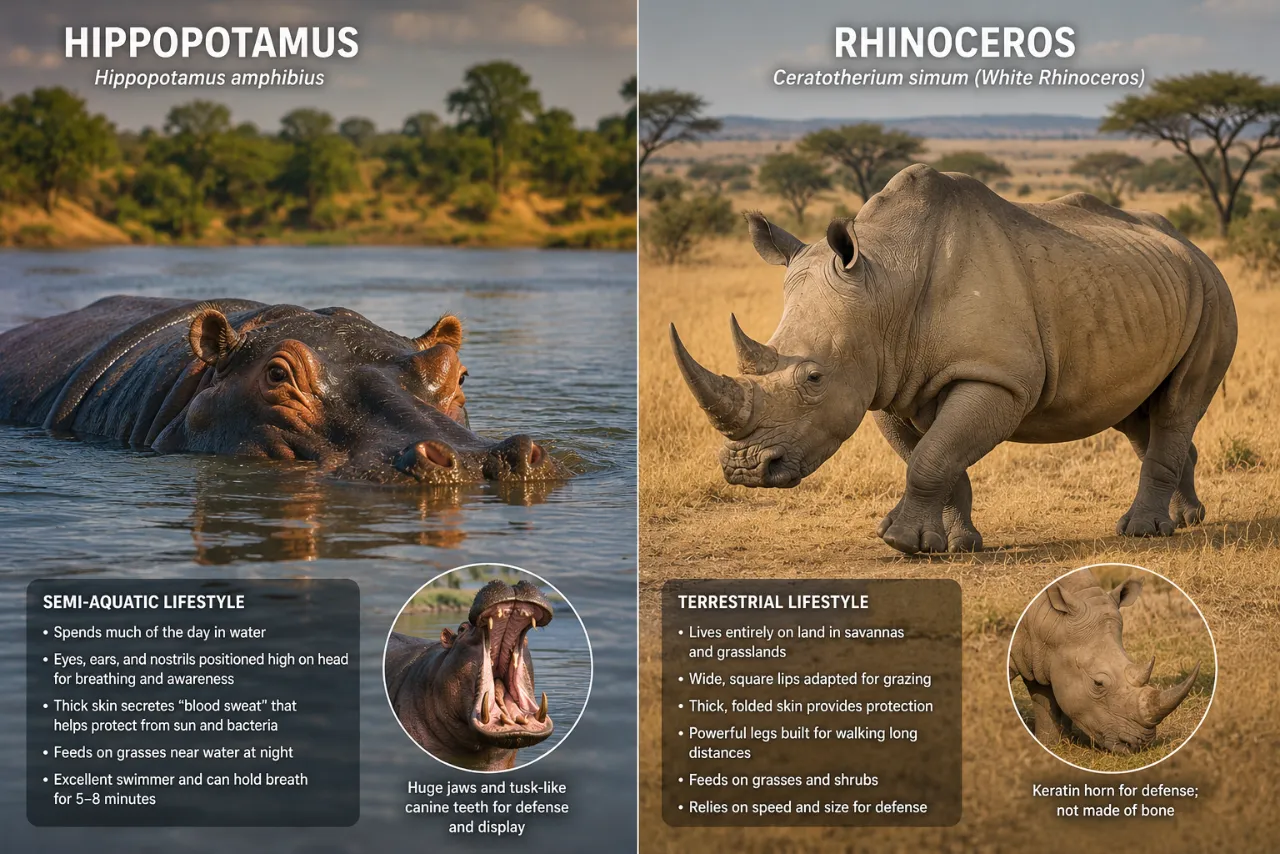
A hippo spends much of the day in water or mud to keep its skin moist and body cool. At night, it usually leaves the water to graze on grass. Despite its heavy body and short legs, a hippo can move quickly on land for short distances. Its most famous features are its enormous mouth, massive jaw muscles, and long canine teeth, which are used mainly for fighting and defense rather than for eating grass.
What Is a Rhino?
A rhinoceros is a large, thick-skinned herbivorous mammal known for the horn or horns on its snout. There are five living rhino species: white rhino, black rhino, Indian rhino, Javan rhino, and Sumatran rhino. African rhinos usually have two horns, while Indian and Javan rhinos have one horn. The Sumatran rhino has two smaller horns and is the hairiest living rhino species.
Rhinos are land animals. Some species are grazers, feeding mainly on grasses, while others are browsers that eat leaves, twigs, shrubs, and shoots. A rhino’s horn is not bone; it is made of keratin, the same structural protein found in human hair and fingernails. The horn is used for defense, fighting, digging, breaking vegetation, and social display.
Size Comparison
Both hippos and rhinos are among the largest land mammals, but their size depends heavily on species, sex, age, and nutrition.
A common hippo often weighs around 1,300 to more than 3,000 kilograms. Large males can be exceptionally heavy, with massive heads and thick necks. Their body length can reach roughly 3 to 5 meters, not including the tail.
Rhinos vary more widely. A white rhino can rival or exceed a hippo in weight, especially a large adult male. Indian rhinos can also be extremely heavy. Black, Javan, and Sumatran rhinos are generally smaller. In simple terms, a large white or Indian rhino may be heavier than many hippos, while a large male hippo may outweigh smaller rhino species.
Body Shape and Appearance
The easiest way to tell a hippo from a rhino is body shape. A hippo has a rounded, barrel-like body, very short legs, a huge mouth, small ears, and eyes positioned high on the head. This arrangement lets the animal see, breathe, and hear while most of its body remains underwater.
A rhino has a more sloping or high-shouldered body, depending on the species. It has a large head, thick legs, broad feet, and one or two horns on the nose. Its skin often looks like armor, especially in the Indian rhino, which has large folds that make it appear plated.
Hippos look smooth, wet, and bulky. Rhinos look more rugged, angular, and armored.
Horn vs Teeth
The rhino’s most famous weapon is its horn. A rhino horn grows from the skin and is made of keratin. It is not attached to the skull in the same way that deer antlers are. Rhinos use their horns in fights, defense against predators, and interactions with other rhinos.
The hippo does not have horns. Instead, it has huge canine teeth and incisors. These teeth can continue growing throughout life and may become very long in adult males. Hippos use their teeth in fights with rivals and in defensive attacks. Their wide gape is also a warning display, showing the size of the jaws and tusks.
So the simplest comparison is this: the rhino is a horn-based powerhouse, while the hippo is a jaw-and-teeth powerhouse.
Habitat and Lifestyle
Hippos are strongly tied to water. They live in rivers, lakes, wetlands, and slow-moving waterways, usually with nearby grasslands for nighttime feeding. Water is not just a place to swim; it is central to their survival. It protects their sensitive skin from overheating and helps support their heavy bodies during the day.
Rhinos are more flexible in habitat, depending on species. White rhinos prefer open grasslands and savannas. Black rhinos often live in shrubland and browse on woody plants. Indian rhinos inhabit floodplain grasslands and wetlands. Sumatran and Javan rhinos are associated with dense tropical forests.
In short, hippos are water-centered mammals, while rhinos are land-centered mammals.
Diet and Feeding Behavior
Both animals are herbivores, but they feed in different ways.
Hippos mainly graze on grass at night. They often travel from water to feeding areas after sunset, clipping grass with their lips. Although they have frightening teeth, those teeth are not designed for chewing meat. Their broad lips and strong jaws help them process tough vegetation.
Rhino diets depend on species. White rhinos are mainly grazers, with wide mouths suited to cropping grass. Black rhinos are browsers, using a pointed upper lip to grasp leaves and twigs. Indian rhinos eat grasses, aquatic plants, leaves, fruits, and branches. Sumatran and Javan rhinos browse on forest vegetation.
A useful rule is: hippos are mostly grass-eating night grazers, while rhinos can be grazers or browsers depending on the species.
Temperament and Aggression
Hippos have a reputation for being extremely aggressive, especially in water. A male hippo may defend a stretch of river or lake against rivals, boats, crocodiles, or anything that enters too closely. Females can also be dangerous when protecting calves. Because people often encounter hippos near rivers, the risk of conflict can be high.
Rhinos are not predators, but they can be very dangerous when startled, threatened, or approached too closely. Poor eyesight may contribute to defensive charging behavior. A rhino may charge at vehicles, animals, or people if it feels cornered. Mothers with calves are especially defensive.
Neither animal should be treated as calm or safe. A hippo is especially dangerous near water, while a rhino is especially dangerous when it charges on land.
Speed and Movement
Both animals look heavy and slow, but both can move surprisingly fast over short distances.
A hippo is not built for long-distance running, but it can move quickly on land when alarmed or aggressive. In water, hippos do not truly swim in the same way as many aquatic mammals. They often walk, push, or bounce along the bottom in shallower water.
A rhino can charge rapidly despite its enormous size. Its thick legs and powerful shoulders allow short bursts of speed. This makes a rhino especially dangerous in open ground, where it can accelerate toward a perceived threat.
Neither animal is an endurance runner. Their power lies in short, explosive movement.
Hippo vs Rhino: Which Is Stronger?
Strength depends on how it is measured. A hippo has one of the most formidable bites among land mammals, with huge jaws and tusk-like teeth. Its neck, head, and jaw muscles are built for powerful clashes with other hippos. In close contact, especially near water, a hippo is extremely dangerous.
A rhino’s strength is concentrated in its body mass, shoulders, neck, and horn. Its charge can deliver enormous force, and its horn can cause serious injury. A large rhino is one of the most physically imposing land mammals alive.
If “stronger” means bite and jaw power, the hippo has the advantage. If it means charging force and horn-based impact, the rhino has the advantage.
Hippo vs Rhino: Who Would Win?
A real fight between a hippo and a rhino would be unusual because they occupy different ecological niches and do not normally seek conflict. The result would depend on species, size, terrain, motivation, and whether the encounter happened near water or on open land.
Near water, a large male hippo would have a major advantage. Hippos are territorial in aquatic habitats and are built for close, violent combat using their jaws and teeth.
On open land, a large white rhino or Indian rhino would be a serious opponent. Its weight, horn, and charging power could make it extremely dangerous. However, a rhino would need space to use its charge effectively.
The most scientific answer is that neither animal is “better” overall. The hippo is better adapted for water-based territorial combat, while the rhino is better adapted for land-based defense and charging.
Are Hippos and Rhinos Related?
Hippos and rhinos are not close relatives. They may look similar because both are huge, thick-skinned herbivores, but their evolutionary histories are very different.
Hippos belong to the family Hippopotamidae and are part of a broader group related to whales and dolphins. Rhinos belong to the family Rhinocerotidae and are odd-toed ungulates, making them more closely related to horses and tapirs than to hippos.
The similarity between hippos and rhinos is mostly due to body size and herbivorous lifestyle, not close ancestry.
Conservation Status
Both hippos and rhinos face conservation pressure, but rhinos are generally under more severe threat because of poaching for their horns and habitat loss.
The common hippo is vulnerable in parts of its range due to habitat loss, hunting, water conflict, and human expansion. The pygmy hippo is much rarer and more threatened, mainly because of forest loss and fragmentation.
Rhinos face some of the most intense poaching pressure of any large mammal. White rhinos have recovered in some protected areas but remain threatened. Black rhinos, Indian rhinos, Javan rhinos, and Sumatran rhinos each face serious conservation challenges, with Javan and Sumatran rhinos among the rarest large mammals on Earth.
How to Tell a Hippo from a Rhino Quickly
If the animal is in water with only its eyes, ears, and nostrils showing, it is probably a hippo.
If the animal has one or two horns on its snout, it is a rhino.
If the body is rounded, smooth, and barrel-shaped, it is likely a hippo.
If the body looks high-shouldered, armored, and horned, it is a rhino.
If the main weapon is a huge mouth with tusk-like teeth, it is a hippo.
If the main weapon is a forward-facing horn, it is a rhino.
Final Comparison
Hippos and rhinos are both massive herbivores, but they represent two very different survival strategies. The hippo is a semi-aquatic territorial grazer with immense jaw power and dangerous teeth. The rhino is a land-based giant with thick skin, powerful shoulders, and a horn used for defense and combat.
A hippo is more associated with rivers, lakes, and water-based aggression. A rhino is more associated with savannas, forests, grasslands, and land-based charging. Both are powerful, both deserve respect, and both play important roles in their ecosystems.
FAQs About Hippos and Rhinos
Is a hippo bigger than a rhino?
Sometimes, but not always. A large common hippo can be heavier than some rhino species, but a large white rhino or Indian rhino can equal or exceed many hippos in weight.
Which is more dangerous, a hippo or a rhino?
Both are dangerous. Hippos are especially dangerous near water because they are territorial and have powerful jaws. Rhinos are dangerous on land because they can charge with great force and use their horns defensively.
Do hippos and rhinos fight in the wild?
They do not commonly fight because they usually use different habitats and have different lifestyles. Encounters may happen in some African landscapes, but direct fights are not a normal part of their behavior.
Does a hippo have a stronger bite than a rhino?
Yes, the hippo is much more specialized for jaw power. Rhinos are powerful animals, but their main defensive tools are body mass, charging force, and horns rather than bite strength.
Are rhinos related to hippos?
No. Rhinos are odd-toed ungulates related to horses and tapirs. Hippos are more closely related to whales and dolphins than to rhinos.
Can a rhino swim like a hippo?
Rhinos can move through water and may cross rivers or wallow in mud, but they are not semi-aquatic animals like hippos. Hippos are far more dependent on water for daily life.
Why do hippos spend so much time in water?
Hippos spend the day in water or mud to stay cool and protect their sensitive skin from drying out. They usually come out at night to graze.
Why do rhinos have horns?
Rhino horns are used for defense, fighting, digging, breaking vegetation, and social interactions. The horn is made of keratin, not bone.