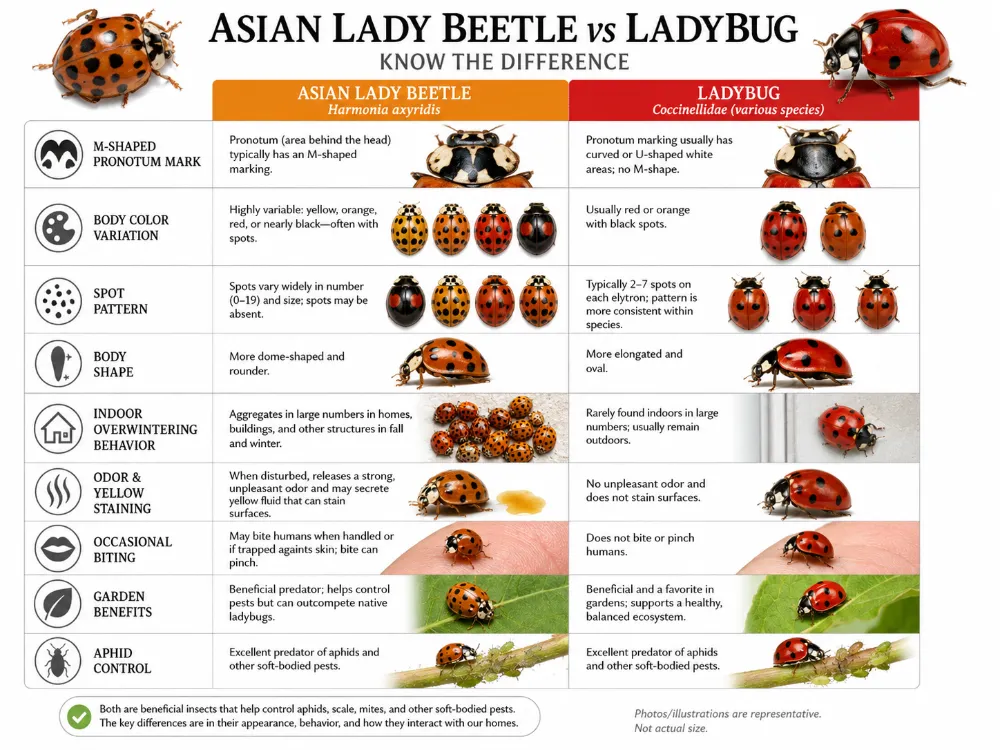
An Asian beetle, more accurately called the Asian lady beetle, is actually a type of ladybug or lady beetle. The main difference is that Asian lady beetles often have a black “M” or “W” mark behind the head, vary from yellow to orange or red, gather indoors in fall, may release a foul-smelling yellow fluid, and may occasionally bite. Most native ladybugs are less likely to invade homes.
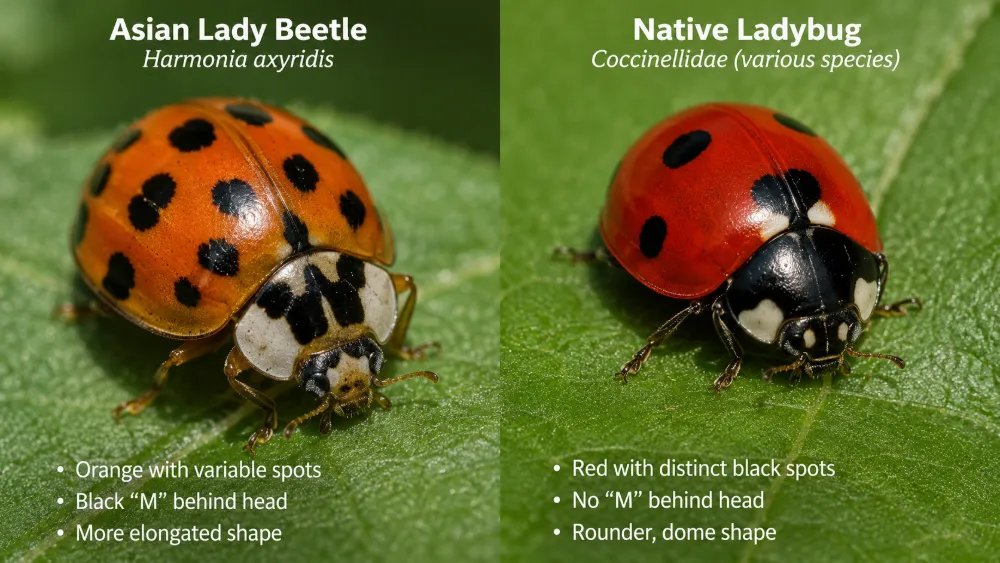
| Feature | Asian Lady Beetle | Ladybug / Native Lady Beetle | Quick Tip |
|---|---|---|---|
| Scientific identity | Harmonia axyridis | Many species in the family Coccinellidae | Asian lady beetles are lady beetles, but not all ladybugs are Asian lady beetles. |
| Common name confusion | Often called Asian beetle, Asian ladybug, or Asian lady beetle | Often called ladybug, ladybird, or lady beetle | “Asian beetle” usually means Asian lady beetle in home pest discussions. |
| Color | Yellow, orange, tan, red, or reddish-orange | Often bright red or orange, depending on species | Asian lady beetles are more color-variable. |
| Spot pattern | May have many spots, few spots, faint spots, or no spots | Often has a more consistent spot pattern within a species | Spots alone are not enough for identification. |
| Mark behind head | Usually has a black “M” or “W” mark on a pale area behind the head | Usually does not have the same bold “M” mark | The M-shaped mark is one of the best clues. |
| Body shape | Slightly larger and more oval or elongated | Often rounder and more dome-shaped | Asian lady beetles may look a little longer. |
| Behavior outdoors | Feeds on aphids and other soft-bodied insects | Also feeds on aphids and garden pests | Both can be beneficial in gardens. |
| Behavior indoors | Often gathers on buildings and enters homes to overwinter | Usually less likely to invade homes in large numbers | Indoor swarms usually point to Asian lady beetles. |
| Biting | May occasionally pinch or bite skin | Usually less likely to bite | Asian lady beetle bites are usually minor but annoying. |
| Odor and staining | Can release yellow defensive fluid with a strong smell | Some lady beetles can also release fluid, but Asian lady beetles are more notorious indoors | Avoid crushing them inside the home. |
Are Asian Beetles and Ladybugs the Same Thing?
Asian beetles and ladybugs are closely related, but the wording can be confusing. The insect most people call an “Asian beetle” is usually the multicolored Asian lady beetle, Harmonia axyridis. It belongs to the same beetle family as ladybugs, Coccinellidae.
That means an Asian lady beetle is technically a kind of lady beetle or ladybug. However, when people compare “Asian beetle vs ladybug,” they usually mean Asian lady beetles versus native or more familiar ladybug species.
The simplest answer is:
Ladybug: A general common name for many small round beetles in the lady beetle family.
Asian lady beetle: One specific species, Harmonia axyridis, originally from Asia and now widespread in many countries.
Asian beetle: A casual name that usually means Asian lady beetle, though it is not the most precise term.
Why People Confuse Asian Lady Beetles With Ladybugs
Asian lady beetles look very similar to familiar ladybugs. They are small, rounded beetles with hard wing covers, short legs, and bright warning colors. They also eat aphids, scale insects, and other plant pests, just like many native ladybugs.
The confusion happens because “ladybug” is not one single species. There are many kinds of ladybugs, and they can vary in color, size, and spots. The Asian lady beetle belongs to this same broad group, but it has habits that make it more noticeable and more annoying around homes.
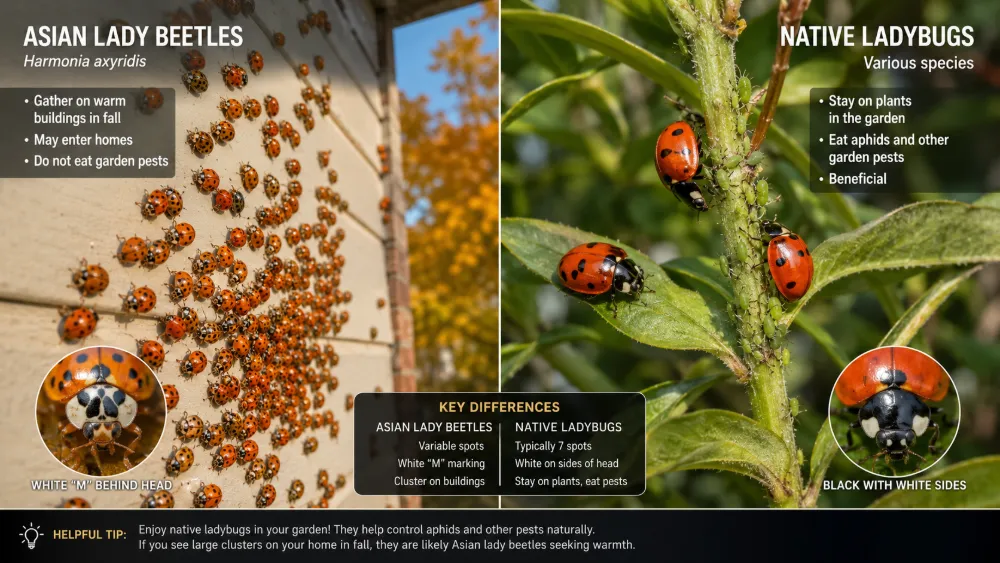
Most homeowners notice the difference in fall, when Asian lady beetles gather on sunny walls and enter houses, attics, window frames, and wall gaps to overwinter. Native ladybugs are generally less likely to invade buildings in large numbers.
Scientific Classification
Both Asian lady beetles and other ladybugs are true beetles. They belong to the order Coleoptera, which includes beetles with hardened front wings called elytra.
| Category | Asian Lady Beetle | Ladybug / Lady Beetle |
|---|---|---|
| Order | Coleoptera | Coleoptera |
| Family | Coccinellidae | Coccinellidae |
| Species example | Harmonia axyridis | Many species, such as convergent lady beetles and seven-spotted lady beetles |
| Common role | Predator of aphids and soft-bodied insects | Predator of aphids and soft-bodied insects |
| Main human concern | Home invasion, odor, staining, occasional biting | Usually viewed as beneficial garden insects |
The word “bug” is common in everyday English, but scientifically these insects are beetles, not true bugs. A more accurate name is “lady beetle,” although “ladybug” remains widely used.
Appearance: How to Identify an Asian Lady Beetle
The most useful identifying feature of the Asian lady beetle is the pale area behind the head, called the pronotum. This area often has a dark marking shaped like an “M” or “W.” The exact shape can vary, but it is one of the best field clues.
Asian lady beetles can be difficult to identify by color alone because they are highly variable. Some are pale yellow-orange. Others are deep orange, red, or reddish brown. Some have many black spots. Some have only a few. Some have almost none.
Common Asian lady beetle identification clues include:
A black “M” or “W” mark on the pale area behind the head
Yellow, orange, tan, red, or reddish-orange body color
Variable spots: many, few, faded, or absent
Slightly larger and more oval body than many native ladybugs
Large groups on sunny walls in fall
Strong odor and yellowish fluid when disturbed or crushed
Appearance: What Typical Ladybugs Look Like
Native or familiar ladybugs vary by species, but many are rounder, smaller, and more consistently colored than Asian lady beetles. The classic image of a ladybug is a bright red beetle with black spots, but not all ladybugs look exactly like that.
Some native lady beetles are orange, yellow, black, or patterned differently. Some have stripes, patches, or no obvious spots. That is why identifying every ladybug by color alone can be misleading.
Still, compared with Asian lady beetles, many familiar ladybugs tend to:
Look rounder and more dome-shaped
Have more consistent markings within the species
Lack the bold black “M” mark behind the head
Stay outdoors more often
Cause fewer indoor nuisance problems
The M-Shaped Mark Behind the Head
The black “M” or “W” mark is the most famous clue for identifying Asian lady beetles. It appears on the pale shield-like area just behind the head. Depending on the angle, it may look like an M, W, dark blotch, or connected pattern.
This mark is helpful because Asian lady beetle spot patterns are extremely variable. A beetle may have many spots, no spots, or spots that fade with age. The M-shaped mark often remains easier to notice than the wing-cover spots.
However, insect identification is never perfect from one clue alone. Lighting, age, species variation, and photo angle can make markings harder to see. Use the M mark together with body shape, color variation, behavior, and season.
Color and Spot Differences
Many people think all ladybugs are red with black spots. In reality, both Asian lady beetles and other ladybugs can vary. The Asian lady beetle is especially variable, which is why it is also called the multicolored Asian lady beetle.
| Color or Spot Trait | Asian Lady Beetle | Other Ladybugs |
|---|---|---|
| Body color | Yellow, orange, tan, red, or reddish-orange | Red, orange, yellow, black, or patterned depending on species |
| Spot number | Highly variable; may have many, few, or no spots | Often more predictable within a species |
| Spot shape | May be round, irregular, faint, or worn | Often more regular, depending on species |
| Best visual clue | M-shaped mark behind the head | Species-specific body pattern |
Because color and spot count can mislead, the best approach is to look at several traits together. A beetle with orange color, variable spots, a pale pronotum with a black M mark, and a habit of entering homes in fall is likely an Asian lady beetle.
Behavior Differences
Outdoors, Asian lady beetles and many native ladybugs behave in similar ways. Both hunt aphids and other soft-bodied insects. This makes them useful in gardens, farms, orchards, and natural habitats.
The biggest behavioral difference appears around buildings. Asian lady beetles are famous for gathering in large numbers on warm, sunlit walls in autumn. They search for protected places to survive winter, and homes can accidentally become overwintering shelters.
Behavior differences include:
Asian lady beetles: More likely to gather in large groups, enter homes, release odor, stain surfaces, and occasionally pinch skin.
Native ladybugs: Usually more likely to remain outdoors and less likely to become indoor nuisance pests.
Both: Eat aphids and other small plant pests as larvae and adults.
Do Asian Lady Beetles Bite?
Asian lady beetles can occasionally bite or pinch human skin. These bites are usually mild and feel like a small pinch rather than a dangerous wound. They do not inject venom, and they are not blood-feeding insects.
Biting is more likely when beetles are handled, trapped against the skin, or present in large numbers indoors. Most bites do not require medical treatment, but sensitive people may experience irritation.
Other ladybugs can also use their mouthparts, but Asian lady beetles are more often reported as nuisance biters because they gather around homes and people in large numbers.
Do Ladybugs Bite?
Most ladybugs are not aggressive toward people. They are predators of tiny insects, not humans. However, many lady beetles have small chewing mouthparts, so a ladybug can technically pinch skin if handled or pressed against the body.
For most people, native ladybugs are harmless. They do not damage homes, do not breed indoors in large numbers, and do not seek out people. Their main value is pest control in gardens and crops.
If a “ladybug” is biting, staining curtains, smelling bad, and appearing in large indoor clusters, it is more likely to be an Asian lady beetle.
Odor and Yellow Staining
Asian lady beetles can release a yellowish defensive fluid from their leg joints when disturbed. This behavior is called reflex bleeding. The fluid may smell unpleasant and can stain walls, curtains, clothing, and furniture.
The fluid is part of the beetle’s natural defense. It warns predators that the beetle tastes bad and may not be worth eating. Many lady beetles have chemical defenses, but Asian lady beetles are especially noticeable because they often release this fluid indoors.
To avoid odor and stains:
Do not crush beetles indoors.
Use a vacuum or gentle collection method.
Empty the vacuum container or bag outside.
Seal entry points before fall swarming season.
Keep windows, screens, and door seals in good condition.
Why Asian Lady Beetles Enter Homes
Asian lady beetles enter homes because they are looking for protected overwintering sites. In nature, they may overwinter in cracks, rock faces, tree bark, leaf litter, or sheltered crevices. Buildings with sun-warmed walls can mimic these natural winter shelters.
They are especially attracted to:
Sunny exterior walls
Light-colored buildings
South- and west-facing surfaces
Cracks around windows and doors
Attic vents
Gaps around siding
Utility openings
Loose screens
Once inside, they do not usually reproduce indoors, eat wood, eat fabric, or infest stored food. They are mainly a nuisance because they gather, crawl, fly around windows, smell bad when crushed, and may stain surfaces.
Are Asian Lady Beetles Harmful?
Asian lady beetles are not dangerous in the same way that biting flies, mosquitoes, termites, or venomous insects can be. They do not feed on human blood, do not destroy wooden structures, and do not usually damage indoor belongings by eating them.
However, they can be harmful or annoying in several ways:
They may invade homes in large numbers.
They can release smelly yellow fluid.
They may stain surfaces when crushed.
They may occasionally bite or pinch skin.
They may trigger allergic symptoms in some people.
They may compete with native lady beetle species outdoors.
So they are not “bad” insects in every context. Outdoors, they eat plant pests. Indoors, they become nuisance pests.
Are Ladybugs Beneficial?
Yes. Ladybugs are among the best-known beneficial insects. Both larvae and adults can eat aphids, mites, scale insects, mealybugs, and other soft-bodied pests. Gardeners often welcome ladybugs because they reduce pest pressure naturally.
Ladybug larvae do not look like adult ladybugs. They are often dark, alligator-shaped, and spiky-looking. Many people mistake them for pests, but they are active predators of aphids.
Benefits of ladybugs include:
Natural aphid control
Reduced need for pesticides
Support for garden and crop health
Predation on soft-bodied insects
Important role in food webs
Are Asian Lady Beetles Beneficial Outdoors?
Yes, Asian lady beetles are beneficial outdoors because they eat aphids and other plant pests. In gardens, orchards, and farms, they can help control insect populations that damage plants.
The problem is that their benefits come with drawbacks. They can outcompete some native lady beetles, gather in large numbers on buildings, and become indoor pests during cold months.
This makes the Asian lady beetle a complicated insect. It is not simply good or bad. It is a useful predator outdoors but a nuisance invader indoors.
Asian Lady Beetle vs Ladybug Larvae
Lady beetle larvae often look very different from adult beetles. They may be long, dark, spiny, and somewhat alligator-like. Asian lady beetle larvae are also predatory and feed heavily on aphids and small insects.
Because larvae are less familiar, many homeowners mistake them for harmful pests. In most cases, lady beetle larvae on plants are beneficial. They are part of the natural pest-control cycle.
General larval traits include:
Longer body than adults
Dark color with orange or yellow markings in some species
Spiny or bumpy appearance
Active movement on plant stems and leaves
Strong appetite for aphids
Why Asian Lady Beetles Are Considered Invasive
Asian lady beetles are native to parts of Asia, but they have been introduced or spread to many other regions. In some places, they are considered invasive because they can become extremely abundant and compete with native lady beetles.
Invasive does not mean the insect has no ecological value. It means the species is outside its original range and may affect local ecosystems, native species, or human environments.
Possible concerns include:
Competition with native lady beetles
Large overwintering groups in homes
Nuisance problems in buildings
Impact on fruit crops when beetles gather in damaged fruit
Possible allergic reactions in sensitive people
Do Asian Lady Beetles Kill Native Ladybugs?
Asian lady beetles may compete with native ladybugs for food and habitat. They are strong predators and can be highly successful in many environments. In some cases, they may also feed on eggs or larvae of other lady beetles.
However, native ladybug decline is not caused by one factor alone. Pesticide use, habitat loss, invasive species, agricultural change, climate conditions, and reduced prey availability can all affect native lady beetle populations.
For gardeners, the best response is to create a healthy insect habitat rather than trying to kill every lady beetle. Native plants, fewer pesticides, diverse flowers, and shelter for overwintering insects can support beneficial beetle diversity.
How to Tell Them Apart Indoors
If beetles are appearing indoors in large numbers, especially in fall or winter, they are very likely Asian lady beetles. Native ladybugs may occasionally enter buildings, but large swarms inside windows, attics, and wall spaces are a classic Asian lady beetle problem.
Indoor identification clues include:
Many beetles clustering near windows or lights
Appearance in fall, winter, or early spring
Orange or yellowish beetles mixed with red ones
Black M-shaped mark behind the head
Unpleasant odor when disturbed
Yellow stains after crushing
How to Remove Asian Lady Beetles Safely
The best indoor removal method is physical removal, not crushing. Crushing beetles can release odor and stains. Spraying indoors is usually not ideal because dead beetles may accumulate in wall voids and attract other pests.
Safe removal steps include:
Use a vacuum to collect beetles.
Place a stocking or cloth inside the vacuum hose for easier release.
Empty the vacuum outside promptly.
Wipe stained areas gently with appropriate cleaner.
Seal entry points to prevent more beetles from entering.
Avoid crushing them on walls, curtains, or furniture.
If infestations are large or recurring every year, prevention on the outside of the home is usually more effective than repeated indoor cleanup.
How to Prevent Asian Lady Beetles From Entering the House
Prevention should happen before beetles begin gathering in fall. Once they are already inside walls, control becomes harder.
Useful prevention steps include:
Seal cracks around windows and doors.
Repair damaged screens.
Replace worn weather stripping.
Seal gaps around pipes, vents, siding, and utility openings.
Install or repair door sweeps.
Check attic vents and soffit gaps.
Reduce bright indoor light leaking through windows at night during peak activity.
Inspect sunny exterior walls in early fall.
In severe cases, homeowners may contact a pest management professional before fall aggregation begins. Exterior prevention is usually more useful than waiting until beetles are already inside.
Should You Kill Asian Lady Beetles in the Garden?
In most garden situations, it is not necessary to kill Asian lady beetles outdoors. They eat aphids and other pests, so removing them may reduce natural pest control. The bigger issue is preventing them from entering buildings.
Gardeners who want to support native ladybugs should focus on habitat quality:
Plant diverse flowering native plants.
Avoid broad-spectrum insecticides.
Leave some leaf litter and sheltered areas for overwintering insects.
Provide continuous bloom through the growing season.
Reduce unnecessary pesticide sprays that kill beneficial insects.
Healthy garden ecosystems are more resilient than gardens that rely on constant chemical control.
Asian Lady Beetle vs Ladybug vs Japanese Beetle
Asian lady beetles are sometimes confused with Japanese beetles because both names include an Asian geographic reference. They are completely different insects.
| Insect | What It Looks Like | Main Behavior | Garden Impact |
|---|---|---|---|
| Asian lady beetle | Small round orange, yellow, or red lady beetle with possible M mark | Eats aphids; may enter homes in fall | Beneficial outdoors, nuisance indoors |
| Ladybug | Small round beetle, often red or orange with black spots | Eats aphids and soft-bodied pests | Usually beneficial |
| Japanese beetle | Metallic green and copper beetle | Chews leaves and flowers | Often a destructive plant pest |
A Japanese beetle is not a ladybug. It has a shiny metallic green head and copper-colored wing covers, and it damages plants by chewing leaves, flowers, and fruit.
Common Myths About Asian Lady Beetles and Ladybugs
Because these insects look cute but can also become annoying, many myths surround them.
Myth: Asian lady beetles are not ladybugs at all.
Fact: They are lady beetles in the same family, but they are a specific non-native species in many regions.Myth: All orange ladybugs are harmful.
Fact: Color alone is not enough. Many lady beetles can be orange.Myth: Asian lady beetles eat your house.
Fact: They do not eat wood or fabric like structural pests.Myth: Ladybugs never bite.
Fact: Some lady beetles can pinch skin, but serious bites are uncommon.Myth: Asian lady beetles are useless.
Fact: They are strong predators of aphids outdoors, even though they are nuisance pests indoors.
How to Help Native Ladybugs
If you care about native ladybugs, the best strategy is to build a garden that supports beneficial insects. Ladybugs need prey, shelter, and a safe environment without excessive pesticide exposure.
Helpful steps include:
Grow native flowering plants.
Allow some aphid populations to support predators naturally.
Avoid broad-spectrum insecticides.
Plant herbs and flowers that attract small beneficial insects.
Provide leaf litter, mulch, and overwintering shelter.
Avoid buying and releasing random ladybugs without knowing the species and source.
Purchased ladybugs may fly away quickly, may not be native, or may not solve the underlying pest problem. Habitat-based pest control is usually more sustainable.
Final Takeaway
The Asian beetle most homeowners talk about is the Asian lady beetle, Harmonia axyridis. It is technically a type of ladybug or lady beetle, but it differs from many native ladybugs in appearance, behavior, and indoor nuisance potential.
The easiest identification clue is the black M-shaped or W-shaped mark behind the head. Asian lady beetles also vary widely in color and spots, gather on sunny buildings in fall, enter homes to overwinter, may release a smelly yellow fluid, and may occasionally bite.
Outdoors, they can be beneficial predators of aphids. Indoors, they are best handled by prevention, sealing entry points, and vacuum removal rather than crushing or unnecessary spraying.
FAQs About Asian Beetle vs Ladybug
Is an Asian beetle the same as a ladybug?
An Asian lady beetle is a type of ladybug or lady beetle, but it is one specific species. When people compare Asian beetles and ladybugs, they usually mean Asian lady beetles versus native or more familiar ladybug species.
What is the main difference between Asian lady beetles and ladybugs?
The main difference is behavior and identification. Asian lady beetles often have a black M-shaped mark behind the head, vary widely in color, gather indoors in fall, release odor, and may occasionally bite. Many native ladybugs are less likely to invade homes.
How can I identify an Asian lady beetle?
Look for a pale area behind the head with a black M-shaped or W-shaped mark. Asian lady beetles may be yellow, orange, tan, red, spotted, faintly spotted, or spotless.
Are Asian lady beetles harmful?
Asian lady beetles are not usually dangerous, but they can be nuisance pests indoors. They may release a smelly yellow fluid, stain surfaces, trigger allergies in some people, and occasionally pinch skin.
Do Asian lady beetles bite?
Yes, Asian lady beetles may occasionally bite or pinch human skin. The bite is usually mild and not venomous, but it can be annoying.
Do ladybugs bite?
Some ladybugs can pinch skin with their mouthparts, but most are not aggressive toward people. Biting is more commonly reported with Asian lady beetles because they gather indoors in larger numbers.
Why do Asian lady beetles come into my house?
They enter homes in fall while searching for protected places to overwinter. Sunny walls, cracks, attic vents, window gaps, and door frames can attract them.
Do Asian lady beetles reproduce inside homes?
They usually do not reproduce indoors. They enter to overwinter, then become active again when temperatures warm or when indoor heat wakes them.
Do Asian lady beetles damage houses?
They do not eat wood, fabric, or stored food. Their main problems are odor, staining, indoor swarms, and nuisance activity near windows and lights.
What is the yellow liquid from Asian lady beetles?
The yellow liquid is a defensive secretion released from the beetle’s leg joints. It can smell unpleasant and may stain walls, curtains, or clothing.
Should I kill Asian lady beetles?
Outdoors, they can be beneficial because they eat aphids. Indoors, it is better to vacuum or gently remove them rather than crush them. Prevention by sealing entry points is the best long-term solution.
Are Asian lady beetles good for gardens?
Yes, they eat aphids and other soft-bodied pests. Their main downside is that they can outcompete native lady beetles and become nuisance pests indoors.
What is the best way to remove Asian lady beetles indoors?
Vacuum them and empty the vacuum outside. Avoid crushing them because they can release odor and leave yellow stains.
How can I keep Asian lady beetles out of my house?
Seal cracks, repair screens, replace weather stripping, close gaps around vents and utility openings, and inspect sunny exterior walls before fall aggregation begins.
Are Asian lady beetles the same as Japanese beetles?
No. Asian lady beetles are lady beetles that eat aphids and may enter homes. Japanese beetles are metallic green and copper plant-feeding beetles that damage leaves, flowers, and fruit.