Siberian tigers, also called Amur tigers, are usually larger, paler, and thicker-furred than Bengal tigers. Bengal tigers are generally more numerous, more orange, and adapted to warmer forests, grasslands, and mangroves. Both are tigers and belong to the mainland tiger lineage, but they live in different regions and evolved different body, coat, and habitat adaptations.
| Feature | Siberian Tiger / Amur Tiger | Bengal Tiger | Key Difference |
|---|---|---|---|
| Common name | Siberian tiger, Amur tiger | Bengal tiger, Indian tiger | “Amur tiger” is now often preferred for the Siberian tiger. |
| Scientific classification | Mainland tiger population, traditionally called Panthera tigris altaica | Mainland tiger population, traditionally called Panthera tigris tigris | Modern taxonomy often groups both within the continental tiger lineage. |
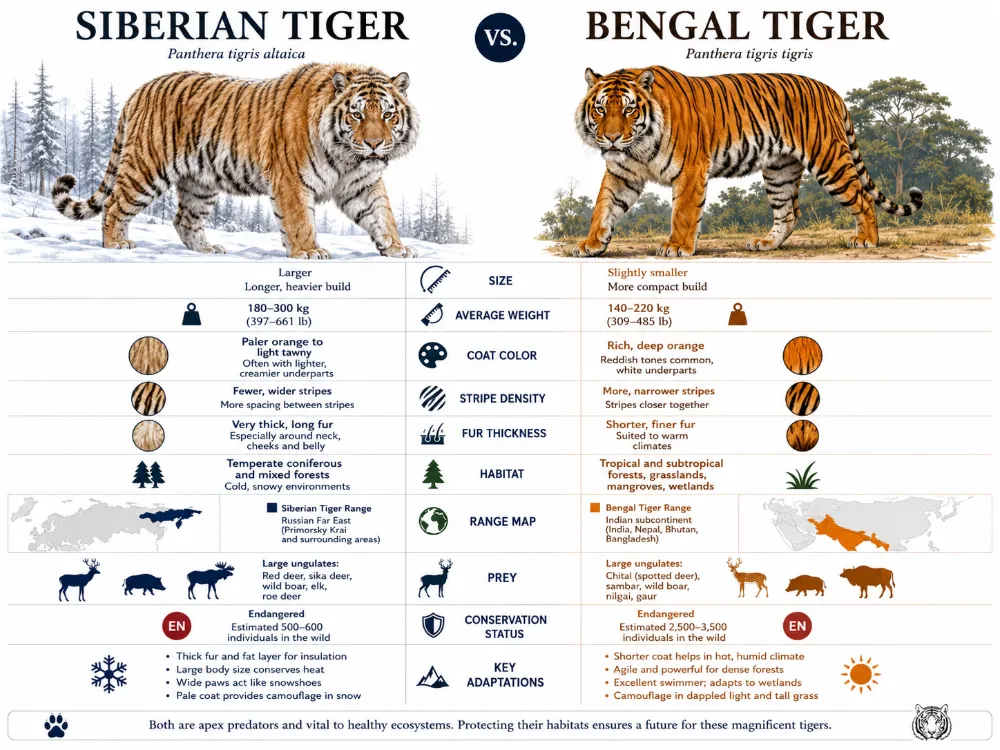
| Average male weight | About 160–190 kg, with exceptional males heavier | About 180–260 kg in many populations, with strong regional variation | Siberian tigers are often described as the largest, but real wild weights overlap. |
| Average female weight | About 110–130 kg | About 100–160 kg | Females of both types are smaller than males. |
| Body build | Long-bodied, powerful, thick-coated, cold-adapted | Muscular, compact, powerful, heat-adapted | Siberian tigers look bulkier in winter because of dense fur. |
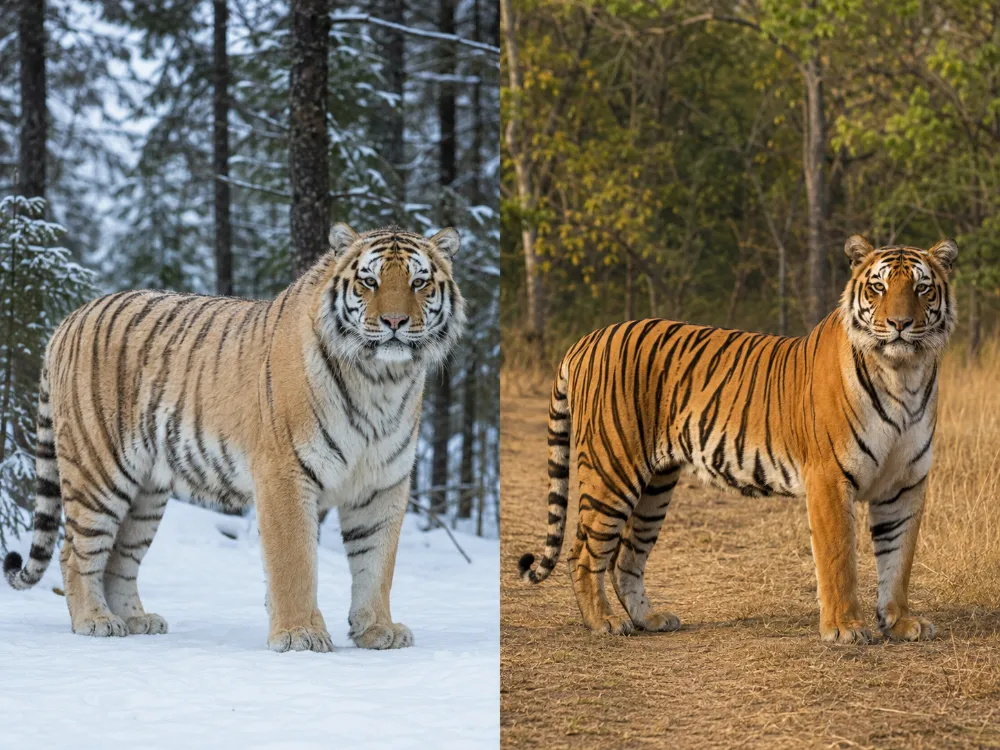
| Coat color | Paler orange, sometimes more golden or rusty, especially in winter | Richer orange or reddish-orange | Bengal tigers usually look brighter and more saturated. |
| Fur thickness | Very thick winter coat | Shorter coat suited to warm climates | The Siberian tiger is better adapted to cold. |
| Stripe pattern | Often fewer, wider, and more widely spaced stripes | Often darker, more numerous, and sharper stripes | Stripe density varies by individual. |
| Habitat | Cold temperate forests, snowy mountains, Russian Far East, northeast China | Tropical forests, grasslands, riverine forests, mangroves, foothills | Their habitats are very different. |
| Main prey | Wild boar, red deer, sika deer, roe deer, musk deer | Chital, sambar, wild boar, gaur calves, buffalo calves, deer, antelope | Both depend heavily on large hoofed animals. |
| Wild population | Only a few hundred mature or adult animals in the wild | The most numerous wild tiger population, mainly in India | Bengal tigers are far more numerous. |
| Main threats | Poaching, prey loss, logging, habitat fragmentation, conflict | Habitat loss, poaching, prey decline, human conflict, climate threats in mangroves | Both are endangered and need large protected landscapes. |
Are Siberian Tigers and Bengal Tigers the Same Species?
Yes. Siberian tigers and Bengal tigers are both tigers. They are not separate species. They belong to Panthera tigris, the tiger species. In older and still common public usage, the Siberian tiger is often called Panthera tigris altaica, while the Bengal tiger is called Panthera tigris tigris.
Modern tiger taxonomy has been simplified in many conservation contexts. Instead of treating every regional tiger form as a fully separate subspecies, many experts now group living tigers into the continental tiger and the Sunda island tiger. Under this view, Bengal, Amur, Indochinese, Malayan, and South China tiger populations belong to the continental tiger group.
For a general reader, the most useful way to understand the comparison is this: Siberian and Bengal tigers are regional tiger populations with different climates, body proportions, coat adaptations, and conservation situations. They are close relatives, but they are not identical in ecology or appearance.
Why the Siberian Tiger Is Also Called the Amur Tiger
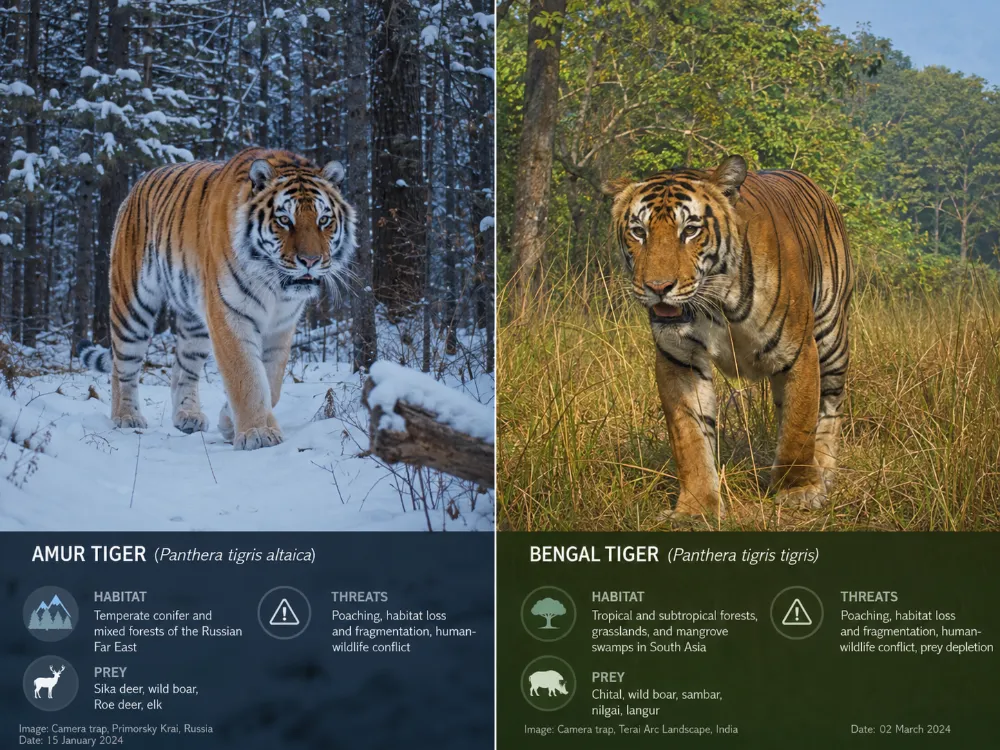
The name “Siberian tiger” is famous, but “Amur tiger” is often more accurate. These tigers do not live across all of Siberia. Their modern wild range is mainly in the Russian Far East, especially around the Sikhote-Alin mountain region, with smaller numbers in nearby northeast China and possibly border areas of North Korea.
The word “Amur” refers to the Amur River region of northeast Asia. Conservationists often prefer “Amur tiger” because it better describes where this tiger still lives today.
Both names refer to the same animal:
Siberian tiger: Traditional and widely known common name.
Amur tiger: More geographically accurate modern name.
Bengal tiger: Tiger population mainly associated with India, Bangladesh, Nepal, and Bhutan.
Size Comparison
The Siberian tiger is often called the largest tiger in the world, and historically some very large males were recorded. However, the size comparison is more complicated than many online lists suggest. Modern wild Siberian and Bengal tigers overlap in weight, and some large Bengal males can match or exceed many modern Amur males.
In general, Siberian tigers tend to have long bodies, large paws, thick fur, and a powerful cold-adapted build. Bengal tigers tend to be extremely muscular and may reach very large weights in prey-rich regions of India and Nepal.
| Measurement | Siberian Tiger / Amur Tiger | Bengal Tiger |
|---|---|---|
| Male weight | Often about 160–190 kg, with exceptional males heavier | Often about 180–260 kg, depending on region and prey base |
| Female weight | Often about 110–130 kg | Often about 100–160 kg |
| Total length | Often around 2.7–3.3 m including tail | Often around 2.7–3.1 m including tail |
| Body impression | Long, thick-coated, broad, cold-adapted | Deep-chested, muscular, powerful, heat-adapted |
The safest conclusion is that the Siberian tiger has the reputation as the largest tiger, especially in historical records and winter appearance, but Bengal tigers can be extremely large. Body size varies by sex, age, region, prey availability, health, and measurement method.
Which Tiger Is Bigger?
If we use traditional reputation and maximum historical records, the Siberian tiger is usually considered the bigger tiger. If we look at modern wild averages, the answer is less absolute. Large male Bengal tigers from prey-rich habitats can be as heavy as, or sometimes heavier than, many male Amur tigers recorded in the wild today.
There are several reasons for this overlap:
Historic Siberian tiger measurements often included exceptional males.
Modern Amur tiger populations recovered from a severe genetic and population bottleneck.
Prey density in the Russian Far East is often lower than in some Bengal tiger landscapes.
Bengal tigers in productive habitats may have access to abundant deer and wild boar.
Winter fur can make Amur tigers look even larger than their actual body mass.
So the best answer is: Siberian tigers are generally the larger-looking and cold-adapted form, but Bengal tigers are not smaller in any simple way. The largest Bengal males are among the biggest cats alive.
Coat and Color Differences
Coat color is one of the easiest ways to compare these two tigers. Siberian tigers usually have a paler orange coat, especially in winter. Their fur may look golden, rusty, or light orange, with a thick white underside and a dense neck ruff.
Bengal tigers usually have a richer orange or reddish-orange coat. Their stripes often look darker, sharper, and more numerous. This strong color contrast helps them blend into sunlit grass, forest shadows, and dense vegetation.
Typical coat differences include:
Siberian tiger: Paler coat, thicker fur, less dense striping, more winter insulation.
Bengal tiger: Brighter orange coat, sharper stripes, shorter fur, better suited to warm habitats.
Both: White underside, black stripes, white facial markings, unique stripe pattern for each individual.
Every tiger has a unique stripe pattern, much like a human fingerprint. Conservationists use camera-trap photos of stripe patterns to identify individual tigers in the wild.
Habitat Differences
The Siberian tiger lives in cold temperate forests, mountainous landscapes, and snowy woodland habitats of the Russian Far East and nearby northeast Asia. It must survive freezing winters, deep snow, low prey density, and huge home ranges.
The Bengal tiger lives across much warmer and more varied habitats. These include tropical forests, subtropical forests, grasslands, riverine forests, foothills, dry forests, and mangrove swamps such as the Sundarbans.
| Habitat Feature | Siberian Tiger / Amur Tiger | Bengal Tiger |
|---|---|---|
| Climate | Cold temperate, snowy winters | Tropical, subtropical, humid, dry, or mangrove environments |
| Main landscape | Mountain forests and mixed woodland | Forests, grasslands, wetlands, riverine zones, mangroves |
| Prey density | Often lower, requiring larger territories | Often higher in protected Indian and Nepalese landscapes |
| Key adaptation | Cold tolerance and long-distance ranging | Heat tolerance and flexible habitat use |
This habitat difference explains many of their physical traits. A Siberian tiger needs dense fur, large paws, and big territories. A Bengal tiger needs power, camouflage, stealth, and the ability to hunt in warm, complex environments.
Range and Distribution
Siberian tigers once ranged across a much larger area of northeast Asia, including parts of the Korean Peninsula, northeast China, and the Russian Far East. Today, their main stronghold is in the Russian Far East, with important conservation efforts also occurring across the border in China.
Bengal tigers have their strongest population in India, but they also occur in Bangladesh, Nepal, and Bhutan. India holds the largest number of wild Bengal tigers, and several protected reserves support breeding populations.
Their ranges do not naturally overlap. A Siberian tiger and a Bengal tiger would not meet in the wild unless humans moved them, which should not happen for normal conservation or ecological reasons.
Diet and Hunting Style
Both Siberian and Bengal tigers are solitary ambush predators. They rely on stealth, cover, and sudden explosive power. A tiger usually stalks close to prey before making a short, powerful attack.
Siberian tigers commonly hunt:
Wild boar
Red deer
Sika deer
Roe deer
Musk deer
Occasionally smaller mammals
Rarely bears or bear cubs in some situations
Bengal tigers commonly hunt:
Chital deer
Sambar deer
Wild boar
Barasingha
Nilgai
Gaur calves or weakened adults
Water buffalo calves in some areas
Monkeys, birds, reptiles, and smaller prey when needed
Both tigers prefer large prey because their bodies are large and energy demands are high. A successful kill may feed a tiger for several days.
Behavior and Territory
Siberian and Bengal tigers are both solitary. Adult males and females usually live separately, except during mating or when a mother is raising cubs. Each tiger maintains a home range, which it marks with scent, urine, scratches, and vocalizations.
Siberian tigers often need larger territories because prey is more spread out in the cold forests of the Russian Far East. Bengal tiger territory size can be smaller in prey-rich reserves, but it varies greatly by habitat quality, prey numbers, human disturbance, and tiger density.
Important shared behaviors include:
Solitary hunting
Scent marking
Scratching trees
Roaring to communicate over distance
Avoiding unnecessary fights
Mothers raising cubs alone
Strong dependence on cover and prey availability
Male tigers may overlap with the territories of several females, but they usually avoid other adult males. Territorial fights can be dangerous and sometimes fatal.
Strength and Fighting Ability
Both Siberian and Bengal tigers are extremely strong. They have powerful shoulders, heavy skulls, long canine teeth, strong forelimbs, and muscular bodies built for grappling large prey. A direct “which would win” comparison is not very meaningful because they do not naturally meet in the wild.
If two individual tigers fought, the outcome would depend on:
Sex
Age
Weight
Health
Experience
Motivation
Injuries
Environmental conditions
A large male Siberian tiger would have size and cold-climate endurance advantages. A large male Bengal tiger would be equally formidable and may be heavier than many modern Amur males. In real biology, individual condition matters more than the label “Siberian” or “Bengal.”
Which Tiger Is Stronger?
There is no reliable scientific ranking that proves one is always stronger. Siberian tigers are often associated with larger body size and cold endurance. Bengal tigers are often associated with dense prey habitats, strong musculature, and high population density in some reserves.
Strength in a wild predator is not just about weight. It includes hunting skill, bite force, stamina, stealth, agility, and experience. Both tigers can bring down large hoofed animals. Both are apex predators. Both are among the most powerful land carnivores alive.
The most accurate answer is: neither is universally “stronger.” A large, healthy male of either population would be an extraordinarily powerful animal.
Adaptations to Cold and Heat
The Siberian tiger is adapted to cold climates. Its thick winter fur, large body, and broad paws help it survive snow and freezing temperatures. The thick fur around the neck and belly gives insulation, and its large feet help it move through snowy ground.
The Bengal tiger is adapted to warmer environments. Its coat is shorter, and its body is suited to hunting in forests, grasslands, and wetlands. Bengal tigers may rest during the hottest parts of the day and become more active during cooler hours.
Climate adaptations include:
Siberian tiger: Dense winter coat, pale coloration, large paws, cold tolerance.
Bengal tiger: Shorter coat, vivid camouflage, heat tolerance, habitat flexibility.
White Tigers: Are They Siberian or Bengal?
Most white tigers in captivity are Bengal tigers or Bengal-related hybrids, not true Siberian tigers. A white tiger is not a separate species or a special “snow tiger.” It is usually a tiger with a rare genetic color condition that reduces orange pigment.
White tigers are mostly seen in captivity because the trait has been maintained through selective breeding. This has caused serious welfare concerns in many cases, especially when close relatives are bred to produce more white cubs.
In the wild, white tigers are extremely rare. Their pale coat would not necessarily be an advantage in most Bengal tiger habitats, where orange and black striping provides effective camouflage in grass and forest light.
Conservation Status
Both Siberian and Bengal tigers are endangered, but their conservation situations differ. Bengal tigers are the most numerous tiger population, especially in India. Siberian or Amur tigers remain far fewer, mostly concentrated in the Russian Far East, with some movement into China.
However, “more numerous” does not mean safe. Bengal tigers still face habitat loss, poaching, prey depletion, human conflict, and climate threats. In the Sundarbans, sea-level rise and severe storms may affect tiger habitat. In other regions, expanding roads, farms, and settlements fragment tiger landscapes.
Amur tigers face a different set of pressures, including low prey densities, poaching, logging, forest degradation, disease impacts on prey species, and conflict when hungry tigers approach villages or livestock.
| Conservation Issue | Siberian Tiger / Amur Tiger | Bengal Tiger |
|---|---|---|
| Population size | Much smaller, only a few hundred wild animals | Largest remaining wild tiger population |
| Major stronghold | Russian Far East | India, with populations also in Bangladesh, Nepal, and Bhutan |
| Key threats | Poaching, prey decline, logging, conflict, habitat fragmentation | Habitat loss, poaching, prey decline, conflict, climate impacts |
| Main conservation need | Large connected forests with enough deer and wild boar | Protected reserves, corridors, prey recovery, conflict reduction |
Why Tiger Conservation Matters
Tigers are apex predators. Their presence helps protect entire ecosystems because a landscape large enough for breeding tigers also protects forests, rivers, prey animals, birds, reptiles, insects, and local ecological processes.
Tigers are often called umbrella species. Protecting them requires protecting large habitats. Those habitats also support many other species and provide benefits for people, such as water security, carbon storage, flood control, and local livelihoods.
Saving tigers is not only about saving one famous animal. It is about protecting the living systems that tigers represent.
Human-Tiger Conflict
Both Siberian and Bengal tigers can come into conflict with people. Conflict usually happens when tiger habitat overlaps with farms, villages, roads, livestock, or areas where natural prey has declined.
Common causes of conflict include:
Loss of wild prey
Livestock grazing inside or near tiger habitat
Habitat fragmentation
Old, injured, or displaced tigers searching for easier prey
Human settlement near forest edges
Roads and infrastructure through tiger corridors
Reducing conflict requires more than simply blaming tigers. Effective solutions include protecting prey, compensating livestock losses fairly, improving livestock enclosures, maintaining forest corridors, educating communities, and responding quickly to problem situations.
Are Siberian Tigers More Dangerous Than Bengal Tigers?
No tiger should be treated as harmless. Both Siberian and Bengal tigers are powerful wild predators. However, danger to humans depends more on circumstances than population type.
Bengal tigers may be involved in more human encounters simply because they live in landscapes with more people nearby. In parts of India, Bangladesh, and Nepal, tiger habitats can overlap with villages, forest workers, fishers, honey collectors, and livestock areas.
Amur tigers live in colder, less densely populated regions, but conflict can still occur, especially when prey declines or tigers approach settlements. The risk is shaped by human density, prey availability, habitat condition, and individual tiger behavior.
Common Myths About Siberian and Bengal Tigers
Many online comparisons simplify the two tigers too much. Some claim the Siberian tiger is always much larger, while others claim the Bengal tiger is always more aggressive. Real biology is more nuanced.
Myth: Siberian tigers are always much bigger than Bengal tigers.
Fact: They often look larger and have a large-size reputation, but modern wild weights overlap.Myth: Bengal tigers are a different species from Siberian tigers.
Fact: Both are tigers, Panthera tigris.Myth: White tigers are Siberian snow tigers.
Fact: Most white tigers are Bengal or Bengal-related captive tigers with a color mutation.Myth: Siberian tigers only live in Siberia.
Fact: Their modern range is mainly the Russian Far East, so “Amur tiger” is often more accurate.Myth: One tiger is clearly stronger in every situation.
Fact: Strength depends on the individual animal.
How to Identify Them Visually
In photographs, Siberian and Bengal tigers can sometimes be difficult to distinguish, especially if the image lacks habitat context. Still, several clues can help.
| Visual Clue | Siberian Tiger / Amur Tiger | Bengal Tiger |
|---|---|---|
| Fur | Thicker and longer, especially in winter | Shorter and sleeker |
| Color | Paler orange or golden | Richer orange or reddish-orange |
| Stripes | Often wider and less dense | Often darker and more sharply defined |
| Body look | Large, thick-necked, cold-adapted | Muscular, compact, powerful |
| Background habitat | Snow, temperate forest, cold mountains | Grassland, tropical forest, riverine forest, mangrove |
Individual variation is strong. Lighting, season, camera angle, age, and captivity can make identification harder.
Which Tiger Is Rarer?
The Siberian or Amur tiger is much rarer than the Bengal tiger. Only a few hundred remain in the wild, mostly in the Russian Far East with small numbers in nearby parts of China. Bengal tigers are still endangered, but they are the most numerous tiger population today.
This does not mean Bengal tigers are secure. Their future depends on protected habitats, healthy prey populations, anti-poaching work, wildlife corridors, and reducing conflict with people.
For both types, numbers can rise only when habitat, prey, and protection improve together.
Which Tiger Would Win in a Fight?
This is a popular question, but it is not a useful conservation or zoological question. Siberian and Bengal tigers do not naturally fight each other in the wild. They live in different regions and evolved for different environments.
If a fight happened between two individual tigers, the winner would depend on body size, age, health, fighting experience, injury status, and motivation. A large adult male of either population could defeat a smaller, younger, injured, or weaker opponent.
From a scientific point of view, both are apex predators with similar weapons: powerful jaws, long canines, sharp claws, muscular forelimbs, and explosive attack speed. Neither should be reduced to a simple “winner.”
Final Takeaway
Siberian tigers and Bengal tigers are both forms of the same species, Panthera tigris. The Siberian or Amur tiger is adapted to cold forests of northeast Asia, with thicker fur, paler color, large paws, and huge territories. The Bengal tiger is adapted to warmer forests, grasslands, and mangroves, with a vivid orange coat, strong striping, and powerful muscular build.
Siberian tigers are often considered the largest tigers, but modern wild body sizes overlap with Bengal tigers. Bengal tigers are more numerous, while Siberian tigers are much rarer. Both are endangered, both are apex predators, and both depend on large protected landscapes with healthy prey populations.
The best comparison is not about which tiger is “better.” It is about how two magnificent tiger populations evolved to survive in very different worlds.
FAQs About Siberian Tiger vs Bengal Tiger
Are Siberian tigers and Bengal tigers the same species?
Yes. Siberian and Bengal tigers are both tigers, Panthera tigris. They are regional tiger populations with different adaptations, not separate species.
Which is bigger, a Siberian tiger or a Bengal tiger?
Siberian tigers are traditionally considered the largest tigers, especially because of their large frames and thick winter coats. However, modern wild Bengal and Siberian tiger weights overlap, and some large Bengal males can be extremely heavy.
Is the Siberian tiger the same as the Amur tiger?
Yes. The Siberian tiger and Amur tiger are the same animal. “Amur tiger” is often more accurate because the modern wild population lives mainly in the Russian Far East near the Amur region.
Where do Siberian tigers live?
Siberian or Amur tigers live mainly in the Russian Far East, especially forested mountain regions, with smaller numbers in nearby northeast China and possibly border areas of North Korea.
Where do Bengal tigers live?
Bengal tigers live mainly in India, with additional wild populations in Bangladesh, Nepal, and Bhutan. They inhabit forests, grasslands, riverine areas, foothills, and mangrove swamps.
Which tiger is more endangered?
Both are endangered, but the Siberian or Amur tiger is much rarer in the wild. Bengal tigers are more numerous, but they still face serious threats from habitat loss, poaching, prey decline, and human conflict.
Do Siberian and Bengal tigers ever meet in the wild?
No. Their natural ranges do not overlap. Siberian tigers live in northeast Asia, while Bengal tigers live in South Asia.
Which tiger has thicker fur?
The Siberian tiger has thicker fur, especially in winter. This helps it survive freezing temperatures and snowy habitats.
Which tiger has brighter color?
The Bengal tiger usually has a richer orange or reddish-orange coat with dark, sharp stripes. Siberian tigers are often paler, especially in winter.
What do Siberian tigers eat?
Siberian tigers mainly eat wild boar, red deer, sika deer, roe deer, musk deer, and other prey available in the forests of the Russian Far East.
What do Bengal tigers eat?
Bengal tigers commonly eat chital deer, sambar deer, wild boar, barasingha, nilgai, and sometimes larger prey such as gaur calves or buffalo calves.
Are white tigers Siberian tigers?
Usually no. Most white tigers in captivity are Bengal tigers or Bengal-related hybrids. White tigers are not a separate species and are not true “snow tigers.”
Which tiger is stronger?
Neither is always stronger. A large, healthy adult male of either population is extremely powerful. Strength depends on individual size, age, health, and condition.
Can Siberian and Bengal tigers breed?
Yes, because they are the same species. However, mixing regional tiger populations in captivity is usually discouraged for conservation breeding unless there is a specific scientific or management reason.
Why are tiger stripes important?
Tiger stripes provide camouflage in grass, forest shadows, and broken light. Each tiger’s stripe pattern is unique, allowing researchers to identify individuals in camera-trap photos.