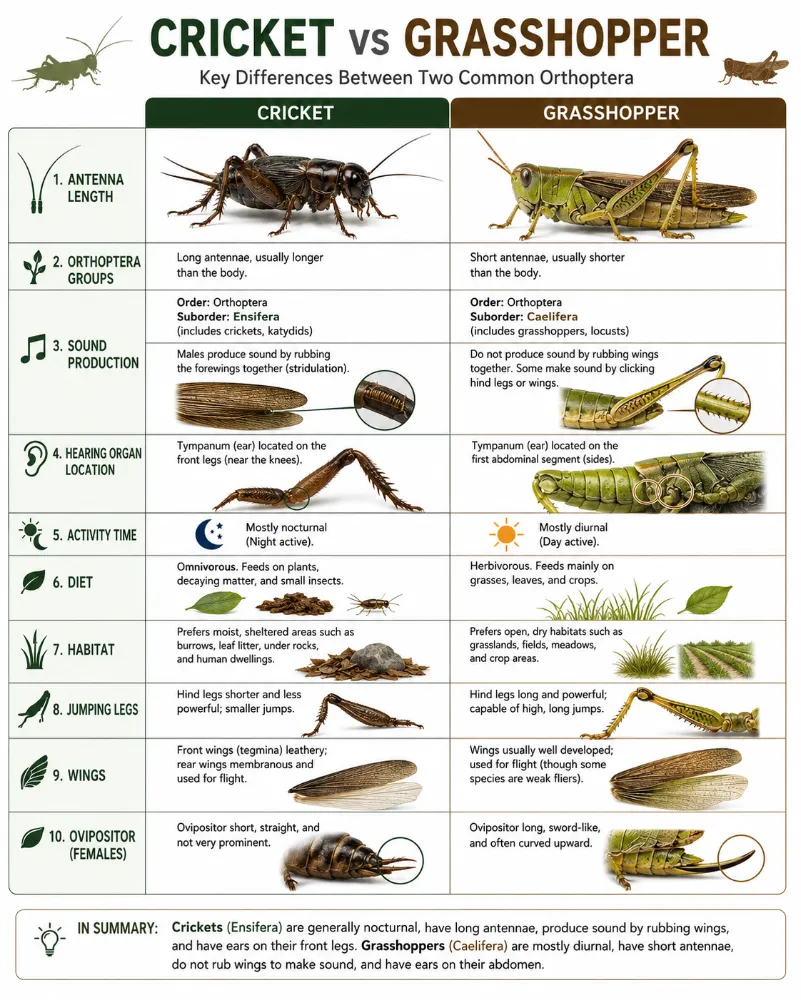
Crickets and grasshoppers are related jumping insects, but they are not the same. Crickets usually have very long antennae, are more active at night, and chirp by rubbing their wings together. Grasshoppers usually have short antennae, are active during the day, and often make sound by rubbing their hind legs against their wings. Crickets are often omnivorous, while grasshoppers are mainly plant eaters.
| Feature | Cricket | Grasshopper | Quick Identification Tip |
|---|---|---|---|
| Order | Orthoptera | Orthoptera | Both are related jumping insects. |
| Main group | Ensifera, the long-horned orthopterans | Caelifera, the short-horned orthopterans | Crickets are long-horned; grasshoppers are short-horned. |
| Antennae | Long, thin, often as long as or longer than the body | Shorter, thicker, usually much shorter than the body | Antennae are the easiest clue. |
| Activity time | Mostly nocturnal or crepuscular | Mostly diurnal | Crickets sing at night; grasshoppers are common in daytime fields. |
| Sound production | Males usually rub wings together | Many rub hind legs against wings; some click in flight | Cricket chirps usually come from wings. |
| Hearing organs | Often on the front legs | Often on the abdomen | Their “ears” are in different places. |
| Body shape | Often more cylindrical, softer-looking, and darker | Often more wedge-shaped, robust, and green or brown | Grasshoppers often look more sun-adapted and field-colored. |
| Diet | Often omnivorous: plants, fungi, small insects, dead matter | Mainly herbivorous: grasses, leaves, crops, wild plants | Grasshoppers are stronger plant feeders. |
| Jumping | Good jumpers, but many also hide or run | Powerful jumpers, often leap away in open grass | Grasshoppers are more visible jumpers in fields. |
| Egg-laying structure | Females often have a long, sword-like ovipositor | Females usually have a shorter, less obvious ovipositor | A long tail-like egg-laying tube often suggests a cricket or katydid. |
| Habitat | Leaf litter, soil cracks, logs, grass, homes, caves, gardens | Grasslands, meadows, crop fields, roadsides, open vegetation | Crickets hide more; grasshoppers bask and feed in the open. |
Are Crickets and Grasshoppers the Same?
Crickets and grasshoppers are related, but they are not the same insect. Both belong to the order Orthoptera, a group known for strong hind legs, jumping ability, chewing mouthparts, and sound-producing behavior in many species.
The main difference is that crickets belong to the long-horned orthopteran group called Ensifera, while true grasshoppers belong to the short-horned group called Caelifera. In simple terms, crickets are long-antenna relatives, and grasshoppers are short-antenna relatives.
They can look similar because both may have folded wings, long hind legs, and a jumping lifestyle. However, their antennae, sounds, body structure, daily activity, food habits, and egg-laying anatomy make them easy to separate once you know what to look for.
The Fastest Way to Tell a Cricket From a Grasshopper
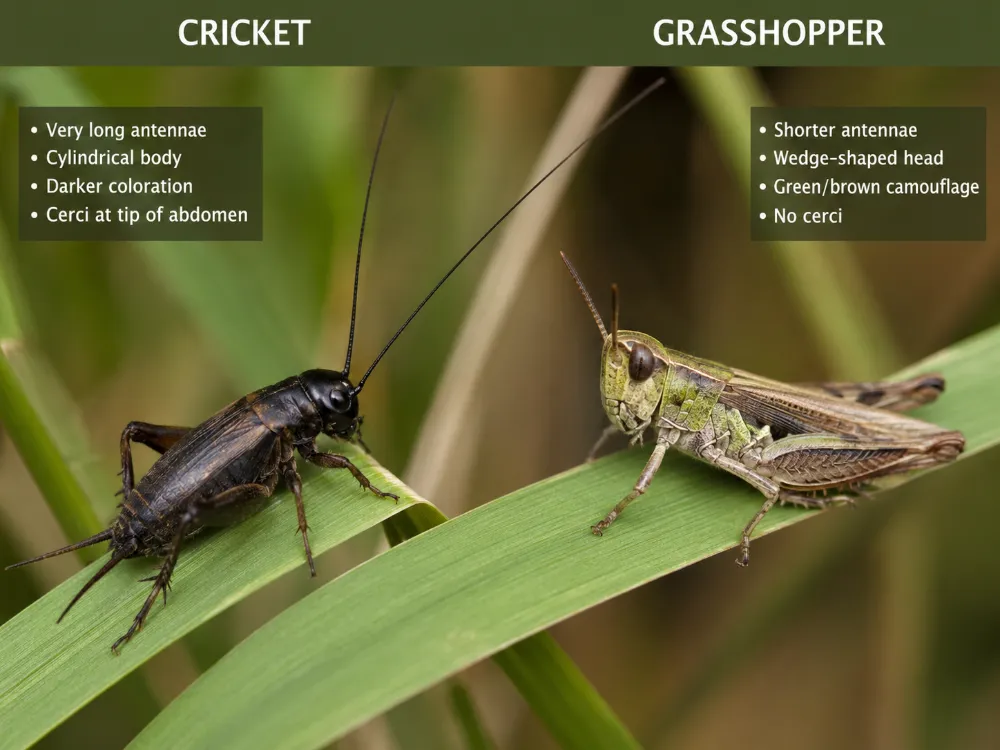
The fastest way to identify them is to look at the antennae. Crickets usually have very long, threadlike antennae. These antennae may be as long as the body or even longer. Grasshoppers usually have much shorter antennae that look thicker and more stubby.
Use this simple rule:
Long, thin antennae: usually a cricket, katydid, or another long-horned orthopteran.
Short, thick antennae: usually a grasshopper or locust-type insect.
This clue is especially useful in the field. Color can mislead you because crickets can be brown, black, green, or pale, and grasshoppers can also be green, brown, gray, yellowish, or patterned. Antennae are more reliable than color.
Scientific Classification
Crickets and grasshoppers share the same insect order, but they split into different major branches. This explains why they look related but behave differently.
| Classification | Cricket | Grasshopper |
|---|---|---|
| Kingdom | Animalia | Animalia |
| Phylum | Arthropoda | Arthropoda |
| Class | Insecta | Insecta |
| Order | Orthoptera | Orthoptera |
| Main group | Ensifera | Caelifera |
| Common families | Gryllidae and related cricket families | Acrididae and related grasshopper families |
| Common relatives | Katydids, bush-crickets, cave crickets | Locusts, slant-faced grasshoppers, band-winged grasshoppers |
Not every insect called a “cricket” in everyday language belongs to the same family. Cave crickets, mole crickets, tree crickets, and field crickets all differ in shape and lifestyle. Similarly, grasshoppers include many species with different colors, wings, songs, and habitats.
Antennae Differences
Antennae are the most obvious difference between crickets and grasshoppers. Crickets use long antennae to explore their surroundings, detect touch, sense chemicals, and navigate in low light. Because many crickets are active at night, long sensitive antennae are extremely useful.
Grasshoppers usually live in brighter, more open habitats. Their shorter antennae are still important sensory organs, but they are not usually as long or delicate as cricket antennae.
| Antenna Feature | Cricket | Grasshopper |
|---|---|---|
| Length | Very long, often body-length or longer | Short, usually much shorter than the body |
| Shape | Thin and threadlike | Thicker and more stubby |
| Use | Important for dark, hidden, or night activity | Useful for sensing the environment in open habitats |
| Best field clue | Long “feelers” waving ahead of the body | Shorter feelers on a wedge-shaped head |
Sound Differences
Crickets are famous for chirping. Male crickets usually make sound by rubbing one forewing against the other. This is called stridulation. The sound is used mainly to attract females, defend territory, or communicate with other crickets.
Grasshoppers can also make sound, but many do it differently. Many grasshoppers rub their hind legs against their forewings. Some grasshoppers make clicking or snapping sounds during flight. Others are relatively quiet or produce sounds that humans may not easily notice.
In simple terms:
Crickets: usually sing by rubbing wings together.
Grasshoppers: often sing by rubbing legs against wings or by making flight sounds.
This difference is not just a fun fact. It reflects their anatomy, courtship behavior, and active time of day.
Why Crickets Chirp at Night
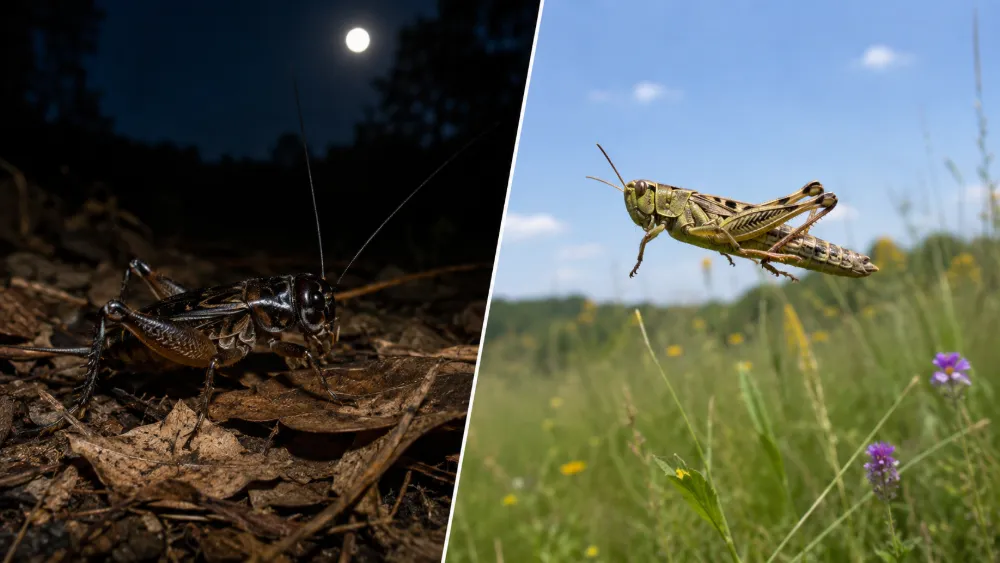
Many crickets are nocturnal. They hide during the day and become active in the evening or at night. Night singing helps males advertise to females while reducing exposure to some daytime predators.
Cricket chirping can also be affected by temperature. In many species, warmer temperatures increase the rate of chirping because insect metabolism speeds up. This is why cricket song often seems faster on warm nights and slower on cool nights.
However, not all crickets sound the same. Different species have different rhythms, pulse patterns, and pitches. To an entomologist, cricket songs can help identify species just as bird songs help identify birds.
Why Grasshoppers Are More Active During the Day
Most grasshoppers are daytime insects. They often feed, mate, bask, and escape predators in warm sunlight. Their body temperature and activity are strongly influenced by the sun, which is one reason they are so common in open fields, meadows, roadsides, and grasslands.
Grasshoppers often rely on vision more than crickets do. Their eyes are well suited for detecting movement in open habitats, and their strong legs allow rapid escape jumps when a predator approaches.
If you walk through a sunny meadow and insects leap away with short antennae, they are probably grasshoppers. If you hear chirping from dark corners, leaf litter, or under rocks at night, crickets are more likely.
Where Are Their Ears?
Crickets and grasshoppers both detect sound, but their hearing organs are in different places. This surprises many readers because insect “ears” do not look like mammal ears.
Crickets often have tympanal hearing organs on their front legs. Grasshoppers often have tympanal organs on the sides of the abdomen. These thin membrane-like structures detect vibrations in the air.
| Feature | Cricket | Grasshopper |
|---|---|---|
| Hearing organ location | Usually on the front legs | Usually on the abdomen |
| Main sound use | Finding mates and recognizing cricket songs | Detecting songs, rivals, mates, and environmental sounds |
| Human comparison | Not external ears, but thin sound-sensitive membranes | Not external ears, but abdominal tympana |
This is one of the clearest anatomical differences between the two groups.
Body Shape and Appearance
Crickets often look more cylindrical, compact, and soft-bodied. Many field crickets are dark brown or black, while tree crickets may be pale green or whitish. Cave crickets can look hump-backed and spider-like because of their long legs and curved bodies.
Grasshoppers often have a more wedge-shaped or streamlined body. Many are green or brown, which helps them blend into grasses, leaves, bare soil, or dry vegetation. Their heads can look more slanted, and their bodies often appear better suited to life in sunny, open places.
Common visual clues include:
Crickets: long antennae, cylindrical body, often darker color, long ovipositor in females.
Grasshoppers: short antennae, stronger wedge-shaped head, plant-colored body, powerful jumping legs.
Jumping and Movement
Both crickets and grasshoppers have enlarged hind legs for jumping. These legs work like spring-loaded levers, allowing the insect to escape quickly from predators.
Grasshoppers are usually more visible jumpers because they live in open habitats. When disturbed, they may leap forward and then fly a short distance. Their movement is often sudden and obvious.
Crickets also jump well, but many rely more on hiding, running into cracks, or staying active in darkness. House crickets and field crickets may leap when startled, but they often disappear into shelters rather than launching across open ground.
Wing Differences
Both crickets and grasshoppers may have wings, but wing size and use vary widely by species. Some are strong fliers, some fly only short distances, and some have reduced wings.
Grasshoppers often use wings for short escape flights after jumping. Some species show brightly colored hind wings when they fly, then disappear when they land and fold the wings. This can confuse predators.
Crickets often use their forewings for sound production. In many male crickets, the wings are modified to create chirps. Some crickets fly well, while others rarely fly or have reduced wings.
Diet Differences
Grasshoppers are mainly herbivores. They feed on grasses, leaves, stems, crops, and wild plants. Some species specialize in certain plants, while others feed on many kinds of vegetation. Large outbreaks can damage crops and rangelands.
Crickets are often more omnivorous. Many eat plant material, fungi, seeds, small insects, dead insects, decaying organic matter, and sometimes other crickets. This flexible diet helps crickets survive in leaf litter, soil cracks, buildings, gardens, and other sheltered habitats.
| Diet Feature | Cricket | Grasshopper |
|---|---|---|
| Main diet | Often omnivorous or scavenging | Mainly herbivorous |
| Common foods | Plants, fungi, seeds, insects, dead matter | Grass, leaves, crops, wild plants |
| Garden impact | Can be minor pests, scavengers, or food for wildlife | Can damage plants when abundant |
| Ecological role | Decomposition, food web support, occasional pest control | Plant consumption, nutrient cycling, prey for many animals |
Habitat Differences
Crickets often prefer sheltered places. They may live in leaf litter, under logs, under stones, in grass clumps, in soil cracks, in caves, in buildings, or near damp areas. Some species are common around homes, basements, garages, and sheds.
Grasshoppers are more typical of open vegetation. They are common in meadows, grasslands, crop fields, pastures, roadsides, dry scrub, and sunny gardens. Many species need warmth and sunlight to remain active.
Habitat clues can help identification:
In dark leaf litter at night: more likely a cricket.
Jumping through sunny grass in daytime: more likely a grasshopper.
Inside a basement or garage: often a cricket or cave cricket.
Feeding openly on leaves in a field: often a grasshopper.
Egg-Laying Differences
Female crickets often have a long egg-laying structure called an ovipositor. It can look like a straight needle or sword extending from the rear of the body. This structure helps the female place eggs into soil, plant tissue, or protected spaces.
Female grasshoppers usually have a shorter ovipositor. Many lay eggs in soil in clusters or pods. The female may push the abdomen into the ground and deposit eggs below the surface.
A long tail-like spike on the rear of an insect is often mistaken for a stinger. In female crickets and katydids, it is usually an ovipositor, not a weapon. Crickets do not sting people.
Life Cycle
Crickets and grasshoppers both go through incomplete metamorphosis. This means they do not have a caterpillar-like larval stage or a pupa like butterflies. Instead, young insects hatch as nymphs that look like smaller, wingless versions of the adults.
The life cycle usually includes:
Egg
Nymph
Several molts as the nymph grows
Adult
Young crickets and grasshoppers grow by shedding their exoskeleton. Wing pads become more visible as they develop. Adults usually have fully formed reproductive organs and, in many species, functional wings.
Cricket Song vs Grasshopper Song
Cricket songs are usually more familiar to people because they are loud at night and often repetitive. A male cricket may produce calling songs to attract females, courtship songs when near a female, and rivalry sounds when near another male.
Grasshopper sounds are often heard during the day. They may be softer, raspier, buzzing, clicking, or snapping. Some grasshoppers make sounds mainly in flight, while others rub the hind legs against the wings while perched.
Sound can help identify species, but it can also be confusing. Katydids, tree crickets, field crickets, and grasshoppers all make different kinds of songs. A nighttime “insect chorus” may include several groups at once.
Cricket vs Grasshopper vs Katydid
Katydids are another group that people often confuse with crickets and grasshoppers. They are usually more closely related to crickets than to true grasshoppers. Many katydids have long antennae, green leaf-like bodies, and strong singing behavior.
| Insect | Antennae | Common Body Shape | Common Activity |
|---|---|---|---|
| Cricket | Very long | Compact or cylindrical | Often active at night |
| Grasshopper | Short | Wedge-shaped, field-adapted | Often active during the day |
| Katydid | Very long | Often leaf-like and green | Often active at night or dusk |
If the insect is green, leaf-like, and has very long antennae, it may be a katydid rather than a true grasshopper.
Cricket vs Grasshopper vs Locust
A locust is not a separate basic body type like a cricket. A locust is a type of grasshopper that can form swarming populations under certain environmental conditions. Not all grasshoppers become locusts, but all locusts are grasshoppers.
Locusts can change behavior, color, and movement patterns when crowding and environmental conditions trigger a swarming phase. These swarms can cause serious agricultural damage because large groups consume huge amounts of vegetation.
In simple terms:
Cricket: long antennae, often nocturnal, wing chirping.
Grasshopper: short antennae, mostly daytime plant feeder.
Locust: a swarming form of certain grasshopper species.
Are Crickets or Grasshoppers Harmful?
Most crickets and grasshoppers are not dangerous to humans. They do not sting, they are not venomous, and they do not attack people. They may bite only if handled roughly, and even then the bite is usually minor.
Grasshoppers can become agricultural pests when populations are high. They may damage grasses, vegetables, crops, and ornamental plants. Crickets can sometimes damage seedlings, fabrics, paper, or stored materials indoors, but most are minor nuisance insects rather than serious pests.
From an ecological view, both are important. They feed birds, reptiles, amphibians, spiders, rodents, bats, and many other animals. They also help move nutrients through ecosystems.
Are Crickets and Grasshoppers Good for the Garden?
The answer depends on the species and population size. A few crickets or grasshoppers in a garden are usually normal and may not cause serious damage. They are part of a healthy outdoor food web.
Crickets may help break down organic matter and serve as prey for beneficial animals. Grasshoppers feed on plants, so they can become pests if there are many of them. However, they also feed wild birds, reptiles, and predatory insects.
Garden damage is more likely when:
Grasshopper numbers are high
Weather favors survival of many young nymphs
Natural predators are reduced
Gardens are near dry grassland or weedy fields
Young seedlings are exposed
Do Crickets and Grasshoppers Bite?
Crickets and grasshoppers have chewing mouthparts, so they can technically bite. However, they are not aggressive toward people. A bite may happen if the insect is trapped in the hand, handled roughly, or pressed against skin.
Most bites are mild and do not need special care beyond normal cleaning. The greater concern is usually plant damage from grasshoppers or indoor nuisance problems from crickets.
Neither crickets nor grasshoppers have stingers. A female cricket’s long ovipositor may look sharp, but it is used for egg laying, not stinging.
Why Crickets Enter Homes
Crickets may enter homes while searching for warmth, shelter, moisture, or food. House crickets, field crickets, and camel crickets are commonly found in garages, basements, crawl spaces, sheds, and laundry rooms.
They may be attracted to:
Outdoor lights
Door gaps
Basement cracks
Damp areas
Stored boxes
Pet food
Plant debris near foundations
Crickets inside the home are usually nuisance insects. The chirping may be annoying, and some species may nibble on materials, but they are not dangerous.
Why Grasshoppers Usually Stay Outdoors
Grasshoppers usually stay outdoors because they need living plants, sunlight, open space, and warm conditions. They may land on porches, windows, or walls, but they are not typical indoor insects.
If grasshoppers are abundant around a home, it is usually because the surrounding vegetation supports them. Tall grass, weedy borders, dry fields, and nearby pastures can produce large numbers during favorable seasons.
Unlike crickets, grasshoppers do not usually hide in basements or chirp from indoor cracks at night.
Predators and Ecological Role
Crickets and grasshoppers are important prey animals. Their abundance makes them a major food source in many ecosystems. Birds, lizards, frogs, spiders, mantises, rodents, bats, and predatory insects all eat them.
They also affect plant communities and nutrient cycling. Grasshoppers consume plant material and return nutrients through waste and decomposition. Crickets help process organic matter and may scavenge dead insects or plant material.
Ecological roles include:
Food for birds and reptiles
Food for amphibians and spiders
Plant consumption
Seed and organic matter processing
Soil nutrient cycling
Natural soundscape creation
How to Identify Them in Your Yard
To identify a cricket or grasshopper in your yard, observe from a short distance and look at the antennae, activity time, sound, and habitat.
Ask these questions:
Are the antennae long and thin, or short and thick?
Is the insect active at night or during the day?
Is it chirping from a hidden place or leaping through open grass?
Does it have a long ovipositor at the rear?
Is it feeding openly on leaves?
Does it hide under debris or stay in sunny vegetation?
Long antennae and nighttime chirping suggest a cricket. Short antennae and daytime jumping in grass suggest a grasshopper.
Common Myths About Crickets and Grasshoppers
Crickets and grasshoppers are familiar insects, but several myths cause confusion.
Myth: Crickets and grasshoppers are the same insect.
Fact: They are related but belong to different major groups within Orthoptera.Myth: All green jumping insects are grasshoppers.
Fact: Some green long-antenna insects are katydids or bush-crickets.Myth: Crickets sting with the long spike at the rear.
Fact: That structure is usually an ovipositor used for laying eggs.Myth: Grasshoppers only jump and cannot fly.
Fact: Many grasshoppers can fly, though some fly only short distances.Myth: All grasshoppers are locusts.
Fact: Locusts are specific grasshoppers that can form swarms under certain conditions.
Final Takeaway
Crickets and grasshoppers are both Orthoptera insects with powerful hind legs, chewing mouthparts, and jumping ability. The easiest difference is antenna length: crickets have long, thin antennae, while grasshoppers have short, thicker antennae.
Crickets are usually more active at night, often chirp by rubbing their wings together, and commonly eat a mixed diet. Grasshoppers are usually active during the day, often make sound with their legs and wings, and mostly feed on plants.
If you see a short-antenna insect jumping through a sunny meadow, it is probably a grasshopper. If you hear a long-antenna insect chirping from the shadows at night, it is probably a cricket.
FAQs About Cricket vs Grasshopper
What is the main difference between a cricket and a grasshopper?
The main difference is antenna length. Crickets have long, thin antennae, often as long as or longer than the body. Grasshoppers have shorter, thicker antennae.
Are crickets and grasshoppers related?
Yes. Both crickets and grasshoppers belong to the insect order Orthoptera. However, crickets belong to the long-horned group Ensifera, while grasshoppers belong to the short-horned group Caelifera.
Do crickets and grasshoppers both chirp?
Both can make sounds, but they usually do it differently. Crickets usually chirp by rubbing their wings together, while many grasshoppers make sound by rubbing their hind legs against their wings or by clicking during flight.
Are crickets active at night?
Many crickets are nocturnal and sing at night. This is why cricket chirping is commonly heard after sunset.
Are grasshoppers active during the day?
Yes. Most grasshoppers are daytime insects. They often feed, jump, fly, and bask in sunny open habitats.
Do crickets have ears?
Yes. Many crickets have hearing organs on their front legs. These organs help them detect the songs of other crickets.
Do grasshoppers have ears?
Yes. Many grasshoppers have hearing organs on the sides of the abdomen. These are thin membrane-like structures that detect sound vibrations.
Do crickets bite humans?
Crickets can technically bite with their chewing mouthparts, but they are not aggressive and bites are usually minor. They do not sting.
Do grasshoppers bite humans?
Grasshoppers may bite if handled roughly, but they do not attack people and are not venomous. Their bite is usually mild.
Do crickets eat plants?
Yes, many crickets eat plant material, but they are often omnivorous. They may also eat fungi, seeds, small insects, dead insects, and decaying matter.
Do grasshoppers eat plants?
Yes. Grasshoppers are mainly herbivores and commonly eat grasses, leaves, crops, and wild plants.
Can grasshoppers become locusts?
Some grasshopper species can become locusts under certain environmental conditions. Locusts are swarming forms of specific grasshopper species, not a separate basic insect group.
Why do crickets have long antennae?
Long antennae help crickets sense touch, chemicals, obstacles, and nearby objects, especially in dark or hidden habitats where vision is less useful.
Why do grasshoppers jump so far?
Grasshoppers have enlarged hind legs with strong muscles that store and release energy quickly. This helps them escape predators in open habitats.
Which is more harmful to gardens, crickets or grasshoppers?
Grasshoppers are usually more harmful to gardens because they feed heavily on leaves and grasses. Crickets may nibble plants or materials, but many are scavengers and only minor pests.