“Asian beetles” usually refers to Asian lady beetles, especially the multicolored Asian lady beetle. They are actually a type of ladybug, but they behave differently from many native ladybugs. Asian lady beetles often have an M-shaped mark behind the head, vary widely in color, gather on buildings in fall, may bite lightly, and can release a yellowish defensive fluid with a strong odor.
Asian Beetles vs Ladybugs Quick Answer
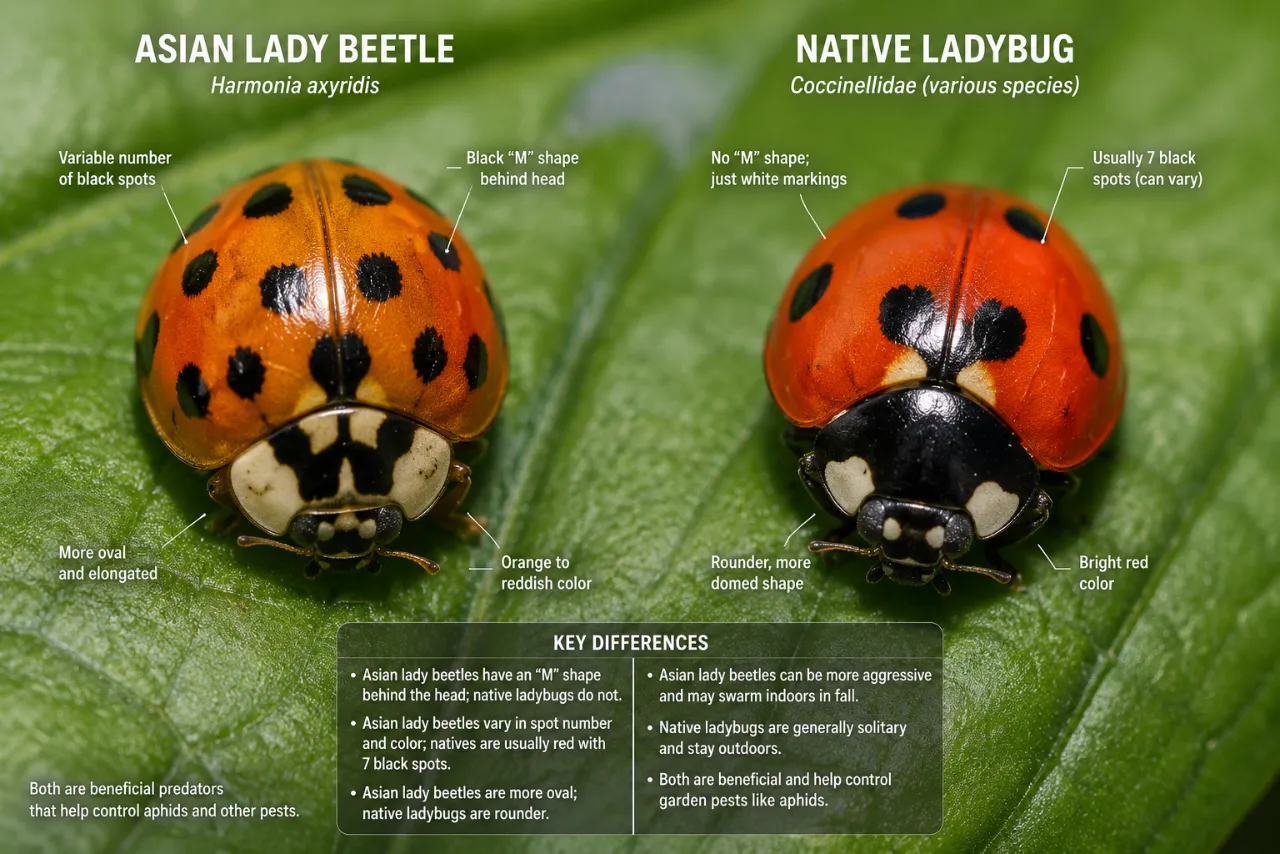
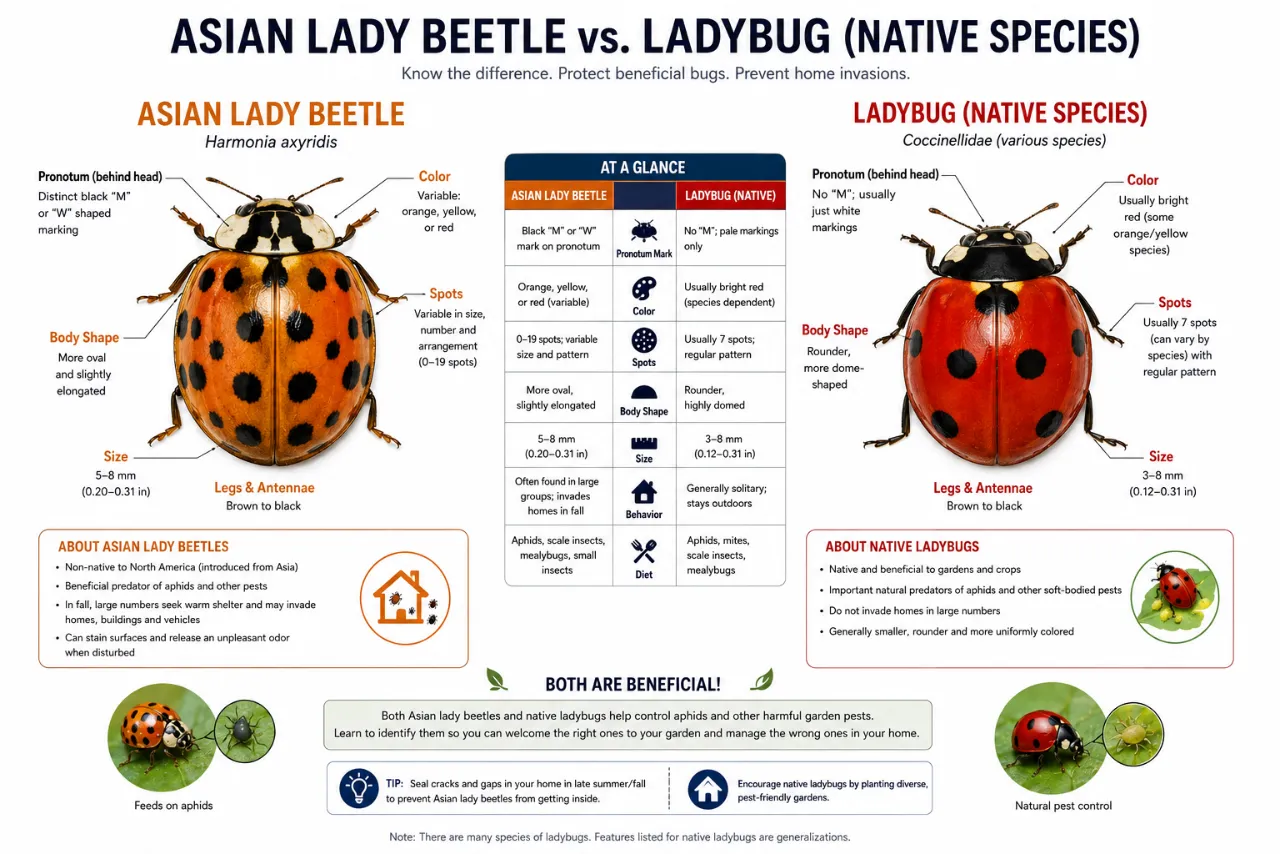
The easiest way to tell an Asian lady beetle from a typical native ladybug is to look at the pale area behind the head. Asian lady beetles often have a black M-shaped or W-shaped marking on the pronotum, the shield-like section just behind the head. They may be orange, yellow, red, or tan, and the number of black spots can vary greatly. Many familiar native ladybugs are smaller, rounder, brighter red, and less likely to invade homes in large numbers.
Asian Beetles vs Ladybugs Summary Table
| Feature | Asian Lady Beetle | Typical Native Ladybug |
|---|---|---|
| Common name | Asian beetle, Asian lady beetle, multicolored Asian lady beetle | Ladybug, ladybird, lady beetle |
| Scientific example | Harmonia axyridis | Many species in the family Coccinellidae |
| Body shape | Oval, dome-shaped, often slightly larger | Usually round or oval, often smaller |
| Color | Highly variable: orange, yellow, tan, red, or reddish-orange | Often red or orange, depending on species |
| Spots | May have many spots, few spots, or almost no spots | Spot pattern is often more consistent within each species |
| Key marking | Often has a black M-shaped or W-shaped mark behind the head | Usually lacks the bold M-shaped mark |
| Home invasion | Often gathers on sunny walls and enters homes in fall | Less likely to invade homes in large groups |
| Biting | Can nip or pinch skin lightly | Usually does not bite people |
| Odor and staining | May release yellowish defensive fluid that smells unpleasant and can stain | Can also release defensive fluid, but usually less noticeable indoors |
| Garden role | Eats aphids and other pests, but may outcompete native species | Often beneficial predators of aphids, scale insects, and other plant pests |
| Quick identification clue | Look for the M-shaped mark and fall swarms on buildings | Look for a rounder red body and no strong M-shaped mark |
What Are Asian Beetles?
In everyday language, “Asian beetles” usually means Asian lady beetles, not a completely separate group from ladybugs. The best-known species is the multicolored Asian lady beetle, Harmonia axyridis. It belongs to the same beetle family as other ladybugs: Coccinellidae.
Asian lady beetles were introduced to some regions because they eat aphids and other agricultural pests. In gardens and farms, they can be helpful predators. However, they have also become famous for gathering on buildings in autumn, entering homes through cracks, and overwintering indoors. This is why many people notice them more as a household nuisance than as a garden helper.
What Are Ladybugs?
Ladybugs, also called ladybirds or lady beetles, are small predatory beetles in the family Coccinellidae. Many species are brightly colored and have black spots, although not all ladybugs are red with spots. Some are orange, yellow, black, gray, or patterned in different ways.
Most ladybugs are beneficial insects because they eat aphids, scale insects, mites, and other soft-bodied plant pests. Gardeners often welcome them because they help control pests naturally. However, “ladybug” is a broad name, and it includes many species, including the Asian lady beetle.
Quick Visual Difference
The most useful visual clue is the area behind the head. Asian lady beetles often have a pale white or cream pronotum with a black marking shaped like an M or W. This mark can be bold or broken, but it is one of the best field clues.
Asian lady beetle: often orange, tan, yellow, or reddish; may have many, few, or no spots; often has an M-shaped mark behind the head.
Typical native ladybug: often rounder and redder; spot pattern is usually more stable; usually lacks a strong M-shaped pronotum mark.
Asian lady beetle: commonly gathers on sunny walls, windows, and light-colored buildings in fall.
Typical native ladybug: more often seen on plants, leaves, stems, flowers, and garden vegetation.
The M-Shaped Mark Behind the Head
The black M-shaped marking is the classic clue for identifying an Asian lady beetle. This mark appears on the pale shield-like area behind the head, not on the wing covers. Depending on the individual beetle, the mark may look like an M, W, thick black lines, or several connected spots.
Native ladybugs can also have pale markings behind the head, so this clue is not perfect by itself. However, when the M-shaped mark appears together with an orange or tan body, variable spots, and large fall gatherings on buildings, the insect is very likely an Asian lady beetle.
Color and Spot Differences
Color can help, but it should not be the only identification clue. Asian lady beetles are highly variable. One individual may be pale orange with almost no spots, while another may be deep reddish-orange with many spots. This variation is why they are often called “multicolored” Asian lady beetles.
Many familiar native ladybugs have more predictable patterns. For example, some species are bright red with a fixed number of black spots. However, because there are many native ladybug species, color alone can be misleading. A red beetle is not always a native ladybug, and an orange beetle is not always an Asian lady beetle.
Body Shape and Size
Asian lady beetles are small, dome-shaped beetles, but they may look slightly more oval and elongated than some classic round ladybugs. They are often a little larger than many native ladybug species, though size overlaps.
Typical ladybugs often have a compact, rounded body. Their hard wing covers form a smooth dome over the back. From above, many native species look more circular, while Asian lady beetles may appear more oval. Still, body shape is only a supporting clue; the M-shaped marking and behavior are usually more useful.
Behavior: Garden Helper or Home Invader?
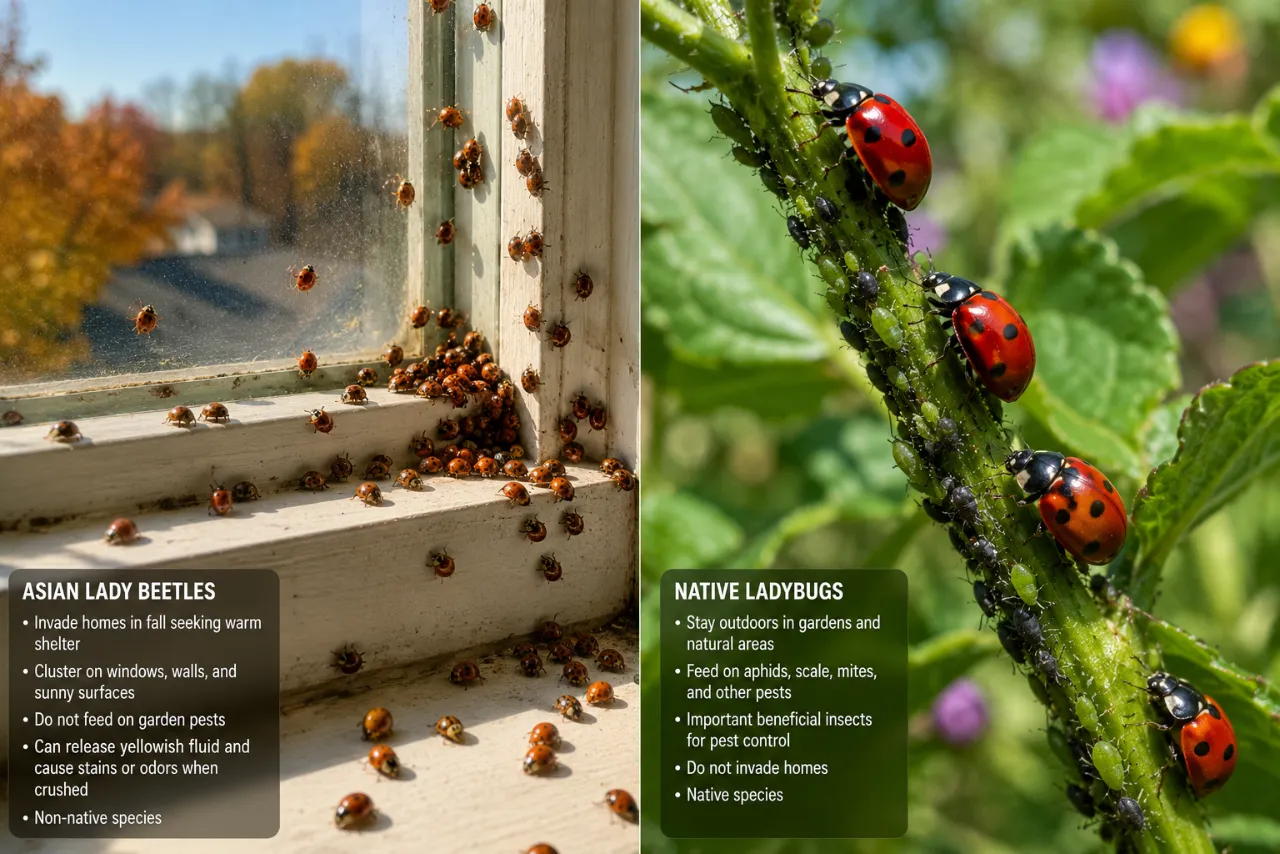
Both Asian lady beetles and native ladybugs can be beneficial in gardens because they eat aphids and other plant pests. The big behavioral difference is what happens in fall. Asian lady beetles commonly gather in large numbers on sunny sides of buildings, especially light-colored walls, windows, and warm surfaces.
They are looking for protected places to spend the winter. In nature, they may shelter in cracks, rock crevices, bark, or other protected spaces. In human environments, houses can look like excellent overwintering shelters. Once they find small gaps around windows, doors, vents, siding, or rooflines, they may enter indoors.
Many native ladybugs also seek shelter in cold weather, but they are usually less famous for invading homes in large, noticeable groups.
Do Asian Beetles Bite?
Asian lady beetles can sometimes bite or pinch human skin. Their bite is usually mild and not medically serious for most people. It may feel like a tiny pinch rather than a true dangerous bite. They do not suck blood, and they are not trying to feed on people.
Typical native ladybugs are much less likely to bite. Most people can handle them without noticing anything more than movement on the skin. However, because ladybugs are small beetles with mouthparts, any species may occasionally pinch if trapped or pressed against the skin.
Odor, Yellow Fluid, and Staining
Asian lady beetles are well known for releasing a yellowish defensive fluid from their leg joints when disturbed. This behavior is called reflex bleeding. The fluid can have a strong, unpleasant odor and may leave yellow stains on walls, curtains, clothing, or surfaces.
Native ladybugs can also release defensive fluid, but indoor problems are usually more associated with Asian lady beetles because they gather in larger numbers inside homes. Crushing them often makes the odor and staining worse, so gentle removal is better.
Are Asian Lady Beetles Harmful?
Asian lady beetles are not dangerous in the way that venomous insects or disease-carrying pests can be. They do not damage wood, eat fabric, or reproduce inside walls like some household pests. Their main problems are nuisance swarms, odor, staining, and occasional mild bites.
Ecologically, the issue is more complicated. Asian lady beetles can be strong competitors and may reduce some native ladybug populations. They are excellent aphid predators, but their success can make them disruptive in ecosystems where native ladybugs are already under pressure from habitat change, pesticide use, and invasive species.
Are Ladybugs Good for Gardens?
Yes, many ladybugs are excellent garden allies. Both adults and larvae can eat large numbers of aphids and other soft-bodied insects. Ladybug larvae look very different from adults; they are often dark, alligator-shaped, and spiny-looking. Many people mistake them for pests, but they are often powerful pest predators.
Native ladybugs are especially valuable because they are part of local ecosystems. They support natural pest control without becoming the same kind of indoor nuisance associated with Asian lady beetles.
How to Identify One in a Photo
When looking at a photo, use a combination of clues rather than one feature alone:
Check the pronotum: a black M-shaped or W-shaped mark behind the head suggests an Asian lady beetle.
Check the color: orange, tan, yellow, or reddish-orange with variable spots often points to Asian lady beetle.
Check the body shape: a slightly oval body may suggest Asian lady beetle; a very round red body may suggest a native ladybug.
Check the behavior: beetles clustering on windows or walls in fall are often Asian lady beetles.
Check the setting: a single beetle feeding on aphids in a garden could be either; a large indoor group is more likely Asian lady beetles.
Common Misidentifications
Many people call every small red or orange spotted beetle a ladybug. That is understandable, but not all ladybugs look the same. Some native ladybugs are orange, some have no spots, and some are black with red or yellow markings. This means Asian lady beetles cannot be identified by orange color alone.
Another common mistake is assuming that Asian lady beetles are “bad” and native ladybugs are “good.” Asian lady beetles do eat pests and can help in gardens, but they become unwanted when they invade homes or outcompete local species. The real difference is not that one is useful and the other is useless; the difference is their behavior, ecological impact, and tendency to become a nuisance indoors.
How to Keep Asian Lady Beetles Out of the House
The best control method is prevention. Asian lady beetles usually enter homes through small openings, especially in fall. Sealing gaps before cold weather is more effective than trying to remove large numbers after they are inside.
Seal cracks around windows, doors, siding, utility openings, and rooflines.
Repair damaged screens and weather stripping.
Use a vacuum to remove indoor beetles gently, then empty the container outside.
Avoid crushing them because this can release odor and stains.
For heavy infestations, consider contacting a professional pest-control service.
If beetles are already indoors, they are usually trying to overwinter, not breed inside the home. Removing them physically and blocking future entry points is usually the most practical approach.
Should You Kill Asian Lady Beetles?
From a practical home-care perspective, most people simply want them out of the house. Vacuuming or gently collecting them is usually better than crushing them. Outdoors, they still function as predators of aphids and other pests, so there is no need to kill every beetle seen in the garden.
If the goal is to support native ladybugs, focus on habitat. Avoid unnecessary broad-spectrum insecticides, plant diverse flowers, allow some natural garden areas, and reduce chemical pressure on beneficial insects. A healthy garden can support many predators, including native ladybugs, lacewings, hoverflies, spiders, and parasitic wasps.
Final Comparison
Asian lady beetles and ladybugs are closely related, and technically Asian lady beetles are a kind of ladybug. The difference is that Asian lady beetles are more variable in color, often have a black M-shaped mark behind the head, gather on buildings in fall, may enter homes in large numbers, and can release a smelly yellow defensive fluid.
Typical native ladybugs are usually more welcome in gardens because they help control aphids without commonly becoming a major indoor nuisance. For quick identification, look for the M-shaped mark, variable orange color, and fall clustering behavior.
Related Insect Comparisons
Ladybug vs Ladybird
Ladybug Larvae vs Pests
Bee vs Wasp
Ants vs Termites
Dragonfly vs Damselfly
FAQs About Asian Beetles vs Ladybugs
Are Asian beetles the same as ladybugs?
Asian lady beetles are a type of ladybug, but they are not the same as many native ladybug species. They belong to the same beetle family but differ in markings, behavior, home-invasion habits, and ecological impact.
How can you tell an Asian lady beetle from a ladybug?
Look for a black M-shaped or W-shaped mark on the pale area behind the head. Asian lady beetles also vary widely in color and spot number and often gather on buildings or windows in fall.
Do Asian lady beetles bite?
Yes, they can sometimes give a mild pinch or bite, but they are not blood-feeding insects and are not dangerous to most people. The bite is usually minor.
Why do Asian lady beetles come inside houses?
They enter homes in fall while searching for warm, protected places to overwinter. Small cracks around windows, doors, siding, vents, and rooflines can allow them inside.
Do Asian lady beetles smell bad?
They can release a yellowish defensive fluid with a strong odor when disturbed or crushed. This fluid may also stain light-colored surfaces.
Are ladybugs good for plants?
Yes. Many ladybugs eat aphids, scale insects, mites, and other plant pests. They are important natural pest-control insects in gardens and farms.
Are Asian lady beetles harmful to gardens?
They can help gardens by eating aphids, but they may also compete with native ladybugs. Their biggest problem for homeowners is usually indoor swarming, not plant damage.
What should I do if Asian lady beetles are inside my house?
Use a vacuum or gentle collection method instead of crushing them. Then seal gaps around windows, doors, vents, and siding to reduce future entry.