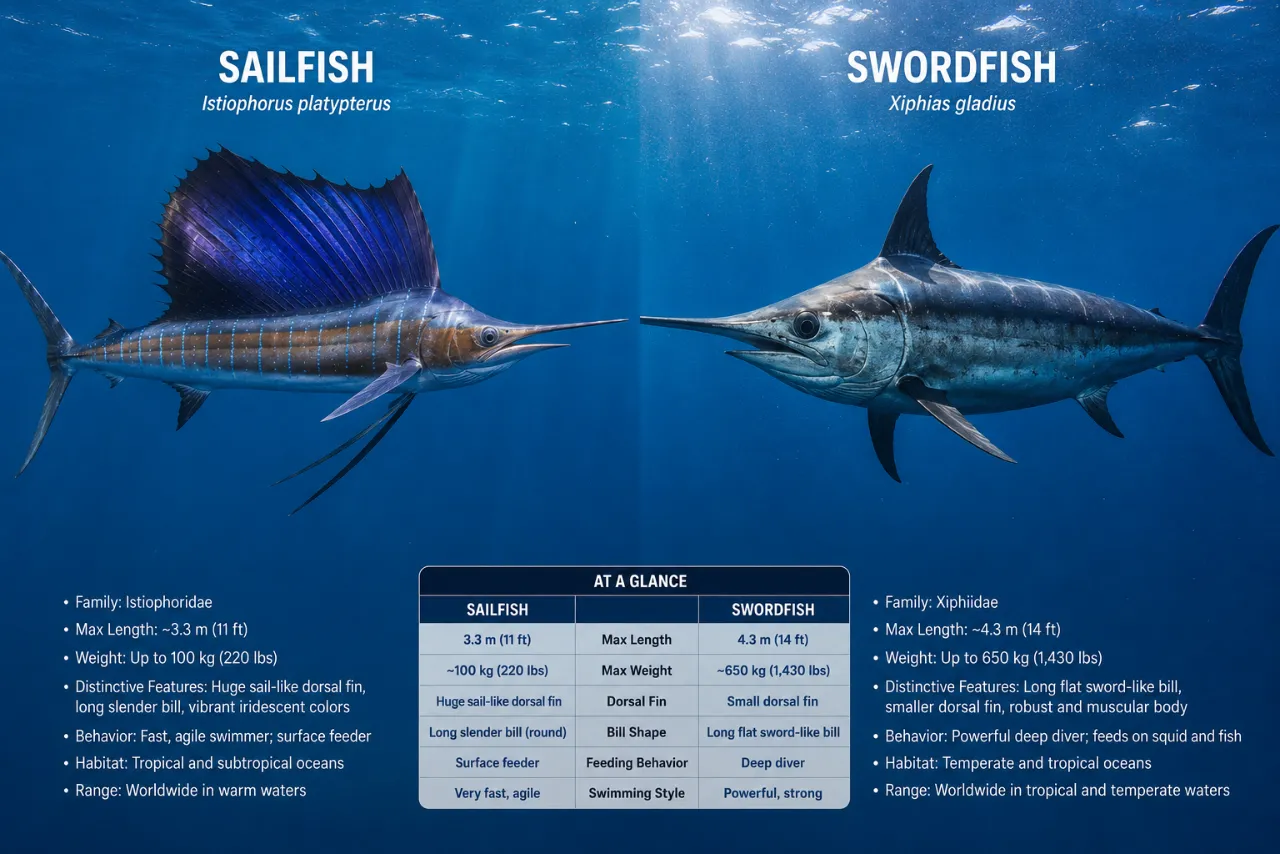
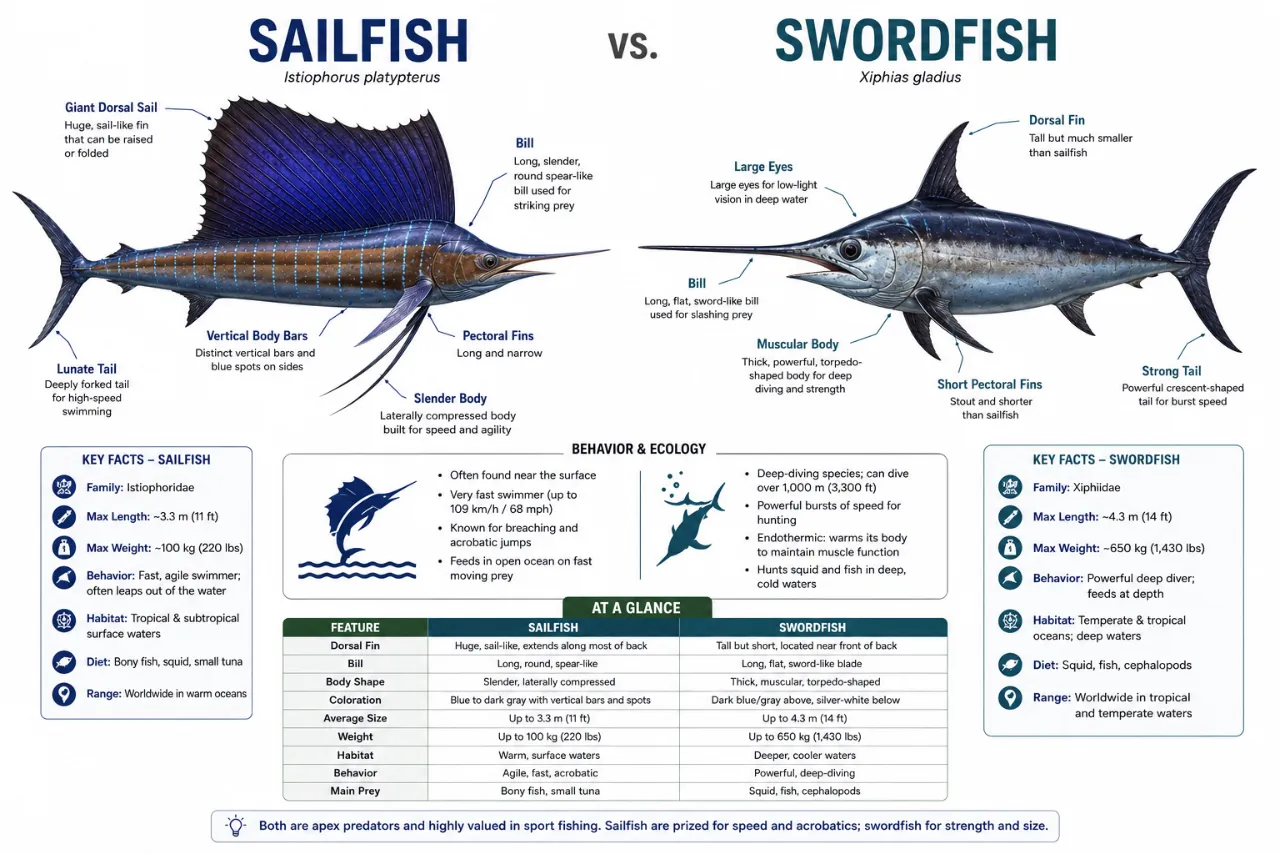
Sailfish and swordfish are both powerful billfish, but they are not the same animal. Sailfish are famous for their tall sail-like dorsal fin, slender body, and extreme speed near the ocean surface. Swordfish are heavier, deeper-diving predators with a broad, flattened sword-like bill and no large sail. The easiest way to tell them apart is to look at the dorsal fin, bill shape, body depth, and overall size.
Sailfish vs Swordfish Quick Answer
A sailfish is usually slimmer, more colorful, and easier to recognize because of its huge sail-like dorsal fin. A swordfish is usually bulkier, darker, and has a long, flattened bill that looks more like a blade. Sailfish often hunt in warmer surface waters and use speed and teamwork to herd small fish. Swordfish can dive much deeper and use their powerful bodies and sword-like bill to attack prey such as squid and fish.
Sailfish vs Swordfish Summary Table
| Feature | Sailfish | Swordfish |
|---|---|---|
| Scientific name | Istiophorus species | Xiphias gladius |
| Family | Istiophoridae | Xiphiidae |
| Most obvious feature | Very tall sail-like dorsal fin | Long, broad, flattened sword-like bill |
| Body shape | Slender, streamlined, and laterally compressed | Heavier, muscular, and torpedo-shaped |
| Bill shape | Long, rounder, spear-like bill | Long, flat, blade-like bill |
| Dorsal fin | Large, high, sail-shaped fin running along much of the back | Shorter, more triangular dorsal fin in adults |
| Typical habitat | Warm tropical and subtropical surface waters | Open ocean, including deeper and cooler waters |
| Diet | Small schooling fish, squid, and other open-water prey | Fish, squid, and deeper-water prey |
| Hunting style | Often herds prey near the surface, sometimes in groups | Often hunts alone, using speed, power, and deep-diving ability |
| Speed reputation | Often described as one of the fastest fish in the ocean | Very fast, but usually known more for power and deep-water hunting |
| Quick identification clue | Look for the giant “sail” on the back | Look for the flat sword and heavier body |
What Is a Sailfish?
A sailfish is a fast, predatory marine fish best known for its enormous dorsal fin, which can be raised like a sail. Sailfish belong to the billfish family Istiophoridae, the same broader group that includes marlins and spearfishes. They live mainly in warm tropical and subtropical waters and are highly adapted for speed, rapid turns, and surface hunting.
The sailfish has a long, narrow body, a pointed bill, and a tall dorsal fin that may be raised or folded down depending on behavior. When the sail is raised, the fish looks much larger and more dramatic. This fin may help with maneuvering, communication, and herding prey. Sailfish often feed on small schooling fish such as sardines, anchovies, and mackerel, as well as squid.
What Is a Swordfish?
A swordfish is a large, powerful ocean predator and the only living species in the family Xiphiidae. Its scientific name, Xiphias gladius, refers to its sword-like bill. Unlike the rounded, spear-like bill of many other billfish, the swordfish has a broad, flattened bill shaped more like a blade.
Swordfish are strong swimmers and impressive deep divers. They can move between warmer surface waters and colder deep waters while hunting squid and fish. Adult swordfish have a robust, muscular body, large eyes, and a reduced dorsal fin compared with the dramatic sail of a sailfish. They are built less like a surface sprinter with a visible sail and more like a powerful open-ocean hunter.
Quick Visual Difference
The fastest way to tell a sailfish from a swordfish is to look at the dorsal fin. If the fish has a huge, high, sail-like fin along the back, it is a sailfish. If the fish has a long, flat sword-like bill and a much smaller dorsal fin, it is a swordfish.
Sailfish: giant sail-like dorsal fin, slender body, rounder spear-like bill.
Swordfish: flattened sword-shaped bill, heavier body, smaller adult dorsal fin.
Sailfish: often more colorful, with bluish tones and vertical bars that may brighten during hunting.
Swordfish: usually darker above and lighter below, with a more muscular torpedo-shaped outline.
Bill Shape: Spear vs Sword
Both animals have long bills, but the shape is different. The sailfish has a long, pointed bill that is relatively round in cross-section. It looks like a spear and is useful for slashing or stunning small schooling fish. Sailfish may use quick head movements to strike prey, making individual fish easier to catch.
The swordfish has a much flatter and broader bill. It looks more like a sword blade than a spear. This sword-like structure can be used to slash at prey, injure fish, and help the swordfish capture fast-moving animals in the open ocean. The flattened bill is one of the best identification features for separating swordfish from sailfish, marlins, and other billfish.
Dorsal Fin: The Sail Is the Biggest Clue
The sailfish gets its name from its spectacular dorsal fin. This fin is tall, flexible, and often almost as high as the body is deep. When raised, it creates a dramatic “sail” shape that makes the fish instantly recognizable. When the sailfish swims at high speed, the fin may be folded down to reduce drag.
An adult swordfish does not have this giant sail. Its dorsal fin is much smaller and more triangular, especially in mature individuals. Young swordfish may have a longer dorsal fin than adults, but they still do not have the same huge, sail-like structure seen in sailfish.
Size and Weight
Swordfish are generally larger and heavier than sailfish. A large swordfish can grow to impressive lengths and may weigh several hundred kilograms. Its body is thick, muscular, and built for power.
Sailfish are long and fast but usually much lighter than swordfish. Their bodies are more slender and streamlined. They are designed for rapid acceleration, quick turns, and surface pursuit rather than the heavy, deep-diving power of a swordfish.
In simple terms: sailfish are usually the sleeker sprinters, while swordfish are usually the heavier power hunters.
Speed: Which Fish Is Faster?
Sailfish are often called the fastest fish in the ocean. Exact speed claims are difficult to measure and some older figures may be exaggerated, but sailfish are undoubtedly among the fastest marine predators. Their long, streamlined bodies, narrow tails, and folding dorsal fins help reduce drag during fast swimming.
Swordfish are also very fast, but they are usually not as strongly associated with extreme surface-speed records as sailfish. Instead, swordfish are known for combining speed with strength, endurance, and deep-diving ability. A swordfish does not need a giant sail because its hunting strategy is different.
If the question is “which one is usually considered faster,” the answer is the sailfish. If the question is “which one is more powerful and better adapted to deep hunting,” the answer is the swordfish.
Habitat and Depth
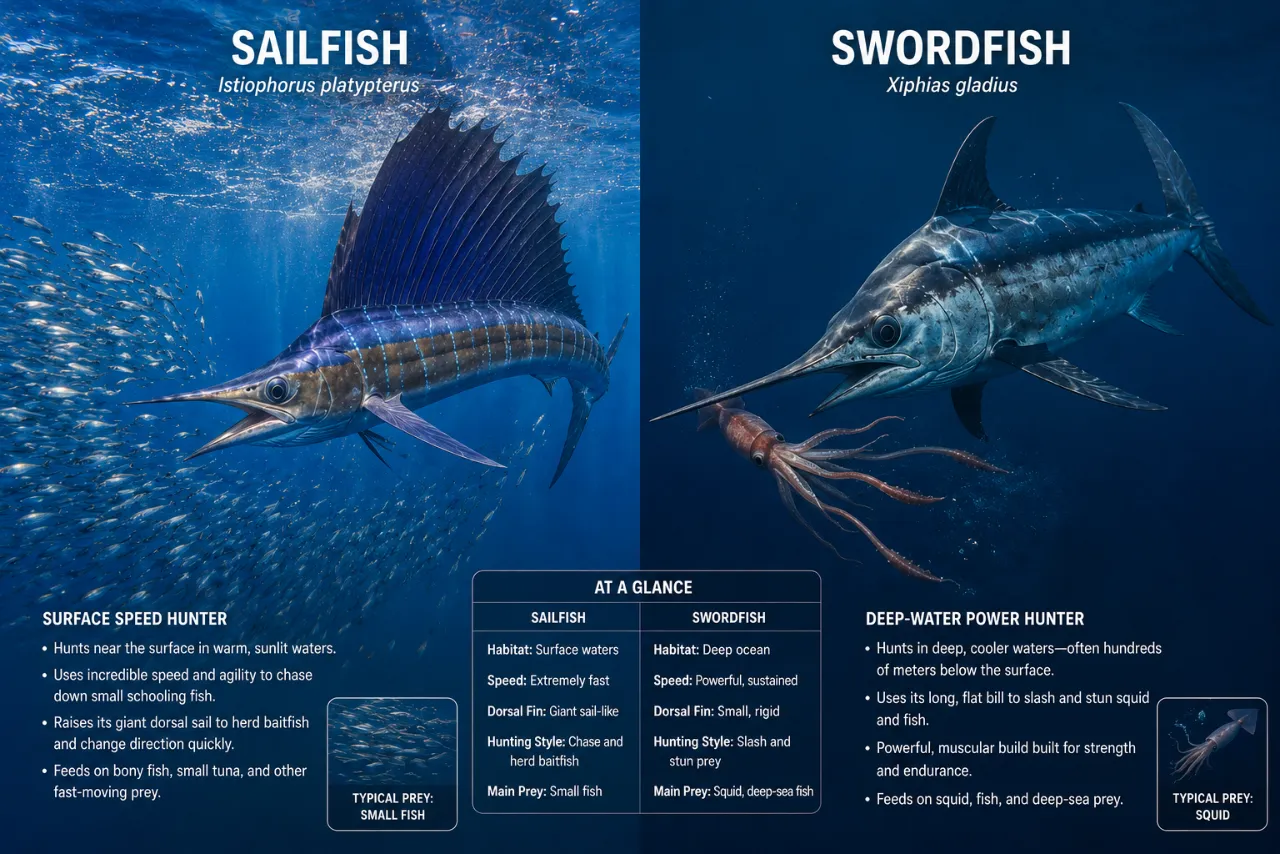
Sailfish are usually associated with warm surface waters in tropical and subtropical oceans. They often occur near currents, reefs, drop-offs, and areas where small fish gather. Because they frequently hunt near the surface, they are more likely to be seen leaping, chasing baitfish, or raising their sail during feeding behavior.
Swordfish have a broader vertical range. They are open-ocean predators that can dive into deep, cold water and return toward warmer surface layers. Their large eyes and specialized adaptations help them hunt in dimmer environments where squid and deep-water fish may be found.
This habitat difference is important: sailfish are more surface-oriented, while swordfish are stronger deep-water hunters.
Diet and Hunting Behavior
Sailfish mostly eat small fish and squid. They often hunt schooling prey near the surface. In some situations, sailfish may work loosely together, using their bodies and sails to herd baitfish into tighter groups. Once the prey school is compressed, individual sailfish slash with their bills and pick off injured or separated fish.
Swordfish eat fish and squid, including prey found in deeper waters. They are often solitary hunters. Their sword-like bill can slash through prey schools or strike individual animals. Swordfish are powerful predators that can move through different depth zones, following prey that sailfish may not regularly pursue.
Body Color and Markings
Sailfish are often more visually striking than swordfish. They may show dark blue or metallic blue tones along the back, silvery sides, and vertical bars that become more visible during excitement or hunting. Their large dorsal sail may also show spots or dark markings.
Swordfish are usually darker above and lighter below, a common pattern called countershading. This helps open-ocean fish blend with dark depths when viewed from above and with brighter surface light when viewed from below. Adult swordfish are generally less colorful and less patterned than sailfish.
Behavior at the Surface
Sailfish are famous for dramatic surface behavior. They may leap, raise their sails, and chase prey in highly visible feeding events. This makes them popular among wildlife photographers, anglers, and ocean documentaries.
Swordfish can also come near the surface and may leap, but they are less defined by surface displays. Much of their hunting life happens in deeper or more open water. Their behavior is often harder for people to observe directly.
Sailfish vs Swordfish: Who Would Win?
A direct fight between a sailfish and a swordfish is not a normal ecological event. They are both predators, but they do not usually seek combat with each other. If such an encounter happened, the outcome would depend on size, age, condition, and environment.
A sailfish would have the advantage in agility, speed, and quick turning near the surface. It is built for rapid pursuit and fast directional changes. A swordfish would have the advantage in body mass, strength, and the broader, heavier bill. A large adult swordfish would likely be the more powerful animal in a physical confrontation.
The most scientific answer is that sailfish are better adapted for speed and group-style surface hunting, while swordfish are better adapted for power, depth, and solitary predation.
Are Sailfish and Swordfish Related?
Sailfish and swordfish are both commonly called billfish because they have elongated upper jaws, but they belong to different families. Sailfish belong to the family Istiophoridae, which includes marlins and spearfishes. Swordfish belong to the family Xiphiidae and are the only living species in that family.
This means a sailfish is more closely related to marlins than to swordfish. The swordfish is a more distinct lineage with its own unique body plan, especially the flattened bill and reduced adult dorsal fin.
How to Identify One in a Photo
When looking at a photo, use these simple clues:
Look at the dorsal fin. A giant sail-like fin means sailfish.
Look at the bill. A broad, flat, blade-like bill means swordfish.
Look at the body. A slim, elegant body suggests sailfish; a thick, muscular body suggests swordfish.
Look at the color. Bright blue tones and vertical bars are more typical of sailfish.
Look at the setting. A fish shown herding bait near the surface is more likely a sailfish; a large deep-ocean predator with a heavy body is more likely a swordfish.
Common Misidentifications
Sailfish and swordfish are sometimes confused with marlins because all three have long bills and fast, open-ocean lifestyles. However, marlins usually have a rounder bill like sailfish but lack the extremely tall sail-like dorsal fin. Swordfish are easier to separate because their bill is flatter and their adult dorsal fin is smaller.
A useful identification order is: first check for the giant sail. If it is present, think sailfish. If there is no giant sail, check the bill. If the bill is flat and sword-like, think swordfish. If the bill is rounder and the fish is large and powerful, it may be a marlin.
Conservation and Human Impact
Both sailfish and swordfish are important ocean predators, but they also face pressure from fishing. Swordfish are commercially valuable and are caught for seafood markets around the world. Sailfish are often prized in recreational sport fishing, with many fisheries encouraging catch-and-release practices.
Major concerns include overfishing, bycatch, habitat shifts, and the broader effects of changing ocean conditions. Because these fish travel widely across international waters, effective management often requires cooperation between countries and regional fisheries organizations.
Final Comparison
Sailfish and swordfish may look similar at first because both are fast ocean predators with long bills, but their differences are easy to see once you know what to look for. The sailfish is the slender, surface-hunting speed specialist with a giant dorsal sail. The swordfish is the heavier, deeper-diving power predator with a flat blade-like bill.
If you see a dramatic sail on the back, it is a sailfish. If you see a muscular fish with a true sword-shaped bill and a smaller dorsal fin, it is a swordfish.
Related Animal Comparisons
Marlin vs Swordfish
Sailfish vs Marlin
Tuna vs Swordfish
Shark vs Swordfish
Mahi Mahi vs Sailfish
FAQs About Sailfish vs Swordfish
Is a sailfish the same as a swordfish?
No. Sailfish and swordfish are different species from different families. Sailfish have a huge sail-like dorsal fin, while swordfish have a broad, flattened sword-like bill and a heavier body.
Which is faster, a sailfish or a swordfish?
The sailfish is generally considered faster and is often described as one of the fastest fish in the ocean. Swordfish are also fast, but they are better known for strength, deep diving, and powerful hunting.
Which is bigger, a sailfish or a swordfish?
Swordfish are usually bigger and heavier than sailfish. Sailfish are long and slender, while swordfish have a thicker, more muscular body and can reach much greater weights.
How can you tell a sailfish from a swordfish?
The easiest clue is the dorsal fin. A sailfish has a huge sail-like fin along its back. A swordfish has a smaller dorsal fin and a long, flat bill shaped like a blade.
Do sailfish and swordfish use their bills as weapons?
Yes, both can use their bills to slash or strike prey. Sailfish often target small schooling fish near the surface, while swordfish may slash fish or squid in deeper open-ocean habitats.
Do swordfish live deeper than sailfish?
Yes. Swordfish are stronger deep divers and often move between surface waters and deeper, colder layers. Sailfish are more strongly associated with warm surface waters.
Are sailfish and swordfish related to marlins?
Sailfish are closely related to marlins because both belong to the family Istiophoridae. Swordfish are more separate and belong to their own family, Xiphiidae.
Can sailfish and swordfish be found in the same ocean?
Yes. Their ranges can overlap in warm and temperate oceans, but they often use different depths and hunting strategies.