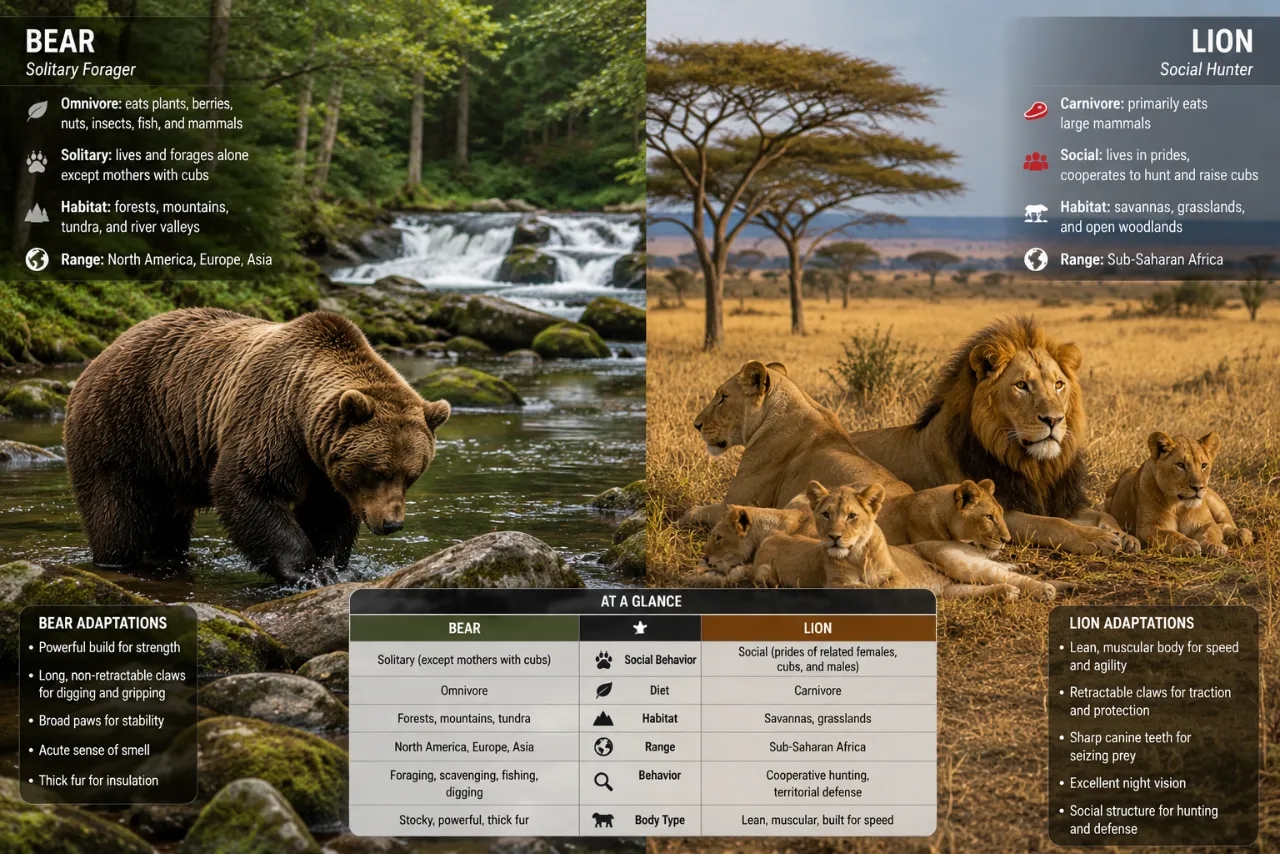
Bears and lions are both powerful mammals, but they are built for different lives. Lions are social big cats designed for speed, teamwork, and hunting large prey. Bears are heavier, stronger-bodied omnivores with massive forelimbs, long claws, and great endurance. In a direct size-and-strength comparison, a large brown bear or polar bear is usually bigger and physically stronger than a lion, while a lion is faster, more agile, and more specialized for killing prey.
Bear vs Lion Quick Answer
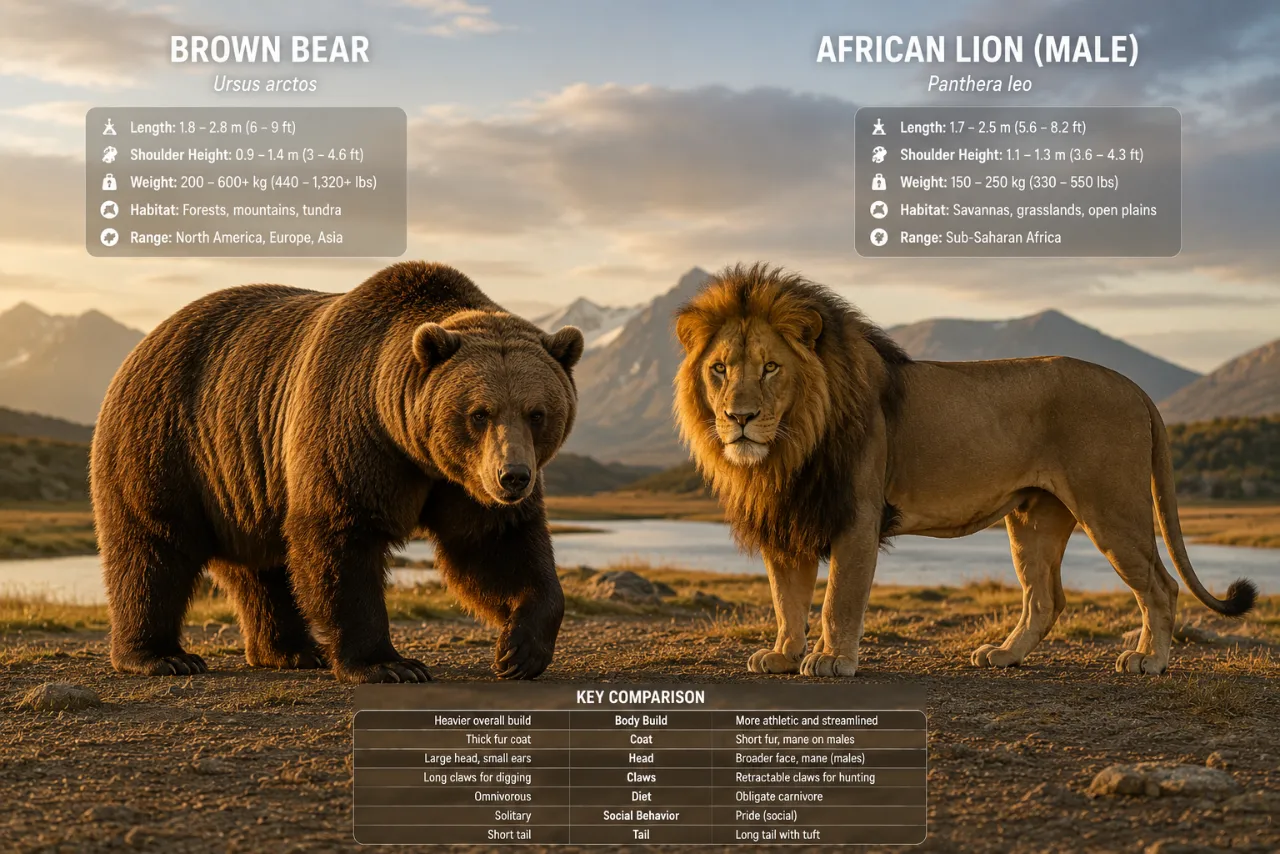
The biggest difference is lifestyle. A lion is a hypercarnivorous predator that hunts with claws, teeth, speed, and often teamwork. A bear is usually an omnivore, eating plants, fish, insects, carrion, and meat depending on species and season. Lions are more agile and better adapted for active predation, while large bears have greater body mass, stronger forelimbs, and more raw pushing power.
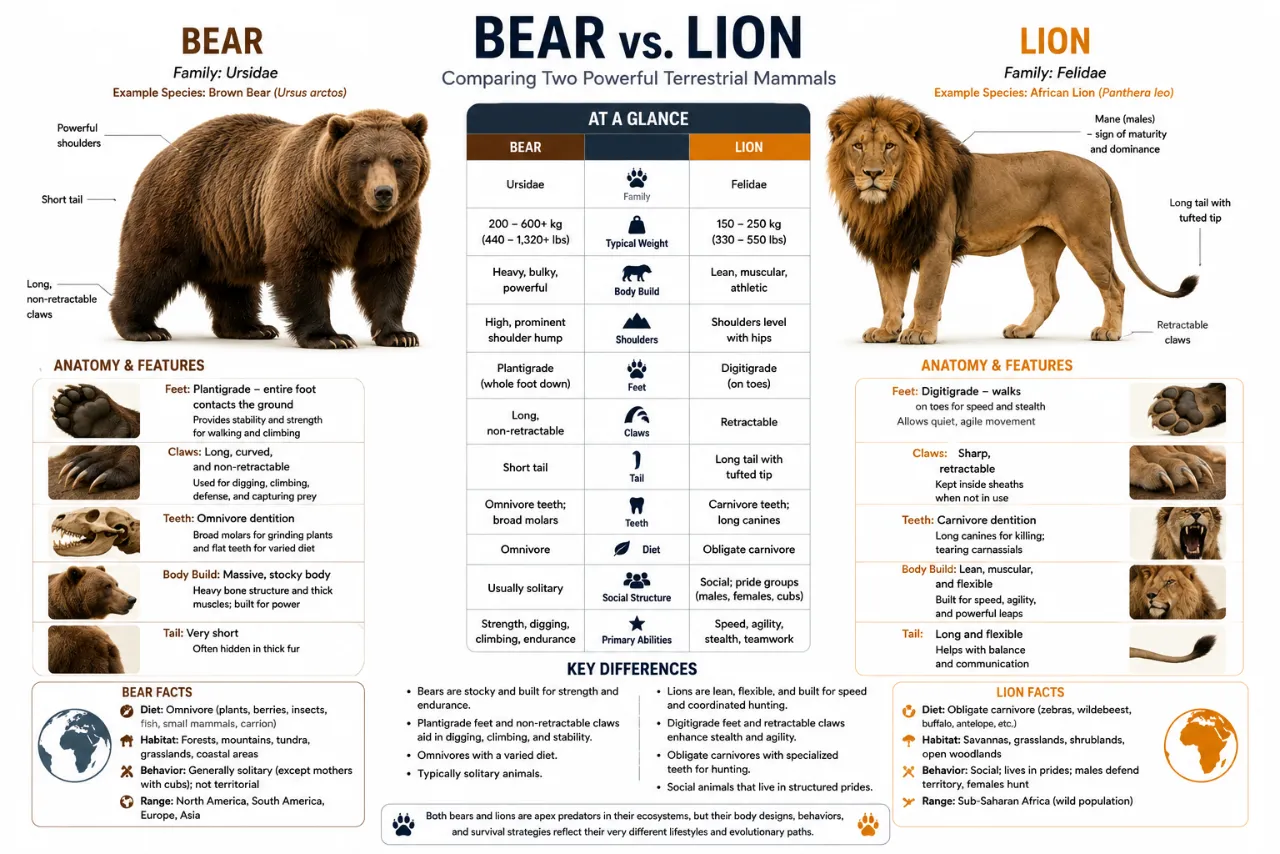
Bear vs Lion Summary Table
| Feature | Bear | Lion |
|---|---|---|
| Animal group | Family Ursidae | Family Felidae |
| Main examples | Brown bear, polar bear, American black bear, Asian black bear, sloth bear, sun bear, spectacled bear, giant panda | African lion and Asiatic lion |
| Diet | Usually omnivorous, though polar bears are mostly carnivorous and pandas mostly herbivorous | Mostly carnivorous |
| Social behavior | Mostly solitary | Highly social, living in prides |
| Body shape | Heavy, muscular, strong shoulders, plantigrade feet | Long-bodied, athletic, flexible spine, digitigrade feet |
| Main weapons | Massive forelimbs, long claws, strong bite, body weight | Canine teeth, retractable claws, speed, agility, hunting skill |
| Claws | Long, strong, non-retractable claws | Sharp, curved, retractable claws |
| Speed | Fast for short distances, but generally less agile than lions | Very fast in short bursts, especially during hunting |
| Habitat | Forests, mountains, tundra, Arctic sea ice, grasslands, and mixed habitats depending on species | Savannas, grasslands, open woodland, and dry forests |
| Hunting style | Opportunistic; some hunt large prey, many forage widely | Active predator, often hunting cooperatively |
| Most obvious difference | Heavier body, short tail, long muzzle, walking on the full sole of the foot | Cat-like body, long tail, mane in adult males, walking on toes |
What Is a Bear?
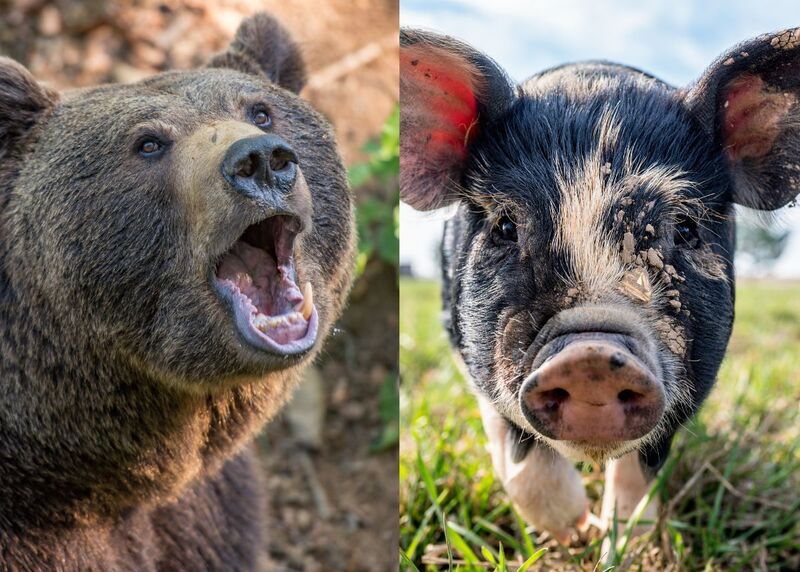
Bears are large mammals in the family Ursidae. They include brown bears, polar bears, American black bears, Asian black bears, sloth bears, sun bears, spectacled bears, giant pandas, and other regional forms. Although people often imagine bears as fierce predators, most bear species are flexible omnivores. They may eat berries, roots, nuts, insects, fish, carrion, young mammals, grasses, and human food waste when available.
Bears have heavy bodies, powerful shoulders, strong necks, long claws, and plantigrade feet, meaning they walk on the soles of their feet much like humans do. This gives them stability and strength. Some bears can climb, dig, swim, fish, break logs, overturn rocks, or travel long distances in search of seasonal food.
What Is a Lion?
The lion is a large cat in the genus Panthera. It is one of the most famous predators in the world and is best known for living in prides, especially in African savannas and open woodlands. Adult males are recognized by their mane, while females are usually the main hunters in many prides.
Lions are specialized carnivores. Their bodies are built for stalking, sprinting, grappling, and killing large prey. They have retractable claws, powerful jaws, sharp canine teeth, strong shoulders, and flexible bodies. Unlike most bears, lions are highly social. Pride life allows lions to defend territories, raise cubs cooperatively, and hunt animals larger than a single lion could easily handle alone.
Size Comparison
Size depends heavily on which bear species is being compared with which lion. This is important because “bear vs lion” is not a single simple comparison.
A large male African lion usually weighs far less than the biggest bears. Many adult male lions weigh roughly 150 to 250 kilograms, while females are smaller. By contrast, large brown bears, Kodiak bears, and polar bears can be much heavier. Some large adult males can weigh several hundred kilograms, and exceptional individuals may be far heavier than any lion.
However, not all bears are larger than lions. Sun bears, spectacled bears, sloth bears, and many black bears may be smaller than a large male lion. So the best answer is: a large brown bear or polar bear is usually much bigger than a lion, but smaller bear species are not.
Body Shape and Appearance
Bears and lions look powerful in very different ways. A bear has a thick body, broad head, strong neck, heavy limbs, and a short tail. Its back may slope upward toward the shoulders, especially in brown bears with a muscular shoulder hump. Bears look compact, heavy, and ground-based.
A lion has a longer, more athletic body with a flexible spine, long tail, deep chest, and strong hindquarters. A male lion’s mane makes the head and neck look even larger. Lions look more like sprinting hunters, while bears look more like weight-bearing power animals.
The feet are also different. Bears are plantigrade, walking on the full sole of the foot. Lions are digitigrade, walking on their toes. This helps lions move quietly and accelerate quickly, while bears gain stability and strength.
Claws: Digging Power vs Killing Grip
Bear claws and lion claws are designed for different jobs. Bear claws are usually long, strong, and non-retractable. They are excellent for digging, tearing open logs, catching fish, climbing in some species, and gripping the ground. Brown bears and grizzlies have especially long front claws useful for digging roots and excavating dens.
Lion claws are sharp, curved, and retractable. This keeps them sharper for gripping prey. When a lion attacks, the claws help hold onto an animal while the jaws target the throat, muzzle, or neck area. Lion claws are not as long and digging-focused as bear claws, but they are more specialized for predatory gripping.
In simple terms, bear claws are stronger tools, while lion claws are sharper hunting weapons.
Bite Force and Teeth
Both animals have dangerous jaws, but their teeth reflect different diets. Lions have long canine teeth and carnassial teeth adapted for slicing meat. Their bite is designed to grip, suffocate, and process flesh. A lion’s killing method often depends on holding prey with the forelimbs and delivering a targeted bite.
Bears have strong jaws and a more mixed set of teeth. Because most bears eat both plant and animal foods, their molars are broader and better suited for crushing and grinding than those of a strict carnivore. Large bears still have powerful canine teeth and can bite with tremendous force, especially species such as brown bears and polar bears.
Rough bite-force estimates vary by source and method, but large bears are generally considered to have stronger absolute bite force than lions because of their larger skulls, jaw muscles, and body size. Lions, however, have a more specialized predator bite.
Speed and Agility
Lions are faster and more agile than most bears in short hunting bursts. Their bodies are built for explosive acceleration, quick turns, and coordinated attacks. A lion can sprint rapidly over short distances, but it cannot keep that speed for long.
Bears can also run surprisingly fast, especially over short distances, but they are usually less agile than lions. A large bear has tremendous strength, but its heavy body is not designed for the same kind of cat-like turning and leaping. Bears are powerful movers, not precision sprinters.
If the comparison is short-distance speed and hunting agility, the lion has the advantage. If the comparison is strength, endurance in rugged terrain, and physical force, a large bear has the advantage.
Strength and Power
A large bear is usually stronger than a lion in raw physical terms. Bears have massive shoulders, strong forelimbs, heavy bones, and great body weight. They can dig through soil, roll heavy objects, break into logs, drag carcasses, and overpower many animals through sheer strength.
A lion is extremely strong for its body size, but its power is more athletic and predatory. Lions are built to tackle prey, grip with the claws, and deliver a killing bite. Their strength is combined with speed, coordination, and hunting technique.
So the difference is not simply “strong vs weak.” A bear is stronger like a heavyweight wrestler. A lion is stronger like an explosive sprinter and grappler.
Hunting Style
Lions are active predators. They commonly hunt antelope, zebra, buffalo, wildebeest, warthogs, and other mammals. Lionesses often hunt together, using stalking, positioning, and teamwork. Male lions also hunt, especially when alone or in coalitions, and they can be powerful hunters of large prey.
Bears are more opportunistic. Some bears hunt large mammals, but many spend much of their time feeding on plants, insects, fish, carrion, or seasonal foods. Brown bears may hunt young ungulates, catch salmon, scavenge carcasses, or steal kills from other predators. Polar bears are the most carnivorous bears and are highly specialized for hunting seals.
Lions are more specialized hunters. Bears are more flexible survivalists.
Social Behavior
One of the clearest differences is social life. Lions are the most social of the big cats. A pride may include related females, cubs, and one or more adult males. This social structure helps lions defend territory and raise young.
Bears are mostly solitary. Mothers stay with cubs, and bears may gather at rich food sources such as salmon streams, but they do not form cooperative prides like lions. Adult bears usually avoid each other outside of mating or food-rich situations.
This matters because a single lion is powerful, but lions often succeed because of group behavior. A bear’s survival strategy is usually based on individual strength, memory, seasonal movement, and food flexibility.
Habitat and Range
Lions today live mainly in sub-Saharan Africa, with a small wild population of Asiatic lions in India. They prefer savannas, grasslands, open woodlands, and dry forests where prey is available and hunting visibility is good.
Bears have a much wider habitat range as a group. Brown bears live in forests, mountains, tundra, and open landscapes across parts of North America, Europe, and Asia. Polar bears live in Arctic sea-ice ecosystems. Black bears are highly adaptable forest animals. Sun bears live in tropical forests. Spectacled bears live in the Andes. Giant pandas live in bamboo forests in China.
Lions are more associated with open hunting landscapes. Bears, as a group, occupy a wider variety of environments.
Bear vs Lion: Who Would Win?
A real bear-versus-lion fight is not a normal natural event. Lions and most bears do not share the same habitats today, and animals do not fight for entertainment. Any outcome would depend on species, size, age, sex, health, terrain, and motivation.
If the comparison is a male lion against a large brown bear, Kodiak bear, or polar bear, the bear would usually have a major advantage in size, strength, durability, and forelimb power. A large bear may be two or more times the weight of a lion. That difference matters greatly in a physical clash.
However, the lion has advantages in agility, speed, predatory technique, and targeted biting. Against a smaller bear species, a large male lion could be the more dangerous combatant. Against a large bear, the lion would face a much heavier and stronger animal.
The most scientific answer is: a large bear would usually have the physical advantage, while the lion is the more specialized predator.
Would Bears and Lions Meet in the Wild?
Modern African lions do not naturally meet brown bears or polar bears. Their ranges are separated by geography and habitat. Asiatic lions live in India, where they do not normally overlap with the world’s largest bear species in a way that would make direct conflict common.
In prehistoric and historical contexts, different large carnivores sometimes overlapped more than they do today. But for modern wildlife, bear-versus-lion encounters are not a normal ecological relationship.
Ecological Role
Lions are apex predators. They shape prey behavior, compete with hyenas and other carnivores, and influence savanna ecosystems through predation. Their hunting can affect where herbivores graze, how prey animals group together, and how scavengers access carcasses.
Bears play more varied ecological roles. They can be predators, scavengers, seed dispersers, soil diggers, salmon transporters, and ecosystem engineers. For example, brown bears feeding on salmon can move marine nutrients into forests. Bears also spread seeds through their droppings after eating berries and fruits.
Lions mainly influence ecosystems as predators. Bears influence ecosystems as omnivores, scavengers, diggers, and seasonal foragers.
Conservation Status
Lions have declined greatly across their historic range due to habitat loss, conflict with humans, prey decline, and illegal killing. They now occupy only a fraction of their former range. Conservation efforts focus on protecting habitat, reducing livestock conflict, maintaining prey populations, and supporting local communities.
Bear conservation varies by species. Some bear populations are stable or recovering in protected regions, while others are threatened by habitat loss, poaching, climate change, or conflict with humans. Polar bears face serious long-term pressure from shrinking sea ice. Giant pandas have benefited from intensive conservation work, though habitat fragmentation remains important. Sun bears and Asiatic black bears face threats from forest loss and wildlife trade.
Both lions and bears show that large mammals need space, prey or food resources, and reduced conflict with people to survive.
How to Tell a Bear from a Lion Quickly
If the animal has a mane, a long tail, and a cat-like body, it is a lion.
If the animal has a short tail, heavy body, long muzzle, and broad paws, it is a bear.
If it walks on its toes with retractable claws, it is a lion.
If it walks on the full sole of the foot with long non-retractable claws, it is a bear.
If it lives in a pride and hunts cooperatively, it is a lion.
If it lives mostly alone and eats a wide range of foods, it is probably a bear.
Final Comparison
Bears and lions are both impressive large mammals, but they represent different evolutionary designs. The lion is a social big cat built for speed, precision, and cooperative hunting. The bear is a powerful, heavy-bodied omnivore built for strength, endurance, digging, foraging, and survival across changing seasons.
In a simple comparison, a lion is faster, more agile, and more predatory. A large bear is heavier, stronger, and more physically powerful. Neither animal is “better” overall; each is highly adapted to its own environment and way of life.
Related Animal Comparisons
Tiger vs Lion
Grizzly Bear vs Polar Bear
Bear vs Gorilla
Lion vs Hyena
Wolf vs Lion
Cougar vs Lion
FAQs About Bear vs Lion
Is a bear bigger than a lion?
Many large bears are bigger than lions, especially brown bears, Kodiak bears, and polar bears. However, smaller bear species, such as sun bears, may be smaller than a large male lion.
Which is stronger, a bear or a lion?
A large bear is usually stronger in raw physical power because it has greater body mass, stronger forelimbs, and heavier bones. A lion is more agile and more specialized for hunting.
Which is faster, a bear or a lion?
A lion is generally faster and more agile in short hunting bursts. Bears can also run surprisingly fast, but they are usually not as quick-turning or cat-like as lions.
Would a bear beat a lion?
A large brown bear, Kodiak bear, or polar bear would usually have a major size and strength advantage over a lion. Against smaller bear species, a large male lion could be the stronger predator.
Do bears and lions live in the same place?
Modern lions and the largest bear species usually do not share the same habitats. Lions mainly live in Africa and a small part of India, while large bears live in northern forests, mountains, tundra, and Arctic regions.
Are lions better hunters than bears?
Lions are more specialized hunters and often hunt cooperatively. Bears are more opportunistic and flexible, eating plants, insects, fish, carrion, and meat depending on species and season.
Does a lion have sharper claws than a bear?
Lion claws are sharper and retractable, making them excellent for gripping prey. Bear claws are usually longer, stronger, and better for digging, tearing, climbing in some species, and gripping the ground.
Which animal has a stronger bite?
Large bears generally have stronger absolute bite force than lions because of their larger skulls and jaw muscles. Lions, however, have teeth and hunting behavior highly specialized for killing prey.