An Asian lady beetle is technically a type of ladybug, but it is not the same as many native ladybugs people know from gardens. Asian lady beetles are more variable in color, often have a black “M” or “W” mark behind the head, may gather inside homes in autumn, can bite lightly, and release a yellow defensive fluid. Most native ladybugs are less likely to invade houses.
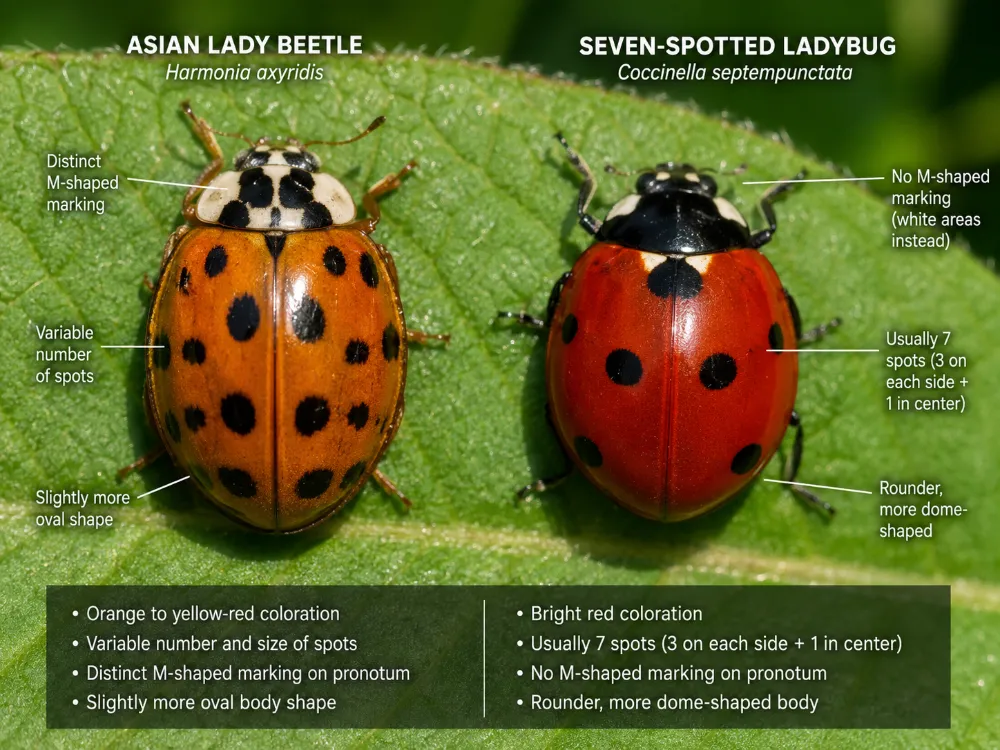
Asian Lady Beetle vs Ladybug Summary Table
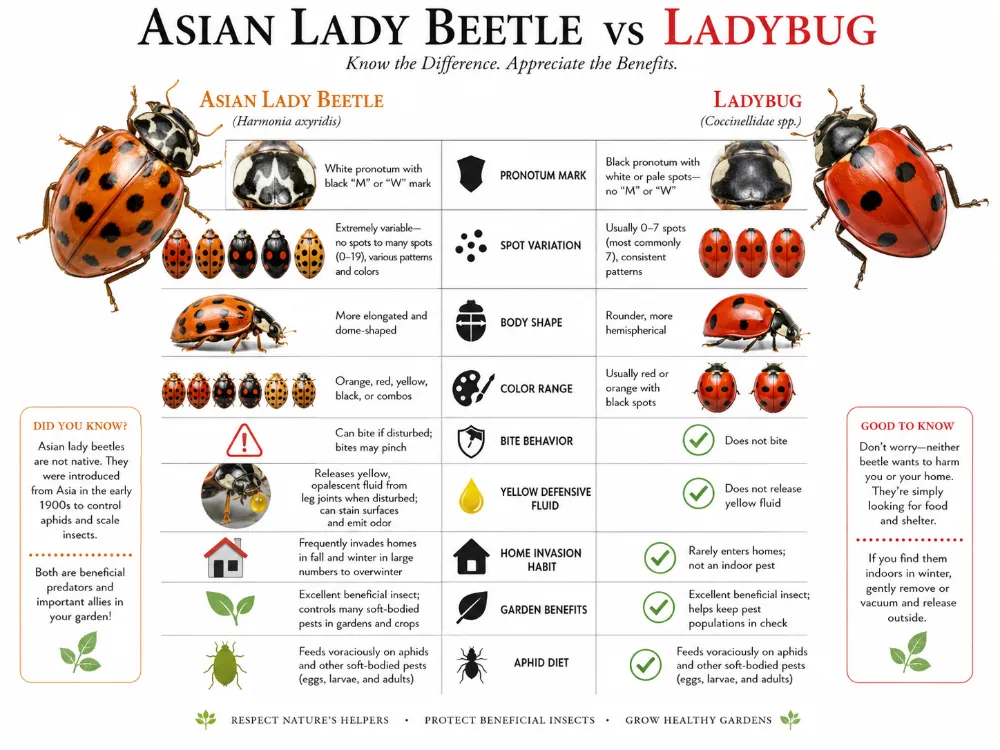
| Feature | Asian Lady Beetle | Ladybug |
|---|---|---|
| Scientific meaning | Usually refers to the multicolored Asian lady beetle, Harmonia axyridis | Common name for many beetles in the family Coccinellidae |
| Is it a ladybug? | Yes, it is a kind of lady beetle or ladybug | General term that includes many species |
| Common comparison | Often compared with native ladybugs | Often used to mean native or familiar garden ladybugs |
| Color | Very variable: orange, red, yellowish, tan, or almost black | Often red or orange with black spots, but varies by species |
| Spots | May have many spots, few spots, or no spots | Spot number depends on species; often more consistent within a species |
| Head marking | Often has a black “M” or “W” shaped mark on the pale pronotum behind the head | Usually lacks the strong Asian lady beetle-style M/W marking |
| Body shape | Often slightly larger and more oval | Often rounder and more dome-shaped, depending on species |
| Autumn home invasion | Commonly gathers on buildings and enters homes to overwinter | Many native ladybugs are less likely to invade homes in large numbers |
| Biting | Can give a small, mild bite or pinch | Most familiar ladybugs rarely bite people |
| Defensive fluid | Releases yellowish fluid that can smell bad and stain surfaces | Many ladybugs can release defensive fluid, but Asian lady beetles are especially noticeable indoors |
| Garden role | Feeds on aphids and other soft-bodied pests | Many species are beneficial predators of aphids, scale insects, mites, and other pests |
| Main concern | Indoor nuisance, odor, staining, biting, and competition with native species | Usually viewed as beneficial garden insects |
What Is an Asian Lady Beetle?
The Asian lady beetle, often called the multicolored Asian lady beetle, is a species of lady beetle with the scientific name Harmonia axyridis. It is native to parts of Asia but has been introduced to many other regions, partly because it eats aphids and other plant pests.
In gardens and farms, Asian lady beetles can be useful predators. They feed on aphids, scale insects, and other soft-bodied insects that damage plants. This is why they were once welcomed as biological control insects in some areas.
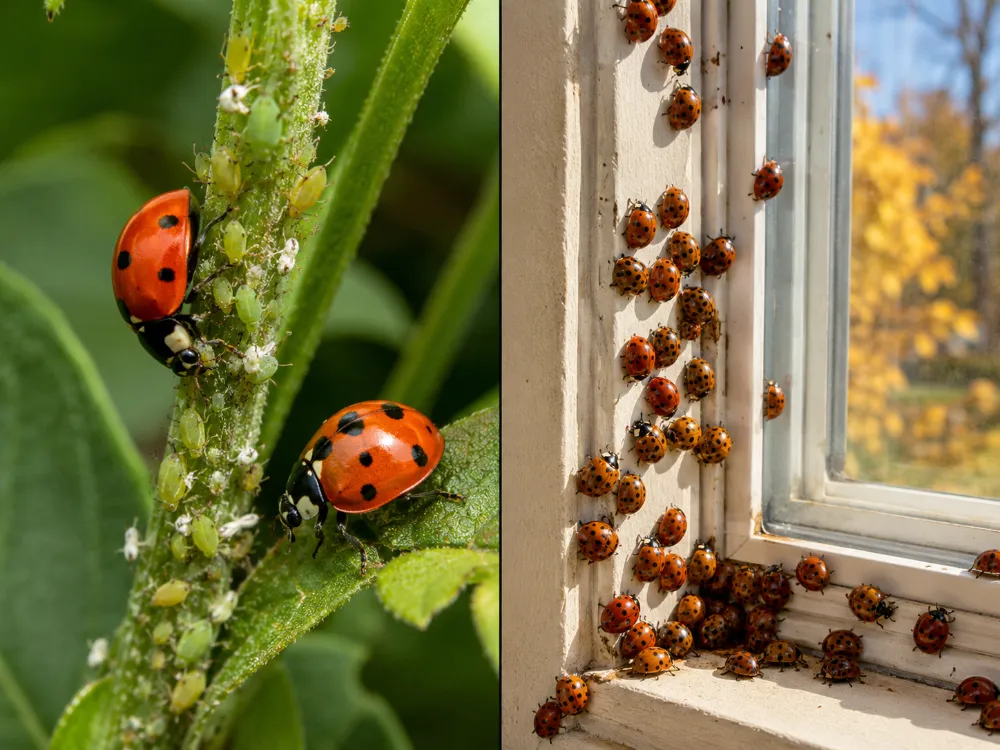
However, Asian lady beetles are also famous for becoming indoor pests. In autumn, they may gather on sunny walls, windows, attics, and rooflines, then enter homes to overwinter. Once inside, they can release a yellow defensive fluid, produce a noticeable odor, stain surfaces, and sometimes bite people lightly.
What Is a Ladybug?
“Ladybug” is a common name, not a single species. In North America, people often say ladybug, while “ladybird” is more common in British English. Scientists often use the term “lady beetle” because these insects are beetles, not true bugs.
Ladybugs belong to the family Coccinellidae. This family includes thousands of species around the world. Many are small, rounded beetles with red, orange, yellow, black, or patterned wing covers. Some have spots, some have stripes, and some have no obvious markings.
Most ladybugs are beneficial predators as both larvae and adults. They eat aphids, mealybugs, scale insects, mites, insect eggs, and other small pests. This makes them important allies in gardens, farms, orchards, and natural ecosystems.
Is an Asian Lady Beetle a Ladybug?
Yes. An Asian lady beetle is a ladybug in the broad common-language sense. It belongs to the same family as other lady beetles. The confusion comes from how people use the word “ladybug.”
When people search for “Asian lady beetle vs ladybug,” they usually mean “Asian lady beetle vs native ladybug” or “Asian lady beetle vs the familiar red garden ladybug.” Scientifically, the Asian lady beetle is not outside the ladybug group. It is one species within that group.
The more accurate comparison is between the multicolored Asian lady beetle and other lady beetle species, especially native or non-invasive garden species.
Color Differences
Asian lady beetles are highly variable in color. They may be orange, red, yellowish, tan, or even very dark. Some individuals have many black spots, some have only a few, and some have no spots at all. This wide variation is one reason they are called “multicolored” Asian lady beetles.
Many familiar ladybugs are red or orange with black spots, but this is not true for every species. Some native lady beetles are black with red spots, yellow with black markings, or patterned in other ways.
Color alone is not enough to identify an Asian lady beetle. A red beetle is not automatically a native ladybug, and an orange beetle is not automatically an Asian lady beetle. Markings near the head are usually more helpful.
The M or W Mark Behind the Head
The most useful field mark for the Asian lady beetle is the dark marking on the pronotum, the small shield-like area behind the head. Many Asian lady beetles have a black mark shaped like an “M” or “W” on a pale or whitish background.
This marking is not always perfect, and individuals vary, but it is one of the best quick clues. If you see an orange or red lady beetle with a strong black M-shaped mark behind the head, it is likely an Asian lady beetle.
Many other ladybug species do not have this same bold M/W pattern. They may have different spots, patches, or head markings depending on the species.
Spot Differences
Asian lady beetles can have many spots, few spots, or no spots. Some individuals have nineteen or more visible spots, while others look almost spotless. This makes spot counting unreliable if used alone.
Other ladybug species may have more predictable spot patterns. For example, some species are named for their number of spots. However, even in other species, spots can vary with age, genetics, wear, or individual differences.
When identifying lady beetles, use spots together with body shape, head markings, color, size, and behavior.
Body Shape and Size
Asian lady beetles are often slightly larger and more oval than many familiar native ladybugs. Their body may look elongated compared with the round, dome-like shape people often associate with classic ladybugs.
Many native ladybugs are rounder and more compact, though this depends strongly on the species. Some native lady beetles are small and circular, while others are oval or elongated.
Body shape helps, but it is not a perfect identification feature. The M/W mark behind the head and the tendency to gather in homes are often more noticeable clues.
Behavior Differences
One of the biggest differences is behavior around buildings. Asian lady beetles often gather in large numbers on sunny walls in autumn. They are attracted to light-colored buildings, warm surfaces, cracks, window frames, vents, rooflines, and attic spaces. They enter homes to survive winter.
Many other ladybugs overwinter outdoors under leaves, bark, logs, grass clumps, rocks, or natural shelters. Some may enter buildings occasionally, but they usually do not create the same large indoor nuisance as Asian lady beetles.
If dozens or hundreds of ladybug-like beetles appear inside a house in fall or winter, Asian lady beetles are a strong possibility.
Do Asian Lady Beetles Bite?
Asian lady beetles can bite or pinch human skin, but they are not blood-feeding insects. Their bite is usually mild and feels like a small prick or pinch. They do not bite to feed on people.
The biting behavior may happen when beetles are disturbed, trapped against skin, or crawling indoors. For most people, it is only a minor irritation. However, some people may experience skin irritation, allergic reactions, or respiratory discomfort when many beetles are present indoors.
Most familiar ladybugs rarely bite people, although any small beetle with mouthparts may pinch under unusual conditions.
Do Ladybugs Bite?
Most ladybugs do not commonly bite humans. They are predators of small insects, not people. If handled roughly, some may pinch the skin, but this is usually harmless.
The reason Asian lady beetles are more often associated with biting is not because they are dangerous predators of humans. It is because they gather indoors in large numbers, increasing the chance of contact with people.
In normal garden situations, ladybugs are best observed rather than handled.
Yellow Fluid and Odor
Asian lady beetles can release a yellowish defensive fluid from their leg joints. This behavior is called reflex bleeding. The fluid contains defensive chemicals that taste bad to predators and can produce a strong odor.
This yellow fluid may stain walls, curtains, furniture, clothing, or window frames. It is one reason Asian lady beetles become unpleasant indoor guests.
Other ladybugs can also release defensive fluids, but Asian lady beetles are especially noticeable because they often enter houses in large numbers.
Are Asian Lady Beetles Harmful?
Asian lady beetles are not dangerous in the same way as venomous insects. They do not sting, spread disease like mosquitoes, or feed on human blood. However, they can be nuisance pests indoors.
Their main problems are odor, staining, mild biting, allergic reactions in some people, and large overwintering clusters inside homes. In vineyards, they can also become a problem if accidentally crushed with harvested grapes, because their defensive chemicals may affect wine quality.
Ecologically, they may compete with native lady beetles and other beneficial insects. This is one reason they are often considered both useful and problematic.
Are Ladybugs Beneficial?
Yes. Many ladybugs are highly beneficial because they eat plant pests. Aphids are one of their most famous foods, but many species also eat scale insects, mites, mealybugs, whiteflies, insect eggs, and other soft-bodied prey.
Both adult ladybugs and larvae can be predators. Ladybug larvae look very different from adults. They are often dark, elongated, and somewhat alligator-like in shape. Many people mistake them for pests, but they are often excellent aphid hunters.
Healthy ladybug populations can help reduce pest outbreaks in gardens, farms, orchards, and wild plant communities.
Diet and Feeding Habits
Asian lady beetles feed mainly on aphids and other soft-bodied insects. This makes them useful in agricultural and garden settings. They may also feed on pollen, nectar, fruit juices, and other small food sources when prey is scarce.
Other ladybug species have varied diets. Many are predators, but some specialize in scale insects, mites, fungi, or even plants. The common image of ladybugs as aphid eaters is mostly true, but the family is more diverse than many people realize.
In both cases, lady beetles are important small predators in plant-based ecosystems.
Life Cycle
Asian lady beetles and other ladybugs go through complete metamorphosis. Their life stages are egg, larva, pupa, and adult. Females lay clusters of yellow or orange eggs near prey-rich areas, especially near aphid colonies.
Larvae hatch and begin feeding on small insects. They do not look like adult ladybugs. Many are dark, spiny, elongated, and active hunters. After feeding and growing, they pupate on leaves, stems, or other surfaces. The adult beetle emerges later.
Newly emerged ladybugs may look pale or soft at first. Their colors and spots darken as the outer skeleton hardens.
Why Do Asian Lady Beetles Enter Homes?
Asian lady beetles enter homes because they are searching for protected overwintering sites. In nature, they may overwinter in cliffs, rock crevices, tree bark, or other sheltered places. Buildings can mimic these warm, protected spaces.
They are often attracted to sunny, light-colored, or south-facing walls. Once they find cracks or gaps around windows, doors, siding, vents, rooflines, or utility openings, they may move inside.
They do not come indoors to reproduce, eat wood, or infest food. They are mainly looking for winter shelter.
How to Keep Asian Lady Beetles Out of a House
The best control method is prevention. Seal cracks, gaps, and openings before autumn. Check window frames, door sweeps, attic vents, siding gaps, roof edges, and utility entry points. Screens should fit tightly and damaged screens should be repaired.
If beetles are already indoors, vacuuming is usually better than crushing them. Crushing can release odor and yellow stains. A vacuum bag or container should be emptied promptly so beetles do not escape back indoors.
For a wildlife-friendly approach, avoid unnecessary pesticide use outdoors because many lady beetles are beneficial predators. Focus first on exclusion and sealing entry points.
Native Ladybugs vs Asian Lady Beetles
Native ladybugs are often valued because they help control garden pests without becoming major indoor nuisances. However, many native lady beetle species have declined in some regions because of habitat change, pesticide use, competition, disease, and introduced species.
Asian lady beetles are successful because they reproduce well, eat many kinds of prey, tolerate different habitats, and use buildings for overwintering. These traits make them effective survivors but also make them difficult neighbors for humans.
The goal should not be to dislike all ladybugs. Instead, it is useful to understand which species are present and how their behavior differs.
Asian Lady Beetle vs Ladybug Larvae
Ladybug larvae can be confusing. They do not look like round red beetles. Many look like tiny black or gray alligators with orange markings. Asian lady beetle larvae are also predatory and feed on aphids and other soft-bodied insects.
Because larvae are active pest predators, they should not be killed simply because they look unusual. If they are on garden plants near aphids, they are probably helping.
The adult stage is usually easier to identify than the larval stage, especially for non-specialists.
Do Asian Lady Beetles Harm Plants?
Asian lady beetles usually help plants by eating aphids and other pests. They do not normally damage healthy plant leaves the way many plant-feeding insects do.
However, they may feed on soft fruits or damaged fruit when insect prey is scarce. They can also become a problem during fruit harvests if large numbers are accidentally collected with crops.
In most gardens, their plant-protection role is real. The main conflict with humans happens indoors, not on outdoor plants.
Do Asian Lady Beetles Kill Native Ladybugs?
Asian lady beetles can compete with native lady beetles for food and habitat. They may also prey on eggs, larvae, or pupae of other lady beetles in some situations. This kind of intraguild predation is common among small insect predators.
The decline of native ladybugs cannot be blamed on one factor alone. Habitat loss, pesticides, changes in agriculture, introduced species, and climate effects may all play roles.
Still, Asian lady beetles are often considered one pressure on native lady beetle communities because they are aggressive, adaptable, and highly successful.
Are Orange Ladybugs Always Asian Lady Beetles?
No. Orange color alone does not prove that a beetle is an Asian lady beetle. Some native ladybugs are also orange, yellowish, or variable in color.
To identify an Asian lady beetle, look for the pale pronotum behind the head with a dark M- or W-shaped mark. Also consider behavior. Large numbers entering homes in autumn strongly suggest Asian lady beetles.
Color is only one clue. Markings and behavior are usually better.
Are Asian Lady Beetles Bad?
Asian lady beetles are not simply “bad.” They are beneficial predators outdoors because they eat many plant pests. Farmers and gardeners may benefit from their appetite for aphids.
At the same time, they can be invasive, compete with native species, invade homes, release unpleasant odors, stain surfaces, and occasionally bite. This makes them a mixed species from a human perspective.
They are helpful in the garden but annoying in the house.
How to Tell an Asian Lady Beetle from a Ladybug Quickly
Look for the M/W mark: Asian lady beetles often have a black M- or W-shaped mark behind the head.
Check the color range: Asian lady beetles may be orange, red, yellowish, tan, or dark.
Do not rely only on spots: Asian lady beetles may have many spots, few spots, or no spots.
Watch the behavior: large fall clusters on houses usually suggest Asian lady beetles.
Notice indoor problems: odor, yellow stains, and mild biting are more associated with Asian lady beetles.
Remember the taxonomy: Asian lady beetles are ladybugs, but not all ladybugs are Asian lady beetles.
Asian Lady Beetle vs Ladybug: Final Comparison
The Asian lady beetle is a real ladybug, but it behaves differently from many native or familiar garden ladybugs. It is highly variable in color, often has a dark M/W mark behind the head, and commonly enters homes in autumn to overwinter. It can release yellow defensive fluid, produce odor, stain surfaces, and sometimes give a mild bite.
Other ladybugs are usually thought of as beneficial garden insects that eat aphids and rarely bother people indoors. The best quick identification clue is the M/W mark behind the head, combined with fall home-invasion behavior. Outdoors, both Asian lady beetles and many other ladybugs can help control plant pests.
FAQs About Asian Lady Beetles vs Ladybugs
Is an Asian lady beetle the same as a ladybug?
An Asian lady beetle is a type of ladybug or lady beetle. However, when people compare Asian lady beetles vs ladybugs, they usually mean Asian lady beetles vs native or familiar garden ladybugs.
What is the easiest way to identify an Asian lady beetle?
Look for a black M- or W-shaped mark on the pale area behind the head. Also look for variable orange, red, yellowish, or tan color and the habit of gathering on buildings in autumn.
Do Asian lady beetles bite?
Yes, Asian lady beetles can give a small mild bite or pinch. They do not feed on blood, and the bite is usually not serious, but it can be annoying.
Do regular ladybugs bite?
Most ladybugs rarely bite people. They may pinch if handled roughly, but they are not aggressive toward humans. Asian lady beetles are more often noticed biting because they enter homes in large numbers.
Are Asian lady beetles poisonous?
Asian lady beetles are not poisonous to touch in the usual sense, but they can release yellow defensive fluid that smells bad and may irritate some people or pets. They should not be eaten.
Why do Asian lady beetles come into houses?
They enter homes to overwinter. In autumn, they search for warm, protected spaces and may enter through cracks around windows, doors, siding, vents, and rooflines.
Do Asian lady beetles damage houses?
They do not eat wood, fabric, or stored food like some household pests. Their main problems are odor, staining, indoor clustering, and nuisance behavior.
How do I remove Asian lady beetles indoors?
Vacuum them rather than crushing them. Crushing can release odor and yellow stains. After vacuuming, empty the container or bag promptly. Long-term prevention depends on sealing entry points before autumn.
Are Asian lady beetles good for gardens?
Yes, outdoors they can be beneficial because they eat aphids and other soft-bodied plant pests. The problem is that they can also become invasive and annoying indoors.
Are all orange ladybugs Asian lady beetles?
No. Some native ladybugs are also orange. The M/W mark behind the head and the habit of entering homes in large numbers are better clues than color alone.
Do Asian lady beetles kill native ladybugs?
They can compete with native lady beetles and may eat eggs or larvae of other lady beetles in some situations. Native ladybug declines are complex and may involve habitat loss, pesticides, introduced species, and other pressures.
What do Asian lady beetles eat?
They mainly eat aphids and other soft-bodied insects. They may also feed on pollen, nectar, fruit juices, or damaged fruit when prey is limited.
Are ladybugs true bugs?
No. Ladybugs are beetles, not true bugs. Scientists often call them lady beetles because they belong to the beetle order Coleoptera.
Should I kill Asian lady beetles?
Indoors, removal by vacuuming and sealing entry points is usually better than crushing or spraying. Outdoors, they can be beneficial predators, so unnecessary pesticide use may harm helpful insects.