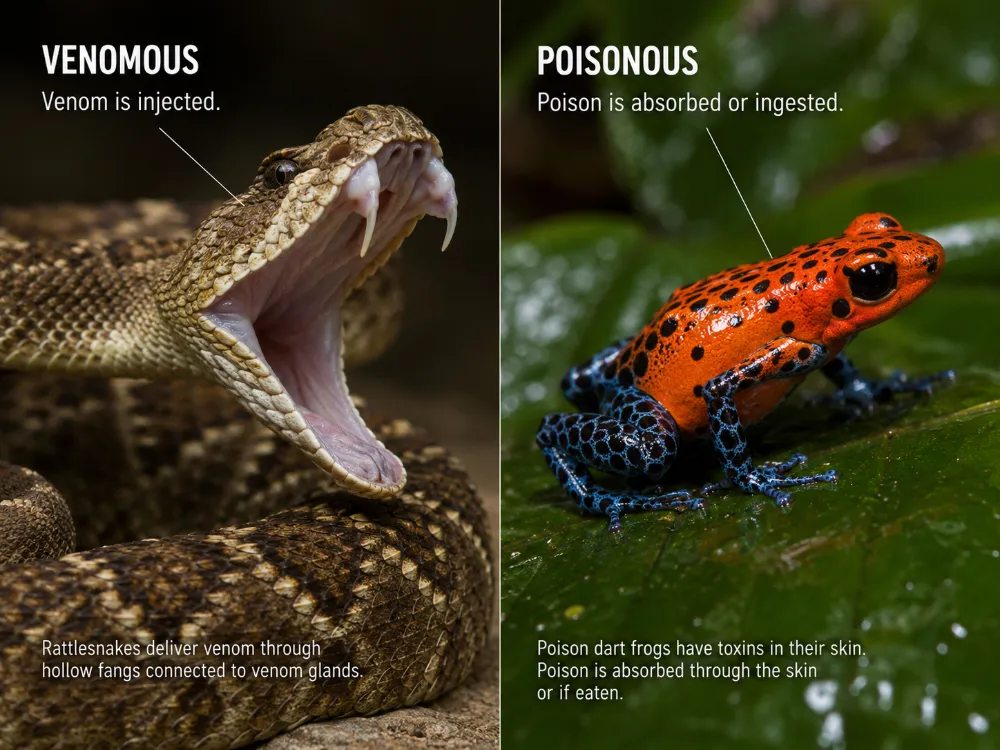
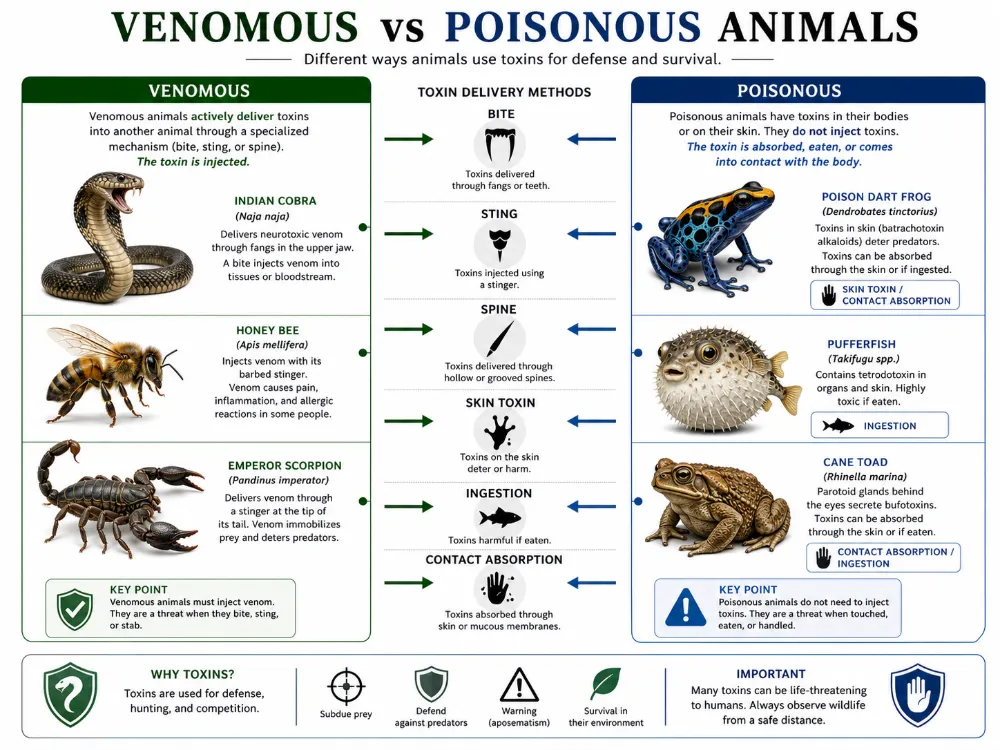
Venomous animals deliver toxins by biting, stinging, spurring, or stabbing. Poisonous animals cause harm when another animal eats, touches, or absorbs their toxins. A cobra is venomous because it injects venom through fangs. A poison dart frog is poisonous because toxins on its skin can harm a predator that touches or eats it. The key difference is delivery: venom is injected, poison is absorbed or ingested.
Venomous vs Poisonous Summary Table
| Feature | Venomous | Poisonous |
|---|---|---|
| Basic meaning | Uses venom that is actively delivered into another animal | Contains poison that harms when eaten, touched, or absorbed |
| How the toxin enters | Injection through fangs, stingers, spines, harpoons, or spurs | Ingestion, skin contact, mucous membrane contact, or absorption |
| Common delivery method | Bite, sting, stab, or puncture | Being eaten, handled, licked, or touched |
| Typical purpose | Capturing prey, defense, or both | Defense against predators |
| Examples | Rattlesnakes, cobras, bees, wasps, scorpions, spiders, cone snails | Poison dart frogs, monarch caterpillars, pufferfish, some newts, cane toads |
| Best simple rule | If it bites or stings you and you get sick, it is venomous | If you bite, eat, or touch it and you get sick, it is poisonous |
| Can it be used for hunting? | Yes, many venomous animals use venom to subdue prey | Usually no; poison is more often passive defense |
| Can it be used for defense? | Yes, many venomous animals sting or bite defensively | Yes, poison often discourages predators from eating the animal |
| Human risk | Usually from bites, stings, or puncture wounds | Usually from eating, touching, or handling the animal incorrectly |
| Scientific category | A type of toxic animal with an active delivery system | A type of toxic animal with passive or contact-based defense |
| Can an animal be both? | Yes, a few animals can be both venomous and poisonous | Yes, some species combine multiple toxin strategies |
What Does Venomous Mean?
A venomous animal is an animal that produces venom and has a way to deliver it into another animal’s body. The delivery system may be fangs, stingers, spines, modified mouthparts, harpoon-like teeth, or even specialized spurs.
Venom is usually injected through a wound. This is why venomous animals are often dangerous when they bite, sting, or puncture the skin. A rattlesnake injects venom through hollow or grooved fangs. A bee injects venom through a stinger. A cone snail uses a harpoon-like tooth to deliver venom into prey.
Venom is often used for hunting. It can immobilize prey, start digestion, stop blood clotting, affect the nervous system, or cause pain. In some animals, venom is also used defensively to discourage predators.
What Does Poisonous Mean?
A poisonous animal contains toxins that cause harm when another animal eats it, touches it, licks it, or absorbs the toxin through skin or mucous membranes. Poison does not need to be injected by the poisonous animal.
Poison dart frogs are a classic example. They do not inject venom through fangs or stingers. Instead, toxins on their skin can harm predators that try to eat or handle them. Pufferfish are another famous example because some species contain powerful toxins in their tissues.
Poison is usually a defensive strategy. The poisonous animal does not need to chase, bite, or sting a predator. The predator learns, sometimes fatally, that the animal is dangerous to eat.
The Simple Rule: Bite or Be Bitten
The easiest way to remember the difference is this: if the animal bites or stings you and you get sick, it is venomous. If you bite, eat, or touch the animal and you get sick, it is poisonous.
A venomous snake is dangerous because it can bite and inject venom. A poisonous frog is dangerous because its skin contains toxins. A venomous scorpion actively stings. A poisonous newt may be dangerous if a predator tries to eat it.
This rule is simple, memorable, and accurate for most everyday examples.
Venom, Poison, and Toxin
The word “toxin” is the broadest term. A toxin is a harmful biological chemical produced by a living organism. Venom and poison are both types of toxins, but they differ in delivery.
Venom is a toxin that is actively delivered into another body by injection. Poison is a toxin that causes harm when it is eaten, touched, or absorbed. So, all venoms and poisons are toxins, but not all toxins are delivered in the same way.
In animal biology, delivery method matters because it changes how the animal uses the toxin, how predators respond, and how humans should understand the risk.
Examples of Venomous Animals
Many well-known animals are venomous. Venomous snakes include cobras, vipers, rattlesnakes, kraits, coral snakes, and many sea snakes. These animals use fangs to inject venom, usually for prey capture and sometimes for defense.
Spiders are also venomous, although most are not dangerous to humans. They use venom to subdue insects and other small prey. Scorpions have venomous stingers at the end of the tail. Bees, wasps, and some ants inject venom through stings.
In the ocean, venomous animals include lionfish, stonefish, stingrays, cone snails, jellyfish, sea anemones, and some octopuses. Their venom delivery systems vary widely, from spines to nematocysts to beak-based bites.
Examples of Poisonous Animals
Poisonous animals are often dangerous because of toxins in the skin, organs, blood, or body tissues. Poison dart frogs are famous for skin toxins. Some newts produce strong skin toxins that make them dangerous for predators to eat.
Pufferfish can contain tetrodotoxin, a powerful toxin concentrated in certain organs and tissues. Monarch caterpillars and butterflies can be distasteful or toxic to many predators because they store chemicals from milkweed plants.
Cane toads have poison glands behind the eyes. When threatened or bitten, they can release toxins that may harm predators such as dogs, snakes, or mammals that try to eat them.
Can an Animal Be Both Venomous and Poisonous?
Yes, but it is uncommon. Some animals can be both venomous and poisonous if they can actively deliver toxins and also contain toxins that harm predators when eaten or touched.
For example, some amphibians have poisonous skin secretions, while a few species may also have special structures that help deliver toxins through puncture wounds. Some animals may also gain toxins from their diet and use them defensively while still having another venom-based system.
Most animals, however, are usually described as one or the other based on their main toxin strategy.
Venomous Snakes vs Poisonous Snakes
Most dangerous snakes are venomous, not poisonous. Cobras, vipers, rattlesnakes, kraits, mambas, and many sea snakes inject venom through bites. Their venom may affect nerves, blood, muscles, tissue, or multiple body systems.
The phrase “poisonous snake” is common in casual speech, but it is usually scientifically inaccurate when people mean a snake that bites and injects venom. The better term is “venomous snake.”
There are rare cases in which a snake may be harmful to eat because of toxins from its prey, but that is not what people usually mean. For most snake safety and biology discussions, use venomous.
Poison Dart Frog vs Venomous Snake
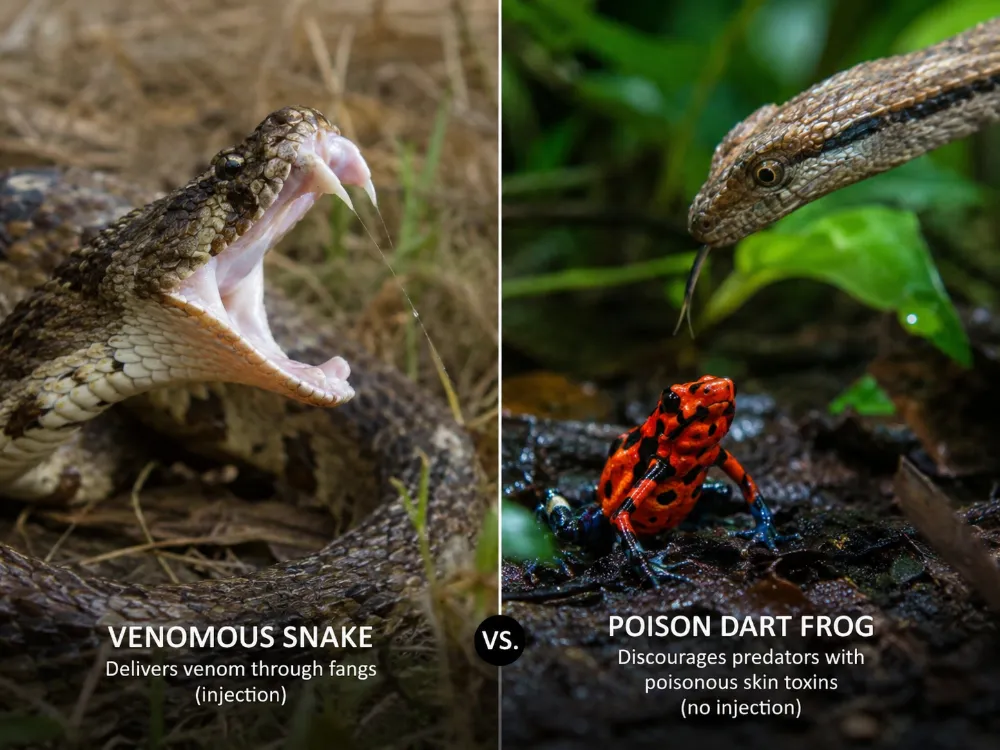
A poison dart frog and a venomous snake show the difference clearly. The frog has toxins on or in its skin. It does not chase prey and inject toxins through fangs. Its poison mainly protects it from being eaten.
A venomous snake has specialized teeth and venom glands. It actively delivers venom into prey or enemies through a bite. Its venom is often part of a hunting system.
Both animals are toxic, but their toxin delivery is completely different.
Stings, Bites, and Spines
Venom can be delivered in several ways. Snakes use fangs. Bees and wasps use stingers. Scorpions use a tail stinger. Spiders use fang-like mouthparts. Cone snails use a harpoon-like tooth. Stonefish and lionfish use venomous spines.
The important point is that the toxin enters through a puncture, bite, or injection-like mechanism. This active delivery system is what makes the animal venomous.
Not every sharp spine is venomous. Some spines are only physical defenses. A spine is venomous only if it delivers toxin into the wound.
Skin Toxins and Contact Poisoning
Poisonous animals often use skin toxins. Frogs, toads, salamanders, and newts may have glands that release irritating or dangerous chemicals. These toxins can discourage predators from biting or swallowing them.
In many cases, the poison is most dangerous if it enters the mouth, eyes, open wounds, or digestive system. This is why touching some poisonous animals and then touching your eyes or mouth can be risky.
Wild animals should not be handled unnecessarily, even if they look harmless. Bright colors, unusual patterns, or strong secretions may be warning signs.
Why Are Many Poisonous Animals Brightly Colored?
Many poisonous animals use warning coloration, also called aposematism. Bright colors such as red, yellow, orange, blue, and black can warn predators that the animal is toxic, distasteful, or dangerous.
Poison dart frogs, monarch butterflies, some caterpillars, and many toxic amphibians use strong visual signals. A predator that has a bad experience may learn to avoid similar colors in the future.
However, not every bright animal is poisonous, and not every poisonous animal is bright. Some animals mimic warning colors without being highly toxic, while others rely on camouflage instead.
Why Are Many Venomous Animals Not Brightly Colored?
Many venomous animals use camouflage because they are predators or ambush hunters. A rattlesnake blends into leaves, rocks, sand, or grass. A stonefish looks like a rock. A spider may hide in a web, burrow, flower, or crevice.
Venomous animals often need to capture prey, so hiding can be more useful than advertising danger. However, some venomous animals do have warning colors. Coral snakes, wasps, bees, and some venomous marine animals use bright patterns that signal risk.
Color is helpful, but it is not a perfect guide to venom or poison.
How Venom Helps Animals Hunt
Venom is one of the most powerful hunting tools in nature. It allows a predator to subdue prey that might otherwise escape, fight back, or injure the predator. A venomous snake can strike a rodent and wait for the venom to work. A spider can immobilize insects. A cone snail can stop a fish almost instantly.
Different venoms work in different ways. Some affect nerves and muscles. Some damage blood or tissue. Some cause pain. Some begin breaking down prey before it is swallowed.
Venom is biologically expensive to produce, so many venomous animals use it carefully rather than wasting it on every encounter.
How Poison Protects Animals
Poison is often a passive defense. The poisonous animal does not need to win a fight. It only needs to be unpleasant or dangerous enough that predators avoid it.
A poison dart frog’s skin toxins discourage predators from eating it. A toxic caterpillar may make a bird vomit or feel sick. A pufferfish may be deadly if eaten. A cane toad may poison animals that bite it.
This defense is especially useful for small or slow animals that cannot outrun predators. Poison makes them costly to attack.
Do Animals Make Their Own Toxins?
Some animals produce their own toxins in specialized glands or tissues. Venomous snakes, scorpions, spiders, and bees produce venom in venom glands. Many poisonous amphibians produce skin secretions from specialized glands.
Other animals obtain toxins from their diet. Poison dart frogs in the wild often gain toxins from small arthropods they eat. Monarch butterflies gain defensive chemicals from milkweed as caterpillars. Some marine animals store toxins from bacteria, algae, or prey.
This explains why some captive poisonous animals may become less toxic if their diet does not contain the same chemical sources found in the wild.
Are Venomous Animals Always More Dangerous Than Poisonous Animals?
No. Danger depends on the toxin, dose, delivery, animal size, human exposure, and medical situation. A venomous bee can be deadly to someone with a severe allergy, while many venomous spiders are not dangerous to most people. A poisonous pufferfish can be deadly if eaten, while many poisonous insects only taste bad to predators.
Venomous does not automatically mean more dangerous, and poisonous does not automatically mean safe to touch. Both categories include animals with mild, moderate, or extremely serious risks.
The safest approach is to avoid handling unknown wildlife and to respect warning signs in nature.
Are Poisonous Animals Safe If You Do Not Eat Them?
Not always. Some poisonous animals are mainly dangerous when eaten, but others can release toxins through the skin or glands. These toxins may irritate skin, eyes, or mucous membranes. Handling a toxic amphibian and then touching your mouth or eyes can be risky.
Many poisonous animals are not aggressive, but their toxins can still cause harm if contact occurs in the wrong way. Children, pets, and predators are especially vulnerable because they may lick, bite, or mouth unfamiliar animals.
As a general rule, do not handle brightly colored or unfamiliar wild animals.
Are Venomous Animals Aggressive?
Most venomous animals are not aggressive toward humans. They usually use venom for prey or defense, not for attacking large animals without reason. Many bites and stings happen when the animal is stepped on, grabbed, trapped, threatened, or surprised.
A snake may bite if someone tries to pick it up. A bee may sting if its nest is threatened. A stingray may sting if stepped on. A scorpion may sting if pressed against skin inside clothing, shoes, or bedding.
Venomous animals are best understood as defensive when threatened, not malicious.
Venomous vs Poisonous in Everyday Language
In everyday speech, people often use “poisonous” for any dangerous animal. For example, many people say “poisonous snake” when they mean “venomous snake.” In science writing, the difference matters.
Use “venomous” when the animal injects a toxin through a bite, sting, spine, or puncture. Use “poisonous” when the animal is harmful to eat, touch, or absorb.
For an animal website, this distinction makes the content more accurate and helps readers understand how animals actually defend themselves or capture prey.
Common Animal Examples
| Animal | Venomous or Poisonous? | Why? |
|---|---|---|
| Cobra | Venomous | Injects venom through fangs |
| Rattlesnake | Venomous | Uses fangs to inject venom during a bite |
| Bee | Venomous | Injects venom through a stinger |
| Scorpion | Venomous | Uses a tail stinger to inject venom |
| Poison dart frog | Poisonous | Has toxins on the skin |
| Pufferfish | Poisonous | Contains toxins in body tissues and organs |
| Monarch butterfly | Poisonous or distasteful to many predators | Stores chemicals from milkweed eaten as a caterpillar |
| Cane toad | Poisonous | Releases toxins from glands behind the eyes |
| Stonefish | Venomous | Delivers venom through sharp dorsal spines |
| Platypus | Venomous | Males have venomous ankle spurs |
Venomous Mammals
Venom is most common in animals such as snakes, spiders, insects, scorpions, jellyfish, and marine invertebrates, but a few mammals are also venomous. The male platypus has venomous spurs on the hind legs. Some shrews produce toxic saliva that can help subdue prey.
Venomous mammals are rare compared with venomous reptiles, arthropods, and marine animals. This makes them especially interesting from an evolutionary point of view.
The platypus is a good reminder that venom is not limited to snakes and insects.
Poisonous Birds and Mammals
Poisonous birds and mammals are also uncommon, but they exist. Some birds can carry toxins in their skin or feathers, often linked to their diet. A few mammals may be toxic or distasteful because of skin secretions, glands, or food-derived chemicals.
These examples show that poison can evolve in many different animal groups. However, most familiar poisonous animals are amphibians, fish, insects, or marine organisms.
In mammals and birds, toxicity is much less common than in amphibians, insects, reptiles, and marine life.
Venomous vs Poisonous Plants and Fungi
People usually call toxic plants and mushrooms poisonous, not venomous. A poisonous mushroom harms you if you eat it. A poisonous plant may harm you if you eat it, touch it, or absorb its chemicals.
Plants and fungi generally do not inject toxins with fangs or stingers. Their toxins are usually defensive chemicals that discourage animals from eating them.
This is why “poisonous plant” is correct, while “venomous plant” is almost never used in normal biological writing.
Human Safety Around Venomous and Poisonous Animals
Most toxic animals are not trying to harm humans. Accidents usually happen when people handle wildlife, walk barefoot in risky habitats, reach into hidden spaces, disturb nests, eat dangerous animals, or ignore local safety advice.
To reduce risk, never pick up unknown snakes, frogs, caterpillars, marine animals, or brightly colored wildlife. Wear shoes in areas with scorpions, snakes, or stingrays. Avoid touching unfamiliar sea creatures, even if they look dead or harmless.
If a bite, sting, or poisoning exposure occurs, seek appropriate medical or emergency help. Do not rely on folk remedies.
How to Remember the Difference Quickly
Venomous: the animal delivers toxin into you by biting, stinging, or puncturing.
Poisonous: you are harmed when you eat, touch, lick, or absorb the animal’s toxin.
Venom is injected: snakes, bees, scorpions, spiders, cone snails, and stonefish are common examples.
Poison is absorbed or ingested: poison dart frogs, pufferfish, newts, and cane toads are common examples.
Toxic: the broad word for any organism that produces harmful biological chemicals.
Some animals can be both: but most are mainly described as either venomous or poisonous.
Venomous vs Poisonous: Final Comparison
The difference between venomous and poisonous is not about how deadly an animal is. It is about how the toxin enters another body. Venomous animals inject toxins through bites, stings, spines, or other delivery structures. Poisonous animals harm predators or people when their toxins are eaten, touched, or absorbed.
A rattlesnake is venomous. A poison dart frog is poisonous. A bee is venomous. A pufferfish is poisonous. Both venom and poison are toxins, but their delivery systems are different. Once you remember “venom is injected, poison is ingested or absorbed,” the difference becomes easy to understand.
FAQs About Venomous vs Poisonous
What is the difference between venomous and poisonous?
Venomous animals inject toxins through bites, stings, spines, or punctures. Poisonous animals cause harm when they are eaten, touched, licked, or absorbed. The key difference is how the toxin enters the body.
Is a snake venomous or poisonous?
Most dangerous snakes are venomous, not poisonous. They inject venom through fangs when they bite. The phrase “poisonous snake” is common in everyday speech, but “venomous snake” is usually more accurate.
Is a poison dart frog venomous or poisonous?
A poison dart frog is poisonous. Its toxins are found on the skin and can harm predators that touch or eat it. It does not inject venom through fangs or stingers.
Are bees venomous or poisonous?
Bees are venomous because they inject venom through a stinger. They are not poisonous in the usual sense because their main toxin delivery method is a sting.
Are spiders venomous?
Yes, spiders are venomous. They use venom to subdue prey, usually insects or other small animals. Most spider venom is not dangerous to humans, but some species can cause medically important bites.
Are pufferfish venomous or poisonous?
Pufferfish are poisonous. Some species contain powerful toxins in their organs or tissues. The danger usually comes from eating them, not from being bitten or stung.
Can an animal be both venomous and poisonous?
Yes, a few animals can be both, but it is uncommon. An animal would need both an active toxin delivery system and toxins that are harmful when eaten or touched.
Is venom always injected?
In biological terms, venom is actively delivered into another animal, usually through a bite, sting, spine, or puncture wound. That active delivery system is what separates venom from poison.
Is poison always eaten?
Poison is often eaten, but it can also harm through skin contact, licking, mucous membrane contact, or absorption. Poisonous animals are dangerous because toxins enter passively rather than through active injection.
Are poisonous animals more dangerous than venomous animals?
Not necessarily. Danger depends on the toxin, dose, exposure route, species, and medical response. Some venomous animals are mildly harmful, while some poisonous animals can be deadly if eaten.
Why are many poisonous animals brightly colored?
Bright colors can warn predators that the animal is toxic or unpleasant to eat. This warning coloration helps predators learn to avoid dangerous prey.
Why do venomous animals have fangs or stingers?
Fangs and stingers are delivery tools. They allow venomous animals to inject toxins into prey or attackers. This can help with hunting, defense, or both.
Are toxic and poisonous the same?
Not exactly. “Toxic” is a broad word meaning harmful because of biological chemicals. Poisonous and venomous are more specific terms that describe how those toxins are delivered.
What should I do if I find a venomous or poisonous animal?
Leave it alone, keep a safe distance, and do not touch, pick up, or provoke it. Most accidents happen when people handle wildlife or ignore warning signs.