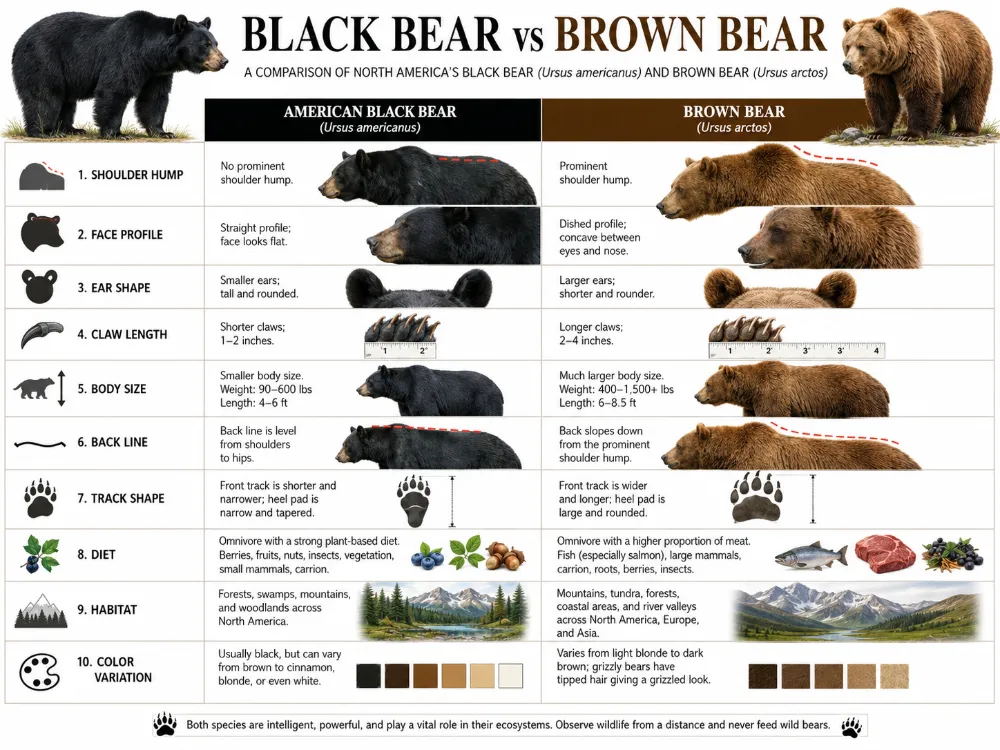
Black bears and brown bears are different bear species, not just different color forms. Black bears are usually smaller, lack a large shoulder hump, have shorter claws, and often climb trees well. Brown bears are usually larger, have a prominent shoulder hump, longer claws, and a more powerful digging build. Color alone is not reliable because black bears can be brown, cinnamon, blond, or even whitish.
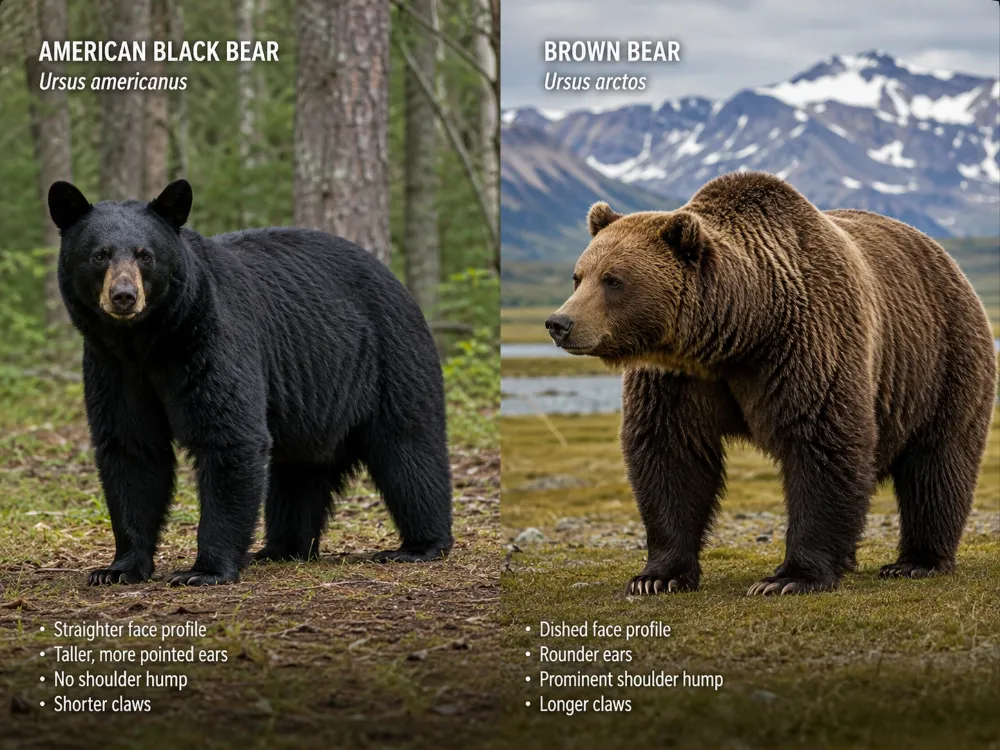
Black Bear vs Brown Bear Summary Table
| Feature | Black Bear | Brown Bear |
|---|---|---|
| Common meaning | Usually refers to the American black bear, Ursus americanus | Refers to Ursus arctos, including grizzlies, coastal brown bears, and Kodiak bears |
| Typical size | Usually smaller and lighter | Usually larger and heavier, especially coastal and Kodiak bears |
| Shoulder hump | No large shoulder hump | Prominent muscular shoulder hump |
| Face profile | Straighter face profile, often with a longer-looking muzzle | More dished or concave face profile |
| Ears | Taller, more pointed ears | Shorter, rounder ears |
| Claws | Shorter, more curved claws, useful for climbing | Longer, straighter claws, useful for digging |
| Back shape | Back may look higher at the rump than the shoulders | Shoulders often look higher because of the hump |
| Color | Can be black, brown, cinnamon, blond, grayish, or white in rare populations | Can be dark brown, light brown, blond, cinnamon, grayish, or grizzled |
| Diet | Omnivorous: berries, nuts, insects, plants, carrion, small animals, and human food if available | Omnivorous: roots, grasses, berries, fish, insects, carrion, and large mammals in some areas |
| Climbing ability | Excellent climber, especially younger and smaller individuals | Can climb when young, but large adults are less tree-oriented |
| Habitat | Forests, mountains, swamps, brushlands, and mixed woodland habitats | Mountains, tundra, forests, river valleys, coastal areas, and open wilderness |
| General behavior around humans | Often shy, but can become bold around food | Can be more defensive, especially mothers with cubs or bears guarding food |
What Is a Black Bear?
In North America, “black bear” usually means the American black bear, Ursus americanus. It is the most widespread bear species in North America and lives in forests, mountains, wetlands, brushlands, and areas near human settlements when suitable food and cover are available.
Despite the name, black bears are not always black. Their coats may be black, chocolate brown, cinnamon, blond, grayish, or even creamy white in rare coastal populations. This is why color is one of the least reliable ways to identify them.
Black bears are highly adaptable omnivores. They eat many plant foods, including berries, acorns, nuts, grasses, and roots, but they also eat insects, carrion, small animals, fish, and human food if people leave it accessible. Their adaptability helps explain why they survive in many different habitats.
What Is a Brown Bear?
The brown bear, Ursus arctos, is a large bear species found across parts of North America, Europe, and Asia. In North America, brown bears include grizzly bears, coastal brown bears, and Kodiak bears. These names often describe regional forms or populations rather than completely separate species.
Brown bears are usually larger and more powerfully built than black bears. They have a distinctive shoulder hump made of strong muscles used for digging, turning over soil, excavating roots, tearing into logs, and moving heavy objects.
Brown bears are also omnivores, but their diets vary greatly by region. Some feed heavily on roots, grasses, berries, insects, and carrion. Coastal brown bears may grow very large when they have access to salmon and other rich foods. Inland grizzlies may be smaller, especially where food is less abundant.
Color Is Not the Best Difference
Many people assume a black bear is black and a brown bear is brown. This is a common mistake. Coat color overlaps strongly between the two species. A black bear can be brown, cinnamon, blond, or grayish. A brown bear can be dark brown, nearly black, light brown, blond, or grizzled.
The word “grizzly” comes from the pale-tipped hairs that can give some brown bears a frosted or grizzled appearance. However, not every brown bear looks grizzled, and not every brown-colored bear is a brown bear.
To identify a bear accurately, focus on body shape, shoulder hump, face profile, ears, claws, and behavior rather than color alone.
Shoulder Hump Differences
The shoulder hump is one of the clearest field marks. Brown bears have a prominent muscular hump over the shoulders. This hump gives the front of the body a powerful, raised appearance and supports their digging strength.
Black bears do not have a large shoulder hump. Their back line often looks more even, and the rump may appear higher than the shoulders, especially when the bear is walking. This difference is usually easier to see from the side.
If the bear has a large raised shoulder hump and a powerful front-heavy body, it is more likely a brown bear. If the bear lacks a hump and has a smoother back profile, it may be a black bear.
Face Shape and Muzzle
Black bears usually have a straighter face profile. Their muzzle may look longer and more tapered, especially when viewed from the side. Their nose often appears more pointed compared with the broader face of a brown bear.
Brown bears often have a dished or concave face profile. The forehead rises more sharply above the muzzle, giving the face a scooped appearance. This is especially noticeable in many adult grizzlies.
Face shape is useful, but it can vary with age, angle, and individual anatomy. It works best when combined with the shoulder hump and claw length.
Ear Shape
Black bears usually have taller, more pointed ears. Because their heads are often smaller and less massive than those of brown bears, the ears can look relatively large and upright.
Brown bears usually have shorter, rounder ears. Their larger head and thicker neck can make the ears appear smaller and more widely spaced.
In quick visual identification, tall pointed ears suggest a black bear, while short rounded ears suggest a brown bear.
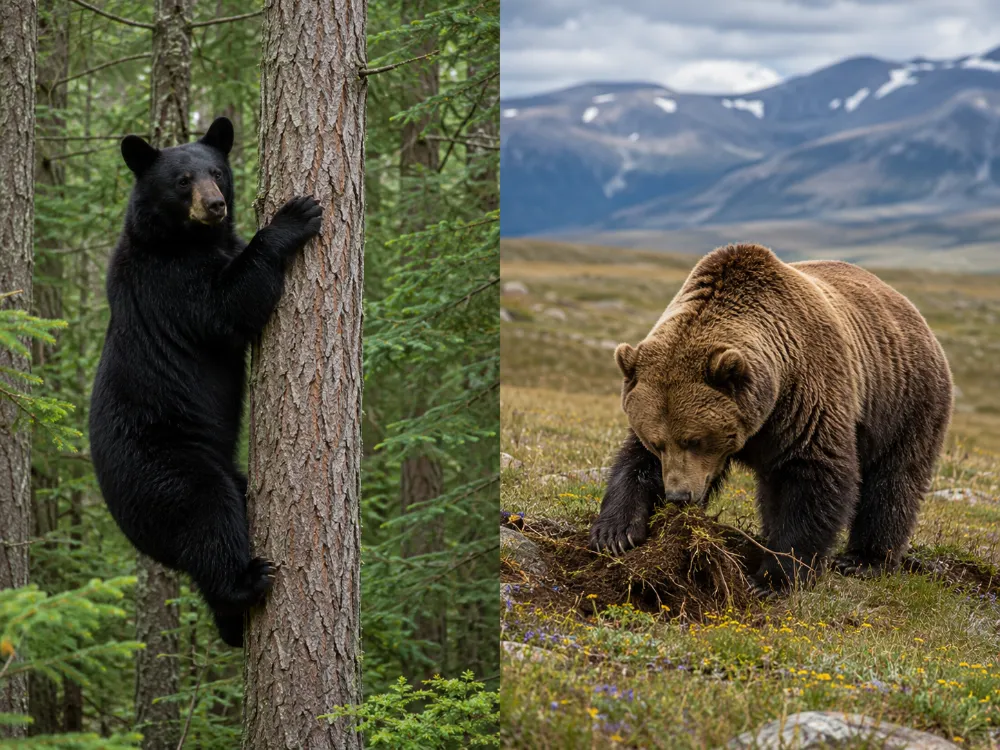
Claw Differences
Claws are another major difference. Black bears have shorter, more curved claws. These claws are excellent for climbing trees, tearing into logs, and handling food. Young black bears are especially skilled climbers and may escape danger by going up a tree.
Brown bears have longer, straighter claws. These claws are not as good for climbing, but they are excellent digging tools. Brown bears use them to dig roots, excavate dens, uncover ground squirrels, turn over soil, and tear apart rotting wood.
If you see tracks, long claw marks far ahead of the toes often suggest a brown bear. Shorter claw marks closer to the toe pads are more typical of black bears.
Size and Weight Differences
Brown bears are usually larger than black bears, especially adult males. Coastal brown bears and Kodiak bears can become enormous because they have access to rich seasonal foods such as salmon. Inland grizzlies are often smaller than coastal brown bears, but they are still usually larger and more heavily built than black bears in the same region.
Black bears are generally smaller and more lightly built. However, large male black bears can overlap in size with smaller female brown bears or smaller inland grizzlies. Because of this overlap, size alone is not always reliable.
Use size as a supporting clue, not the only clue. A very large bear may be a brown bear, but a brown-colored medium-sized bear can still be a black bear.
Body Shape and Posture
Black bears often look more compact, with a straighter back, smaller shoulders, and a more agile body. They are well suited to climbing, moving through forests, and foraging in dense cover.
Brown bears look more front-heavy. Their shoulders, neck, and forelimbs appear extremely strong. This body shape reflects their digging ability and their power in open landscapes, river valleys, and rugged terrain.
When walking, a brown bear may look like it carries more mass in the front of the body. A black bear often looks more balanced or slightly higher at the rear.
Habitat Differences
Black bears are strongly associated with forests and cover. They live in conifer forests, hardwood forests, swamps, mountain woodlands, brushlands, and mixed habitats. Dense vegetation gives them food, hiding places, den sites, and escape routes.
Brown bears can use forests too, but they are also common in more open habitats such as tundra, alpine meadows, river valleys, coastal flats, and mountain slopes. In some regions, brown bears are better adapted to large, open landscapes than black bears.
Habitat is not a perfect identification tool because both species can use overlapping areas. Still, a bear in dense eastern woodland is more likely to be a black bear, while a bear in open northern tundra or salmon-rich coastal wilderness may be a brown bear.
Geographic Range
American black bears are found across much of North America, from parts of Canada and Alaska through many regions of the United States and into northern Mexico. They are the most common bear species on the continent.
Brown bears have a wider global range but a more limited modern range in North America. They occur in Alaska, western Canada, and parts of the northwestern United States. Globally, brown bears also live in parts of Europe and Asia.
In many places in North America, black bears are the only wild bear species present. In regions where black bears and brown bears overlap, careful identification becomes more important.
Diet and Feeding Strategy
Both black bears and brown bears are omnivores, but they often use food differently. Black bears eat large amounts of plant material, including berries, nuts, acorns, grasses, and soft vegetation. They also eat insects, larvae, carrion, fish, and small animals when available.
Brown bears also eat many plant foods, but their digging ability gives them access to roots, bulbs, ground squirrels, and buried foods. In salmon-rich areas, brown bears may feed heavily on fish. In some ecosystems, they may prey on young elk, moose calves, caribou, or other mammals.
The key difference is not that one is a strict carnivore and the other is not. Both are flexible omnivores. Brown bears are usually larger and may take larger prey more often, while black bears often rely heavily on forest foods and seasonal plant resources.
Climbing Ability
Black bears are excellent climbers. Their shorter curved claws, lighter build, and agility allow them to climb trees for safety, food, and rest. Cubs often climb trees when threatened, and adults can climb well too, especially if they are not extremely large.
Brown bear cubs can climb, but large adult brown bears are much less tree-oriented. Their long claws and heavy bodies make climbing more difficult. Adult brown bears usually rely more on strength, size, and ground movement than tree escape.
This difference is important in behavior. A black bear may flee up a tree. A brown bear is more likely to stand its ground, move away on land, or use open space.
Behavior Around Humans
Black bears are often shy and may avoid people when they have not been fed or conditioned to human food. However, a black bear that learns to associate people with food can become bold and dangerous. Garbage, birdseed, pet food, campsites, and unsecured coolers can quickly create problems.
Brown bears can be more defensive in certain situations, especially mothers with cubs, bears guarding carcasses, or bears surprised at close range. A brown bear may react aggressively if it feels threatened or if a person appears suddenly within its personal space.
Neither species should be approached, fed, or treated as predictable. Bear behavior depends on species, individual experience, hunger, season, location, and human actions.
Black Bear vs Grizzly Bear
In North America, the comparison “black bear vs brown bear” often means “black bear vs grizzly bear.” A grizzly bear is a type of brown bear, especially an inland North American brown bear. Grizzlies usually have the classic brown bear traits: shoulder hump, dished face, shorter rounded ears, and long claws.
Black bears can live in some of the same regions as grizzlies, which creates confusion. A cinnamon-colored black bear may look brown, and a dark grizzly may look almost black. The best clues remain shoulder hump, face shape, ear shape, claws, and body proportions.
If you are identifying bears in grizzly country, do not rely on coat color. A brown-colored bear is not automatically a grizzly.
Tracks and Footprints
Bear tracks can help distinguish the two species. Black bear tracks often show a more curved line across the toes, and the claw marks are usually shorter and closer to the toe pads. The front foot may look more compact.
Brown bear tracks often show a straighter toe line and longer claw marks extending farther ahead of the toes. The front foot is usually broader and may look more powerful.
Track identification can be difficult in mud, snow, sand, or partial prints, so it is best used with location, track size, claw length, and other signs.
Reproduction and Cubs
Both black bears and brown bears give birth in winter dens. Cubs are born tiny, blind, and helpless, then grow rapidly while nursing. Mothers are highly protective and invest heavily in their young.
Black bear mothers often use trees as part of their cubs’ safety strategy. Cubs may climb quickly when danger appears. Brown bear mothers, especially grizzlies, are famous for strong defensive behavior when cubs are nearby.
Cubs of both species stay with their mothers long enough to learn what to eat, where to travel, how to avoid danger, and how to survive seasonal changes.
Denning and Winter Dormancy
Black bears den during winter in many parts of their range. Dens may be in hollow trees, root cavities, rock shelters, ground nests, brush piles, or excavated sites. During winter dormancy, they live off stored fat and greatly reduce activity.
Brown bears also den in cold regions. They may dig dens into slopes, use natural cavities, or create sheltered winter sites. Pregnant females give birth in dens and remain with their cubs until spring conditions improve.
Both species depend on building enough fat before winter. This makes late summer and autumn feeding especially important.
Vocalizations and Communication
Black bears and brown bears communicate through body language, scent marking, tracks, vocal sounds, and physical displays. They may huff, woof, jaw-pop, moan, bawl, or growl depending on context.
Many bear signals are warnings rather than immediate attacks. A bear that huffs, stomps, or sways may be stressed or trying to assess danger. However, interpreting bear behavior is difficult, and people should not test a bear’s tolerance.
Both species also use scent marking on trees, trails, and rubbing posts. Scent helps bears communicate identity, reproductive status, and presence in an area.
Which Bear Is More Dangerous?
Both species can be dangerous, but brown bears are generally considered more physically dangerous because they are larger, stronger, and more likely to respond defensively in close encounters. A female brown bear with cubs or a brown bear guarding a carcass can be extremely dangerous.
Black bears are usually less aggressive in defensive encounters, but they should never be underestimated. Rare predatory attacks by black bears can occur, and food-conditioned black bears can become serious threats around homes, campsites, and trails.
The safest approach is to avoid close encounters with either species. Make noise in dense habitat, secure food properly, respect closures, keep distance, and never feed bears.
Conservation Status and Human Conflict
Black bears are relatively widespread and adaptable in many parts of North America. In some regions, their populations are stable or increasing. However, they still face threats from habitat loss, road mortality, poaching, and conflicts caused by unsecured human food.
Brown bear conservation varies greatly by region. Some populations are stable, while others are small, isolated, or recovering slowly. Brown bears need large connected habitats, low human conflict, and access to seasonal foods such as salmon, berries, roots, and carrion.
For both species, coexistence depends heavily on human behavior. Proper garbage storage, bear-safe camping, wildlife corridors, and respect for wild spaces reduce conflict and protect bears.
Common Misidentification Problems
The biggest mistake is using color alone. A cinnamon black bear may be mistaken for a brown bear. A dark brown bear may be mistaken for a black bear. Lighting, wet fur, age, and season can also change appearance.
Another mistake is relying only on size. A large male black bear can be bigger than a young brown bear or a female grizzly. Distance can also make size hard to judge.
The best identification method is to combine several traits: shoulder hump, face profile, ear shape, claw length, back line, tracks, and location.
How to Tell a Black Bear from a Brown Bear Quickly
Look at the shoulder hump: brown bears have a prominent hump; black bears usually do not.
Look at the face: black bears often have a straighter face; brown bears often have a dished face.
Look at the ears: black bears usually have taller, more pointed ears; brown bears have shorter, rounder ears.
Look at the claws: black bear claws are shorter and curved; brown bear claws are longer and straighter.
Look at the back line: black bears may look higher at the rump; brown bears often look higher at the shoulders.
Do not rely on color: both species can be brown, dark, blond, or grizzled.
Black Bear vs Brown Bear: Final Comparison
Black bears and brown bears are both intelligent, adaptable omnivores, but they are built for different lifestyles. Black bears are generally smaller, more tree-oriented, and strongly associated with forest cover. Brown bears are usually larger, more powerful in the shoulders, better diggers, and often more comfortable in open landscapes.
If you are trying to identify one in the wild, do not use coat color alone. A black bear can be brown, and a brown bear can be very dark. Instead, look for the shoulder hump, face shape, ear shape, claw length, and overall body build. These features give a much more accurate answer than color.
FAQs About Black Bears vs Brown Bears
Are black bears and brown bears the same species?
No. Black bears and brown bears are different species. The American black bear is Ursus americanus, while the brown bear is Ursus arctos.
Is a grizzly bear a brown bear?
Yes. A grizzly bear is a type of brown bear. In North America, the name “grizzly” is often used for inland brown bears, while coastal brown bears may grow larger where rich food such as salmon is available.
Can a black bear be brown?
Yes. Black bears can be black, brown, cinnamon, blond, grayish, or even whitish in rare populations. Color alone is not a reliable way to identify a black bear.
Can a brown bear be black?
Some brown bears can appear very dark, especially in certain lighting or when their fur is wet. This is why body shape, shoulder hump, face profile, and claws are better identification clues than color.
Which is bigger, a black bear or a brown bear?
Brown bears are usually bigger than black bears, especially adult males and coastal populations. However, size can overlap between large black bears and smaller brown bears.
What is the easiest way to tell them apart?
The easiest way is to look for the shoulder hump. Brown bears have a prominent muscular hump over the shoulders. Black bears usually lack this hump and often have taller ears and a straighter face profile.
Which bear has longer claws?
Brown bears have longer, straighter claws used for digging. Black bears have shorter, more curved claws that are better for climbing trees.
Which bear climbs trees better?
Black bears are generally better climbers. Their shorter curved claws and lighter build help them climb trees effectively. Young brown bears can climb, but large adults are less adapted for it.
Which bear is more aggressive?
Brown bears are often more defensive in close encounters, especially mothers with cubs or bears guarding food. Black bears are usually more likely to avoid people, but they can still be dangerous, especially if food-conditioned or predatory.
Do black bears and brown bears eat the same food?
They overlap in diet because both are omnivores. Both may eat berries, plants, insects, carrion, and fish. Brown bears may dig more and may take larger prey more often, while black bears often rely heavily on forest foods.
Where do black bears and brown bears live together?
They overlap in parts of western Canada, Alaska, and some northwestern regions of the United States. In these areas, identification requires more than coat color.
Do black bears and brown bears fight?
They can compete where their ranges overlap, but direct fights are not everyday events. Larger brown bears often dominate access to rich food sources if both species are present.
Are black bears safer than brown bears?
Black bears are generally less dangerous than brown bears in defensive encounters, but “safer” does not mean safe. Any bear can injure or kill a person under the wrong circumstances. All wild bears should be respected from a distance.
What should you do if you see a bear?
Stay calm, keep your distance, do not run, and do not approach. Speak calmly, back away slowly if the bear has not noticed you, and follow local bear safety guidance. In bear country, secure food and carry appropriate safety equipment where recommended.