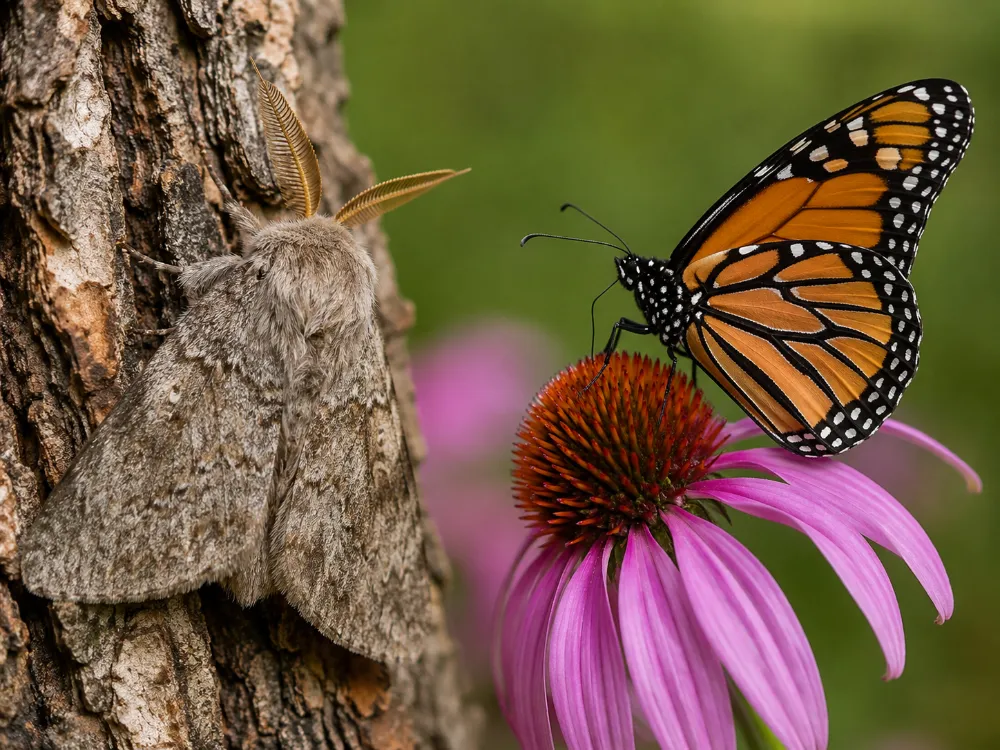
Moths and butterflies are both insects in the order Lepidoptera, but they are usually easy to tell apart. Butterflies often have clubbed antennae, slender bodies, bright colors, and fly during the day. Moths usually have feathery or thread-like antennae, thicker furry bodies, duller colors, and are active at night. However, there are exceptions, so identification should use several traits together.
 Moth vs Butterfly Summary Table
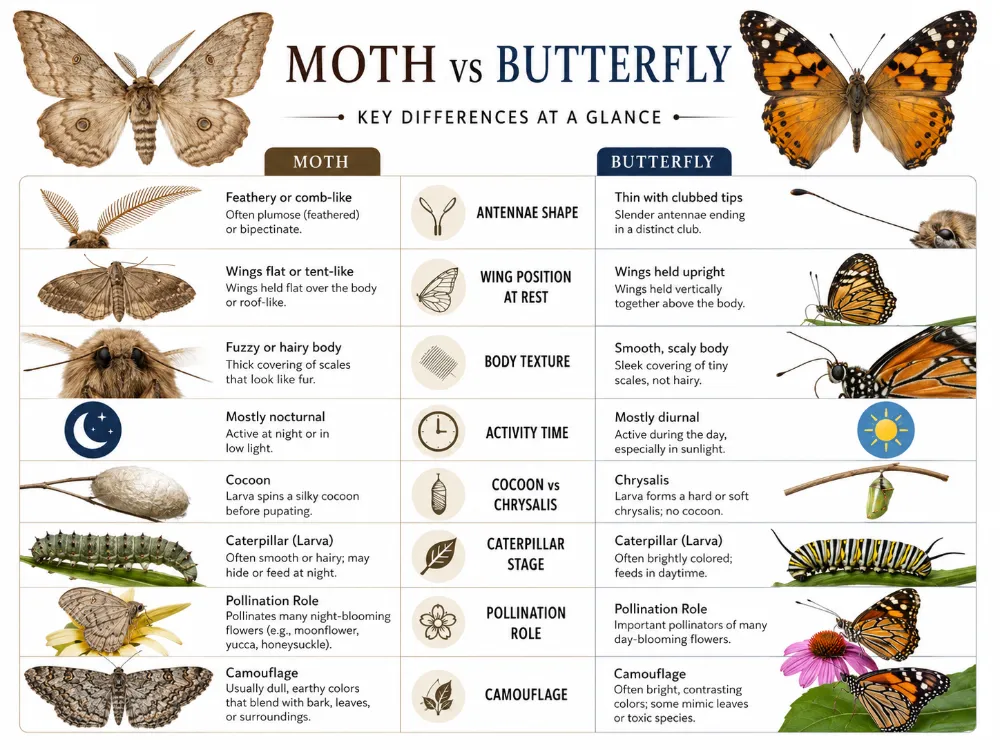
| Feature | Moth | Butterfly |
|---|---|---|
| Scientific group | Order Lepidoptera; moths make up most Lepidoptera species | Order Lepidoptera; butterflies are a smaller, more familiar group |
| Antennae | Usually feathery, comb-like, or thread-like without a clubbed tip | Usually thin with a rounded club at the tip |
| Body shape | Often thicker, fuzzier, and more robust | Often slimmer, smoother, and more delicate-looking |
| Wings at rest | Often held flat, roof-like, or wrapped around the body | Often held upright over the back when resting |
| Activity time | Mostly nocturnal or crepuscular, though some fly by day | Mostly diurnal, active during daylight |
| Color | Often brown, gray, tan, white, or camouflaged; some are colorful | Often brightly colored or patterned; some are dull or cryptic |
| Pupa stage | Many form cocoons, but not all | Usually form a chrysalis, not a silk cocoon |
| Wing coupling | Many have a small bristle-like structure called a frenulum | Usually lack a frenulum |
| Temperature control | Often use furry bodies to retain heat during night activity | Often bask in sunlight to warm flight muscles |
| Main adult food | Nectar, tree sap, fruit juices, or sometimes no feeding as adults | Mostly nectar, but also fruit, minerals, sap, or moisture |
| Ecological role | Major pollinators, prey for bats and birds, and important caterpillar herbivores | Pollinators, prey for birds and insects, and important indicators of habitat health |
| Best quick clue | No clubbed antennae, often furry body, often night-active | Clubbed antennae, often slender body, often day-active |
What Is a Moth?
A moth is an insect in the order Lepidoptera, the same order that includes butterflies. Moths are extremely diverse and make up the majority of Lepidoptera species. They range from tiny leaf-mining moths to giant silk moths with wingspans larger than a human hand.
Most moths are nocturnal or active around dusk and dawn. Many have furry bodies, muted colors, and excellent camouflage that helps them hide on bark, leaves, rocks, or dead vegetation during the day. Some moths are attracted to lights at night, although the exact reason involves complex navigation behavior and artificial light confusion.
Moth caterpillars are ecologically important herbivores. Some feed on leaves, stems, roots, flowers, seeds, lichens, stored grains, wool, or other organic materials. Adult moths may drink nectar, feed on fruit juices, or not feed at all, depending on the species.
What Is a Butterfly?
A butterfly is also an insect in the order Lepidoptera. Butterflies are usually day-flying insects with clubbed antennae, delicate bodies, and colorful wings. They are more familiar to most people because they are active in daylight and often visit flowers in gardens, meadows, forests, and wetlands.
Butterflies go through complete metamorphosis: egg, caterpillar, pupa, and adult. Their pupal stage is usually called a chrysalis. Unlike many moths, butterflies generally do not spin a thick silk cocoon around the pupa.
Adult butterflies mainly feed on nectar, but many species also visit rotting fruit, tree sap, animal dung, carrion, mud, and wet soil for minerals. Their caterpillars often have specific host plants, which makes butterflies closely tied to plant communities.
Are Moths and Butterflies Related?
Yes. Moths and butterflies are close relatives because both belong to Lepidoptera, an insect order known for scaled wings. The name Lepidoptera comes from words meaning “scale” and “wing.” If you touch a moth or butterfly wing, the powdery material that rubs off is made of tiny scales.
Butterflies are not completely separate from moths in a simple everyday sense. Scientifically, butterflies are one branch within Lepidoptera, while the insects commonly called moths include many other branches. In practical terms, people use “butterfly” for the familiar day-flying, club-antennaed forms and “moth” for most other Lepidoptera.
This means the moth vs butterfly difference is real for identification, but nature contains many exceptions.
Antennae Differences
Antennae are the most reliable everyday clue. Butterflies usually have thin antennae with a small rounded club at the end. This clubbed antenna shape is one of the clearest ways to identify a butterfly.
Moths usually do not have clubbed antennae. Their antennae may be thread-like, feather-like, comb-like, or tapered. Male moths of many species have especially feathery antennae because they use them to detect female pheromones over long distances.
If the insect has clubbed antennae, it is probably a butterfly. If the antennae are feathery or plain threads without clubs, it is probably a moth.
Wing Position at Rest
Butterflies often rest with their wings held upright over the back. This creates a narrow vertical profile and makes the underside of the wings visible. Many butterflies also open and close their wings while basking in sunlight.
Moths often rest with their wings flat, roof-like, tent-like, or wrapped around the body. Some look like dead leaves, bark flakes, or small pieces of wood when resting. This helps them avoid predators during the day.
This clue is useful but not perfect. Some butterflies rest with open wings, and some moths may hold their wings in unusual positions. Antennae are usually more dependable.
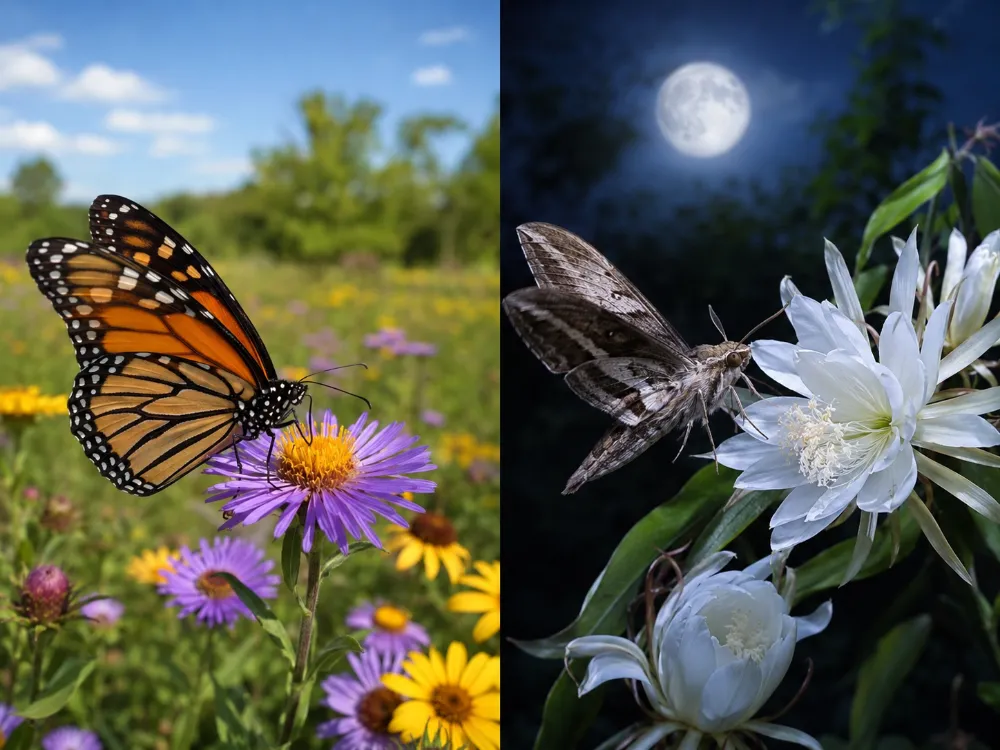
Body Shape and Texture
Moths often have thicker, fuzzier bodies. Their dense scales and hair-like structures help them retain heat, which is especially useful for night flight. Some large moths look almost furry, especially around the thorax.
Butterflies usually have slimmer, smoother-looking bodies. Their bodies are often less hairy, and many rely on sunlight to warm themselves before flying. This is why butterflies are often seen basking with open wings in sunny spots.
A thick fuzzy body suggests a moth. A slender delicate body suggests a butterfly.
Color and Wing Patterns
Butterflies are often brightly colored, with bold patterns used for warning, camouflage, mate recognition, or mimicry. Monarchs, swallowtails, and many tropical butterflies are famous for striking wing colors.
Moths are often duller, with gray, brown, tan, white, or mottled patterns that blend into bark, leaves, soil, or stone. However, many moths are also brightly colored. Tiger moths, day-flying burnet moths, and some giant silk moths can be just as beautiful as butterflies.
Color is helpful but not absolute. Bright does not always mean butterfly, and dull does not always mean moth.
Daytime vs Nighttime Activity
Most butterflies are active during the day. They use sunlight to warm their bodies, find flowers, avoid predators, and recognize mates by color and movement.
Most moths are active at night, dusk, or dawn. Many are adapted to low light and rely heavily on smell. Their muted colors and resting camouflage help protect them during daylight hours.
There are important exceptions. Some moths fly during the day and mimic bees, wasps, or butterflies. Some butterflies may be active in dim conditions or rest in shade. Still, daytime activity usually suggests a butterfly, while nighttime activity usually suggests a moth.
Caterpillar Differences
Both moths and butterflies begin life as caterpillars after hatching from eggs. Caterpillars are the feeding and growing stage. They eat plant material or other specialized foods, molt several times, and store energy for metamorphosis.
Butterfly caterpillars are often found on specific host plants. For example, monarch caterpillars feed on milkweed. Many butterfly species depend on particular plants, which makes habitat loss especially important for their survival.
Moth caterpillars are even more varied. Some feed on tree leaves, crops, grasses, lichens, fungi, wool, stored food, or hidden plant tissues. Many caterpillars that people notice on garden plants, trees, or crops are moth larvae rather than butterfly larvae.
Cocoon vs Chrysalis
The pupa stage is another famous difference. Butterflies usually form a chrysalis. A chrysalis is the hardened pupal form itself, often attached to a plant stem, leaf, or sheltered surface.
Many moths form cocoons. A cocoon is a protective silk covering around the pupa. Some moth caterpillars spin thick silk cocoons, while others pupate in soil, leaf litter, bark crevices, or loose silk shelters.
The simple rule is: butterflies usually make a chrysalis, while many moths make a cocoon. However, the pupa inside a moth cocoon is not the cocoon itself; the cocoon is the outer silk case.
Wing Scales and Flight
Moths and butterflies both have wings covered in microscopic scales. These scales create colors, patterns, camouflage, and sometimes reflective or iridescent effects. They also help with temperature control and flight performance.
Butterflies often use visual signals during flight. Bright wing colors may help them find mates, warn predators, or mimic other toxic species. Many butterflies fly in sunny conditions and may glide, flutter, or soar depending on species.
Moths often use more scent-based communication. Many fly at night and may have wing patterns designed to disappear against bark or leaves. Some moths are powerful long-distance migrants, while others fly only short distances.
Wing Coupling and the Frenulum
Many moths have a small bristle-like structure called a frenulum that helps link the front and hind wings during flight. This allows the wings to work together as one surface.
Most butterflies do not have this typical moth-like frenulum. Their wing structure and flight mechanics are different. This is a more technical identification feature and is usually not needed for casual observation.
For everyday identification, antennae and body shape are easier to use. For scientific identification, wing structure can be very important.
Diet of Adult Moths and Butterflies
Adult butterflies usually drink nectar through a long coiled mouthpart called a proboscis. When not in use, the proboscis coils like a spring. When feeding, the butterfly uncoils it to sip liquid food.
Many adult moths also drink nectar and use a similar proboscis. Some moths are important night pollinators because they visit pale or strongly scented flowers after dark. Hawk moths, for example, can hover while feeding, much like hummingbirds.
Not all adults feed. Some adult moths emerge without functional mouthparts and live only long enough to mate and lay eggs. Their energy comes from what they stored as caterpillars.
Pollination Roles
Butterflies are familiar flower visitors and can pollinate many plants as they move from bloom to bloom. They are especially attracted to colorful flowers with landing platforms and nectar sources.
Moths are often overlooked pollinators. Night-blooming flowers may depend on moths, especially flowers that are pale, fragrant, and open after sunset. Some plants have deep floral tubes that match the long proboscis of certain moths.
Both moths and butterflies contribute to pollination, but moths may be more important than many people realize because much of their activity happens at night.
Predators and Defense
Moths are eaten by bats, birds, spiders, frogs, lizards, and other insects. Many moths use camouflage, sudden wing flashes, toxic chemicals, bad taste, or sound-detecting organs to avoid predators. Some can detect bat echolocation and take evasive action.
Butterflies are eaten by birds, spiders, mantises, dragonflies, lizards, and other predators. Some butterflies use warning colors to advertise toxicity. Others mimic toxic species even if they are not toxic themselves.
Both moths and butterflies have evolved impressive survival strategies, from disguise to chemical defense.
Mimicry and Camouflage
Many moths are masters of camouflage. Some look like dead leaves, bark, bird droppings, moss, or broken twigs. This helps them rest safely during the day when birds are active.
Butterflies often use color in more visible ways. Some use bright warning patterns, while others mimic poisonous butterflies to avoid being eaten. Some butterflies also use eyespots to startle predators or direct attacks away from the head.
Both groups use deception, but moths are especially famous for hiding, while butterflies are especially famous for visual signaling.
Are Moths Attracted to Light?
Many moths are attracted to artificial lights at night, but this does not mean they “like” light in a human sense. Artificial light may interfere with natural navigation systems, confuse their orientation, or trap them in repeated flight patterns around lamps.
Not all moths come to lights, and some species are more strongly attracted than others. Bright outdoor lighting can also affect moth behavior, feeding, mating, and predator risk.
This is one reason reducing unnecessary night lighting can help nocturnal insects.
Are Butterflies More Beautiful Than Moths?
Butterflies are often considered more beautiful because they are active in daylight and many have bright colors. However, moths can be equally spectacular. Luna moths, atlas moths, rosy maple moths, tiger moths, and many silk moths have remarkable colors and shapes.
The idea that moths are dull and butterflies are colorful is too simple. Moths include some of the most visually stunning insects in the world.
A better comparison is that butterflies are more visible to humans, while moth beauty is often hidden in the night.
Which Group Has More Species?
Moths are far more diverse than butterflies. Most Lepidoptera species are moths, not butterflies. Butterflies are more familiar because they are active during the day, but moths represent a much larger share of the order’s diversity.
This diversity includes tiny micro-moths, large silk moths, hawk moths, tiger moths, owlet moths, geometrid moths, and many other groups. Their shapes, diets, habitats, and life cycles vary enormously.
So, although butterflies are better known, moths are the larger and more varied group.
Are Moths Harmful?
Most moths are harmless to humans. Adult moths do not bite people, and many are beneficial pollinators. However, some moth larvae can be pests. Clothes moth larvae may feed on wool, fur, feathers, or other animal-based fibers. Pantry moth larvae may infest stored grains, flour, nuts, or dried foods.
Some caterpillars of moths can also damage crops, trees, or garden plants. A few have irritating hairs or spines that can cause skin reactions if touched.
Even so, most moth species are not household pests. They are normal parts of ecosystems and important food for many animals.
Are Butterflies Harmful?
Butterflies are generally harmless to humans. They do not bite, sting, or attack people. Adult butterflies mostly feed on liquids such as nectar or fruit juice.
Some butterfly caterpillars can feed heavily on garden or crop plants, but many are restricted to wild host plants and are not serious pests. In fact, butterflies are often valued as pollinators and indicators of healthy habitats.
The main concern for butterflies is not harm to humans, but the harm humans cause to them through habitat loss, pesticides, climate change, and loss of host plants.
How to Tell a Moth from a Butterfly Quickly
Look at the antennae: butterflies usually have clubbed tips; moths usually do not.
Look at the body: moths are often thicker and fuzzier; butterflies are often slimmer.
Look at resting wings: butterflies often hold wings upright; moths often hold them flat or roof-like.
Look at activity time: butterflies usually fly by day; moths usually fly at night or dusk.
Look at the pupa: butterflies usually form a chrysalis; many moths form cocoons.
Do not rely only on color: some moths are bright, and some butterflies are dull.
Moth vs Butterfly: Final Comparison
Moths and butterflies are both scaled-wing insects in the order Lepidoptera, but they usually differ in antennae, body shape, activity time, resting posture, and pupal form. Butterflies generally have clubbed antennae, slender bodies, upright resting wings, daytime activity, and a chrysalis. Moths usually have non-clubbed antennae, fuzzier bodies, flat or roof-like resting wings, night activity, and often cocoons.
The most reliable quick clue is the antennae. Clubbed antennae usually mean butterfly. Feathery, comb-like, or thread-like antennae usually mean moth. Still, nature has exceptions, so the best identification uses several features together.
FAQs About Moths vs Butterflies
Are moths and butterflies the same animal?
No. Moths and butterflies are both insects in the order Lepidoptera, but they are different groups within that order. Butterflies are usually day-flying insects with clubbed antennae, while moths are more diverse and often night-active.
What is the easiest way to tell a moth from a butterfly?
The easiest way is to look at the antennae. Butterflies usually have thin antennae with rounded clubs at the tips. Moths usually have feathery, comb-like, or thread-like antennae without clubs.
Do moths turn into butterflies?
No. A moth caterpillar becomes an adult moth, and a butterfly caterpillar becomes an adult butterfly. Both go through metamorphosis, but one does not turn into the other.
Do butterflies make cocoons?
Butterflies usually form a chrysalis rather than a silk cocoon. Many moths form cocoons, but not all moths do. The words cocoon and chrysalis are often confused, but they are not the same thing.
Are all moths nocturnal?
No. Most moths are nocturnal or active around dusk, but some moths fly during the day. Day-flying moths may be brightly colored and can be mistaken for butterflies.
Are all butterflies colorful?
No. Many butterflies are colorful, but some are brown, gray, or camouflaged. Color alone is not a reliable way to separate butterflies from moths.
Why are moths attracted to lights?
Artificial lights may confuse moth navigation and orientation. Many moths use natural light cues, and bright lamps can disrupt their normal flight behavior.
Do moths bite humans?
Adult moths do not normally bite humans. Most have mouthparts for drinking nectar or other liquids, and some adult moths do not feed at all. A few caterpillars may have irritating hairs, but that is different from biting.
Do butterflies bite humans?
No. Butterflies do not bite humans. They use a coiled proboscis to drink liquids such as nectar, fruit juice, sap, or mineral-rich moisture.
Which has more species, moths or butterflies?
Moths have far more species than butterflies. Butterflies are more familiar because they are active during the day, but moths make up most of the diversity in Lepidoptera.
Are moths important pollinators?
Yes. Many moths are important pollinators, especially for night-blooming flowers. Some plants are strongly associated with moth pollination.
Are moths pests?
Most moths are not pests. Some moth larvae damage clothing, stored food, crops, or garden plants, but many moths are harmless or beneficial parts of ecosystems.
Why do butterflies rest with wings closed?
Many butterflies rest with their wings held upright over the back. This posture may help with camouflage, temperature control, or protection. However, some butterflies also bask with wings open.
Why are moths usually fuzzy?
Many moths have thick scales and hair-like structures that help retain heat. This is useful because many moths fly at night or in cooler conditions.