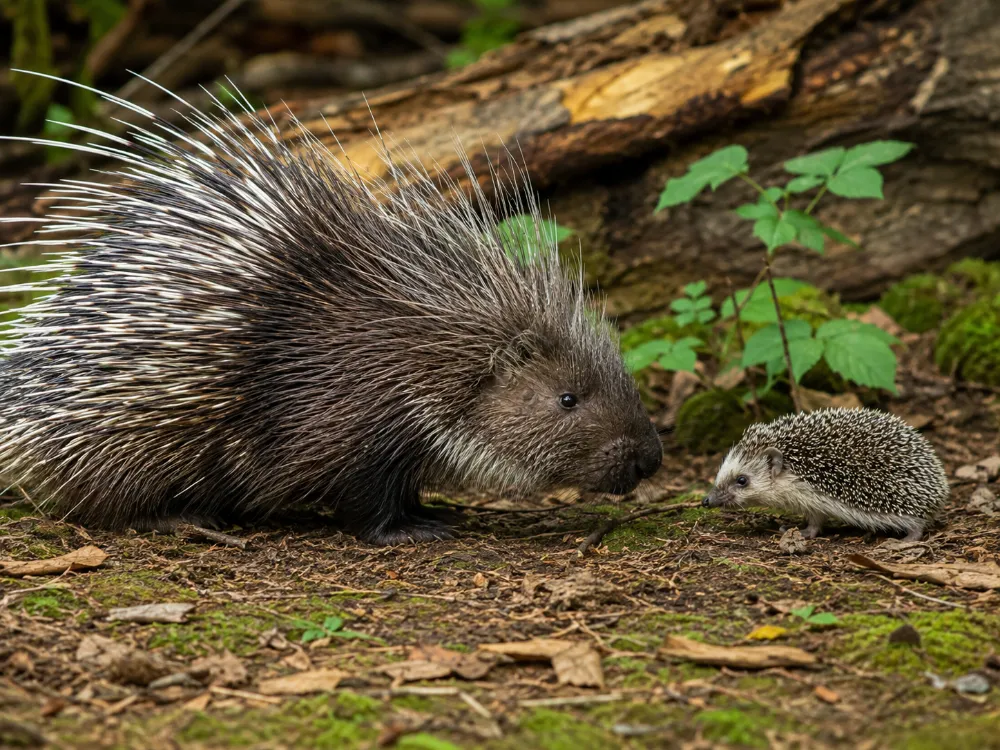
Porcupines and hedgehogs both have spines, but they are very different mammals. Porcupines are rodents with long defensive quills, larger bodies, and mostly plant-based diets. Hedgehogs are small insect-eating mammals with short spines, pointed faces, and the ability to roll into a tight ball. Porcupines rely on painful quills; hedgehogs rely on curling up and presenting a spiny shield.
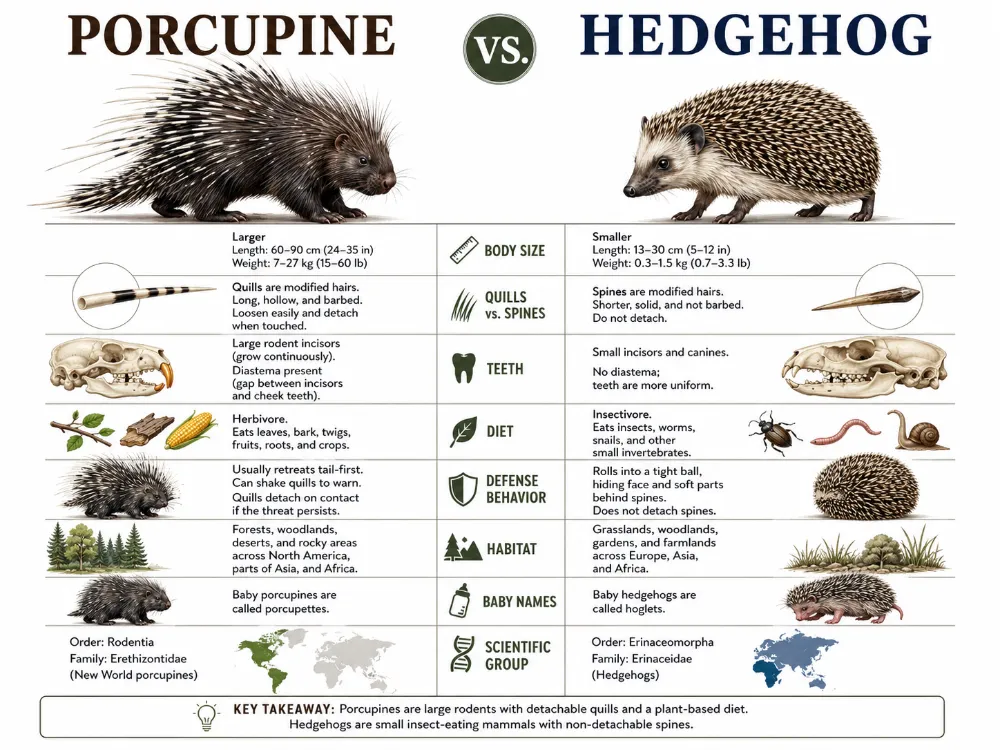
Porcupine vs Hedgehog Summary Table
| Feature | Porcupine | Hedgehog |
|---|---|---|
| Scientific group | Rodents in several porcupine families | Family Erinaceidae, order Eulipotyphla |
| Closest common comparison | Related to other rodents such as guinea pigs, beavers, and squirrels | Related to other small insectivorous mammals, not rodents |
| Body size | Usually much larger and heavier | Small, compact, and lightweight |
| Body covering | Long, sharp quills mixed with fur or bristles | Short, stiff spines on the back and sides |
| Quill or spine structure | Quills may detach easily; many have microscopic barbs | Spines usually stay attached and are not used like detachable quills |
| Defense strategy | Raises quills, turns back to predator, lashes tail, or backs into attacker | Rolls into a tight ball with spines pointing outward |
| Can they shoot quills? | No, porcupines cannot shoot quills | No, hedgehogs do not shoot spines |
| Main diet | Mostly herbivorous: bark, leaves, stems, roots, fruits, and vegetation | Mostly insectivorous or omnivorous: insects, worms, snails, eggs, and small animals |
| Typical habitat | Forests, deserts, grasslands, rocky areas, and trees depending on species | Grasslands, gardens, hedgerows, scrub, woodland edges, and semi-open habitats |
| Activity pattern | Mostly nocturnal or crepuscular | Mostly nocturnal |
| Climbing ability | Many New World porcupines climb well | Can climb a little, but mainly ground-dwelling |
| Pet status | Not a normal household pet | Some species are kept as exotic pets where legal, especially African pygmy hedgehogs |
What Is a Porcupine?
A porcupine is a spiny rodent. Porcupines are not one single species; they include several kinds of medium to large rodents found in different parts of the world. They are best known for their long, sharp quills, which protect them from predators.
Porcupines are divided into two broad groups: Old World porcupines and New World porcupines. Old World porcupines live in parts of Africa, Europe, and Asia. They are mostly ground-dwelling and often have heavy bodies with long defensive quills. New World porcupines live in the Americas and many are excellent climbers, spending much of their time in trees.
Porcupines are mostly herbivores. Depending on the species and season, they may eat bark, leaves, roots, stems, fruits, buds, grasses, and aquatic plants. Their strong teeth grow continuously, as in other rodents, and are well suited for gnawing tough plant material.
What Is a Hedgehog?
A hedgehog is a small spiny mammal in the family Erinaceidae. Hedgehogs are not rodents. They belong to a different mammal group and are more closely associated with insect-eating mammals than with porcupines, squirrels, mice, or beavers.
Hedgehogs are famous for their short spines, pointed faces, small legs, and defensive ball posture. When threatened, a hedgehog can curl into a tight ball, hiding its soft face, belly, and limbs while exposing a coat of stiff spines.
Wild hedgehogs are mostly nocturnal and forage along the ground for insects, beetles, caterpillars, earthworms, snails, slugs, eggs, carrion, fruit, and other small foods. They are common in some gardens, hedgerows, grasslands, and woodland edges, especially where there is cover and abundant invertebrate prey.
Are Porcupines and Hedgehogs Related?
Porcupines and hedgehogs are not close relatives. Their spiny appearance is a case of convergent evolution. This means they evolved similar defensive features because they faced similar survival problems, not because they are closely related.
Porcupines are rodents. They have the typical rodent pattern of strong, continuously growing incisors adapted for gnawing. Hedgehogs are not rodents and have a different skull, tooth structure, diet, and evolutionary history.
Their spines may make them look similar at first, but biologically they are very different animals.
Body Size and Shape
Porcupines are usually much larger than hedgehogs. Many porcupines are chunky, heavy-bodied mammals with short legs, powerful claws, and a slow, deliberate walking style. Some species may be the size of a small dog or larger.
Hedgehogs are much smaller. They usually have compact oval bodies, short legs, small ears, and pointed snouts. Their body shape is designed for ground-level foraging, sniffing through leaf litter, and curling into a ball when danger appears.
A simple field rule is useful: if the animal is large, heavy, and rodent-like, it is more likely a porcupine. If it is small, round, and able to curl into a spiny ball, it is more likely a hedgehog.
Quills vs Spines
The most famous difference is the defensive covering. Porcupines have quills. These are modified hairs that are sharp, stiff, and often loosely attached. In many species, the quills can detach when a predator makes contact. Some porcupine quills have tiny backward-facing barbs that make them difficult and painful to remove.
Hedgehogs have spines. These are also modified hairs, but they are shorter, more evenly distributed over the back, and usually remain attached to the body. Hedgehog spines are defensive, but they are not used in the same way as porcupine quills.
Porcupine quills are more offensive as a contact defense. Hedgehog spines work more like a protective shield when the animal curls up.
Can Porcupines or Hedgehogs Shoot Their Quills?
No. Porcupines cannot shoot their quills, and hedgehogs cannot shoot their spines. This is one of the most common myths about spiny mammals.
A porcupine’s quills may come loose when touched, bitten, or struck by a predator. Because the quills detach so easily, it can look as if the porcupine launched them, but it did not. The predator must make contact with the quills for them to become embedded.
Hedgehog spines do not shoot out either. A hedgehog protects itself by curling into a ball, not by throwing spines at attackers.
Defense Behavior
Porcupines defend themselves by making their quills difficult to avoid. A threatened porcupine may raise its quills, stamp, rattle its tail, turn its back, or back toward the attacker. Some porcupines can lash their tails, driving quills into a predator’s face, mouth, or paws.
Hedgehogs use a different strategy. When threatened, they contract strong muscles around the body and roll into a tight ball. This hides the soft underside and leaves only spines exposed. Many predators find this difficult to bite or swallow.
In simple terms, porcupines defend by presenting dangerous detachable quills, while hedgehogs defend by becoming a spiny ball.
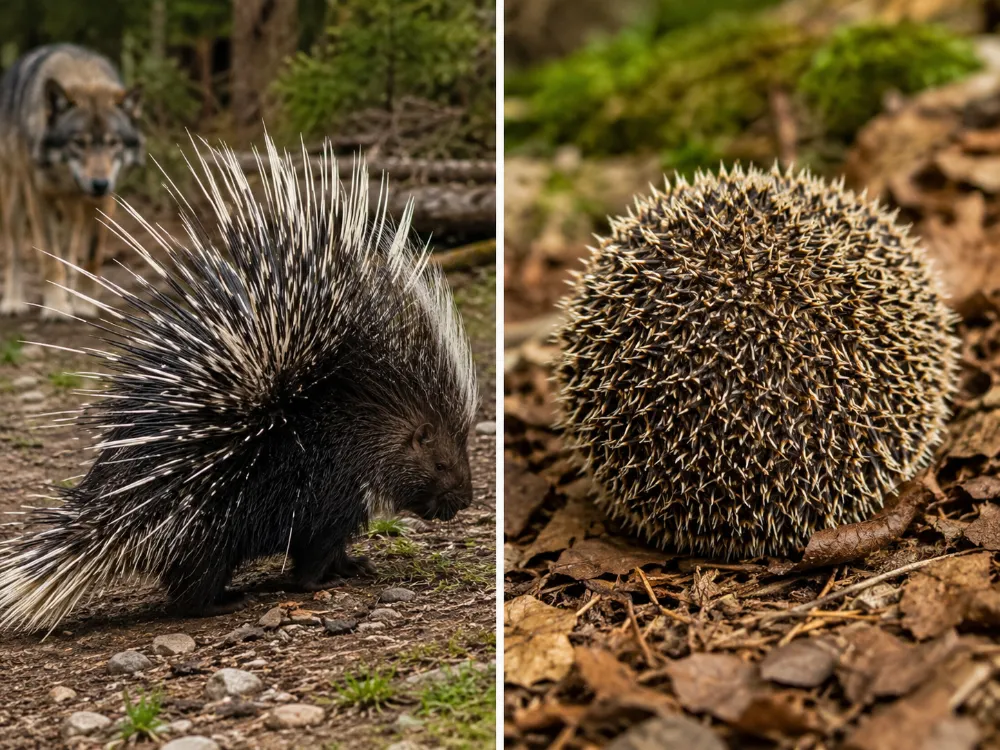
Face, Feet, and Tail Differences
Porcupines usually have a more rodent-like face, with strong gnawing teeth and a blunt or rounded head. Their feet may be strong for climbing, digging, or walking over rough ground. Some species have prehensile tails that help them grip branches.
Hedgehogs have pointed snouts designed for sniffing out insects and other small prey. Their legs are short, and their feet are adapted for walking, digging lightly, and foraging along the ground. Their tails are very short and often hidden under the spiny body outline.
The face gives a strong clue: porcupines look like large spiny rodents, while hedgehogs look like small insect hunters with pointed noses.
Diet and Feeding Habits
Porcupines are mainly plant eaters. Their diet may include bark, twigs, leaves, fruit, roots, flowers, grasses, and crops. In winter, some species rely heavily on bark and woody plants. Because they gnaw trees and wooden objects, porcupines can sometimes damage forestry areas, cabins, fences, or tool handles.
Hedgehogs are mostly insectivores, though many are flexible omnivores. They eat beetles, caterpillars, worms, snails, slugs, earwigs, eggs, small vertebrates, carrion, and some fruit. In gardens, wild hedgehogs may help reduce some insect and slug populations, although their diet is broader than just “pest control.”
Their teeth reflect their diets. Porcupines have rodent incisors for gnawing plants. Hedgehogs have sharper teeth suited for catching and chewing small animal prey.
Habitat and Range
Porcupines live in many habitats depending on the species. Some inhabit forests, deserts, rocky slopes, grasslands, savannas, and scrublands. New World porcupines are often associated with trees and forests, while many Old World porcupines are more terrestrial and may live in burrows or rocky shelters.
Hedgehogs live in parts of Europe, Africa, the Middle East, and Asia. They often prefer areas with ground cover, insects, and nesting sites. Gardens, hedgerows, woodland edges, meadows, farmland borders, and scrubby habitats can all support hedgehogs when conditions are suitable.
Porcupines are generally more widespread across different continents and habitat types, while hedgehogs are smaller ground foragers often linked to edge habitats and cover-rich landscapes.
Old World Porcupines vs New World Porcupines
Porcupines are more diverse than many people realize. Old World porcupines are usually heavy, ground-dwelling animals with long dramatic quills. They may shelter in burrows, caves, or rocky crevices and come out at night to feed.
New World porcupines are often more tree-dwelling. The North American porcupine, for example, can climb trees and feed on bark, leaves, and twigs. Some tropical New World porcupines have prehensile tails that help them move through branches.
This diversity means that not every porcupine behaves the same way. However, all porcupines are rodents and rely heavily on quills for defense.
Movement and Climbing Ability
Porcupines are usually slow on the ground, but they are not helpless. Their defense allows them to move without needing to outrun most predators. Many species can climb, and New World porcupines are especially good in trees.
Hedgehogs move close to the ground and usually travel by walking, sniffing, and searching through vegetation. They can move surprisingly quickly for short distances, and some can climb low obstacles, but they are not specialized tree climbers.
Porcupines rely on quills and sometimes climbing. Hedgehogs rely on ground cover, nocturnal movement, and curling into a ball.
Activity Pattern and Daily Life
Both porcupines and hedgehogs are mostly nocturnal or crepuscular. This means they are usually most active at night or around dawn and dusk. Night activity helps them avoid many predators and, in warm climates, reduces heat stress.
A porcupine may spend the day resting in a tree, burrow, hollow log, rock shelter, or dense vegetation. At night, it travels slowly to feed on plant material.
A hedgehog may sleep during the day in a nest made from leaves, grass, or other plant matter. At night, it searches for insects and other small foods, often using its keen sense of smell.
Predators and Survival
Porcupines are protected by quills, but they still have predators. Fishers, large cats, wolves, coyotes, owls, and other predators may attack porcupines, especially young or weakened individuals. Some predators learn how to flip a porcupine over to reach the softer belly.
Hedgehogs are preyed on by foxes, badgers, owls, large snakes, and other carnivores depending on the region. Their curled posture protects them from many attacks, but not all predators are discouraged.
Both animals show that spines are useful but not perfect. Defense reduces risk; it does not remove danger completely.
Reproduction and Young
Porcupines usually have relatively few young compared with many small rodents. The baby is often called a porcupette. Porcupettes are born with soft quills that harden soon after birth. Because quills are already part of their defense system, young porcupines become better protected as they grow.
Baby hedgehogs are called hoglets. They are born with soft, hidden spines that emerge and stiffen after birth. The mother cares for them in a nest until they are strong enough to explore and feed.
Both animals must solve the same biological problem: how to give birth to spiny young safely. In both cases, the spines or quills are softer at birth and harden later.
Are Hedgehogs Good Pets?
Some hedgehogs, especially African pygmy hedgehogs, are kept as exotic pets in places where it is legal. However, they are not simple beginner pets. They are nocturnal, need proper temperature control, require a balanced diet, and may become stressed by rough handling or poor housing.
Pet hedgehogs also need exercise, safe enclosures, veterinary care, and careful attention to hygiene. They are solitary animals and do not behave like dogs or cats. A hedgehog may tolerate handling, but it should not be treated like a cuddly toy.
Anyone considering a hedgehog should check local laws and animal welfare standards first.
Are Porcupines Good Pets?
Porcupines are not normal household pets. They are wild animals with powerful teeth, specialized diets, strong natural behaviors, and dangerous quills. They may damage property by gnawing and can injure people or other animals if mishandled.
Some porcupines may be kept in licensed wildlife facilities, zoos, or rescue centers, but that is very different from keeping one as a casual pet. Their care requires expertise, space, safety precautions, and legal permission.
In general, porcupines should be respected as wild animals rather than considered pets.
Common Myths About Porcupines and Hedgehogs
One common myth is that porcupines shoot quills. They do not. Quills detach when touched or struck, but they are not fired like arrows.
Another myth is that hedgehogs are baby porcupines. This is also false. Hedgehogs and porcupines are separate mammals with different ancestry, diets, sizes, and defense systems.
A third myth is that hedgehogs are rodents. Hedgehogs are not rodents. Porcupines are rodents, but hedgehogs belong to a different mammal group.
How to Tell a Porcupine from a Hedgehog Quickly
Look at size: porcupines are usually much larger; hedgehogs are small and compact.
Look at the face: porcupines look more rodent-like; hedgehogs have pointed snouts.
Look at the spines: porcupines have long quills; hedgehogs have shorter spines.
Look at defense behavior: porcupines raise and present quills; hedgehogs roll into a ball.
Look at diet: porcupines mostly eat plants; hedgehogs mostly eat insects and small animals.
Look at habitat use: many porcupines climb or use rocky shelters; hedgehogs forage close to the ground.
Porcupine vs Hedgehog: Final Comparison
Porcupines and hedgehogs look similar only because both evolved spiny defenses. A porcupine is a larger rodent with long quills, strong gnawing teeth, and a mainly plant-based diet. A hedgehog is a small insect-eating mammal with short spines, a pointed snout, and the ability to curl into a defensive ball.
If you are trying to identify one quickly, focus on size, body shape, and defense style. A large slow mammal with long quills is likely a porcupine. A small round mammal that curls into a spiny ball is likely a hedgehog. Both animals are fascinating examples of how mammals use modified hairs for protection.
FAQs About Porcupines vs Hedgehogs
Are porcupines and hedgehogs the same animal?
No. Porcupines and hedgehogs are different mammals. Porcupines are rodents, while hedgehogs belong to the family Erinaceidae and are not rodents.
Is a hedgehog a baby porcupine?
No. A hedgehog is not a baby porcupine. Baby porcupines are called porcupettes, while baby hedgehogs are called hoglets.
Can porcupines shoot their quills?
No. Porcupines cannot shoot quills. Their quills detach when a predator makes contact, but they are not launched through the air.
Can hedgehogs shoot their spines?
No. Hedgehogs cannot shoot their spines. They defend themselves by curling into a tight ball with their spines facing outward.
Which is bigger, a porcupine or a hedgehog?
A porcupine is usually much bigger than a hedgehog. Porcupines can be large, heavy rodents, while hedgehogs are small, compact mammals.
Which animal has sharper quills?
Porcupines usually have longer and more dangerous quills. Many porcupine quills detach easily and may have tiny barbs. Hedgehog spines are shorter and mainly form a protective outer shield.
Do porcupines eat insects?
Porcupines are mainly herbivores and mostly eat plant material such as bark, leaves, stems, roots, and fruit. They are not specialized insect hunters like hedgehogs.
Do hedgehogs eat plants?
Hedgehogs may eat some fruit or plant material, but their diet is mainly based on insects, worms, snails, slugs, eggs, carrion, and other small animal foods.
Are hedgehogs rodents?
No. Hedgehogs are not rodents. They belong to a different mammal group. Porcupines are rodents.
Are porcupines dangerous to dogs?
Yes. Dogs that bite or harass porcupines can get quills embedded in the face, mouth, nose, or paws. These injuries can be painful and usually require veterinary care.
Are hedgehogs dangerous to humans?
Hedgehogs are not usually dangerous, but their spines can feel prickly, and wild hedgehogs should not be handled unnecessarily. Like many wild animals, they may carry parasites or diseases.
Can hedgehogs be kept as pets?
Some hedgehogs are kept as exotic pets where legal, especially African pygmy hedgehogs. However, they need specialized care, proper temperature, suitable diet, safe housing, and veterinary attention.
Can porcupines be kept as pets?
Porcupines are not suitable household pets. They are wild animals with powerful teeth, strong natural behaviors, and dangerous quills. They are best left in the wild or cared for only by qualified facilities.
Why do both animals have spines?
Both evolved spines or quills as protection against predators. Their spiny defenses are similar in function, but they evolved separately in different mammal lineages.