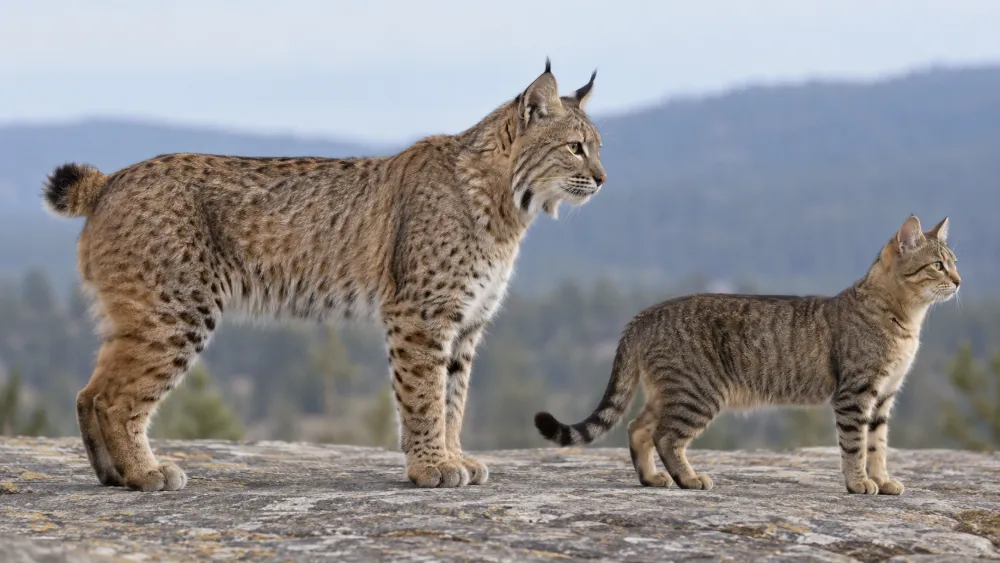
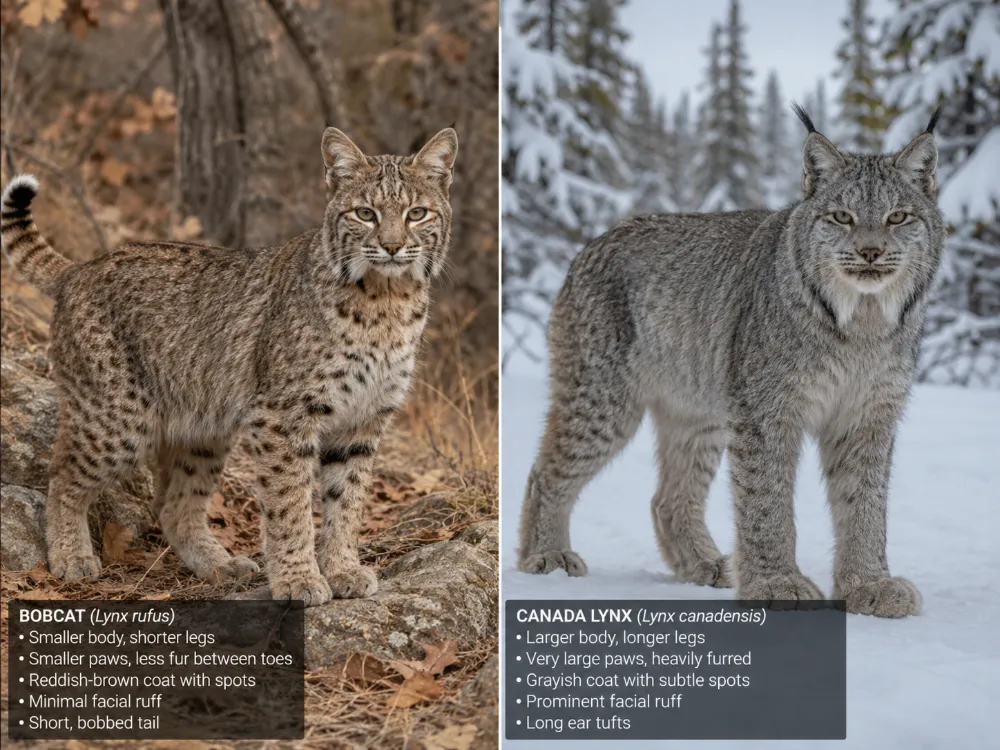
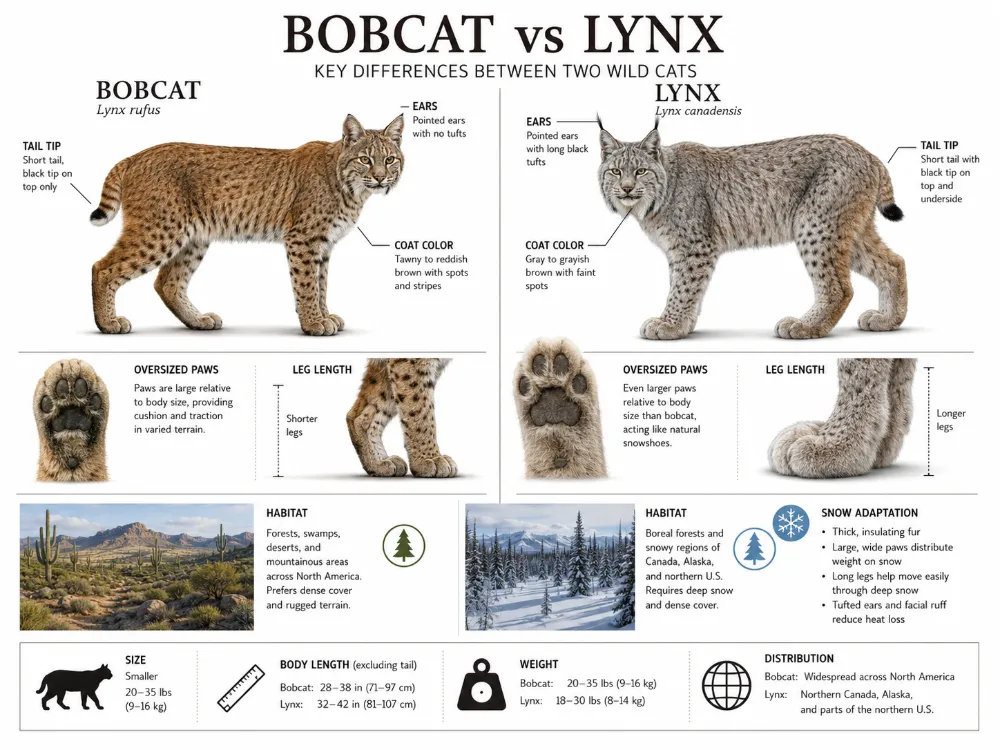
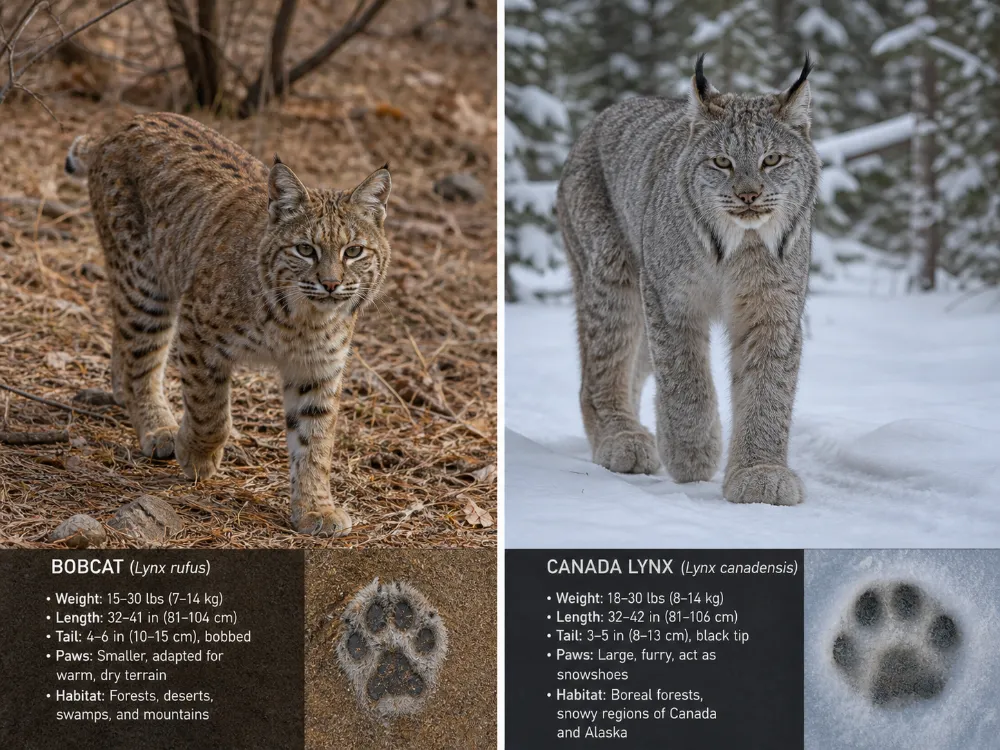
The short answer is that a bobcat is actually a type of lynx, but in everyday English, people usually compare the bobcat with the Canada lynx. Bobcats are generally smaller, browner, shorter-legged, and less specialized for deep snow. Canada lynx are usually longer-legged, grayer, more heavily furred, and famous for their huge snowshoe-like paws. So the difference is partly about language and partly about real body shape, habitat, and adaptation.
People often use the words bobcat and lynx as if they mean two completely separate cat groups. Biologically, that is not quite right. The bobcat belongs to the genus Lynx, the same genus that includes the Canada lynx, Eurasian lynx, and Iberian lynx.
In this guide, you will learn what “bobcat vs lynx” really means, how to tell a bobcat from a Canada lynx, and why these two cats look similar but live somewhat different lives.
Quick comparison table
| Feature | Bobcat | Canada Lynx |
|---|---|---|
| Scientific identity | Lynx rufus, a lynx species | Lynx canadensis, another lynx species |
| Body size | Usually smaller and more compact | Usually taller-legged and more lightly framed |
| Paws | Smaller paws | Very large, furry, snow-adapted paws |
| Leg length | Shorter-looking legs | Longer legs, especially in the hind limbs |
| Coat tone | Often browner, warmer-toned, more strongly spotted | Often grayer or frosted-looking, usually less boldly spotted |
| Tail tip | Black on top with more white underneath | Tail tip usually looks more fully black around the end |
| Main habitat style | Very adaptable, including forests, scrub, deserts, and edges near people | More strongly associated with northern forests and snowy habitats |
| Best quick clue | Smaller paws, browner coat, more adaptable generalist | Huge furry paws, longer legs, cold-climate snow specialist |
A bobcat is actually a lynx
This is the most important point in the whole topic. A bobcat is not outside the lynx group. It is one of the four living lynx species. That means the comparison “bobcat vs lynx” is a little misleading in strict biology, because the bobcat is itself a lynx.
In everyday use, though, when people say “lynx” in North America, they often mean the Canada lynx. So in practice, the phrase usually means bobcat vs Canada lynx.
Once you understand that, the comparison becomes much clearer.
They belong to the same cat genus
Bobcats and Canada lynx both belong to the genus Lynx. They are close relatives, which is why they share some obvious traits such as short tails, ear tufts, long legs compared with many other small wild cats, and a broad-faced “lynx-like” look.
However, close relatives do not have to look identical. These two cats evolved under different environmental pressures, especially when it comes to snow, prey, and habitat style.
That is why the Canada lynx looks more specialized for cold northern conditions, while the bobcat looks more like an adaptable all-purpose wild cat.
Canada lynx usually have much bigger paws
If you want the single best field clue, look at the feet. Canada lynx have very large, furry paws that act almost like natural snowshoes. These paws help spread body weight over soft snow and make movement easier in winter conditions.
Bobcats have much smaller paws by comparison. Their feet are still capable and well adapted for stalking and climbing, but they do not have the same exaggerated snow-adapted look.
If the cat looks like it is wearing oversized furry slippers, Canada lynx is the stronger answer.
Canada lynx usually have longer legs
Canada lynx often look taller and leggier than bobcats. Their hind legs in particular may seem relatively long, which helps give them a slightly high-hipped appearance.
Bobcats usually look more compact and lower to the ground. Their proportions often feel sturdier and less specialized for moving through deep snow.
This leg difference becomes especially obvious when the two species are compared side by side.
Bobcats often look browner and more strongly marked
Bobcats often have a warmer brown, tan, or buff tone, with spotting or streaking that may stand out more clearly on the coat. Their appearance can vary a lot across their large range, but many look richly colored and patterned.
Canada lynx often look grayer, paler, or more frosted in tone, especially in winter coat. Their markings are often softer and less sharply contrasted than those of many bobcats.
Color alone is not perfect for identification, but it can help when combined with paws and body shape.
The face can look different too
Both species have ear tufts and facial ruffs, but the overall face often gives a slightly different impression. Canada lynx usually look more broad-faced and heavily furred, especially in the cheeks, which can make the head appear soft and winter-adapted.
Bobcats often look a bit sharper and less fluffy in the face, especially in warmer regions or seasons. Their expression can seem more compact and catlike rather than heavily winter-coated.
This is a subtle clue, but it supports the larger picture of bobcat as generalist and lynx as cold specialist.
The tail tip is a useful detail
Tail pattern can help if you get a clear view. Bobcats usually show black mainly on the upper side of the tail tip, while the underside often looks whiter. This creates a partly black-tipped effect rather than a fully wrapped black end.
Canada lynx usually have a tail tip that looks more fully black around the end. From the back or side, the dark tip often appears broader and more complete.
This is not always the first clue people notice, but it can be very helpful in photos and good field views.
Bobcats are more adaptable in habitat
Bobcats are famous for adaptability. They can live in forests, deserts, scrublands, swamps, mountains, and edge habitats near farms or suburbs. They are much more flexible in habitat use than many people expect.
Canada lynx are more strongly tied to northern forest ecosystems, especially where snowy conditions and certain prey species shape the environment. They are much more associated with boreal forest and winter landscapes.
So if the cat is living in a hot dry region, it is not a Canada lynx. It is much more likely to be a bobcat.
Snow changes everything
The difference between these cats makes the most sense when you think about snow. Canada lynx are strongly adapted for deep, soft snow. Their big paws and longer legs help them move where smaller-footed predators may struggle.
Bobcats can live in snowy regions too, but deep snow is more challenging for them. Their smaller feet make them less efficient in those conditions, which affects where they do best and how far north they can compete successfully.
This snow adaptation is one of the main ecological reasons the two cats differ so much in shape.
Their prey often reflects their habitat
Bobcats eat a broad range of prey, including rabbits, rodents, birds, reptiles, and other small to medium animals depending on habitat. Their flexible diet matches their flexible range.
Canada lynx are especially famous for their close relationship with snowshoe hares. In many northern ecosystems, lynx numbers and behavior are strongly influenced by hare abundance.
This does not mean lynx eat only hares, but it does mean their ecological story is often more tightly linked to one major prey animal than the bobcat’s is.
Bobcats usually look more like rugged generalist wild cats
In overall impression, bobcats often look like versatile, tough, medium-sized wild cats that can handle many habitats and prey types. Their body is balanced for stalking, pouncing, climbing, and adapting.
Canada lynx often look more specialized. Their large paws, long legs, and dense fur make them feel like a cat shaped by winter, forest cover, and snow-based hunting.
So the bobcat often feels more like a flexible all-rounder, while the Canada lynx feels more like a northern specialist.
They can overlap in some regions
Bobcats and Canada lynx can occur in some of the same broad parts of North America, especially near transitional zones between habitats. In those places, identification can be more challenging because both species may be possible.
Even there, the same main clues still help: paw size, leg length, coat tone, tail tip, and habitat type. Snowy northern forest strongly favors lynx. Mixed or warmer habitat more often favors bobcat.
This overlap is one reason the comparison remains such a popular question.
Why people confuse them so often
People confuse bobcats and lynx because both have short tails, ear tufts, spotted or mottled coats, and the general look of a medium-sized wild cat. If the feet are hidden and the habitat is unclear, the two can look surprisingly similar.
The confusion is also built into language. Since the bobcat is biologically a lynx, the words themselves invite misunderstanding. Many people think “lynx” must refer to a completely separate cat group, when in fact it often refers informally to the Canada lynx.
Once you know that the comparison is really bobcat vs Canada lynx, the whole question becomes much easier.
How to tell them apart quickly
If you need a fast identification guide, use these clues together:
Bobcat: smaller paws, shorter legs, browner coat, more obvious spotting, more adaptable habitat range
Canada lynx: huge furry paws, longer legs, grayer coat, softer markings, northern snowy forest lifestyle
No single clue is perfect every time, but this combination is usually very reliable.
Which one is bigger?
Size can overlap, which is why pure body length alone is not always the best clue. In general, Canada lynx often appear taller and longer-legged, while bobcats often appear more compact. Some large bobcats can approach or overlap the size of smaller lynx in certain measures.
That is why the feet and legs usually matter more than total size when identifying them. A bobcat may be sturdy, but it rarely has the same exaggerated snow-adapted proportions as a Canada lynx.
So the better answer is not just “which is bigger,” but “which is shaped for snow.”
Final takeaway
The main difference between a bobcat and a lynx is that the bobcat is actually one species of lynx, while in everyday North American use “lynx” usually means the Canada lynx. Bobcats are generally smaller-pawed, browner, more compact, and more adaptable across many habitats. Canada lynx are generally longer-legged, grayer, more heavily furred, and famous for their huge snowshoe-like paws. Once you look at the feet, legs, and habitat, telling them apart becomes much easier.
FAQs
Is a bobcat a lynx?
Yes. A bobcat is one of the lynx species.
What is the main difference between a bobcat and a lynx?
In everyday North American use, the main difference usually means bobcat versus Canada lynx. Canada lynx have much larger paws, longer legs, and stronger snow adaptations.
How can I tell a bobcat from a lynx fast?
Look at the feet. Canada lynx usually have much bigger, furrier paws than bobcats.
Do bobcats and lynx live in the same places?
They can overlap in some parts of North America, but bobcats are generally more adaptable while Canada lynx are more strongly tied to northern snowy forests.