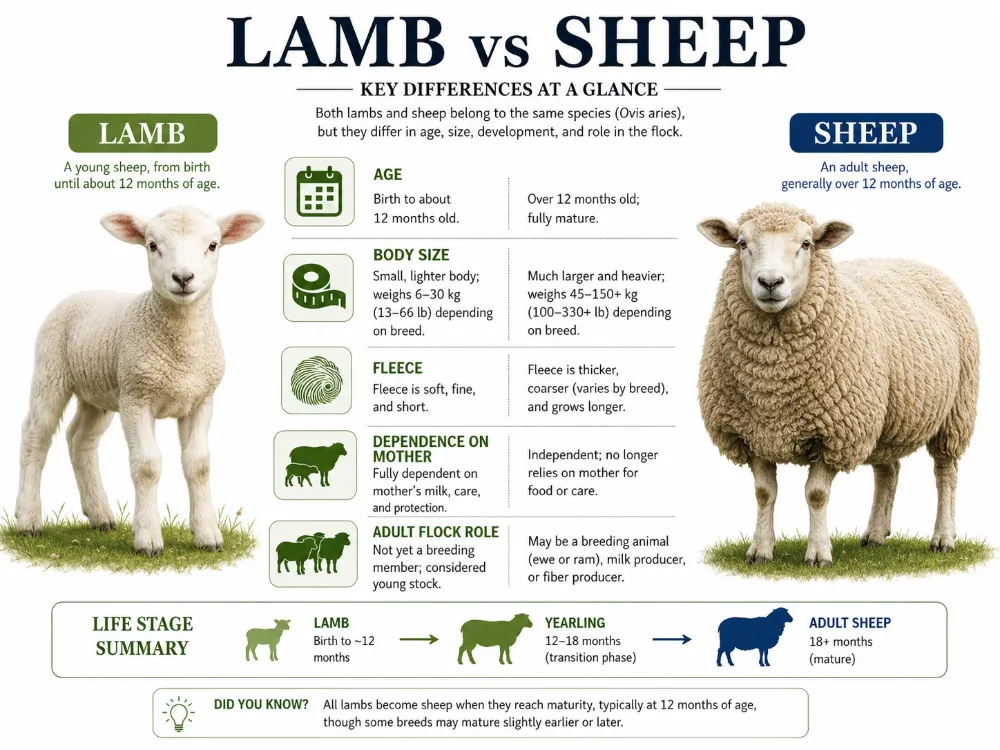
The short answer is that a lamb is a young sheep. Sheep is the broader term for the animal species, while lamb usually refers to a sheep in its first year of life. So the difference is mainly about age and life stage, not two different animals. A lamb grows into an adult sheep, and once it matures, it is no longer called a lamb in the same biological sense.
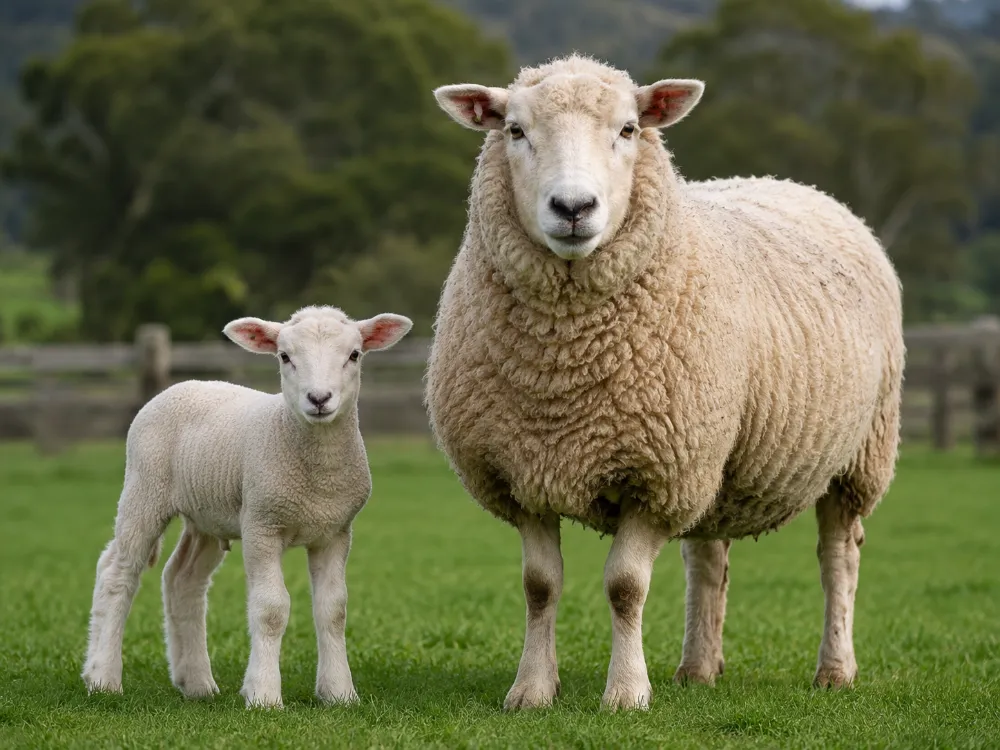
People often use the words lamb and sheep as if they describe completely different animals, but they are closely linked. In simple terms, every lamb is a sheep, but not every sheep is a lamb.
In this guide, you will learn what makes a lamb different from an adult sheep, how sheep life stages work, and why the two words are often confused in everyday English.
Quick comparison table
| Feature | Lamb | Sheep |
|---|---|---|
| Basic meaning | A young sheep | The general animal species or an adult individual |
| Life stage | Juvenile | Usually used broadly, often especially for adults |
| Age | Usually under about one year | Any age, but often refers to mature animals |
| Body size | Smaller and lighter | Larger and fully grown or growing toward adulthood |
| Wool or coat | Softer juvenile fleece or early coat | Heavier adult fleece in wool-producing breeds |
| Reproduction | Not yet mature | Adults can breed |
| Best quick clue | Small size, youthful appearance, close dependence on mother | Larger body, mature proportions, adult flock role |
| Important fact | Every lamb is a sheep | Not every sheep is a lamb |
What is a sheep?
A sheep is a domesticated hoofed mammal kept around the world for wool, meat, milk, and grazing. Sheep belong to the species Ovis aries and are one of the most familiar livestock animals in human agriculture.
The word sheep can refer to the species as a whole or to individual animals of any age. In everyday use, however, people often picture an adult sheep when they hear the word.
This is why the word sheep is broader than lamb. It includes lambs, juveniles, and mature animals all within one species.
What is a lamb?
A lamb is a young sheep. In the biological sense, the term usually refers to a sheep in the early stage of life, especially within its first year. A lamb is not a different species and not a different type of animal outside the sheep group.
It is simply the juvenile life stage of a sheep. In the same way that a calf grows into a cow or a puppy grows into a dog, a lamb grows into an adult sheep.
So when you compare lamb vs sheep, you are really comparing a young individual with the broader animal category it belongs to.
Every lamb is a sheep, but not every sheep is a lamb
This is the most important idea in the whole comparison. A lamb belongs inside the sheep category. That means lamb is the narrower term and sheep is the broader term.
In other words, a lamb is a sheep at a particular age. Once that young animal grows up, it is still a sheep, but it is no longer a lamb in the same developmental sense.
This is why the comparison is about age and maturity rather than about two different species.
Age is the main difference
The biggest difference between a lamb and a sheep is age. Lamb usually refers to a young sheep, especially in the first year of life. Sheep can refer to any member of the species, including the young, but it is often used more broadly or for mature animals.
This age-based difference also affects body size, behavior, dependence, and appearance. A lamb is still developing, while an adult sheep has reached a more mature stage of growth and social role.
So if you are trying to separate the two terms accurately, age is the first thing to think about.
Lambs are smaller and more youthful in appearance
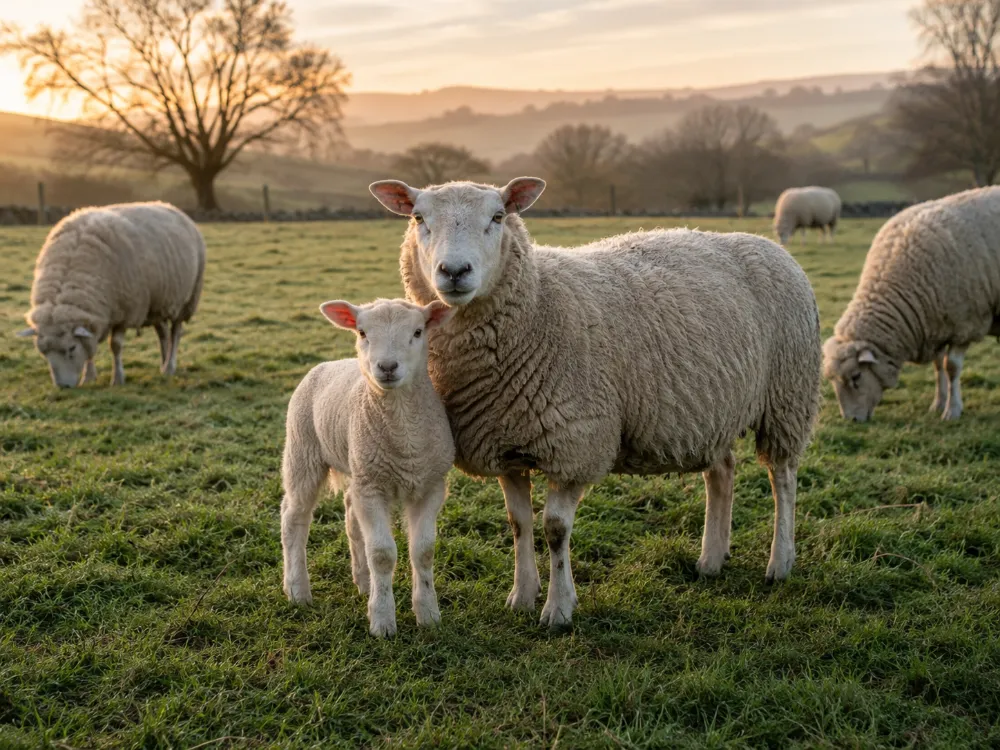
Lambs are usually much smaller than adult sheep. Their body often looks finer-boned, shorter-legged, and softer in overall appearance. The face may appear rounder, and the animal often gives a more delicate impression.
Adult sheep are larger, heavier, and more solidly built. Their head, body, and legs usually look proportionally more mature and sturdy.
If the animal looks small, young, and still closely tied to its mother or nursery group, it is more likely to be a lamb.
Lambs are more dependent on their mothers
In the earliest part of life, lambs depend heavily on their mothers for milk, warmth, protection, and early social learning. They often stay close to the ewe and follow her movements carefully.
Adult sheep are no longer dependent in this way. Mature sheep function as independent members of the flock, even though sheep remain social animals throughout life.
This dependence is one of the clearest behavioral differences between lambs and adult sheep.
Adult sheep have mature flock roles
Sheep are flock animals, and adult individuals take part in the full social structure of the group. They graze, breed, move with the flock, and respond to environmental conditions as mature animals.
Lambs are still learning how to function within that system. They may graze early, but they are still growing into their place in the flock and are not yet fully mature in body or behavior.
This is another reason lamb and sheep should be understood as life stages rather than separate animal types.
Wool and fleece often look different
Depending on breed, lambs may have a softer, finer-looking early fleece or coat. Their wool often looks cleaner, shorter, or more delicate than the heavier fleece of an adult sheep.
Adult sheep, especially in wool breeds, often carry a fuller and more substantial fleece. Over time, the body becomes more heavily coated and the wool may look denser or more strongly developed.
This difference varies by breed, since not all sheep are equally woolly, but maturity often changes the texture and appearance of the coat.
Lambs are not fully mature reproductively
Lambs are immature animals and are not yet in the same reproductive stage as adult sheep. Adult females are called ewes, and adult males are called rams. These terms describe sexually mature sheep, not young lambs.
This is important because the sheep life cycle includes several stages and names. Lamb is the young stage, while ewe and ram are adult terms linked with sex and maturity.
So a lamb is defined not only by size and youth, but also by not yet being a fully mature breeding animal.
Male and female sheep have their own adult names
Part of the confusion comes from the fact that sheep have several common names depending on age and sex. A young sheep is a lamb. An adult female is a ewe. An adult male is a ram. A castrated male may be called a wether.
The word sheep can cover all of them broadly, which is why it remains the most general term. Lamb is much more specific because it refers to youth rather than sex.
Learning these terms makes the whole sheep life cycle easier to understand.
Why people confuse the words so often
People confuse lamb and sheep because one word is often used for the species and the other is also widely known through farming, food terms, religion, and culture. In many contexts, people hear the words separately without being taught the exact biological relationship.
Children may learn that a lamb is a cute white animal in a meadow and that a sheep is a woolly farm animal, which can make them sound like separate creatures. In reality, they are two ways of talking about the same species at different life stages.
The confusion is common because language often separates emotional image from biological accuracy.
Lamb and sheep in farming
In farming, the difference matters because management changes with age. Lambs need nursing, growth support, protection from cold and disease, and careful monitoring during early life. Adult sheep are managed for breeding, grazing, wool production, or other agricultural roles.
This means the word choice is practical as well as biological. Calling an animal a lamb tells the farmer something about its age, development, and care needs.
So in agriculture, the lamb vs sheep distinction is not just vocabulary. It affects how the animal is raised and handled.
Behavior changes as lambs grow
Lambs are often more playful, springy, and visibly energetic than adult sheep. They may run, leap, and stay very close to their mothers or peer group. Their behavior often looks more exploratory and less settled.
Adult sheep are usually calmer, more routine-driven, and more focused on flock movement and grazing. They may still react quickly to danger, but they generally look more deliberate and less playful than lambs.
This is one of the easiest real-life differences to notice in a field or pasture.
Domestic sheep and wild sheep are not the same issue
When people talk about lambs and sheep in everyday English, they usually mean domestic sheep. Wild sheep species exist too, but the lamb term is most commonly heard in farming and pastoral contexts involving domesticated animals.
This is useful because it keeps the article focused on the familiar meaning. A lamb on a farm is simply the young stage of a domestic sheep.
So unless the context is wildlife biology, sheep in this comparison usually means the domestic species.
Does lamb ever mean meat?
Yes, in food language the word lamb is also used for meat from a young sheep. That culinary meaning is one reason the word becomes even more familiar than the purely biological term might otherwise be.
However, in animal biology the important point is still the same: lamb refers to a young sheep. The food meaning comes from that age-based definition rather than replacing it.
So the biological meaning comes first, and the food term grew out of it.
How to tell a lamb from an adult sheep quickly
If you need a fast identification guide, use these clues together:
Lamb: smaller body, younger face, more delicate build, often close to the mother, playful or nursery-group behavior
Adult sheep: larger body, mature proportions, fuller fleece in many breeds, independent flock role, adult social behavior
No single clue is perfect in every case, but body size, age appearance, and dependence are usually enough to make the difference clear.
Why the difference matters
The lamb vs sheep difference matters because good animal understanding depends on knowing life stage, not just species name. Age affects diet, growth, behavior, care, reproduction, and management.
It also matters for education. When people understand that a lamb is simply a young sheep, many other livestock terms begin to make more sense as well.
So this is a basic but important distinction in farm animal biology.
Final takeaway
The main difference between a lamb and a sheep is that a lamb is a young sheep, while sheep is the broader term for the species as a whole and is often used especially for adults. Lambs are smaller, younger, more dependent, and not yet fully mature. Adult sheep are larger, more developed, and part of the breeding and social structure of the flock. In simple terms, every lamb is a sheep, but not every sheep is a lamb.
FAQs
Is a lamb a baby sheep?
Yes. A lamb is a young sheep, usually in its first year of life.
What is the main difference between lamb and sheep?
The main difference is age. Lamb refers to a young sheep, while sheep is the broader term for the animal species and often for adults.
Does a lamb become a sheep?
Yes. As it matures, a lamb grows into an adult sheep.
Are all sheep called lambs?
No. Only young sheep are called lambs. Adult sheep are no longer lambs in the biological sense.