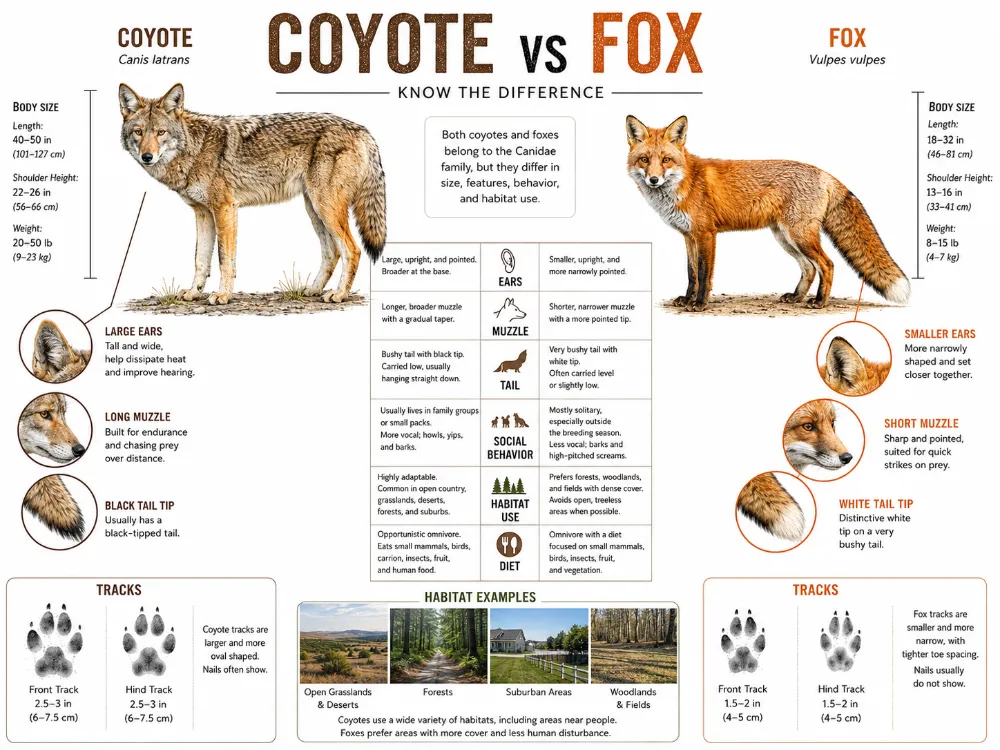
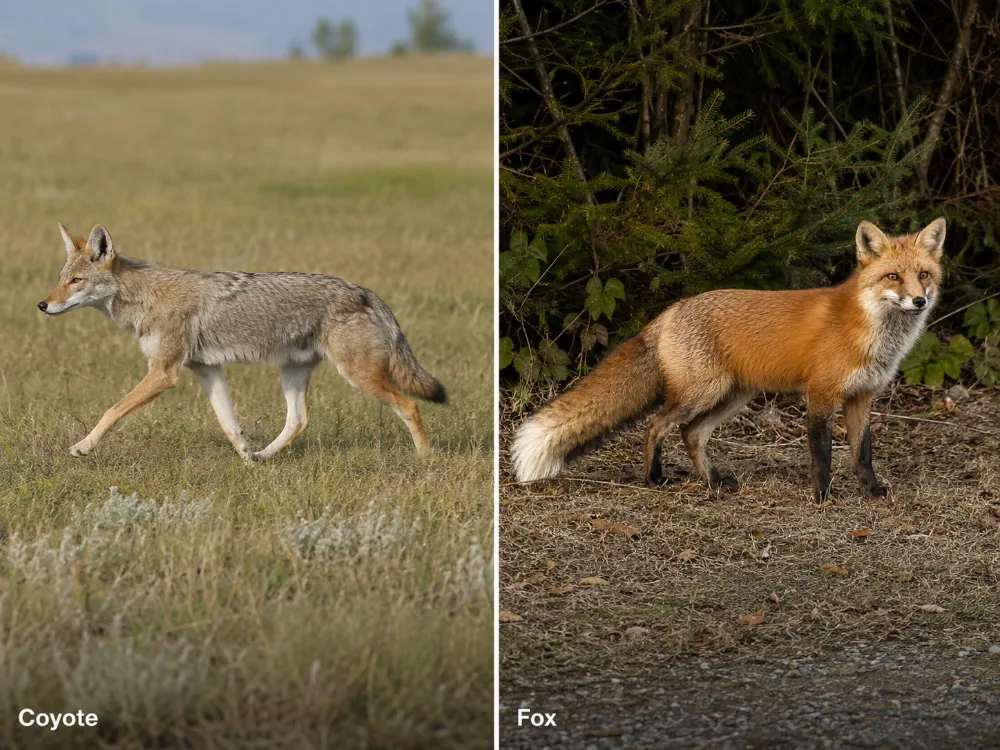
The easiest way to tell a coyote from a fox is to look at size, build, face shape, and tail. Coyotes are usually much larger, longer-legged, and more dog-like, with a narrower but stronger muzzle and a less fluffy overall look. Foxes are usually smaller, shorter-legged, and more delicate-looking, with a bushier tail, a finer face, and a lighter, more graceful build. They are related wild canids, but they are not the same kind of animal.
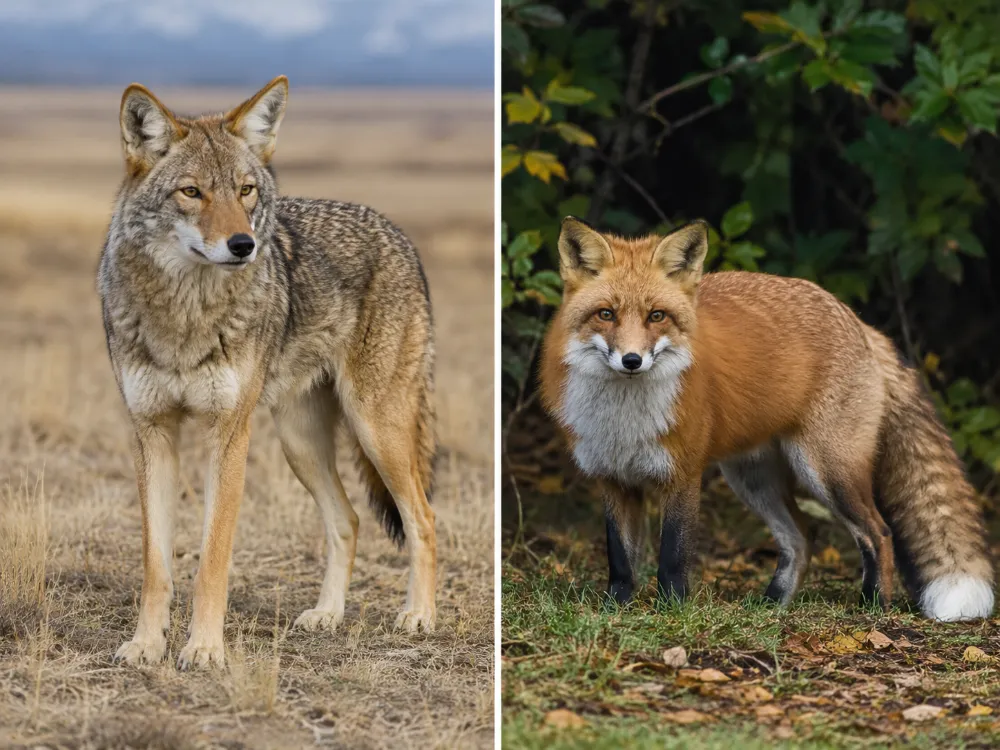
People often confuse coyotes and foxes because both have pointed ears, long snouts, bushy tails, and similar tan, gray, or reddish coats. From a distance, especially at dawn or dusk, they can look surprisingly alike. Once you know what to check, however, the difference becomes much easier to see.
In this guide, you will learn how coyotes and foxes differ in size, shape, behavior, habitat, voice, and hunting style, plus the fastest ways to identify them correctly.
Quick comparison table
| Feature | Coyote | Fox |
|---|---|---|
| Overall size | Much larger and heavier | Smaller and lighter |
| Build | Long-legged, lean, dog-like | Shorter-legged, finer-boned, more delicate |
| Muzzle | Longer and stronger-looking | Narrower, finer, more pointed |
| Ears | Pointed, but usually less oversized relative to the head | Often appear larger relative to the head |
| Tail | Bushy, but usually narrower and carried lower | Very bushy, often more dramatic and plush-looking |
| Social pattern | Often alone, in pairs, or family groups | Often alone or in pairs, depending on species |
| Main prey | Rabbits, rodents, birds, fruit, carrion, and many other foods | Rodents, rabbits, insects, fruit, birds, and small prey |
| Best quick clue | Bigger, taller, more dog-like | Smaller, lower, bushier-tailed |
They are related, but not the same animal
Coyotes and foxes both belong to the dog family, Canidae. That means they are relatives of wolves, jackals, and domestic dogs. This shared ancestry explains why they have similar basic features such as pointed ears, long muzzles, sharp teeth, and bushy tails.
However, they are not simply big and small versions of one animal. A coyote is a distinct wild canid species, while the word fox refers to several smaller canids in different fox groups. In North America, people often mean the red fox or gray fox when they say “fox,” but the broad visual comparison still holds.
So the comparison is real, but it helps to remember that “fox” is a broader everyday label than “coyote.”
Coyotes are much bigger
One of the clearest differences is size. Coyotes are usually much larger than foxes. A coyote often looks long-legged, rangy, and medium-dog-sized, while a fox usually looks noticeably smaller and lighter.
Even a large fox usually does not give the same tall, stretched, athletic impression as a coyote. A fox often looks compact enough that people may first mistake it for a cat-sized or small-dog-sized animal, while a coyote looks more obviously canine.
If the animal seems too big to be a typical fox, coyote becomes much more likely.
Coyotes look more dog-like
Coyotes usually have a more dog-like silhouette. Their chest, legs, and muzzle create a longer, leaner outline that resembles a lightly built wild dog. When they trot across a field, they often move with a steady, efficient, purposeful gait.
Foxes usually look more delicate and more finely shaped. Their body often seems lower, their legs shorter, and their movement lighter or more springy. Many people describe foxes as looking almost cat-like in their careful, quiet motion, even though they are canids.
If the animal feels like a small wild dog, think coyote. If it feels lighter and more delicate, think fox.
Foxes usually have bushier tails
Both coyotes and foxes have bushy tails, but the fox tail is often much more dramatic. It usually looks fuller, fluffier, and more visually dominant compared with the rest of the body. In many foxes, the tail seems like one of the most striking parts of the animal.
Coyote tails are also bushy, but they usually look narrower and less plush. Coyotes often carry the tail lower, especially while trotting, and the tail tends to look more functional than decorative.
If the tail looks exceptionally full and luxuriant, fox becomes the stronger guess.
Foxes often have a finer, sharper face
Foxes usually have a narrower, more delicate face than coyotes. Their muzzle can look fine and pointed, and the whole head often seems smaller relative to the body. This contributes to the classic fox expression that many people recognize from stories and illustrations.
Coyotes also have pointed faces, but their muzzle usually looks longer and stronger. The head is generally more substantial, and the animal gives a more rugged impression overall.
If the face looks slim and refined, especially on a small animal with a big tail, it is more likely to be a fox.
Fox ears often look bigger relative to the head
Foxes often seem to have oversized ears because their head is smaller and finer. The ears can stand out strongly and give the animal a sharp, alert look. This is especially noticeable in red foxes and many desert-adapted fox species.
Coyotes also have pointed ears, but because the head is larger and longer, the ears usually do not look as oversized by comparison. They fit the head in a more balanced way.
This is a subtle clue, but it becomes useful when combined with size and tail shape.
Coyotes have longer legs
Coyotes usually stand taller on longer legs. Their body looks built for covering ground efficiently across grasslands, scrub, farmland, and edge habitats. This longer-legged build supports endurance travel and flexible hunting.
Foxes usually look lower to the ground. Their shorter legs fit a smaller predator that often depends on stealth, quick pounces, and flexible use of cover.
If the animal looks tall and rangy, coyote is more likely. If it looks lower and lighter, fox becomes more likely.
Coat color can overlap, so it is not the best clue
Color alone can be misleading. Coyotes are often grayish-brown, tan, buff, or rusty in mixed tones. Foxes can be red, gray, silver, brown, or mixed, depending on the species and region.
A red fox may be easy to recognize because of its rich reddish coat and white underside, but not all foxes are bright red. Some gray foxes and pale foxes can create much more confusion with coyotes at first glance.
That is why body shape matters more than color in many real-life sightings.
Coyotes are often more adaptable in open and human-modified landscapes
Coyotes are famous for adaptability. They thrive in grasslands, deserts, forests, farmland, suburbs, and even major cities. They are flexible in diet and movement, which has allowed them to spread successfully across a huge range.
Foxes can also live near people, and some species are highly successful around farms, villages, and suburban edges. However, coyotes usually give the stronger impression of being a highly mobile generalist able to use almost any landscape that offers food and cover.
This adaptability is one reason coyotes are so often seen in modern North America.
Foxes often hunt smaller prey more delicately
Foxes are usually associated with small prey such as rodents, rabbits, insects, birds, and fruit. Many foxes hunt with quiet stalking, listening, and sudden pouncing behavior, especially when targeting small animals in grass or under snow.
Coyotes also eat small prey and can be excellent mousers or rabbit hunters, but they are generally more versatile and more capable of taking somewhat larger prey when opportunities arise. They also scavenge readily and shift diet according to season and habitat.
So while both are opportunistic, coyotes often operate on a slightly bigger scale than foxes do.
Coyotes are usually more social than foxes
Coyotes are often seen alone, but they also form pairs and family groups, and in some settings they show more visible group structure than many foxes do. Their social life can be more flexible and may include cooperative territory defense or family-based hunting.
Foxes are often more solitary in everyday appearance, especially outside the breeding season. A fox may seem more like an independent small predator moving quietly through cover.
This is a general pattern rather than a strict rule, but it helps explain the different feel of the two animals in the field.
Their voices sound different
Coyotes are famous for yips, yelps, barks, and rising howls. Their calls often sound sharp, layered, and energetic, especially when several animals vocalize together. Many people recognize the classic high, wavering coyote chorus.
Foxes can also make a surprising range of sounds, including barks, screams, chatter, and other calls. Their voices can sound abrupt, eerie, or even bird-like depending on the species and situation. They are often less likely to produce the long, rolling group-style vocal impression associated with coyotes.
If the sound is a drawn-out wild yipping chorus, coyote is often the stronger guess.
Tracks can differ too
Coyote tracks are usually larger, more dog-like, and more substantial than fox tracks. They often reflect the animal’s bigger body, longer stride, and stronger feet.
Fox tracks are smaller and lighter, often looking neat and delicate by comparison. In snow or mud, track size can be one of the clearest clues when the animal itself is not visible.
As with the body, the key difference is scale and overall robustness.
Gray foxes make the comparison more complicated
One reason the topic can be confusing is that “fox” does not refer to only one exact look. The red fox fits the classic big-tail image most people know, but the gray fox adds complexity because it can look less bright and somewhat more coyote-like in some lighting.
Gray foxes are still much smaller than coyotes, but their color and habitat may create confusion for beginners. They also have a special trait many people do not expect from foxes: they are notably good climbers.
This is another reason body size remains the most dependable starting point.
Why people confuse them so often
People confuse coyotes and foxes because both are slim wild canids with pointed faces and bushy tails, and sightings are often brief. Low light, distance, winter coats, and movement across a road or field make the distinction harder.
A small coyote can seem fox-like, while a large fox in perfect condition can seem bigger than expected. Popular culture also makes foxes seem more uniform than they really are, which adds to the confusion.
Once you focus on scale, legs, and tail fullness, however, the difference becomes much easier to see.
How to tell them apart quickly
If you need a fast identification guide, use these clues together:
Coyote: much larger, longer legs, more dog-like body, narrower but stronger muzzle, less fluffy tail, often seen trotting steadily
Fox: smaller body, shorter legs, finer face, bigger-looking ears, very bushy tail, lighter and more delicate overall impression
No single clue is perfect every time, but this combination is usually very reliable.
Which one is more dangerous?
Coyotes are generally more physically formidable because they are larger and stronger. A coyote can handle bigger prey and usually poses more risk to small pets than a fox does.
Foxes are still wild predators and should not be treated like harmless toy animals, but they are generally much smaller and less imposing than coyotes. Neither should be approached or fed.
The best rule is simple: respect both as wild canids and give them space.
Final takeaway
The main difference between a coyote and a fox is that coyotes are much larger, longer-legged, and more dog-like, while foxes are smaller, shorter-legged, finer-faced, and much bushier-tailed. Coyotes are broad generalists that adapt well to many landscapes, while foxes usually look more delicate and operate on a smaller predatory scale. They can seem similar at first glance, but once you check body size, leg length, and tail shape, the distinction becomes much clearer.
FAQs
How can I tell a coyote from a fox fast?
Look at size and tail. Coyotes are much larger and less fluffy-tailed, while foxes are smaller with very bushy tails.
Is a coyote bigger than a fox?
Yes. Coyotes are usually much larger and heavier than foxes.
Do coyotes and foxes live in the same places?
Yes, in some regions they can overlap, especially in North America, though they may use habitat differently.
Which is more dangerous, a coyote or a fox?
Coyotes are generally more formidable because of their larger size and strength, though both are wild animals that deserve caution.