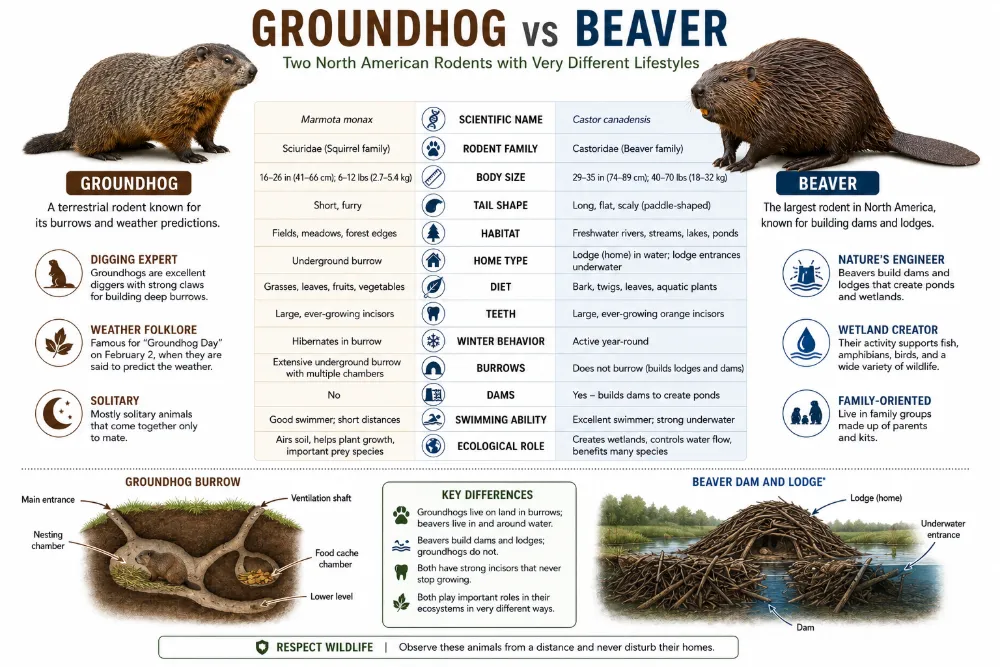
Groundhogs and beavers are both large rodents, but they are very different animals. A groundhog is a land-dwelling marmot that digs burrows in fields, gardens, and woodland edges. A beaver is a semi-aquatic rodent that lives near water, builds lodges and dams, and has a broad flat tail. The fastest clue is habitat: groundhogs live in dry burrows; beavers live in and around water.
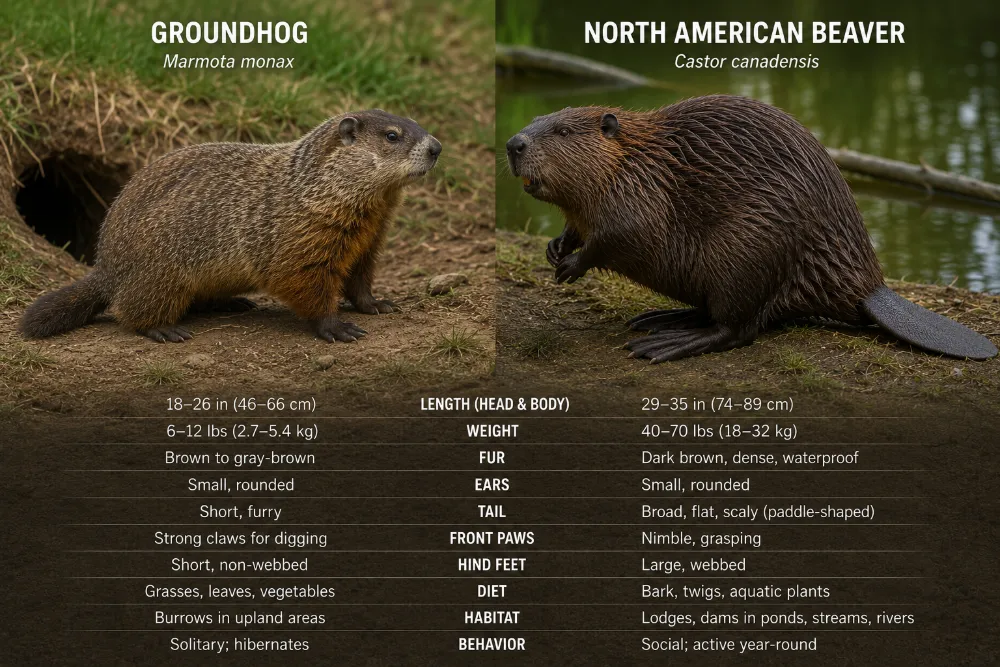
Quick Comparison Table
| Feature | Groundhog | Beaver |
|---|---|---|
| Scientific group | Marmot, ground squirrel, family Sciuridae | Beaver, family Castoridae |
| Common names | Groundhog, woodchuck, whistle-pig | Beaver |
| Scientific name in North America | Marmota monax | Castor canadensis |
| Main lifestyle | Terrestrial, burrowing | Semi-aquatic, water-based |
| Typical habitat | Fields, meadows, gardens, farms, forest edges, roadsides | Rivers, ponds, lakes, streams, wetlands, marshes |
| Tail | Short, furry, rounded tail | Wide, flat, scaly paddle-like tail |
| Body size | Medium-large rodent | Much larger and heavier rodent |
| Home | Underground burrow | Lodge, bank den, pond system, or dam-created habitat |
| Engineering behavior | Digs burrows | Builds dams, lodges, canals, and underwater entrances |
| Diet | Mostly grasses, clover, garden plants, leaves, fruits | Bark, twigs, leaves, aquatic plants, cambium, shrubs |
| Winter strategy | True hibernation | Stays active, using food caches and lodges |
| Best identification clue | Chunky brown animal near a burrow on land | Large swimming rodent with flat tail near water |
What Is a Groundhog?
A groundhog is a large ground squirrel in the marmot group. Its scientific name is Marmota monax. It is also called a woodchuck, whistle-pig, or land beaver, although it is not a true beaver. Groundhogs are native to North America and are common in fields, meadows, pastures, woodland edges, gardens, parks, and suburban areas.
Groundhogs are built for digging. They have compact bodies, strong claws, short legs, small rounded ears, and a short furry tail. They spend much of their lives near underground burrow systems, where they sleep, escape predators, raise young, and hibernate during winter.
Although groundhogs can climb and swim when necessary, they are mainly land animals. They are most often seen standing upright near a burrow entrance, feeding on grass, or running back to cover when alarmed.
What Is a Beaver?
A beaver is a large semi-aquatic rodent in the family Castoridae. In North America, the species is the North American beaver, Castor canadensis. In Europe and parts of Asia, the Eurasian beaver, Castor fiber, fills a similar ecological role.
Beavers are famous for their engineering ability. They cut trees, build dams, create ponds, dig canals, and construct lodges with underwater entrances. Their broad flat tails, webbed hind feet, dense waterproof fur, and strong orange incisors make them highly adapted to life in and around water.
Unlike groundhogs, beavers are not true hibernators. They remain active through winter, often using underwater food caches and protected lodges to survive cold months.
The Main Difference Between Groundhog and Beaver
The main difference is lifestyle. A groundhog is a dry-land burrower. A beaver is a water-based engineer.
Groundhogs dig burrows in soil and feed mostly on soft green plants. Beavers live near water, build lodges or bank dens, and eat woody plants, bark, twigs, leaves, and aquatic vegetation.
The tail is another quick clue. A groundhog has a short furry tail. A beaver has a large, flat, paddle-shaped tail that looks almost scaly.
Size Difference
Beavers are much larger than groundhogs. A groundhog is a chunky rodent, often about the size of a large house cat or small dog. It may look heavy when sitting upright, but it is still far smaller than a mature beaver.
Beavers are among the largest rodents in the world. Adult beavers can be several times heavier than groundhogs. Their bodies are thick, muscular, and adapted for swimming, hauling branches, and working in water.
If the animal is a medium-sized brown rodent sitting near a field burrow, it is likely a groundhog. If it is a very large rodent swimming in a pond or carrying sticks near water, it is likely a beaver.
Tail Shape
Tail shape is one of the easiest ways to tell a groundhog from a beaver.
A groundhog has a short, furry, rounded tail. It may flick the tail when alarmed, but the tail is not especially large or flat. It looks like the tail of a chunky ground squirrel.
A beaver has a broad, flat, paddle-like tail covered with dark, leathery, scale-like skin. The tail helps with swimming, balance, fat storage, and communication. A beaver may slap its tail on the water as an alarm signal.
If you see a flat paddle tail, you are looking at a beaver, not a groundhog.
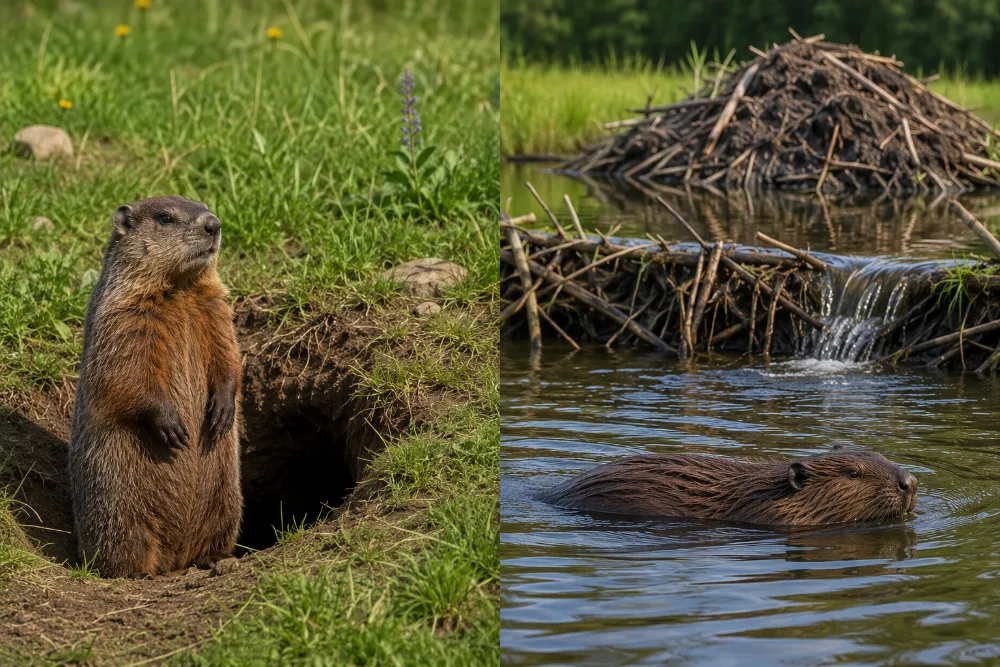
Habitat and Range
Groundhogs prefer open or semi-open land with diggable soil. They are common in meadows, farms, hayfields, gardens, roadsides, orchards, parks, and forest edges. They need enough vegetation for feeding and enough soil depth for burrow construction.
Beavers require water. They live around streams, rivers, ponds, lakes, marshes, wetlands, and slow-moving waterways. If the water is not deep enough for protection, beavers may build dams to raise the water level and create safer habitat.
Groundhogs are animals of fields and burrows. Beavers are animals of wetlands and waterways.
Burrows vs Lodges
Groundhogs live in underground burrows. A groundhog burrow may have several entrances, escape tunnels, sleeping chambers, nesting areas, and waste chambers. Burrow entrances often have piles of excavated soil nearby.
Beavers may live in lodges or bank dens. A lodge is a dome-like structure made of sticks, mud, and vegetation, usually surrounded by water. The entrance is underwater, which helps protect the beaver family from predators. In riverbanks or lakeshores, beavers may dig bank dens instead of building free-standing lodges.
Both animals are diggers, but the architecture is different: groundhogs dig dry underground homes; beavers create water-protected homes.
Dams and Engineering
Groundhogs are strong diggers, but they do not build dams. Their main engineering work is burrow construction. These burrows can affect soil structure, create shelter for other animals, and sometimes cause problems under sheds, fences, gardens, or farm equipment areas.
Beavers are famous ecosystem engineers. By building dams, they slow water flow and create ponds. These ponds can provide habitat for fish, frogs, turtles, waterfowl, insects, and wetland plants. Beaver activity can increase local biodiversity, recharge groundwater, and change entire landscapes.
This is one of the biggest ecological differences: groundhogs modify soil; beavers reshape waterways.
Diet and Feeding Behavior
Groundhogs are mainly herbivores that feed on soft green plants. Their diet includes grasses, clover, dandelions, alfalfa, leaves, flowers, fruits, vegetables, and garden crops. They are especially well known for eating beans, lettuce, peas, squash, carrots, and other cultivated plants.
Beavers are also herbivores, but they eat more woody material. Their diet includes bark, cambium, twigs, leaves, aquatic plants, sedges, grasses, and shrubs. They often cut trees such as aspen, willow, cottonwood, birch, and alder.
Groundhogs graze like chunky land herbivores. Beavers browse, cut, store, and transport woody vegetation near water.
Teeth and Chewing
Both groundhogs and beavers are rodents, so both have strong continuously growing incisors. Rodent incisors must be worn down through gnawing and feeding.
Groundhogs use their teeth to clip plants, chew roots, and occasionally gnaw. Their teeth are strong, but their lifestyle does not require cutting down trees.
Beavers have extremely powerful orange incisors adapted for cutting wood. Their front teeth are strengthened with iron-rich enamel, giving them the orange color. Beavers can fell trees, strip bark, cut branches, and shape wood for dams and lodges.
If the animal is cutting trees and leaving chisel-shaped stumps, it is a beaver, not a groundhog.
Swimming Ability
Groundhogs can swim if they need to, but swimming is not their main lifestyle. They may cross water or escape danger by swimming, but they are not specialized aquatic animals.
Beavers are excellent swimmers. They have webbed hind feet, waterproof fur, closable ears and nostrils, and a streamlined swimming posture. They can move powerfully through water and dive to access underwater entrances, food caches, and safe escape routes.
A swimming groundhog may look awkward and temporary. A swimming beaver looks natural, strong, and at home.
Winter Behavior
Groundhogs are true hibernators. In cold regions, they spend winter underground in a hibernation chamber. Their body temperature, heart rate, and metabolism drop dramatically. They survive on stored body fat until spring.
Beavers do not hibernate. They remain active in winter, though they may spend much time inside their lodge. Before winter, beavers often store branches underwater near the lodge. When ice covers the pond, they can swim under the ice to access stored food.
This is a major biological difference: groundhogs sleep through much of winter; beavers work through winter from their protected aquatic homes.
Social Behavior
Groundhogs are usually more solitary than beavers. Adults often live alone in their own burrow systems, except during the breeding season or when a mother is raising young. They may tolerate nearby groundhogs in good habitat, but they are not strongly family-based engineers like beavers.
Beavers are social animals that usually live in family groups called colonies. A colony may include a breeding pair, their current young, and older offspring from previous years. Family members help maintain dams, lodges, canals, and food caches.
Groundhog life is centered on individual burrows. Beaver life is centered on family construction and water management.
Reproduction and Young
Groundhogs usually mate after emerging from hibernation. Females give birth in underground nesting chambers. The young are born helpless and remain in the burrow until they are old enough to emerge and feed above ground.
Beavers usually form long-term breeding pairs. Young beavers are called kits. Kits are born in the lodge or den and are cared for by the family group. Older siblings may help protect the lodge and maintain the territory.
Groundhog young usually disperse to find their own burrows. Beaver young may remain with their parents for one or more years before leaving to establish new territories.
Predators and Defense
Groundhogs are prey for coyotes, foxes, bobcats, dogs, raptors, and other predators. Their main defense is alertness and rapid retreat into a burrow. They may stand upright to watch for danger and give a sharp whistle-like alarm call.
Beavers are prey for wolves, coyotes, bears, cougars, lynx, large dogs, and sometimes large birds of prey when young. Water is their main defense. A beaver can dive, swim to safety, slap its tail to warn family members, and retreat into a lodge or bank den.
Both animals avoid danger rather than seek conflict, but they can bite if trapped or handled.
Tracks and Signs
Groundhog signs include burrow entrances with soil piles, clipped vegetation, tracks near fields, and damage to garden plants. Their burrows may be found under sheds, brush piles, rock walls, banks, or open field edges.
Beaver signs are usually much more obvious near water. Look for gnawed tree trunks, pointed stumps, peeled sticks, dams, lodges, canals, slides into the water, and muddy paths along banks.
If the evidence is a hole in dry soil and eaten garden plants, think groundhog. If the evidence is cut trees and raised water levels, think beaver.
Groundhog vs Beaver vs Muskrat
Groundhogs and beavers are sometimes confused with muskrats because all three can be brown, semi-chunky rodents seen near water or vegetation. However, muskrats are smaller than beavers and more aquatic than groundhogs.
| Animal | Best Clue | Main Habitat |
|---|---|---|
| Groundhog | Short furry tail, dry burrow, field habitat | Fields, gardens, woodland edges |
| Beaver | Large flat tail, cut trees, dams, lodges | Ponds, streams, rivers, wetlands |
| Muskrat | Smaller body, thin vertically flattened tail, aquatic vegetation | Marshes, ponds, wetlands |
The flat paddle tail is the strongest beaver clue. The dry-land burrow is the strongest groundhog clue.
Are Groundhogs Dangerous?
Groundhogs are not usually dangerous to people. They are shy animals that normally run to their burrows when approached. However, they are wild rodents with strong teeth and claws, and they may bite if cornered, trapped, or handled.
The main concern with groundhogs is property damage. Their burrows can undermine sheds, patios, fences, garden beds, and field edges. Their feeding can also damage vegetable gardens and crops.
People should not try to grab or handle groundhogs. If one is causing serious property issues, local wildlife control or humane exclusion methods may be needed.
Are Beavers Dangerous?
Beavers usually avoid people, but they are powerful wild animals. Their incisors are large and sharp, and a cornered beaver can bite seriously. Most risks occur when people approach too closely, try to touch a beaver, block its escape route, or interfere with a lodge or dam.
The more common concern is landscape impact. Beaver dams can flood roads, yards, culverts, farm fields, and forest areas. At the same time, their wetlands can provide major ecological benefits.
The best approach is coexistence where possible and professional management where flooding creates serious safety or property problems.
Ecological Role of Groundhogs
Groundhogs are important soil engineers. Their burrows mix and aerate soil, create shelter for other animals, and influence plant communities. Abandoned groundhog burrows may be used by rabbits, foxes, skunks, snakes, insects, and other wildlife.
As herbivores, groundhogs help shape vegetation. As prey, they support predators such as foxes, coyotes, raptors, and bobcats.
Although they can be frustrating in gardens, groundhogs are native animals with real ecological value.
Ecological Role of Beavers
Beavers are among the most important ecosystem engineers in North America and Eurasia. Their dams create wetlands, slow streams, trap sediment, raise water tables, and provide habitat for many species.
Beaver ponds can support fish, frogs, turtles, ducks, herons, songbirds, insects, aquatic plants, and mammals. Their wetlands may also help reduce erosion and store water during dry periods.
Because beavers change landscapes so dramatically, they can be both beneficial and challenging. Their ecological value is high, but their engineering may conflict with roads, farms, and human structures.
Common Myths About Groundhogs and Beavers
Myth: Groundhogs are baby beavers
This is false. Groundhogs and beavers are different rodents from different families. A groundhog is a marmot; a beaver is a semi-aquatic rodent in the family Castoridae.
Myth: Groundhogs build dams
This is false. Groundhogs dig burrows. Beavers build dams and lodges.
Myth: Beavers hibernate
This is false. Beavers do not truly hibernate. They remain active in winter and use lodges and underwater food caches.
Myth: Groundhogs eat wood
This is misleading. Groundhogs may gnaw occasionally, but they mainly eat soft plants. Beavers are the rodents famous for cutting trees and eating bark.
Myth: Beavers are pests with no benefits
This is false. Beavers can cause flooding problems, but they also create valuable wetlands that support many wildlife species.
Simple Identification Checklist
| Question | Likely Groundhog | Likely Beaver |
|---|---|---|
| Where did you see it? | Field, yard, garden, roadside, burrow entrance | Pond, river, stream, wetland, lodge or dam area |
| What does the tail look like? | Short, furry, rounded | Wide, flat, paddle-like, scaly |
| How large is it? | Chunky but medium-sized | Much larger and heavier |
| What signs are nearby? | Burrow holes, soil piles, garden damage | Cut trees, dams, lodges, canals, water slides |
| Does it hibernate? | Yes | No true hibernation |
| Main food | Grass, clover, garden plants | Bark, twigs, aquatic plants |
| Best quick rule | Land burrower | Water engineer |
Final Verdict: Groundhog vs Beaver
Groundhogs and beavers are both rodents, but they are not close look-alikes once you know the key features. A groundhog is a land-dwelling marmot that digs burrows, eats soft vegetation, and hibernates through winter. A beaver is a large semi-aquatic rodent that builds dams and lodges, cuts trees, stores food underwater, and remains active in winter.
The fastest identification rule is simple: groundhog equals field burrow and furry tail; beaver equals water, cut trees, dams, and flat paddle tail. Both animals are important ecosystem engineers, but they shape the environment in very different ways.
FAQs About Groundhogs and Beavers
Is a groundhog a beaver?
No. A groundhog is not a beaver. A groundhog is a marmot in the squirrel family, while a beaver belongs to a different rodent family called Castoridae.
Why is a groundhog sometimes called a land beaver?
The nickname “land beaver” comes from its chunky body and digging behavior, but it is not a true beaver. Groundhogs live on land and dig burrows, while beavers live around water and build dams.
Which is bigger, a groundhog or a beaver?
A beaver is much bigger and heavier than a groundhog. Groundhogs are chunky medium-sized rodents, while beavers are among the largest rodents in the world.
How can you tell a groundhog from a beaver quickly?
Look at the tail and habitat. A groundhog has a short furry tail and lives near dry burrows. A beaver has a wide flat tail and lives near water, dams, lodges, or cut trees.
Do groundhogs build dams?
No. Groundhogs dig underground burrows. Beavers build dams, lodges, canals, and water-based shelters.
Do beavers hibernate like groundhogs?
No. Groundhogs are true hibernators. Beavers stay active through winter, often feeding from underwater food caches near their lodges.
Do groundhogs cut down trees?
No. Groundhogs mainly eat soft green plants such as grasses, clover, leaves, and garden crops. Beavers are the rodents known for cutting trees.
Do beavers eat fish?
No. Beavers are herbivores. They eat bark, twigs, leaves, aquatic plants, grasses, and shrubs, not fish.
Can groundhogs swim?
Yes, groundhogs can swim when necessary, but they are not aquatic specialists. Beavers are far better adapted for swimming and diving.
Are groundhogs dangerous?
Groundhogs usually avoid people and are not aggressive. However, they can bite if cornered or handled, so they should be observed from a distance.
Are beavers dangerous?
Beavers usually avoid people, but they are powerful animals with sharp teeth. They can bite seriously if trapped, threatened, or approached too closely.
Which animal is better for the ecosystem?
Both have ecological value. Groundhogs aerate soil and create burrows used by other animals. Beavers create wetlands that support many species and change water flow across landscapes.