The easiest way to tell a raven from a crow is to look at size, tail shape, beak shape, and voice. Ravens are usually larger, heavier-billed, and shaggier around the throat, with a more wedge-shaped tail in flight. Crows are usually smaller, slimmer-billed, and less shaggy, with a fan-shaped tail and a more familiar cawing call. Both are intelligent black birds in the crow family, but they are not the same animal.
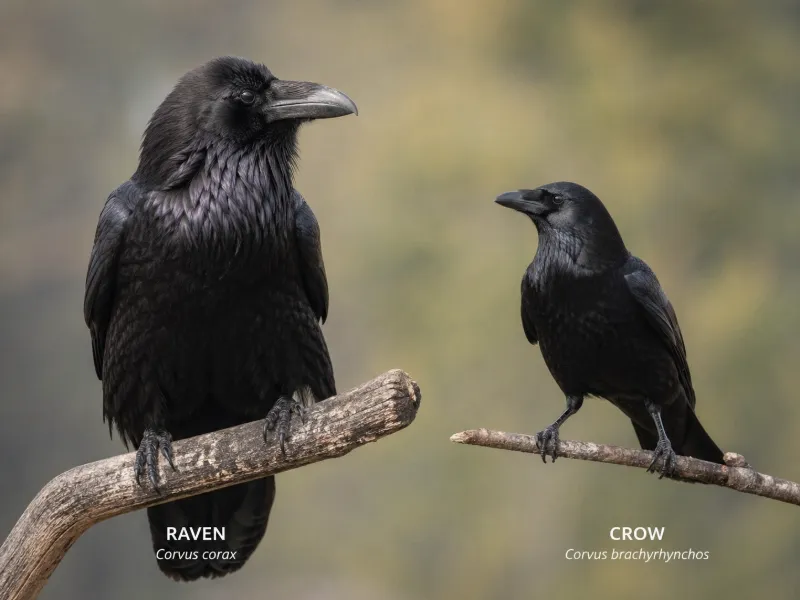
People often confuse ravens and crows because both are dark-feathered, highly intelligent, and members of the corvid family. From a distance, especially when one bird is alone, the difference can be hard to see. Their shared black plumage and similar body shape make them easy to mix up.
In this guide, you will learn how ravens and crows differ in appearance, sound, behavior, habitat, and flight style, plus the quickest ways to identify them in the field.
Quick comparison table
| Feature | Raven | Crow |
|---|---|---|
| Size | Larger and heavier | Smaller and slimmer |
| Beak | Thicker, heavier, more curved | Slimmer and straighter |
| Throat feathers | Often shaggy or shaggy-looking | Smoother |
| Tail in flight | More wedge-shaped or diamond-like | More fan-shaped |
| Voice | Deeper croaks and guttural calls | Classic caws and sharper calls |
| Flight style | Often soars and glides more | More steady flapping |
| Social pattern | Often seen alone or in pairs | Often seen in groups |
| Typical setting | Wilder or more open landscapes, though some live near people | Very common in towns, suburbs, farms, and cities |
They belong to the same bird family
Ravens and crows are both members of the corvid family, which also includes magpies, jays, rooks, and jackdaws. Corvids are famous for intelligence, curiosity, memory, problem-solving, and complex social behavior.
Because ravens and crows are close relatives, they share many features. Both are mostly black, have strong feet, sturdy bills, and adaptable feeding habits. Both are also known for being vocal, observant, and able to live in a variety of environments.
This family relationship is exactly why the two birds can look so similar at first glance.
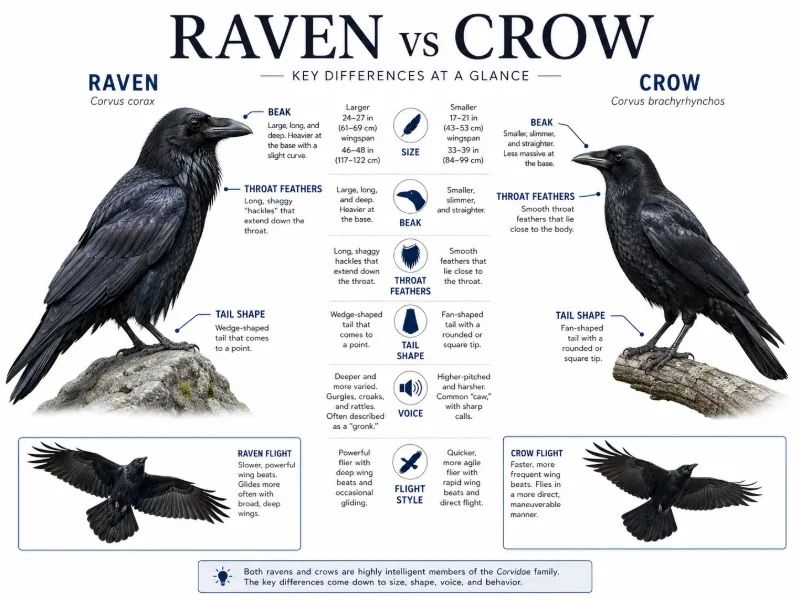
Ravens are usually bigger
One of the first things many birdwatchers notice is that ravens are usually larger than crows. A raven often looks heavier, longer-winged, and more powerful overall, especially when seen beside a crow or flying overhead.
Crows are still fairly large birds, but they usually appear more compact and less bulky. The difference can be obvious when the two are compared side by side, but it is harder when you see only one bird by itself.
If the bird looks especially large, thick-bodied, and strong-billed, it may well be a raven.
The beak shape is different
Ravens usually have a larger, thicker, and more strongly built beak than crows. The bill often looks deeper at the base and slightly more curved, giving the whole head a heavier appearance.
Crows usually have a slimmer, straighter, and less massive beak. Their head often looks smoother and less bulky in profile.
This is a useful clue when the bird is perched close enough for you to see the head clearly. If the beak looks oversized and powerful, raven becomes more likely.
Ravens often have shaggy throat feathers
Another useful field mark is the throat. Ravens often show shaggy or loose-looking throat feathers, especially when calling. These feathers can make the front of the neck look rougher and more textured.
Crows usually have a cleaner, smoother throat area without that dramatic shaggy look. Their neck and chest often look neater in comparison.
This is not always obvious at a distance, but it can be a strong clue in close or moderate views.

The tail shape helps in flight
Tail shape is one of the best ways to separate ravens from crows when they are flying. A raven usually shows a more wedge-shaped or diamond-like tail, especially when the tail is spread.
A crow usually shows a more fan-shaped tail that looks evenly rounded across the end. This difference is often easier to see from behind or below while the bird is in steady flight.
Birdwatchers often rely on this clue because body size can be tricky to judge in the air, but tail shape is often more dependable.
Ravens sound deeper than crows
Voice is another excellent clue. Ravens often make deeper, rougher, more guttural croaks or knocking sounds. Their calls can sound heavier, harsher, and more resonant than those of crows.
Crows are best known for the classic caw, which is usually clearer, sharper, and more familiar to many people. While crows can make a range of sounds, their typical voice is less deep and less gravelly than a raven’s.
If you hear a low croaking call that sounds heavier and more hollow, you may be listening to a raven.
Flight style is not exactly the same
Ravens often appear more powerful and more relaxed in flight. They may glide, soar, or perform rolling and acrobatic movements more often than crows, especially in windy conditions or open landscapes.
Crows usually show steadier, more regular flapping flight and are less likely to spend long periods soaring in the same dramatic way. They can still glide and maneuver well, but their flight often feels more straightforward.
This difference is especially noticeable when a raven is high over open terrain, riding air currents with long wings.
Crows are often more social
Crows are commonly seen in groups, whether feeding in fields, moving through neighborhoods, or gathering in noisy flocks before roosting. Social behavior is a major part of crow life, and in many places they are among the most visible social birds around humans.
Ravens are often seen alone or in pairs, especially outside the breeding season. They can gather too, especially where food is concentrated, but many people first notice ravens as single birds or pairs in larger landscapes.
So if you see several black birds together calling and foraging, they are more likely to be crows than ravens in many everyday settings.
Habitat can give you a clue
Crows are highly adaptable and often thrive in cities, suburbs, farms, parks, school grounds, roadsides, and other human-dominated environments. They are among the most successful birds around people.
Ravens are also adaptable, but they are often associated more strongly with wilder, more open, or more remote landscapes such as mountains, cliffs, forests, coasts, and broad rural areas. In some regions they also live near towns and cities, but they still often feel more like a bird of the open landscape.
Habitat alone is not enough for identification, but it can support the other clues.
Behavior often feels different
Ravens often come across as bold, curious, and almost theatrical. They may soar, tumble in the air, investigate unusual objects, or act with a kind of heavy confidence. Many people who watch ravens closely notice how deliberate and expressive they seem.
Crows are also highly intelligent and curious, but they often feel more practical, busier, and more socially noisy in everyday environments. They are excellent problem-solvers and strong observers, but their behavior in neighborhoods and fields may seem more routine and communal.
These impressions are subjective, but many birdwatchers feel the difference after repeated observation.
Why people mix them up so often
People confuse ravens and crows because both are black corvids with similar body plans, similar intelligence, and overlapping habits. If lighting is poor or the bird is far away, many of the finer clues disappear.
Popular culture also tends to blur them together. In stories, symbolism, and casual conversation, people often call any large black bird a crow or a raven without checking the details.
Once you start looking for tail shape, beak size, throat feathers, and voice, the two birds become much easier to separate.
Are ravens smarter than crows?
Both ravens and crows are exceptionally intelligent birds. Each is capable of problem-solving, memory, social learning, and flexible behavior. It is difficult to make a simple statement that one is “smarter” in every way than the other.
Both are among the most cognitively impressive birds in the world. The main difference for most observers is not intelligence level, but the different style in which that intelligence becomes visible.
So the safer answer is that both are highly intelligent corvids rather than trying to crown one clear winner.
How to tell a raven from a crow quickly
If you need a fast field guide, use these clues together:
Raven: larger size, heavier beak, shaggy throat, wedge-shaped tail, deeper croaking voice, more gliding and soaring
Crow: smaller size, slimmer beak, smoother throat, fan-shaped tail, classic cawing voice, more regular flapping flight
No single clue is perfect every time, but the combination is usually very reliable.
Final takeaway
The difference between a raven and a crow comes down mainly to size, beak shape, throat feathers, tail shape, voice, and flight style. Ravens are usually larger, heavier-billed, shaggier, and deeper-voiced, with a wedge-shaped tail and more soaring flight. Crows are usually smaller, slimmer, smoother-throated, and more likely to give the familiar caw, with a fan-shaped tail and more direct flapping flight. They are close relatives, but once you learn the key clues, they are much easier to tell apart.
FAQs
Is a raven bigger than a crow?
Yes. Ravens are usually larger and heavier than crows.
How can I tell a raven from a crow in flight?
Look at the tail. Ravens usually have a wedge-shaped tail, while crows usually have a fan-shaped tail.
Do ravens and crows sound the same?
No. Ravens usually sound deeper and croak more, while crows are better known for sharp cawing calls.
Are ravens and crows both intelligent?
Yes. Both are highly intelligent corvids known for strong memory, problem-solving, and adaptable behavior.