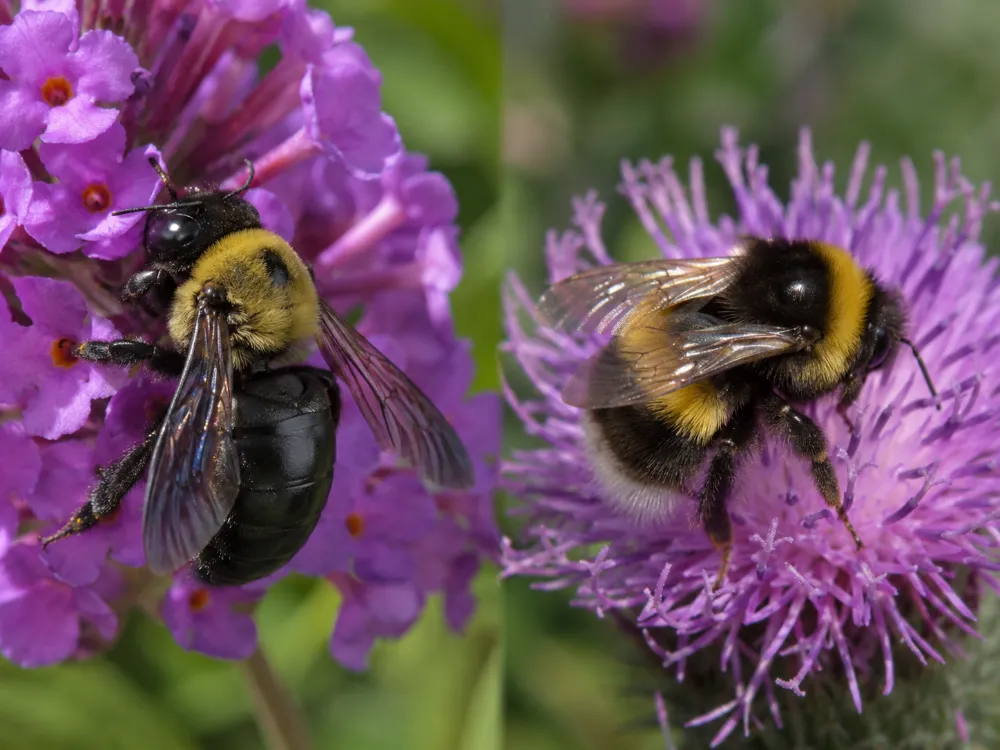
Carpenter bees and bumble bees are both large, black-and-yellow pollinators, but they are easy to separate. Carpenter bees usually have a shiny, mostly hairless abdomen and nest by tunneling into wood. Bumble bees are fuzzier all over, including the abdomen, and usually nest in the ground or hidden cavities. Carpenter bees are mostly solitary; bumble bees live in social colonies with queens and workers.
| Feature | Carpenter Bee | Bumble Bee | Quick Identification Tip |
|---|---|---|---|
| Scientific group | Genus Xylocopa | Genus Bombus | They are different types of bees, not the same insect. |
| Body hair | Fuzzy thorax but shiny, mostly hairless abdomen | Fuzzy thorax and fuzzy abdomen | A shiny black abdomen usually means carpenter bee. |
| Body shape | Robust, smooth-backed, often slightly longer-looking | Round, soft, very fuzzy, teddy-bear-like | Bumble bees look fuzzier and rounder. |
| Nesting habit | Tunnels into untreated, weathered, or soft wood | Nests in ground cavities, old rodent burrows, grass clumps, compost, or sheltered spaces | Round holes in wood suggest carpenter bees. |
| Social structure | Mostly solitary or loosely social | Social colony with queen, workers, and males | Bumble bees live in colonies; carpenter bees usually do not. |
| Wood damage | Can damage wood by excavating tunnels | Does not tunnel into wood | Wood boring is the carpenter bee’s main nuisance issue. |
| Sting risk | Females can sting but are usually not aggressive; males cannot sting | Females and workers can sting; usually defensive near nests | Both are usually peaceful unless handled or threatened. |
| Male behavior | Males often hover near people and guard territories but cannot sting | Males may patrol flowers or search for queens and cannot sting | Hovering carpenter bee males look scary but are harmless. |
| Pollination | Important pollinator; can perform buzz pollination and nectar robbing | Excellent pollinator; famous for buzz pollination | Both are valuable pollinators. |
| Best simple clue | Shiny black abdomen plus round holes in wood | Fuzzy abdomen plus colony behavior near ground or flowers | Look at the abdomen and nesting site first. |
Are Carpenter Bees and Bumble Bees the Same?
No. Carpenter bees and bumble bees are different kinds of bees. They can look similar because both are often large, round-bodied, and black-and-yellow. They also visit many of the same flowers and may buzz loudly while flying.
Carpenter bees belong mainly to the genus Xylocopa. Their name comes from their habit of excavating tunnels in wood. Bumble bees belong to the genus Bombus. They are social bees that form colonies with a queen, workers, and males.
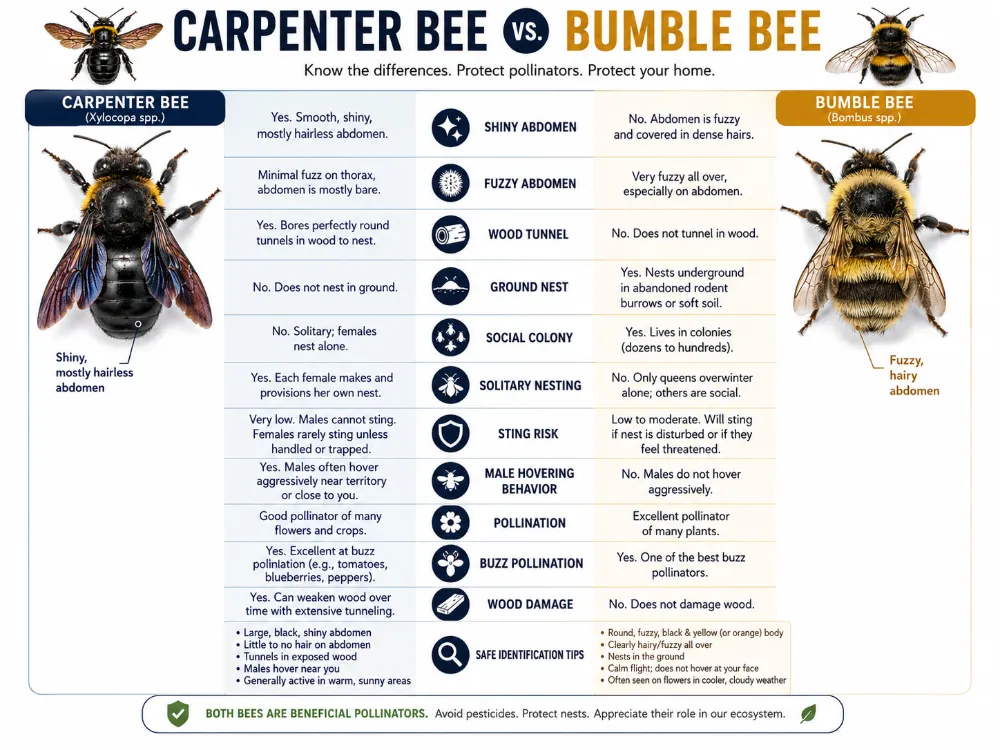
The simplest difference is this: carpenter bees bore into wood and usually have shiny abdomens; bumble bees live in colonies and are fuzzy all over.
The Fastest Way to Tell a Carpenter Bee From a Bumble Bee
Look at the abdomen. The abdomen is the rear part of the bee’s body. A carpenter bee usually has a smooth, shiny, mostly hairless black abdomen. A bumble bee usually has a fuzzy abdomen with bands of yellow, black, orange, white, or brown hair depending on species.
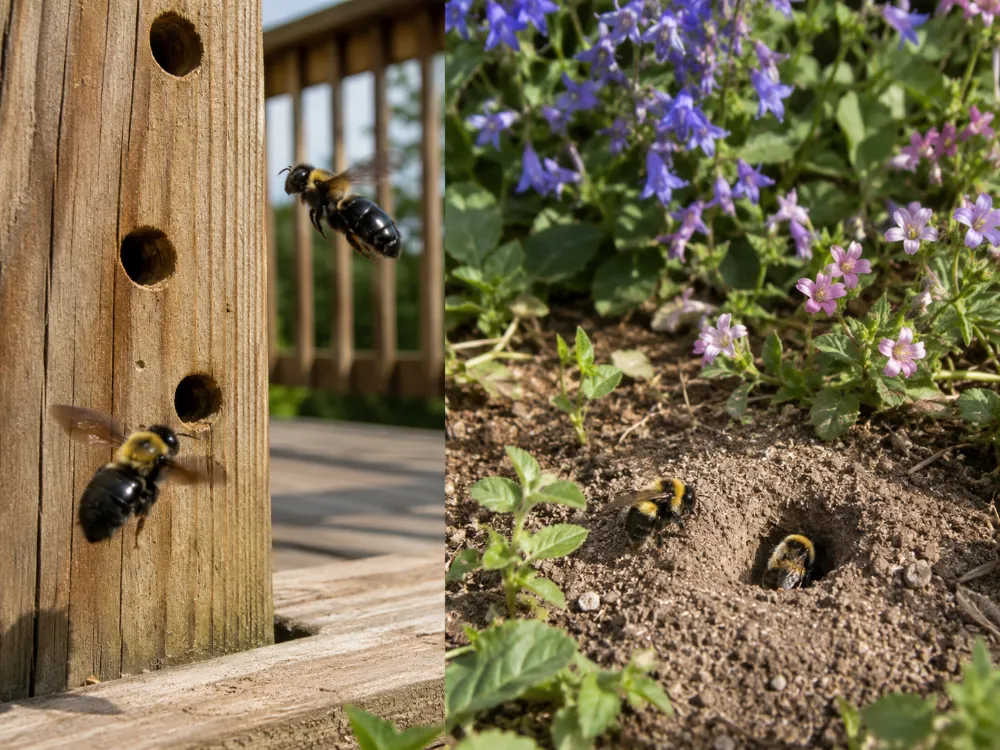
Then look at the nesting location. If large bees are flying around round holes in wooden beams, fence rails, porch trim, rafters, fascia boards, or deck structures, they are likely carpenter bees. If large fuzzy bees are entering a hole in the ground, a grass clump, compost pile, old rodent burrow, or hidden cavity, they are more likely bumble bees.
Shiny black abdomen: usually carpenter bee.
Fuzzy abdomen: usually bumble bee.
Round hole in wood: carpenter bee.
Ground or grass nest: bumble bee.
Large noisy colony traffic: more likely bumble bee.
Scientific Classification
| Classification | Carpenter Bee | Bumble Bee |
|---|---|---|
| Kingdom | Animalia | Animalia |
| Phylum | Arthropoda | Arthropoda |
| Class | Insecta | Insecta |
| Order | Hymenoptera | Hymenoptera |
| Family | Apidae | Apidae |
| Common genus | Xylocopa | Bombus |
| Common role | Solitary wood-nesting pollinator | Social colony-forming pollinator |
Both are true bees. Both are important pollinators. Both can be valuable in gardens and natural ecosystems. The main conflict with humans is different: carpenter bees may damage wood, while bumble bees may defend a nest if people disturb the colony.
Appearance Differences
Carpenter bees and bumble bees are often mistaken for each other because both are large bees with black and yellow coloration. However, their body texture is different.
A carpenter bee usually has a fuzzy thorax, which is the middle body section, but the abdomen is shiny and dark. In many common species, the abdomen looks smooth, black, and polished. This shiny abdomen is the best visual clue.
A bumble bee has a fuzzy thorax and a fuzzy abdomen. The whole bee looks softer, rounder, and more heavily covered in hair. Many bumble bees have bold color bands that may be yellow, black, orange, rusty, white, or buff.
| Body Feature | Carpenter Bee | Bumble Bee |
|---|---|---|
| Thorax | Fuzzy, often yellow or black | Very fuzzy, often banded |
| Abdomen | Smooth, shiny, mostly hairless, often black | Fuzzy, rounded, often color-banded |
| Body impression | Large, glossy, sturdy | Large, soft, round, hairy |
| Best visual clue | Shiny abdomen | Fuzzy abdomen |
Size Comparison
Both carpenter bees and bumble bees are considered large bees. In many regions, they are among the biggest bees people commonly see around gardens, decks, porches, and flowering plants.
Carpenter bees are often similar in size to large bumble bees, which is why confusion is common. A carpenter bee may look slightly longer or smoother, while a bumble bee often looks rounder and fluffier.
Size alone is not enough for identification. A small bumble bee species may be smaller than a carpenter bee, while a large queen bumble bee may look just as large or larger. Abdomen texture and nesting behavior are more reliable clues.
Color Differences
Color can help, but it should not be your only identification tool. Many carpenter bees are black with yellow hair on the thorax. Some have mostly dark bodies. Others may show different colors depending on species and region.
Bumble bees show more obvious color banding. Their fuzzy bodies may have yellow, black, orange, rust, white, or pale bands. Different bumble bee species can be identified partly by these color patterns, although exact identification can be difficult.
In quick backyard identification:
Black-and-yellow bee with shiny black rear: likely carpenter bee.
Black-and-yellow bee with fuzzy striped rear: likely bumble bee.
Nesting Differences
Nesting is the most important behavioral difference. Carpenter bees excavate tunnels in wood. They do not eat wood like termites, but they chew it to create nesting galleries where eggs and pollen food are placed.
Bumble bees do not bore into wood. They usually nest in existing cavities. Many use abandoned rodent burrows, thick grass, compost piles, leaf litter, rock walls, hollow spaces, or sheltered places under sheds or decks.
| Nesting Feature | Carpenter Bee | Bumble Bee |
|---|---|---|
| Nest type | Wood tunnel with brood cells | Social colony in a cavity |
| Common nest location | Decks, porch beams, rafters, fascia, fence posts, untreated wood | Ground holes, old burrows, grass clumps, compost, wall cavities, under sheds |
| Do they build wax comb? | No large colony comb; brood cells are made in wood tunnels | Yes, colony contains wax cells and food pots |
| Colony size | Usually one female per tunnel system, sometimes loose groups | Dozens to hundreds depending on species and season |
| Human concern | Wood damage | Nest defense near high-traffic areas |
Carpenter Bee Tunnels
Carpenter bees make nearly round entrance holes in wood. These holes are often about the width of a finger or slightly smaller, depending on the species. The entrance usually goes inward for a short distance, then turns and follows the grain of the wood.
Inside the tunnel, the female creates separate brood cells. Each cell receives pollen and nectar as food for the developing larva. She lays an egg in the cell, seals it, and continues the process along the tunnel.
Common signs of carpenter bee activity include:
Round holes in wood
Coarse sawdust or wood shavings below the hole
Yellowish staining near the entrance
Large bees hovering near eaves, decks, or rails
Repeated use of the same wooden area each year
Bumble Bee Colonies
Bumble bees live in social colonies. A queen starts the colony in spring after surviving winter. She finds a nest site, lays eggs, and raises the first workers. Once workers mature, they collect food, care for young, and help the colony grow.
Unlike honey bee colonies, bumble bee colonies are usually seasonal in temperate climates. Most workers and males die before winter. New queens mate, find protected overwintering sites, and start new colonies the next year.
A bumble bee nest may contain:
A queen
Female workers
Developing larvae and pupae
Wax cells
Pollen and nectar storage pots
Males later in the season
New queens late in the colony cycle
Wood Damage: Which Bee Causes It?
Carpenter bees cause wood damage. Bumble bees do not tunnel into wood. If you see large bees and round holes in wooden structures, carpenter bees are the likely cause.
Carpenter bees prefer untreated, unpainted, weathered, or soft wood. They may use cedar, pine, redwood, cypress, or other exposed wood. They often choose eaves, fascia boards, porch ceilings, railings, fence posts, deck beams, sheds, and outdoor furniture.
One carpenter bee tunnel may not cause serious structural damage. The problem grows when the same area is reused year after year, multiple females tunnel nearby, or woodpeckers enlarge the damage while searching for larvae.
Do Bumble Bees Damage Houses?
Bumble bees do not chew tunnels into wood and do not damage wood like carpenter bees. However, a bumble bee colony may become a nuisance if it is located near a doorway, patio, walkway, children’s play area, dog run, or garden path.
Most bumble bee nests are temporary and disappear naturally by the end of the season. If the nest is in a low-traffic area, it is often best to leave it alone because bumble bees are valuable pollinators.
Removal may be needed if:
The nest is in a high-traffic area.
Someone nearby has a serious sting allergy.
Pets or children repeatedly disturb the nest entrance.
Bees are entering indoor living spaces.
The colony is inside a sensitive structure or business area.
Sting Differences
Both carpenter bees and bumble bees can sting, but only females have stingers. A stinger is a modified egg-laying structure, so male bees cannot sting.
Female carpenter bees can sting, but they are usually not aggressive. They may sting if handled, trapped, stepped on, or squeezed. Male carpenter bees are often the ones that hover close to people, but they cannot sting.
Bumble bee queens and workers can sting. They are usually peaceful while foraging on flowers, but they may defend a nest if it is disturbed. A bumble bee colony can involve multiple workers, so nest disturbance can lead to more than one sting.
| Sting Feature | Carpenter Bee | Bumble Bee |
|---|---|---|
| Can females sting? | Yes | Yes |
| Can males sting? | No | No |
| Typical aggression | Low; males may bluff by hovering | Low while foraging; higher near nest if disturbed |
| Main risk | Handling or disturbing females in tunnels | Stepping on or disturbing a colony nest |
Why Male Carpenter Bees Hover Near People
Male carpenter bees often hover around nest areas, porches, decks, and wooden structures. They may fly close to a person’s face or patrol a small territory. This behavior can feel intimidating, but male carpenter bees cannot sting.
The male is usually guarding a mating territory. He may investigate moving objects, including people, pets, birds, or other insects. His behavior is mostly bluff and display.
Female carpenter bees are less showy. They do the tunnel excavation and nesting work. They can sting, but they are usually focused on their nest and flowers rather than chasing people.
Pollination Value
Both carpenter bees and bumble bees are important pollinators. They visit flowers for nectar and pollen. As they move between flowers, pollen grains stick to their bodies and transfer to other flowers, helping plants reproduce.
Bumble bees are especially valued because they can fly in cooler temperatures and lower light than many other bees. Their fuzzy bodies carry pollen effectively. They are excellent pollinators of wildflowers, berries, tomatoes, peppers, and many native plants.
Carpenter bees also pollinate many flowers. They are strong flyers and can perform buzz pollination. However, they sometimes engage in nectar robbing, which means they cut or use holes near the base of flowers to reach nectar without contacting the flower’s reproductive parts. Even then, carpenter bees still pollinate many plants during normal flower visits.
Buzz Pollination
Buzz pollination is a special behavior in which a bee vibrates its flight muscles to shake pollen loose from certain flowers. Some plants hold pollen tightly inside tube-like structures, and buzzing helps release it.
Bumble bees are famous buzz pollinators. This is one reason they are important for crops such as tomatoes and blueberries. Carpenter bees can also buzz pollinate, depending on species and flower type.
Honey bees cannot buzz pollinate in the same way. This makes bumble bees and some solitary bees especially valuable for certain plants.
Diet and Feeding
Adult carpenter bees and bumble bees feed mainly on nectar for energy. They collect pollen as a protein-rich food for larvae. Both may visit a wide variety of flowers, though flower preference depends on tongue length, body size, season, and local plant species.
Bumble bee colonies require constant food. Workers gather pollen and nectar to feed larvae and support the queen. Carpenter bee females collect pollen and nectar to provision individual brood cells in their tunnels.
Both bees benefit from gardens with continuous blooms from spring through fall.
Life Cycle of Carpenter Bees
Carpenter bees usually have a solitary nesting cycle. In spring, adults become active, mate, and females begin excavating or reusing tunnels. The female creates brood cells inside the tunnel, provides food for each larva, lays eggs, and seals each cell.
The young develop inside the wood. New adults emerge later in the season. In many regions, adult carpenter bees may overwinter in tunnels and become active again the following spring.
Basic carpenter bee life cycle:
Adults emerge in spring
Mating and territory behavior occur
Females excavate or reuse wood tunnels
Eggs are laid in provisioned brood cells
Larvae develop inside the tunnel
New adults emerge later
Some adults overwinter in protected tunnels
Life Cycle of Bumble Bees
Bumble bee colonies begin with a queen. After winter, a mated queen emerges, feeds on flowers, and searches for a nest site. She lays eggs and raises the first workers herself. Once workers mature, they take over much of the foraging and nest care.
The colony grows through spring and summer. Later, the colony produces males and new queens. The new queens mate and find protected places to overwinter. The old queen, workers, and males usually die as cold weather arrives.
Basic bumble bee life cycle:
Queen emerges after winter
Queen finds a nest cavity
First workers are raised
Workers expand and maintain the colony
Males and new queens are produced later
New queens mate
New queens overwinter
The old seasonal colony dies out
Carpenter Bee vs Bumble Bee Around Homes
Around homes, carpenter bees are most noticeable around wood. They may hover under roof eaves, near deck railings, around exposed beams, or beside fence posts. Their tunnels may leave round holes and sawdust-like material.
Bumble bees are more noticeable around flower beds, vegetable gardens, ground holes, compost piles, shrubs, and grassy edges. They may fly in and out of one ground-level entrance repeatedly if a nest is present.
| Home Sign | Likely Carpenter Bee | Likely Bumble Bee |
|---|---|---|
| Round holes in wooden trim | Yes | No |
| Sawdust below a hole | Yes | No |
| Large bees entering a ground hole | Unlikely | Likely |
| Fuzzy bees visiting flowers | Possible | Very likely |
| Hovering males around porch wood | Common | Less typical |
| Colony traffic from one hidden cavity | Usually no large colony | Common |
How to Prevent Carpenter Bee Damage
Carpenter bee prevention is mostly about protecting wood. Carpenter bees are less likely to tunnel into painted, sealed, or well-maintained surfaces than bare weathered wood.
Useful prevention steps include:
Paint or seal exposed wood.
Repair weathered trim, railings, and fascia boards.
Use hardwoods or treated materials where appropriate.
Fill abandoned tunnels after confirming bees are not active inside.
Install physical barriers on vulnerable surfaces if needed.
Reduce untreated wood surfaces around porches and decks.
Inspect eaves, railings, and fence posts in spring.
Do not simply plug an active tunnel without understanding the nesting stage. Trapped bees may chew a new exit. Long-term prevention works best when combined with repair and surface protection.
Should You Remove Carpenter Bees?
Not every carpenter bee needs removal. Carpenter bees are valuable pollinators and usually not aggressive. If they are using a dead tree, old log, or non-structural wood away from people, leaving them alone may be the best choice.
Control may be reasonable when bees are tunneling into structural or expensive wood, such as deck beams, porch ceilings, fascia boards, railings, sheds, or outdoor furniture.
A balanced approach is best:
Protect important wooden structures.
Provide untreated scrap wood or bee-friendly habitat away from buildings if appropriate.
Plant flowers for pollinators.
Avoid broad insecticide use around blooming plants.
Use professional help for repeated or serious structural problems.
Should You Remove Bumble Bees?
In most cases, bumble bees should be left alone. They are important pollinators, and their colonies are seasonal. If the nest is in a quiet corner of a yard, garden edge, or unused area, it will usually disappear naturally when the season ends.
Removal may be needed if the nest is near a door, sidewalk, playground, dog area, school, business entrance, or someone with a severe sting allergy. In those cases, contact a professional who understands pollinator-safe management.
Never pour gasoline, bleach, boiling water, or chemicals into a bumble bee nest. These methods are unsafe, environmentally harmful, and unnecessary.
Are Carpenter Bees Good or Bad?
Carpenter bees are both beneficial and sometimes troublesome. They are good because they pollinate flowers, support native ecosystems, and contribute to plant reproduction. They are troublesome when they tunnel into important wooden structures.
Whether they are “good” or “bad” depends on location. A carpenter bee in a meadow or dead log is a valuable pollinator. A carpenter bee tunneling into a porch beam may require management.
The best view is practical: protect your home, but do not treat every carpenter bee as a pest.
Are Bumble Bees Good or Bad?
Bumble bees are overwhelmingly beneficial. They are among the most important wild pollinators in many regions. They pollinate native plants, garden flowers, berries, vegetables, and crops.
The only common problem is nest location. A bumble bee colony near heavy human activity may create sting risk if people or pets disturb it. Away from high-traffic areas, bumble bee nests are usually best left undisturbed.
Gardeners should generally welcome bumble bees. Their presence often indicates a healthy flowering habitat.
How to Help Both Bees
Carpenter bees and bumble bees both need flowers, nesting habitat, and reduced pesticide exposure. A pollinator-friendly yard can support them while still protecting human structures.
Helpful actions include:
Plant native flowers that bloom across spring, summer, and fall.
Avoid spraying insecticides on blooming plants.
Leave some natural ground cover for bumble bee nesting where safe.
Keep dead wood or logs in a wild corner away from structures if suitable.
Protect house wood with paint or sealant.
Provide shallow water sources with stones for safe landing.
Reduce lawn-only landscaping.
Grow plants with different flower shapes and bloom times.
Common Myths About Carpenter Bees and Bumble Bees
Myth: Carpenter bees eat wood.
Fact: They do not eat wood. They chew tunnels into wood for nesting.Myth: Bumble bees drill holes in decks.
Fact: Bumble bees do not bore into wood. Carpenter bees do.Myth: Male carpenter bees can sting.
Fact: Male bees cannot sting. Hovering males may look aggressive but are harmless.Myth: All big bees are dangerous.
Fact: Most large bees are not aggressive while foraging and are important pollinators.Myth: Bumble bees are just fat honey bees.
Fact: Bumble bees are a separate group with different colony structure and behavior.Myth: Carpenter bees and bumble bees should always be killed.
Fact: Both are valuable pollinators. Management should focus on safety and structural protection.
How to Identify Them Safely
You do not need to catch a bee to identify it. Observe from a respectful distance and look at the body and nesting location.
Ask these questions:
Is the abdomen shiny or fuzzy?
Are there round holes in wood?
Is there sawdust below the hole?
Are bees entering a ground hole or grass clump?
Is there one bee guarding wood or many workers entering a nest?
Are the bees calmly visiting flowers or defending a nest entrance?
If the bee is foraging on flowers, leave it alone. If bees are nesting in a risky location, identify the nest type before deciding what to do.
Final Takeaway
Carpenter bees and bumble bees are both large, valuable pollinators, but they differ in appearance and nesting behavior. Carpenter bees usually have a shiny black abdomen and tunnel into wood. Bumble bees are fuzzy all over and live in social colonies, usually in the ground or hidden cavities.
If you see smooth, shiny bees around round wooden holes, you are probably looking at carpenter bees. If you see round, fuzzy bees entering a ground nest or visiting flowers in groups, they are probably bumble bees.
The best response is not panic. Protect important wood from carpenter bees, avoid disturbing bumble bee nests, and remember that both insects play important roles in pollinating wild plants, gardens, and crops.
FAQs About Carpenter Bee vs Bumble Bee
What is the main difference between a carpenter bee and a bumble bee?
The main difference is the abdomen and nesting habit. Carpenter bees usually have a shiny, mostly hairless black abdomen and tunnel into wood. Bumble bees have fuzzy abdomens and usually nest in ground cavities or hidden spaces.
Are carpenter bees and bumble bees related?
Yes. Both are bees in the family Apidae, but they belong to different genera. Carpenter bees are usually in the genus Xylocopa, while bumble bees are in the genus Bombus.
How can I tell a carpenter bee from a bumble bee?
Look at the abdomen. A shiny black abdomen usually means carpenter bee. A fuzzy, hairy, color-banded abdomen usually means bumble bee.
Do carpenter bees sting?
Female carpenter bees can sting, but they are usually not aggressive. Male carpenter bees cannot sting, even though they may hover close to people.
Do bumble bees sting?
Yes. Bumble bee queens and workers can sting. They are usually calm while foraging but may defend their nest if disturbed.
Which bee makes holes in wood?
Carpenter bees make holes in wood. They chew tunnels for nesting but do not eat the wood. Bumble bees do not drill into wood.
Do bumble bees damage wood?
No. Bumble bees do not tunnel into wood. They usually use existing cavities such as old rodent burrows, grass clumps, compost, or sheltered spaces.
Are carpenter bees bad for houses?
They can be a problem if they repeatedly tunnel into wooden structures such as decks, porches, railings, fascia boards, or sheds. One tunnel may be minor, but repeated nesting can cause more damage.
Are bumble bees good for gardens?
Yes. Bumble bees are excellent pollinators. They are especially valuable because they can buzz pollinate certain flowers and work in cooler conditions than many other bees.
Are carpenter bees good pollinators?
Yes. Carpenter bees pollinate many flowers. They can also perform buzz pollination, although they sometimes rob nectar from certain flowers.
Why do carpenter bees hover around me?
Hovering carpenter bees are often males guarding territories near nesting sites. They may fly close to investigate, but males cannot sting.
Where do bumble bees nest?
Bumble bees often nest in old rodent burrows, grass clumps, compost piles, leaf litter, rock walls, under sheds, or other sheltered cavities.
Should I remove a bumble bee nest?
If the nest is away from people and pets, it is usually best to leave it alone because the colony is seasonal and beneficial. Removal may be needed if it is in a high-traffic or dangerous location.
How can I prevent carpenter bees?
Paint or seal exposed wood, repair weathered boards, fill old inactive tunnels properly, and inspect vulnerable wooden areas in spring. Carpenter bees are less likely to tunnel into well-maintained painted wood.
Which is more aggressive, carpenter bee or bumble bee?
Neither is normally aggressive while foraging. Bumble bees may be more defensive near a colony nest. Carpenter bee males may hover aggressively, but they cannot sting.