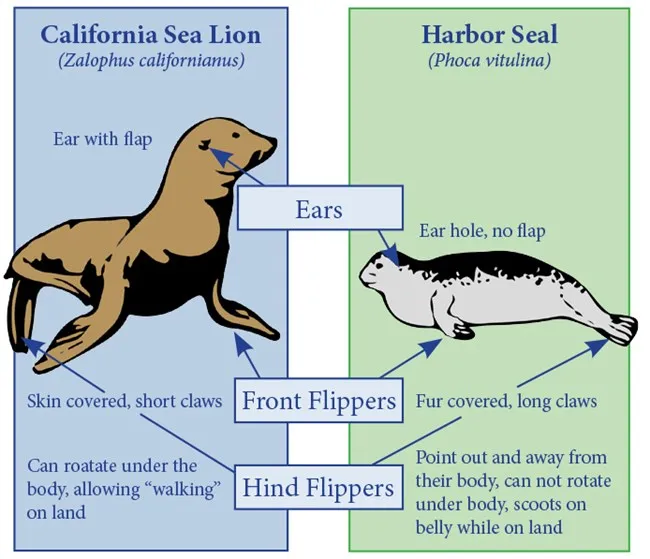
Seals and sea lions are both marine mammals called pinnipeds, but they are easy to tell apart. Sea lions have visible external ear flaps, long front flippers, and can rotate their hind flippers forward to walk on land. True seals have no external ear flaps, shorter front flippers, and move on land by wriggling or scooting on their bellies. Sea lions are usually louder, more social, and more mobile on land.
| Feature | Seal | Sea Lion | Quick Identification Tip |
|---|---|---|---|
| Scientific group | True seals, family Phocidae | Eared seals, family Otariidae | Sea lions are technically a type of eared seal, but not true seals. |
| External ears | No visible ear flaps; only small ear openings | Visible external ear flaps | Ear flaps usually mean sea lion. |
| Front flippers | Shorter, often fur-covered, with more obvious claws | Longer, stronger, more wing-like front flippers | Long front flippers suggest sea lion. |
| Hind flippers | Point backward and cannot rotate under the body | Can rotate forward under the body | Walking on all four flippers means sea lion. |
| Movement on land | Scoots, wriggles, or bounces on belly | Walks, climbs, and moves more easily | Awkward belly movement usually means seal. |
| Swimming style | Uses hind flippers and body movement for propulsion | Uses large front flippers like underwater wings | Seals are rear-powered; sea lions are front-powered. |
| Body shape | More rounded, smooth, torpedo-like body | More upright posture, stronger shoulders, longer neck | Sea lions often sit upright like dogs. |
| Vocalization | Usually quieter; grunts, growls, moans, or soft calls | Loud barking, roaring, honking, or growling | Loud barking colonies are usually sea lions. |
| Social behavior | Often less crowded, though some species gather in groups | Often highly social and colonial | Large noisy groups on docks often indicate sea lions. |
| Common examples | Harbor seal, gray seal, leopard seal, elephant seal | California sea lion, Steller sea lion, Australian sea lion | Harbor seals are true seals; California sea lions are sea lions. |
Are Seals and Sea Lions the Same Animal?
Seals and sea lions are related, but they are not the same animal. Both belong to a marine mammal group called pinnipeds, which means “fin-footed.” Pinnipeds include true seals, sea lions, fur seals, and walruses.
In everyday language, people often call all of these animals “seals,” but zoologists separate them into different families. True seals belong to the family Phocidae. Sea lions belong to the family Otariidae, the eared seal family. Walruses belong to their own family, Odobenidae.
The easiest way to understand the difference is this: sea lions are eared pinnipeds that walk well on land, while true seals are earless pinnipeds that move awkwardly on land but are beautifully streamlined swimmers.
The Fastest Way to Tell a Seal From a Sea Lion
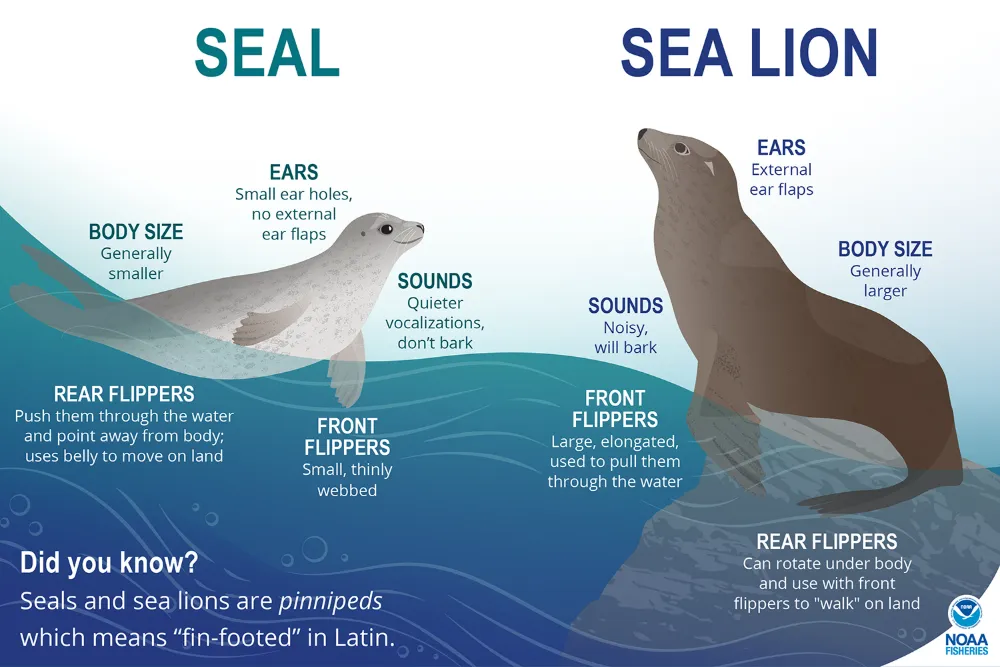
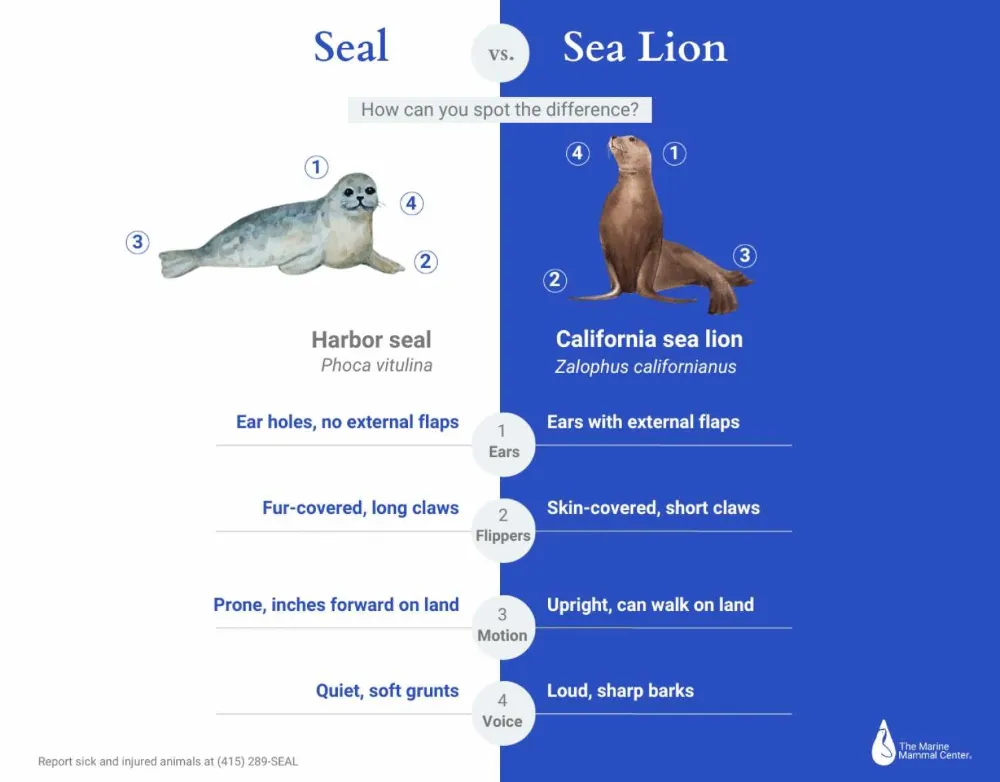
The fastest way is to look for external ear flaps. Sea lions have small but visible ear flaps on the sides of the head. True seals do not. A seal has ears, but they appear only as small holes with no external flap.
Then look at how the animal moves on land. Sea lions can rotate their hind flippers forward and use all four flippers to walk, climb, and scramble. True seals cannot rotate their hind flippers under the body, so they move by wriggling, scooting, or bouncing on their bellies.
Quick field clues:
Visible ear flaps: sea lion.
No visible ear flaps: true seal.
Walks on all four flippers: sea lion.
Scoots on belly: true seal.
Loud barking group: usually sea lions.
Round head and quiet resting posture: often a seal.
Scientific Classification
| Classification | True Seal | Sea Lion |
|---|---|---|
| Kingdom | Animalia | Animalia |
| Phylum | Chordata | Chordata |
| Class | Mammalia | Mammalia |
| Order | Carnivora | Carnivora |
| Marine mammal group | Pinnipeds | Pinnipeds |
| Family | Phocidae | Otariidae |
| Common name | True seal or earless seal | Sea lion or eared seal |
Fur seals also belong to the eared seal family, so they are closer to sea lions than to true seals. Walruses are pinnipeds too, but they are neither true seals nor sea lions.
Ear Differences
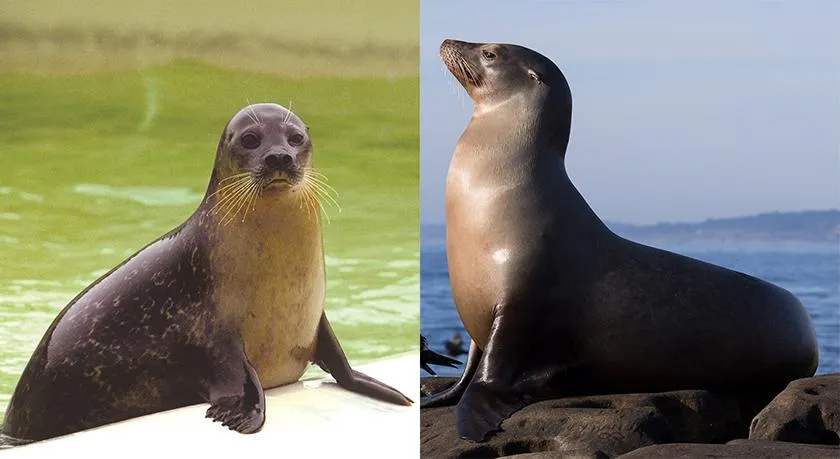
Ear structure is the clearest difference between seals and sea lions. Sea lions have visible external ear flaps. These small flaps are easy to see when the animal lifts its head or sits upright.
True seals do not have external ear flaps. Their ears are small openings on the sides of the head. This smooth head shape helps reduce drag in the water, making seals more streamlined swimmers.
This does not mean seals are deaf. True seals hear well underwater and on land. They simply lack the outer ear flap that sea lions have.
Flipper Differences
Sea lions have long, powerful front flippers that work like underwater wings. When swimming, they use these front flippers to pull themselves through the water. Their shoulders are strong, and their bodies are built for agile movement both in water and on land.
True seals have shorter front flippers. These flippers are useful for steering and maneuvering, but true seals get most of their swimming power from the hind flippers and side-to-side body movement.
| Flipper Feature | Seal | Sea Lion |
|---|---|---|
| Front flippers | Shorter and less wing-like | Long, strong, and wing-like |
| Hind flippers | Point backward and cannot rotate forward | Can rotate forward under the body |
| Main swimming power | Hind flippers and body movement | Front flippers |
| Land movement | Belly scooting or wriggling | Walking and climbing on flippers |
Movement on Land
On land, sea lions are much more mobile than true seals. They can lift the body, rotate the rear flippers forward, and walk using all four flippers. This allows them to climb rocks, move across beaches, and even haul out onto docks and boats.
True seals cannot bring their hind flippers forward under the body. Their rear flippers point backward, which is excellent for swimming but awkward on land. To move, they wriggle, bounce, or scoot their bodies forward.
This difference is easy to see on a beach. If the animal sits upright and walks like a clumsy dog, it is probably a sea lion. If it lies low and moves like a caterpillar, it is probably a seal.
Swimming Style
Both seals and sea lions are excellent swimmers, but they swim differently. True seals are more torpedo-shaped and use side-to-side movements of the hind body and rear flippers to move forward. This makes them highly efficient underwater hunters.
Sea lions swim with powerful strokes of the front flippers. They are agile and graceful, often turning quickly and moving with a wing-like motion. This swimming style gives them excellent maneuverability, especially when chasing fish.
In simple terms:
Seals: swim mainly with hind flippers and body movement.
Sea lions: swim mainly with large front flippers.
Body Shape Differences
True seals often look rounder, smoother, and more streamlined. Their heads are usually rounded, their necks are less obvious, and their bodies taper toward the rear flippers. This shape is excellent for moving efficiently underwater.
Sea lions often have a more upright posture, stronger shoulders, longer necks, and more visible front flippers. Their bodies may look more flexible on land because they can support themselves better.
Common visual clues include:
Seal: smooth head, round body, short front flippers, low posture.
Sea lion: visible ears, long front flippers, upright chest, mobile posture.
Vocal Differences
Sea lions are famous for loud barking. A group of sea lions may bark, roar, growl, honk, or call continuously. This is especially noticeable in crowded colonies, harbors, docks, and breeding areas.
True seals are usually quieter. They can make sounds such as grunts, growls, moans, trills, or underwater calls, but they usually do not bark loudly like sea lions.
If you hear a noisy group of barking pinnipeds near a pier or rocky coast, you are probably hearing sea lions.
Social Behavior
Sea lions are often highly social. They gather in large groups on beaches, rocks, docks, and islands. They may lie close together, push, bark, and compete for space. During breeding season, males may defend territories and gather groups of females.
True seals can also gather in groups, especially at haul-out sites and breeding beaches, but many species are less socially noisy than sea lions. Some true seals rest with more space between individuals.
However, behavior varies by species. Elephant seals, for example, can form huge breeding colonies and are highly dramatic during mating season, even though they are true seals.
Diet and Hunting
Seals and sea lions are carnivorous marine mammals. They eat fish, squid, octopus, crustaceans, and other marine animals depending on species, region, and season.
| Food Type | Seals | Sea Lions |
|---|---|---|
| Fish | Common food | Common food |
| Squid | Common in many species | Common in many species |
| Octopus | Sometimes eaten | Sometimes eaten |
| Crustaceans | Important for some species | Sometimes eaten |
| Penguins or other seabirds | Some species, such as leopard seals, may eat them | Some sea lions may take birds opportunistically |
Both groups use sensitive whiskers, called vibrissae, to detect movement in the water. These whiskers help them track prey, especially in dark, murky, or deep water.
Habitat Differences
Seals and sea lions live in coastal and marine habitats around the world, but their distribution depends on species. True seals include Arctic, Antarctic, temperate, and tropical species. Sea lions are common along many Pacific coasts and southern oceans, but they are not found everywhere seals occur.
Common habitats include:
Rocky coasts
Sandy beaches
Islands
Harbors and docks
Sea ice
Cold coastal waters
Temperate kelp forests
Open ocean feeding areas
Some seals are strongly associated with ice. Harp seals, ringed seals, bearded seals, and Weddell seals depend heavily on icy habitats. Sea lions usually haul out on land rather than sea ice.
Examples of True Seals
True seals belong to the family Phocidae. They lack external ear flaps and move awkwardly on land.
Harbor seal: Small to medium seal found along many northern coasts.
Gray seal: Larger North Atlantic seal with a long muzzle.
Harp seal: Arctic seal known for white pups and dark adult markings.
Ringed seal: Small Arctic seal important in polar food webs.
Elephant seal: Huge true seal; males have enlarged noses and extreme size.
Leopard seal: Powerful Antarctic predator with a long body and large jaws.
Monk seal: Warm-water seal found in limited tropical or subtropical regions.
Examples of Sea Lions
Sea lions belong to the eared seal family, Otariidae. They have external ear flaps and move well on land.
California sea lion: Common along the Pacific coast of North America; famous for barking and hauling out on docks.
Steller sea lion: Very large northern Pacific sea lion.
Australian sea lion: Endemic to Australia and known for a unique breeding cycle.
South American sea lion: Found along South American coasts.
New Zealand sea lion: Rare species found around New Zealand and subantarctic islands.
Galápagos sea lion: Smaller sea lion adapted to the Galápagos Islands.
Seal vs Sea Lion vs Fur Seal
Fur seals create another layer of confusion. Despite the name, fur seals are not true seals. They belong to the eared seal family, like sea lions. They have external ear flaps and can rotate their hind flippers forward to move on land.
The main difference between fur seals and sea lions is coat and build. Fur seals usually have a thicker underfur and may look smaller or more densely furred. Sea lions generally have a smoother coat and a more robust body.
| Animal | Family | External Ear Flaps? | Land Movement |
|---|---|---|---|
| True seal | Phocidae | No | Scoots or wriggles on belly |
| Sea lion | Otariidae | Yes | Walks on flippers |
| Fur seal | Otariidae | Yes | Walks on flippers |
Seal vs Sea Lion vs Walrus
Walruses are also pinnipeds, but they are easy to recognize because of their long tusks, thick whiskers, large bodies, and wrinkled skin. They belong to a separate family, Odobenidae.
Walruses use their tusks for social display, hauling out, and interacting with ice or other walruses. They feed heavily on bottom-dwelling animals such as clams. Their body shape and lifestyle are different from both true seals and sea lions.
In simple terms:
True seal: no ear flaps, belly movement on land.
Sea lion: ear flaps, walks on flippers, loud barking.
Walrus: tusks, thick whiskers, huge body.
Reproduction and Pups
Both seals and sea lions give birth to live pups and nurse them with rich milk. Their breeding strategies differ by species. Some seals give birth on ice, some on beaches, and some in caves or remote coastal areas. Sea lions usually breed in colonies on land.
Seal pups vary greatly. Harp seal pups are famous for white coats. Harbor seal pups can swim soon after birth. Elephant seal pups grow rapidly while nursing on extremely rich milk.
Sea lion pups are usually born in crowded rookeries. Mothers recognize their pups by smell, sound, and behavior. Pups nurse for months, and in some species the mother alternates between nursing on land and feeding at sea.
Do Seals and Sea Lions Have Fur?
Yes. Both seals and sea lions have fur, but thickness and texture vary. True seals often rely heavily on blubber for insulation, especially cold-water and ice-associated species. Sea lions also have blubber and fur, but fur seals have especially dense underfur.
Blubber is important because water removes body heat much faster than air. A thick fat layer helps these animals survive in cold marine environments, store energy, and maintain body temperature.
Do Seals and Sea Lions Have Whiskers?
Yes. Both have sensitive whiskers called vibrissae. These whiskers are not just decorative. They help detect water movements created by fish, squid, and other prey.
In dark water, cloudy water, or deep dives, vision may be limited. Whiskers can help a seal or sea lion sense prey trails and movement patterns. This makes them highly effective underwater hunters.
Are Seals or Sea Lions Smarter?
Both are intelligent marine mammals, but sea lions are often more visible in training and research settings because they are social, mobile on land, and responsive to human cues. California sea lions, for example, are famous for learning complex tasks.
True seals are also intelligent and capable of learning, navigation, prey tracking, and social recognition. Intelligence should not be judged only by trainability. Each group is adapted to its own lifestyle.
Are Seals or Sea Lions Dangerous?
Seals and sea lions are wild animals and should never be approached, touched, chased, fed, or crowded. They may look cute, but they have strong jaws, sharp teeth, and powerful bodies.
Sea lions can be especially intimidating on land because they move faster than people expect and may defend space in crowded areas. Large male sea lions are powerful animals. True seals may look awkward on land, but they can still bite if threatened.
Safety rules include:
Stay far away from resting animals.
Never try to touch a pup.
Keep dogs leashed and away from marine mammals.
Do not feed seals or sea lions.
Do not block an animal’s path to the water.
Report injured or stranded animals to local marine mammal responders.
Why You Should Not Approach Seal or Sea Lion Pups
A seal or sea lion pup alone on a beach is not always abandoned. Mothers may leave pups temporarily while feeding offshore. Human interference can cause stress, separation, or abandonment risk.
Touching a pup can also be dangerous and illegal in many places. Pups can bite, and they may carry diseases or parasites. Dogs can injure pups or be injured by adult marine mammals.
If a pup appears injured, entangled, extremely thin, or in immediate danger, contact a local wildlife or marine mammal rescue organization. Do not attempt to move it yourself.
Conservation Concerns
Seals and sea lions face many threats. The exact conservation status depends on species and region. Some populations are healthy, while others are endangered or declining.
Common threats include:
Fishing gear entanglement
Plastic pollution
Overfishing and prey decline
Climate change
Loss of sea ice for ice-dependent seals
Disturbance at breeding sites
Oil spills
Disease outbreaks
Harmful algal blooms
Conflict with fisheries
Protecting pinnipeds requires clean oceans, healthy fish populations, safe breeding sites, responsible fishing practices, and respectful wildlife viewing.
Common Myths About Seals and Sea Lions
Myth: Seals and sea lions are the same animal.
Fact: They are related pinnipeds, but true seals and sea lions belong to different families.Myth: Sea lions are just big seals.
Fact: Sea lions have external ear flaps, long front flippers, and a different movement style.Myth: Seals have no ears.
Fact: True seals have ears, but they lack external ear flaps.Myth: A seal pup alone is always abandoned.
Fact: Mothers often leave pups alone while feeding.Myth: Sea lions are harmless because they look playful.
Fact: They are strong wild predators and can bite if threatened.Myth: All pinnipeds live in cold water.
Fact: Some species live in temperate, subtropical, or even tropical regions.
How to Identify Them at the Beach
When observing from a safe distance, use a combination of ears, flippers, movement, sound, and posture.
Ask these questions:
Can I see external ear flaps?
Does it walk on all four flippers or scoot on its belly?
Are the front flippers long and strong?
Is the animal barking loudly?
Is it sitting upright with a visible neck?
Is it lying low with a smooth rounded head?
Is it alone and quiet or in a noisy group?
Visible ears, long front flippers, loud barking, and walking on land usually mean sea lion. No ear flaps, short front flippers, quiet behavior, and belly scooting usually mean true seal.
Final Takeaway
Seals and sea lions are both pinnipeds, but their bodies are built differently. True seals have no external ear flaps, short front flippers, rear-powered swimming, and awkward belly movement on land. Sea lions have visible ear flaps, long front flippers, front-powered swimming, and the ability to walk on land using all four flippers.
Sea lions are usually louder, more social, and more mobile on land. Seals are usually smoother, quieter, and more streamlined for underwater movement. Both are intelligent marine predators, both use sensitive whiskers to hunt, and both deserve respectful distance from people.
The easiest rule is simple: ear flaps and walking mean sea lion; no ear flaps and belly scooting mean true seal.
FAQs About Seals vs Sea Lions
What is the main difference between seals and sea lions?
The main difference is ears and movement. Sea lions have visible external ear flaps and can walk on land using all four flippers. True seals have no external ear flaps and move on land by wriggling or scooting on their bellies.
Are sea lions seals?
Sea lions are pinnipeds and belong to the eared seal family, but they are not true seals. True seals belong to the family Phocidae, while sea lions belong to the family Otariidae.
Do seals have ears?
Yes. True seals have ears, but they do not have external ear flaps. Their ears appear as small openings on the sides of the head.
Do sea lions have ears?
Yes. Sea lions have visible external ear flaps, which are one of the easiest ways to tell them apart from true seals.
Why do seals move awkwardly on land?
True seals cannot rotate their hind flippers forward under their bodies. Their rear flippers are excellent for swimming but poor for walking, so they scoot or wriggle on land.
Why can sea lions walk on land?
Sea lions can rotate their hind flippers forward and use their long front flippers for support, allowing them to walk, climb, and move more easily on land.
Which is louder, a seal or a sea lion?
Sea lions are usually louder. They often bark, roar, honk, or growl in groups. True seals are generally quieter, although they can make various calls.
Are seals or sea lions more social?
Sea lions are often more social and gather in large noisy colonies. Some seals also form groups, but many true seals are less noisy and less tightly packed.
What do seals and sea lions eat?
Both eat fish, squid, octopus, crustaceans, and other marine animals depending on species and habitat. Some species specialize in particular prey.
Are seals and sea lions dangerous?
They can be dangerous if approached or harassed. Both have strong jaws and sharp teeth. People should keep a safe distance and never touch, feed, or crowd them.
Can seals and sea lions live in freshwater?
Most live in marine environments, but some seals enter rivers, estuaries, or lakes temporarily. A few seal populations are adapted to lake environments, but sea lions are mainly coastal marine animals.
Do seals and sea lions have fur?
Yes. Both have fur, but they also rely on blubber for insulation. Fur thickness varies by species, with fur seals having especially dense underfur.
What is the difference between a sea lion and a fur seal?
Both are eared seals with external ear flaps. Fur seals generally have thicker underfur and may look smaller or more densely furred, while sea lions usually have smoother coats and more robust bodies.
Is a walrus a seal or a sea lion?
A walrus is neither a true seal nor a sea lion. It is a pinniped in its own family and is easily recognized by tusks, thick whiskers, and a very large body.
How can I tell a seal from a sea lion quickly?
Look for ear flaps and land movement. If it has visible ear flaps and walks on flippers, it is a sea lion. If it has no ear flaps and scoots on its belly, it is a true seal.