The easiest way to tell a centipede from a millipede is to look at the body and legs. Centipedes are usually flatter, faster, and more predatory, with one pair of legs per segment and a more aggressive appearance. Millipedes are usually rounder, slower, and plant- or detritus-feeding, with two pairs of legs on most body segments and a calmer, curling defense posture. They are both many-legged arthropods, but they live very different lives.
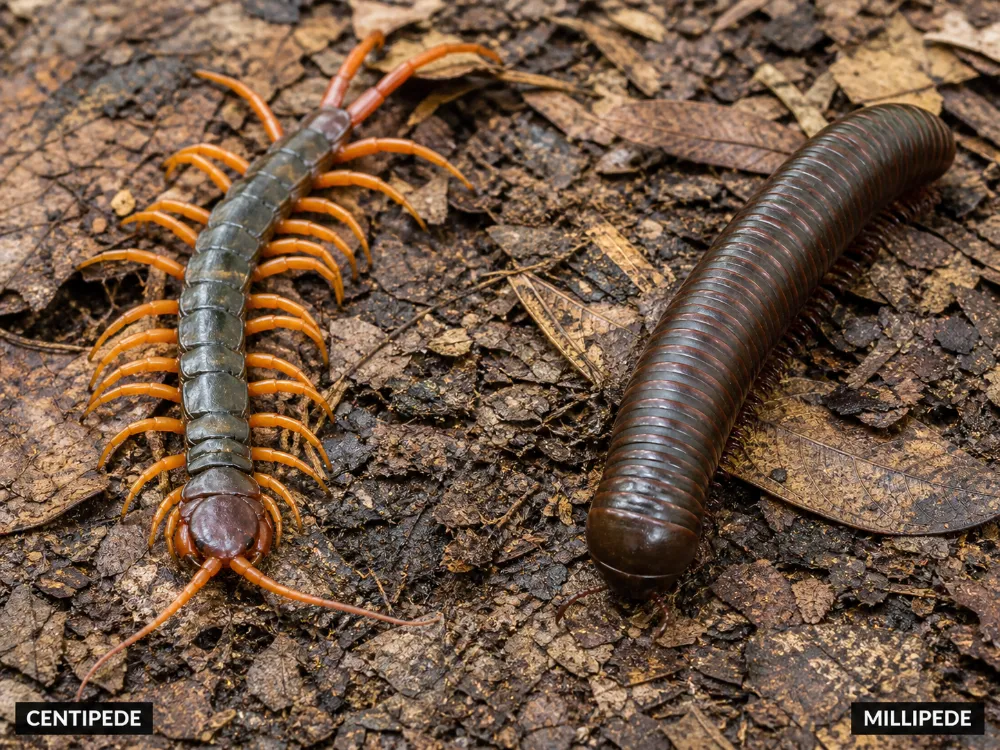
People often mix up centipedes and millipedes because both are long-bodied invertebrates with many legs and segmented bodies. If you only notice that something thin and leggy is moving across the ground, the difference may not seem obvious at first. Once you know what to check, however, they become much easier to tell apart.
In this guide, you will learn how centipedes and millipedes differ in body shape, leg arrangement, movement, diet, defense, habitat, and behavior, plus the fastest ways to identify them correctly.
Quick comparison table
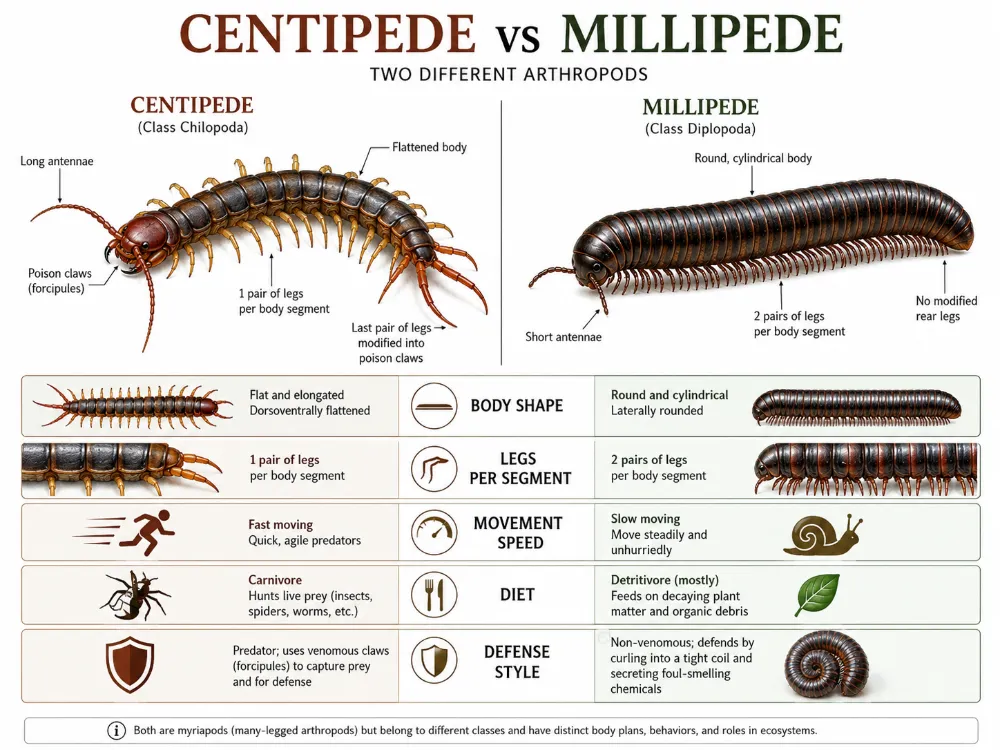
| Feature | Centipede | Millipede |
|---|---|---|
| Main body shape | Usually flatter and more flexible-looking | Usually rounder, more cylindrical, or heavily armored-looking |
| Legs per segment | One pair per segment | Two pairs on most body segments |
| Movement | Fast, darting, active | Slow, steady, wave-like |
| Diet | Predatory | Mainly detritus-feeding or plant-based |
| Defense | Speed, bite-like venom claws, escape | Curling up, hard body, chemical defense |
| First impression | Looks more aggressive and hunter-like | Looks more slow-moving and armored |
| Typical habitat | Under rocks, logs, leaf litter, damp corners | Soil, compost, leaf litter, decaying wood |
| Best quick clue | Flat body, fewer-looking legs, fast motion | Round body, many visible legs, slow curling behavior |
They are related, but not the same kind of arthropod
Centipedes and millipedes are both myriapods, which means they belong to a larger arthropod group known for long segmented bodies and many legs. That shared ancestry explains why they can look similar at first glance.
However, they are not the same kind of animal. Centipedes belong to the class Chilopoda, while millipedes belong to the class Diplopoda. That difference matters because it reflects real changes in body structure, diet, and lifestyle.
So while both are many-legged arthropods, they are not just two names for the same creature. They are distinct groups with different ecological roles.
Centipedes usually look flatter
One of the easiest visual differences is body shape. Centipedes usually have a flatter body that looks lower and more streamlined from top to bottom. This flattened shape helps them move quickly through cracks, bark, leaf litter, and tight hiding places.
Millipedes usually look more rounded or cylindrical. Many species resemble little armored tubes moving slowly across the ground. Their body often looks thicker and more solid than that of a centipede.
If the animal looks pressed down and quick, centipede becomes more likely. If it looks rounded and more pipe-like, millipede becomes more likely.
Leg arrangement is one of the most important differences
The classic scientific difference is the number of legs attached to each body segment. Centipedes have one pair of legs per segment. Millipedes have two pairs of legs on most of their body segments.
This is a very important identification clue, though it can be hard to count on a moving animal. Even if you do not count each segment directly, the general effect is noticeable. Millipedes often look as if they have many more legs packed closely under a longer, more evenly moving body.
So if the legs seem more numerous and tightly arranged, millipede becomes more likely. If the legs look more spaced and individually visible, centipede becomes more likely.
Centipedes move much faster
Movement is one of the fastest real-life clues. Centipedes usually run quickly, often with a sudden, darting, nervous style. They can move with surprising speed and seem more like active hunters than slow crawlers.
Millipedes usually move slowly and steadily. Their legs create a smooth wave-like motion underneath the body, and the whole animal often looks calm and deliberate rather than fast and reactive.
If it runs like it has somewhere urgent to be, think centipede. If it creeps slowly like a tiny armored train, think millipede.
Centipedes are predators
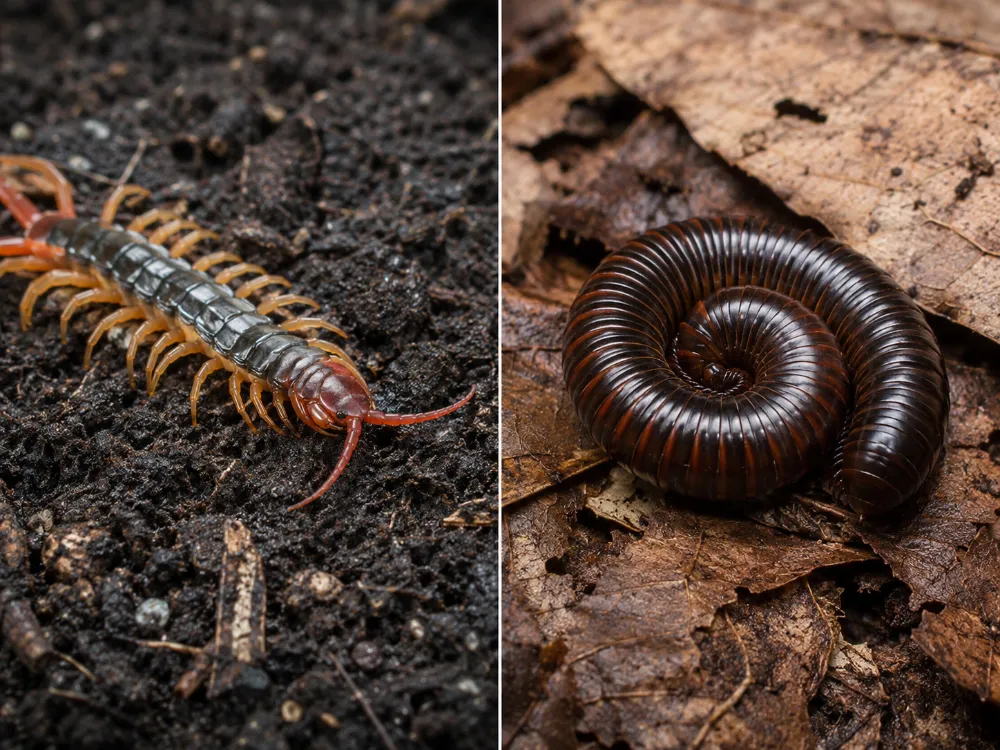
Centipedes are hunters. They feed on insects, spiders, worms, and other small animals they can overpower. Some larger species can take surprisingly substantial prey for their size.
This predatory lifestyle explains a lot about their body design. They are fast, alert, and equipped with modified front appendages that act like venom claws for subduing prey. They are not just wandering scavengers. They are active arthropod predators.
This is one of the biggest biological differences between them and millipedes.
Millipedes usually feed on decaying plant material
Millipedes are usually detritivores, meaning they feed on dead leaves, decaying wood, decomposing plant matter, and other organic material in the soil. Some also feed on fungi or soft plant material depending on species and conditions.
Instead of hunting live prey, millipedes help break down dead material and recycle nutrients back into the ecosystem. In this role, they are more like tiny compost workers than predators.
That is why millipedes are so commonly found in leaf litter, rotting logs, compost, and damp soil where plant material is breaking down.
Centipedes have venom claws, not true fangs
One of the most misunderstood centipede features is the front pair of modified appendages called forcipules. These are not true insect-style jaws or spider fangs. They are specialized structures near the head used to inject venom into prey.
This makes centipedes look more threatening than millipedes, and in a biological sense they are more heavily armed. Small species are usually not a serious issue for people, but larger centipedes can deliver a painful bite-like sting if handled.
Millipedes do not have this hunting weapon system, which is another sign that their lifestyle is very different.
Millipedes defend themselves by curling up
Millipedes often respond to danger by coiling into a tight spiral. This behavior protects their softer underside and legs while exposing the harder outer body to whatever is threatening them.
Centipedes are much less likely to rely on curling into a defensive ball. They usually depend more on speed, aggression, or rapid escape. Their body plan is built for movement, not for becoming a shielded spiral.
If the animal curls into a neat coil when disturbed, millipede is the stronger answer.
Millipedes often use chemical defense
Many millipedes can release defensive chemicals when threatened. These secretions may smell unpleasant, irritate predators, or stain skin or surfaces in some species. This is one reason it is not a good idea to handle millipedes casually and then rub your eyes.
Centipedes, by contrast, are more associated with direct predatory or defensive use of their venom claws rather than chemical ooze-based defense. Their strategy is much more active.
So even their protection methods reflect different personalities: centipede as hunter, millipede as armored chemical defender.
Millipedes are usually not actually “a thousand” legs long
The name millipede means “thousand feet,” but most millipedes do not literally have a thousand legs. Likewise, centipede means “hundred feet,” but centipedes do not literally have exactly one hundred legs.
These names are traditional and descriptive rather than mathematically precise. They reflect the general impression of many legs, not an exact leg count in every species.
So it is better to use the names as common labels, not strict arithmetic descriptions.
Centipedes usually have a more obvious head and antennae
Centipedes often have a more clearly defined head with long antennae that probe actively as they move. The front end often looks alert and purposeful, as if the animal is scanning for prey or escape routes.
Millipedes also have antennae, but the overall front end often looks less sharp and aggressive. Their head is usually less visually dominant because the body shape feels more uniform and armored.
If the front of the animal looks active, fast, and investigative, centipede becomes more likely.
They use similar habitats, but not in the same way
Both centipedes and millipedes like moist, sheltered places because they dry out easily. You may find both under logs, stones, bark, compost, leaf litter, and other damp cover.
However, they are using those spaces differently. Centipedes use them as hunting grounds and hiding places. Millipedes use them as feeding grounds full of decaying organic material. One is searching for prey. The other is processing plant debris.
That is why the same garden or forest floor may support both animals even though they live very different lives.
Centipedes often look more intimidating to people
Most people react more strongly to centipedes than to millipedes. Centipedes move faster, have a flatter body, and often look more aggressive because of their speed and long legs. They can seem unpredictable, especially when they run suddenly from under a rock or across a wall.
Millipedes usually look calmer and less threatening. Their slow movement and curling behavior often make them seem more defensive than aggressive.
This emotional reaction is common, but it also reflects real biology. Centipedes are active predators. Millipedes usually are not.
House centipedes add to the confusion
One reason centipedes stand out so strongly is the house centipede, a fast indoor species with very long legs that can alarm people when it appears on walls or floors. Its body shape and speed give a very different impression from the slow, soil-associated millipedes found outdoors.
Millipedes sometimes wander indoors too, especially after rain or when conditions are damp, but they usually do not race across a room in the same startling way. Their behavior remains slow and curling rather than sprinting.
This contrast makes the centipede-versus-millipede difference especially memorable in homes and gardens.
They play different roles in the ecosystem
Centipedes help control populations of insects and other small invertebrates. As predators, they are part of the balance that keeps many tiny animal populations in check.
Millipedes help break down dead plant material and return nutrients to the soil. As recyclers, they support decomposition and soil health.
So even though both animals are often overlooked, each one does important work. One is a hunter. The other is a decomposer.
Why people confuse them so often
People confuse centipedes and millipedes because both are elongated, segmented, many-legged arthropods found in damp ground-level habitats. For someone who just sees “long bug with lots of legs,” the difference may not be obvious at first.
The names also sound similar, which does not help. Many people remember that one has many legs and the other has many legs too, but forget which one is the fast flat predator and which one is the slow round decomposer.
Once you focus on body shape, speed, and defensive behavior, the distinction becomes much easier.
How to tell them apart quickly
If you need a fast field guide, use these clues together:
Centipede: flat body, one pair of legs per segment, fast movement, predatory behavior, does not usually curl into a tight spiral
Millipede: rounder body, two pairs of legs on most segments, slow movement, curls up when disturbed, feeds mainly on decaying plant matter
No single clue is perfect every time, but this combination is usually very reliable.
Which one is more dangerous?
Centipedes are generally the more potentially painful animal because they are predators with venom claws. Large species can deliver a painful bite-like sting if handled. Even so, most are not serious threats if left alone.
Millipedes are usually less dangerous in that direct sense. They do not bite with venom claws, but some species can release irritating defensive chemicals, so they should still not be handled carelessly.
For most people, the correct approach to both is simple: admire them, but do not pick them up unnecessarily.
Final takeaway
The main difference between a centipede and a millipede is that centipedes are flatter, faster, predatory myriapods with one pair of legs per segment, while millipedes are rounder, slower, mainly detritus-feeding myriapods with two pairs of legs on most segments. Centipedes hunt and rely on speed and venom claws. Millipedes recycle dead plant matter and rely on curling up and chemical defense. They may both be many-legged arthropods, but once you know the body shape and behavior clues, they are much easier to tell apart.
FAQs
What is the main difference between a centipede and a millipede?
Centipedes are usually flat, fast, and predatory, while millipedes are usually round, slow, and mainly feed on decaying plant material.
How can I tell a centipede from a millipede fast?
Look at the body shape and movement. Centipedes are flatter and faster, while millipedes are rounder and slower.
Do centipedes and millipedes both have a hundred or a thousand legs?
No. Their names are traditional rather than exact, and most species do not have exactly one hundred or one thousand legs.
Which one curls up into a spiral?
Millipedes often curl into a spiral when disturbed, while centipedes usually try to run away or defend themselves more actively.