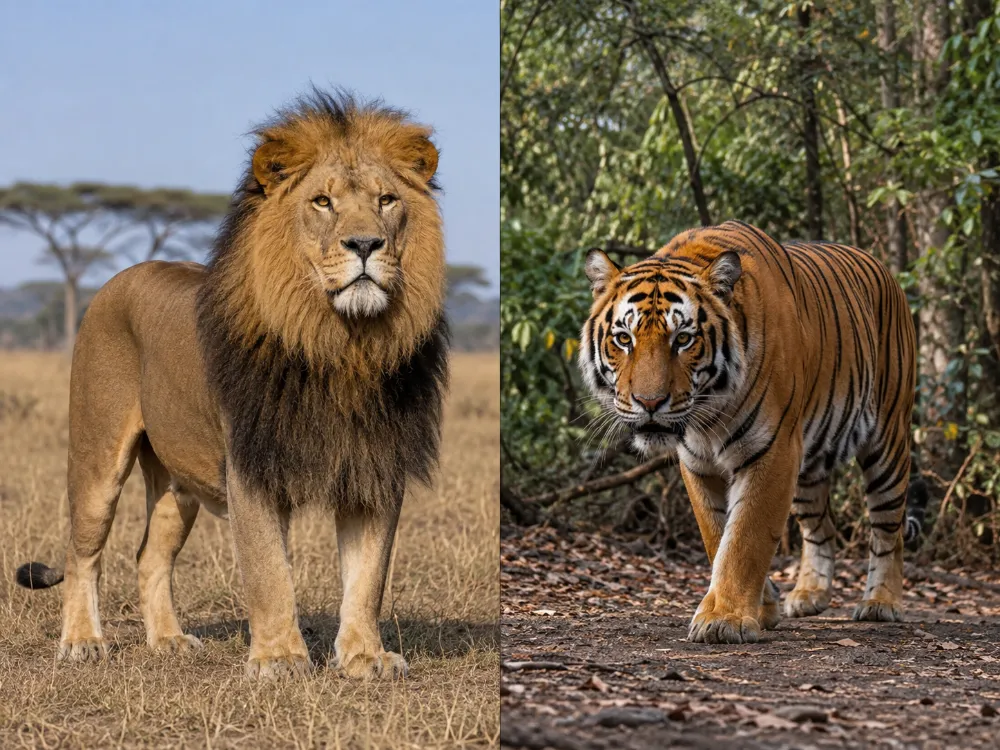
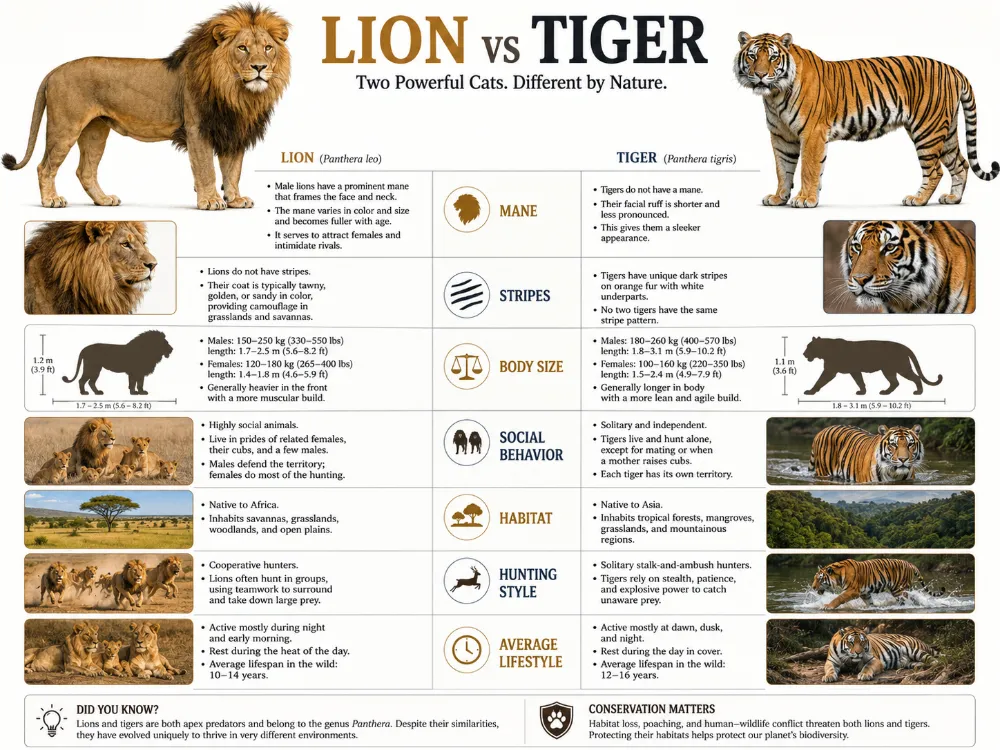
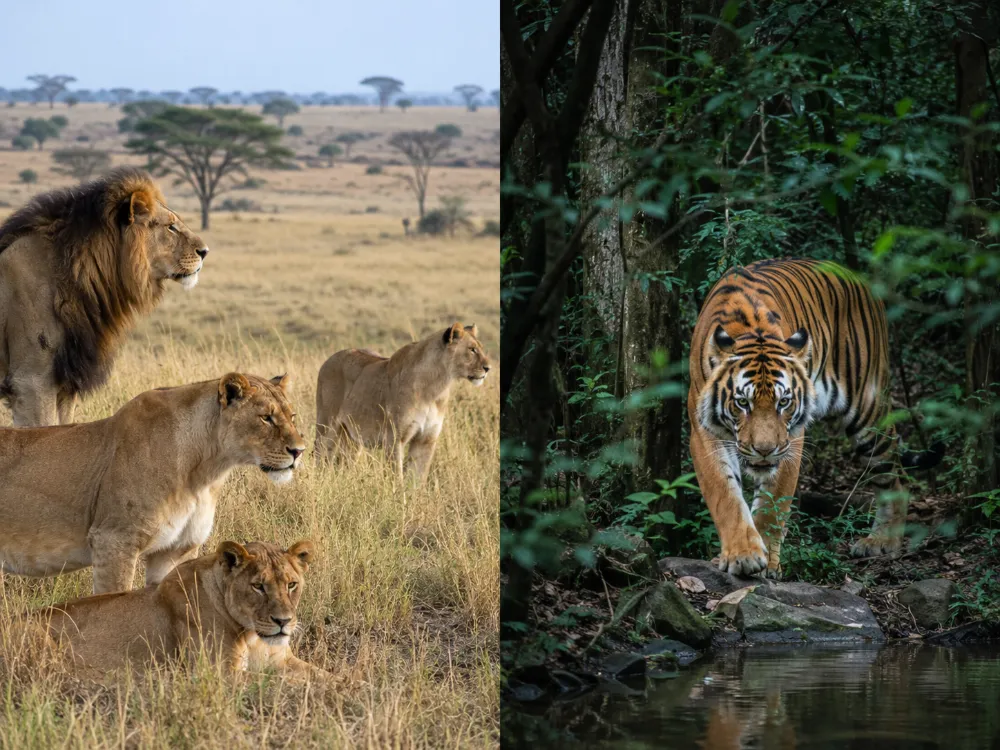
The easiest way to tell a lion from a tiger is to look at the coat, body shape, and behavior. Lions usually have a plain tawny coat, males often have a mane, and they live in social groups called prides. Tigers have dark vertical stripes, no mane, and usually live alone. Tigers are often larger and heavier on average, while lions are more social and more often seen in open grassland landscapes.
People compare lions and tigers more than almost any other big cats because both are famous, powerful, and closely related members of the genus Panthera. At first glance, they can seem like two versions of the same giant cat. In reality, they differ in appearance, habitat, hunting style, and daily life in very important ways.
In this guide, you will learn how lions and tigers differ in body structure, coat pattern, range, social behavior, hunting strategy, and ecology, plus the fastest ways to identify them correctly.
Quick comparison table
| Feature | Lion | Tiger |
|---|---|---|
| Scientific name | Panthera leo | Panthera tigris |
| Coat pattern | Plain tawny or sandy coat | Orange to reddish coat with dark vertical stripes |
| Male appearance | Usually has a mane | No mane |
| Average social style | Highly social, lives in prides | Usually solitary |
| Typical habitat image | Grasslands, savannas, open woodland | Forests, grasslands, wetlands, dense cover |
| Body build | Powerful, broad-chested, social hunter build | Longer-bodied, heavily muscled, stealth hunter build |
| Average size | Very large, but usually smaller than the largest tigers | Usually larger and heavier on average |
| Best quick clue | Mane and plain coat | Stripes and solitary forest-cat look |
They are close relatives, but not the same cat
Lions and tigers are both big cats in the genus Panthera, which is why they share traits such as retractable claws, powerful jaws, roaring ability, and large muscular bodies. They are close relatives, not distant look-alikes.
However, they are separate species with different evolutionary histories. Over time, they adapted to different habitats, prey situations, and social systems. That is why a lion feels like a social open-country cat, while a tiger feels like a solitary, cover-loving ambush predator.
So even though both are iconic giant cats, they are not interchangeable versions of the same animal.
Tigers are usually larger
One of the clearest physical differences is size. Tigers are usually larger and heavier than lions on average, especially the largest tiger populations. They often have a longer body, heavier forequarters, and a more stretched, powerfully muscled frame.
Lions are still enormous and extremely powerful cats, but they often look slightly shorter-bodied and less elongated than tigers. Much of their visual impact, especially in males, also comes from the mane and their broader social presence rather than from body length alone.
If the cat looks exceptionally long, heavy, and muscular even without a mane, tiger becomes more likely.
The coat pattern is the fastest clue
The easiest difference for most people is the coat. Lions usually have a plain tawny, sandy, or golden-brown coat without the bold dark striping seen in tigers. Tigers are famous for their vertical black or dark brown stripes on an orange, reddish, or pale background.
This makes the comparison simple in most cases. If the cat has stripes, it is a tiger. If it has a plain coat and, in a male, possibly a mane, it is a lion.
Even so, the comparison becomes more interesting once you look beyond the coat and into body design and behavior.
Male lions have manes, tigers do not
This is one of the most famous differences in the animal world. Adult male lions usually develop a mane around the head and neck. Mane size and color can vary, but the feature gives the lion a larger, more dramatic profile and helps separate males from females at a glance.
Tigers do not have this mane. Male tigers may look broader-headed than females, but they do not carry the same long neck fur that makes a lion so instantly recognizable.
If you see a giant cat with a full mane, you are looking at a lion, not a tiger.
Lions are more social
One of the biggest ecological differences is social life. Lions are the most social of the big cats and usually live in groups called prides. A pride may include related females, cubs, and a smaller number of adult males or coalitions.
Tigers are usually solitary. Adults often live and hunt alone, meeting mainly for mating or when females are raising cubs. A tiger’s territory and movement pattern are usually organized around individual control of space rather than group living.
This difference shapes almost everything else about the two species, from hunting to communication to the way people usually see them in the wild.
Tigers are usually solitary ambush hunters
Tigers are built for stealth. Their striped coat helps them disappear into grasses, reeds, forest shade, and dense vegetation. They usually hunt by stalking closely and then launching a sudden attack at short range.
Because they hunt alone, tigers rely heavily on personal strength, concealment, and timing. Their body design fits this style perfectly: powerful limbs, strong shoulders, and a long muscular body that can explode forward from cover.
So while lions often reflect group strategy, tigers often reflect individual stealth and force.
Lions often hunt cooperatively
Lions also use ambush, but their social structure gives them an extra option: cooperation. Lionesses may hunt together, especially when targeting larger prey or when taking advantage of open landscapes where teamwork improves success.
This cooperative hunting style is one reason lions can live effectively in prides. Group living helps with territory defense, cub protection, and coordinated feeding, even though lions still compete with one another at kills.
The result is a big cat with a very different daily rhythm from that of the tiger.
The body shape reflects their lifestyle
Tigers often look longer, heavier through the shoulders, and more muscular along the whole body. Their form suits a solitary predator that must overpower prey without help. They often feel like cats built for raw personal force and silent approach.
Lions often look broad-chested and powerful too, but the overall impression is somewhat different. A lion, especially a male, often looks like a social territorial cat built for dominance, group presence, and open-ground confidence.
These are both extremely strong cats, but their bodies reflect different ecological pressures.
Lions usually live in more open country
Lions are most strongly associated with savannas, grasslands, and open woodland, especially in Africa. Their environment often includes broad visibility, large grazing herds, and open landscapes where social living and pride defense make sense.
Tigers are more strongly linked with dense cover. Depending on the population, they may live in forest, swamp, reedbed, grassland, mangrove, or snowy woodland, but they usually depend more on cover and concealment than lions do.
This habitat difference helps explain why stripes work so well for tigers and why lions often appear more openly in the landscape.
Tigers are more strongly associated with water
Although both cats can swim, tigers are especially famous for comfort in water. Many tiger populations use rivers, marshes, wetlands, and water-rich forests, and tigers may swim readily and even use water as part of their daily movement and cooling behavior.
Lions can cross water and may use wet areas, but they are not usually as strongly associated with swimming and watery habitats in the public imagination or in day-to-day behavior.
This does not mean every tiger lives in swamps, but it does mean the tiger often feels more like a water-tolerant forest giant than the lion does.
Their camouflage works differently
A tiger’s stripes help break up the outline of the body in tall grass, reeds, and shifting forest light. This makes the animal surprisingly hard to detect, even though its coat seems bright to human eyes. In nature, the striping is extremely effective.
A lion’s plain tawny coat blends well with dry grass, dust-toned earth, and open savanna light. Lions do not need the same vertical stripe system because their habitat and hunting style are different.
So both are camouflaged, but the camouflage matches the place each species uses most often.
Roaring and vocal life are different too
Both lions and tigers can roar, but lions are especially famous for roaring as part of their social life. Roars help mark territory, maintain group awareness, and communicate between pride members and rivals across distance.
Tigers also vocalize and can produce powerful calls, but their communication style is usually less tied to group living. A solitary cat does not need the same kind of constant pride-level acoustic contact that lions do.
So if you imagine the most iconic social roaring big cat, that role belongs more strongly to the lion.
Lions are more often seen in groups, tigers alone
This may sound obvious after discussing pride life, but it is one of the simplest field clues. If you see several giant cats resting, walking, or feeding together in the wild, lions are the far more likely answer.
If you see one massive striped cat moving alone through cover, it is almost certainly a tiger. Solitary sighting is one of the tiger’s defining ecological patterns.
Group structure is not just a behavior note. It is a core part of identification and natural history.
Which one is stronger?
This question is popular, but it needs a careful answer. Tigers are usually larger and heavier on average, and they often have the stronger reputation for raw individual power. Their body design supports solitary hunting and overpowering prey alone.
Lions are also immensely strong, and male lions in particular combine mass, muscularity, and social territorial pressure in a very formidable way. However, if the question is about average body size and individual muscular build, tigers usually have the edge.
The better scientific comparison is not fantasy combat, but ecological role: tiger for solitary force, lion for social power.
Which one is more dangerous?
Both lions and tigers are apex predators and should be treated as extremely dangerous wild animals. The real issue is not which one “wins,” but how each species behaves in its environment and around risk.
Lions may be more visible and more openly territorial in group settings. Tigers may be more concealed and harder to detect in dense cover. In either case, these are not animals for casual assumptions or close contact.
From a wildlife perspective, both deserve distance, respect, and serious caution.
Why people confuse them less than other big cats
Unlike comparisons such as leopard versus jaguar, lion and tiger are usually easier to separate because the mane and stripes create such strong visual contrast. Even so, people may still misunderstand the deeper ecological differences and assume they are basically the same cat in different colors.
That is where the real story becomes interesting. The lion is the great social big cat of open country. The tiger is the giant solitary striped hunter of cover-rich landscapes.
Once you understand that, the comparison becomes much richer than coat pattern alone.
How to tell them apart quickly
If you need a fast identification guide, use these clues together:
Lion: plain tawny coat, male with mane, social pride structure, open-country look
Tiger: striped coat, no mane, usually solitary, longer heavier body, more cover-associated look
No single clue is more obvious than stripes versus no stripes, but the body, habitat, and behavior differences support the identification immediately.
Why both matter so much in nature
Lions and tigers are not just charismatic animals. They are apex predators that help shape ecosystems by influencing prey populations and the behavior of other animals around them. They also serve as powerful symbols of wild landscapes that still support large carnivores.
Because both species require space, prey, and relative safety from human pressure, they also act as indicators of how well major ecosystems are functioning. Protecting them often means protecting entire biological communities.
So the lion-versus-tiger comparison is not only about appearance. It is also about two different ways a great predator can shape the living world.
Final takeaway
The main difference between lions and tigers is that lions are social big cats with plain tawny coats and, in males, a mane, while tigers are usually solitary big cats with striped coats and a longer, heavier body. Tigers are usually larger on average and more strongly associated with cover-rich habitats and solitary ambush hunting. Lions are more strongly linked with prides, open landscapes, and cooperative social life. They are both giant cats, but once you compare coat, body, habitat, and behavior, they are clearly very different animals.
FAQs
Is a tiger bigger than a lion?
In general, tigers are usually larger and heavier than lions on average, especially the largest tiger populations.
How can I tell a lion from a tiger fast?
Look at the coat. Tigers have stripes, while lions have a plain tawny coat. Adult male lions also usually have a mane.
Do lions and tigers live in the same habitat?
Not naturally in the same way. Lions are more strongly associated with open savannas and woodland, while tigers are more strongly linked with forests, wetlands, and cover-rich habitats.
Which is more social, the lion or the tiger?
The lion is much more social. Lions live in prides, while tigers are usually solitary.