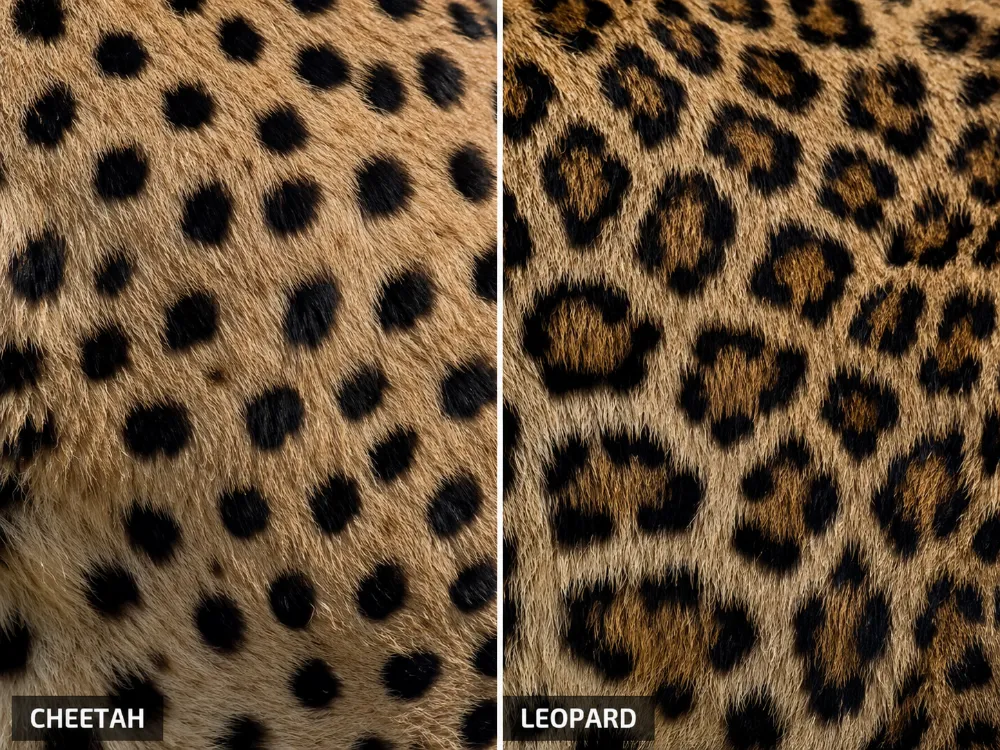
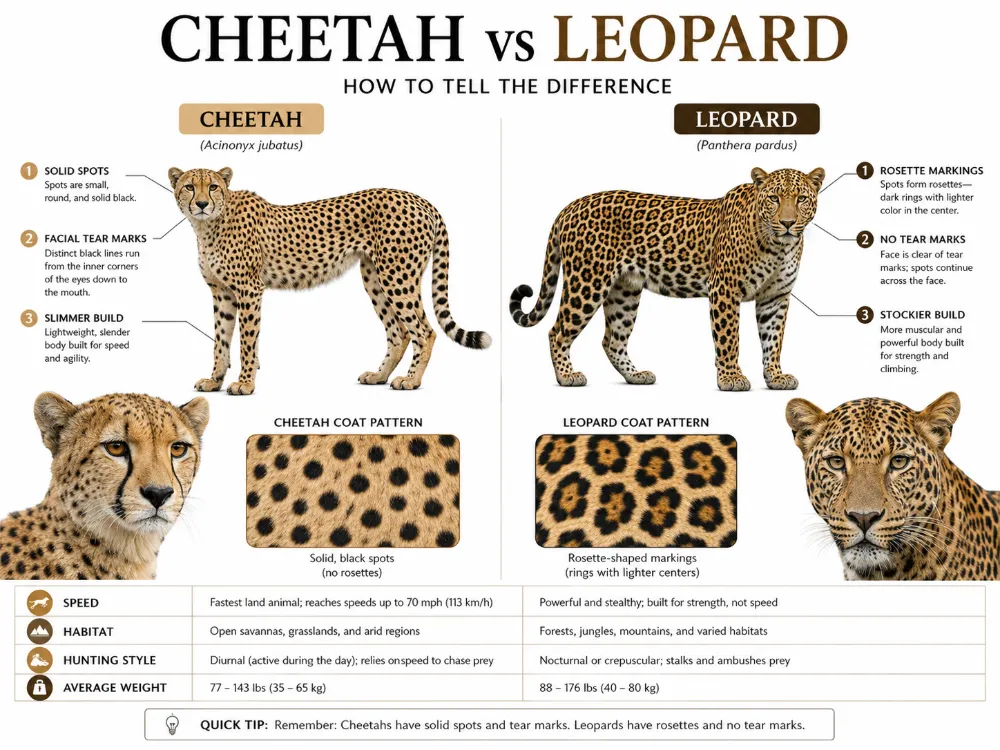
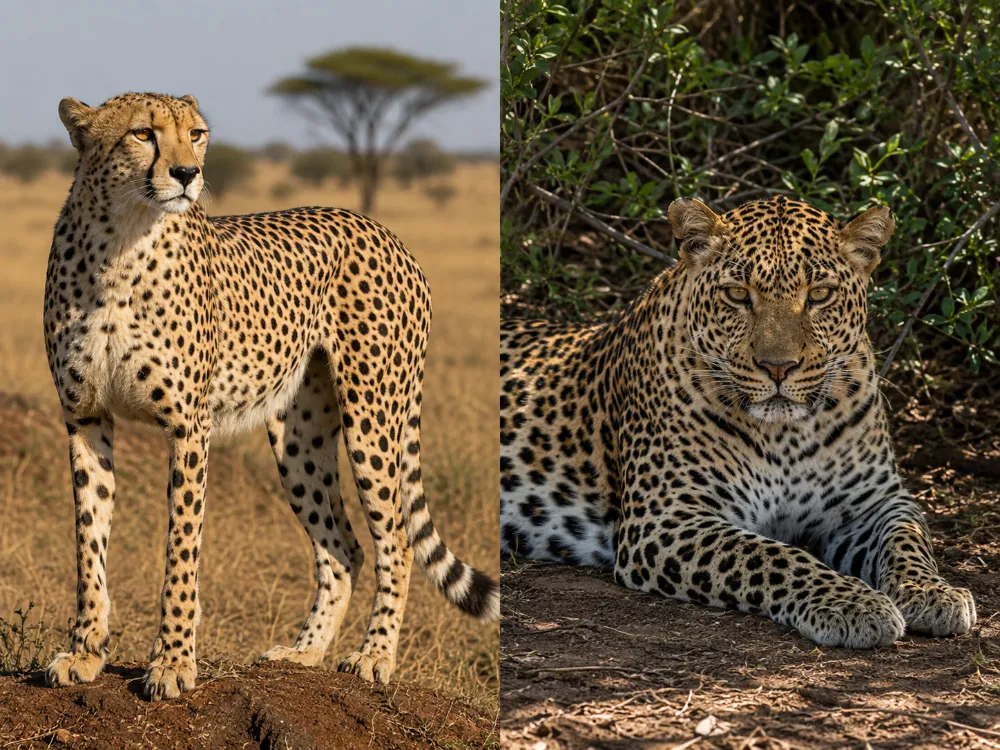
The easiest way to tell cheetah print from leopard print is to look at the spots. Cheetah print is made of solid black dots, while leopard print is made of rosettes, which are dark ring-like markings with a lighter center. In real animals, cheetahs also have dark tear marks on the face, while leopards do not. So although both are spotted cat patterns, they are not the same design in nature.
People often use the words cheetah print and leopard print as if they mean the same thing. In fashion, décor, and casual conversation, the two are frequently mixed up. In zoology, however, the difference is very clear once you know what to look for.
In this guide, you will learn how cheetah print and leopard print differ, why each pattern exists in nature, and how to identify them quickly in both real animals and printed designs.
Quick comparison table
| Feature | Cheetah Print | Leopard Print |
|---|---|---|
| Main pattern | Solid round or oval black spots | Rosettes with dark edges and lighter centers |
| Spot complexity | Simpler and more uniform | More complex and ring-like |
| Overall look | Cleaner dotted pattern | Clustered, flower-like pattern |
| Associated animal build | Slim, long-legged, speed-built cat | Stockier, more muscular, ambush-built cat |
| Face clue in the real animal | Dark tear marks from eyes to mouth | No dark tear marks |
| Best quick clue | Simple black dots | Rosettes instead of dots |
What cheetah print really is
Cheetah print is based on the coat pattern of the cheetah, a fast-running African cat built for sprinting across open ground. On a real cheetah, the pattern consists mainly of small, solid black spots spread across a golden or tan background.
These spots are usually fairly simple in shape. They do not form open circles or ring-like clusters the way leopard markings do. At a glance, cheetah print often looks cleaner and more evenly dotted.
Because the cheetah’s coat pattern is so straightforward, cheetah print is often the easier of the two patterns to identify once you know the basic rule: solid dots, not rosettes.
What leopard print really is
Leopard print is based on the coat of the leopard, a powerful spotted cat found in Africa and parts of Asia. Unlike the cheetah’s simple solid spots, a leopard’s markings are usually rosettes.
A rosette is a dark marking shaped a bit like an open ring or irregular flower, with a lighter center that usually matches or nearly matches the background coat color. These rosettes can vary in size and shape across the body.
This makes leopard print look more layered, more clustered, and often more dramatic than cheetah print.
Solid spots versus rosettes
If you remember only one difference, remember this one. Cheetah print is made of solid spots. Leopard print is made of rosettes.
A cheetah spot usually looks like a single dark dot. A leopard marking usually looks like a dark shape surrounding a lighter center. Even when leopard rosettes are irregular, they still usually feel more open and ring-like than a cheetah’s dots.
This is the fastest and most reliable way to tell the two apart in both wildlife photos and printed designs.
Why the two prints look similar at first
People confuse the two because both patterns belong to golden or tan cats with dark markings. At a quick glance, especially on fabric or in stylized artwork, both may just look like “spotted big cat print.”
The confusion becomes even more common when designers exaggerate or simplify the pattern for fashion. A print may be called cheetah even if it actually uses leopard-like rosettes, or called leopard even if it is closer to solid dots.
In nature, however, the distinction is much clearer. Real cats follow consistent biological patterns that are easier to identify than many commercial prints.
Cheetah print usually looks cleaner and more even
Cheetah print often gives a cleaner visual impression because the spots are simpler and more separate from one another. The pattern often feels lighter, more open, and less crowded than leopard print.
This reflects the actual cheetah coat, where the solid spots are spread across a slim body built for speed. The markings do not usually join together into complicated clusters.
If the print looks like clear black dots scattered across a warm tan coat, it is more likely to be cheetah-inspired.
Leopard print usually looks bolder and more layered
Leopard print often feels richer and more complex because rosettes create contrast between dark borders and lighter inner spaces. The pattern often looks more dramatic, more textured, and sometimes more crowded.
This matches the leopard’s real coat, where rosettes help break up the outline of a stockier ambush predator moving through grass, brush, or forest cover. The irregular ring-like marks create a more complicated visual effect than simple dots do.
If the print looks like broken rings or floral clusters rather than dots, it is more likely leopard-inspired.
The real animals behind the prints are built differently
The print difference makes even more sense when you look at the cats themselves. Cheetahs are slim, long-legged, lightly built cats designed for speed. Leopards are stockier, more muscular, and better built for stealth, climbing, and strength.
These body differences do not directly create the print, but they help explain why the two cats should not be casually blended together. A cheetah is not just a leopard with smaller spots, and a leopard is not just a cheetah without tear marks.
The pattern belongs to a whole animal with its own body plan, hunting style, and habitat.
Cheetahs also have face markings that leopards lack
One of the most famous cheetah traits is the pair of dark tear marks running from the inner corners of the eyes down toward the mouth. These markings are very useful in identifying the real animal.
Leopards do not have the same dramatic tear lines. Their face may still have spots and shading, but not the bold black streaks that are so typical of cheetahs.
If a printed design includes the animal’s face, those tear marks are a strong clue that the design is meant to be cheetah rather than leopard.
Leopard rosettes are not the same as jaguar rosettes
Another layer of confusion is that leopard print is sometimes mixed up not only with cheetah print, but also with jaguar pattern. Leopard rosettes are usually smaller and do not usually contain the obvious central dots often seen in jaguar rosettes.
This matters because some prints sold as “leopard” may actually be closer to a generalized big-cat pattern rather than a faithful leopard design. The fashion world often blends these distinctions in ways zoology does not.
So if you want true animal accuracy, it helps to separate three things: cheetah dots, leopard rosettes, and jaguar rosettes with inner dots.
Why these patterns evolved in nature
Both patterns function as camouflage. A spotted or rosetted coat helps break up the outline of the cat’s body, making it harder for prey or rivals to detect the animal clearly in grass, brush, shadow, or broken light.
Cheetahs often hunt in more open habitats and rely heavily on sight and speed. Leopards often use cover, shadow, and ambush in more varied habitats. Their coat patterns help each species disappear into its environment in slightly different ways.
So these prints are not just beautiful designs. They are part of real survival strategies.
How to identify cheetah print quickly
If you want to identify cheetah print fast, ask yourself three questions. Are the markings solid? Are they simple dots rather than rings? Does the overall pattern look relatively clean and even?
If the answer is yes, the print is likely cheetah-inspired. The more the pattern resembles separate, filled-in black spots on a tan background, the more likely it is to be cheetah rather than leopard.
This is the easiest shortcut for beginners.
How to identify leopard print quickly
If you want to identify leopard print fast, look for open rosettes rather than solid dots. Do the markings look like broken circles, dark-edged shapes, or clustered floral rings with lighter centers?
If so, leopard is the stronger answer. Leopard print usually looks more irregular, more layered, and more complex than cheetah print.
Even when stylized, a leopard pattern usually keeps at least some sense of rosette structure rather than becoming a field of plain dots.
Why fashion often blurs the distinction
In fashion and home design, “animal print” is often treated more as a style category than as a zoologically precise label. Designers may enlarge spots, simplify rosettes, change colors, or blend features from several cats into one print.
This means something sold as cheetah print may not perfectly match a real cheetah coat, and something sold as leopard print may be a stylized hybrid rather than a faithful leopard pattern.
That is why zoological accuracy and commercial naming do not always match.
Which print is more accurate for the real animal?
If accuracy is the goal, the answer depends entirely on the pattern structure. True cheetah-inspired print should use simple solid spots. True leopard-inspired print should use rosettes.
Many commercial prints are inspired by the general idea of a spotted wild cat rather than one exact species. That can be visually attractive, but it is less precise.
For an animal-focused article, the most honest answer is that many so-called “animal prints” are approximations, not exact natural replicas.
Why the difference matters
The difference matters because the pattern belongs to a real animal with a real ecology. Cheetahs and leopards are not interchangeable. One is a lightweight sprinting cat with tear marks and solid spots. The other is a stealthy, muscular climber with rosettes and a more powerful build.
Understanding the print correctly helps people appreciate the animals themselves more accurately. It turns a decorative pattern into a clue about natural history.
That makes the comparison more interesting than simple fashion vocabulary.
Final takeaway
The main difference between cheetah print and leopard print is that cheetah print uses solid black spots, while leopard print uses rosettes with lighter centers. Cheetah print usually looks cleaner and more evenly dotted, while leopard print usually looks more complex and ring-like. In real animals, cheetahs also have black tear marks on the face and a slimmer speed-built body, while leopards are stockier ambush predators without tear marks. Once you know the spot rule, telling them apart becomes much easier.
FAQs
What is the main difference between cheetah print and leopard print?
Cheetah print uses solid black spots, while leopard print uses rosettes with lighter centers.
Is cheetah print the same as leopard print?
No. They are often confused, but in real animal patterns they are clearly different.
How can I tell cheetah print from leopard print fast?
Look at the markings. Simple dots suggest cheetah. Ring-like rosettes suggest leopard.
Why do people mix up cheetah print and leopard print?
Because both are golden cat patterns with dark markings, and many fashion designs simplify or blend the real coat patterns.