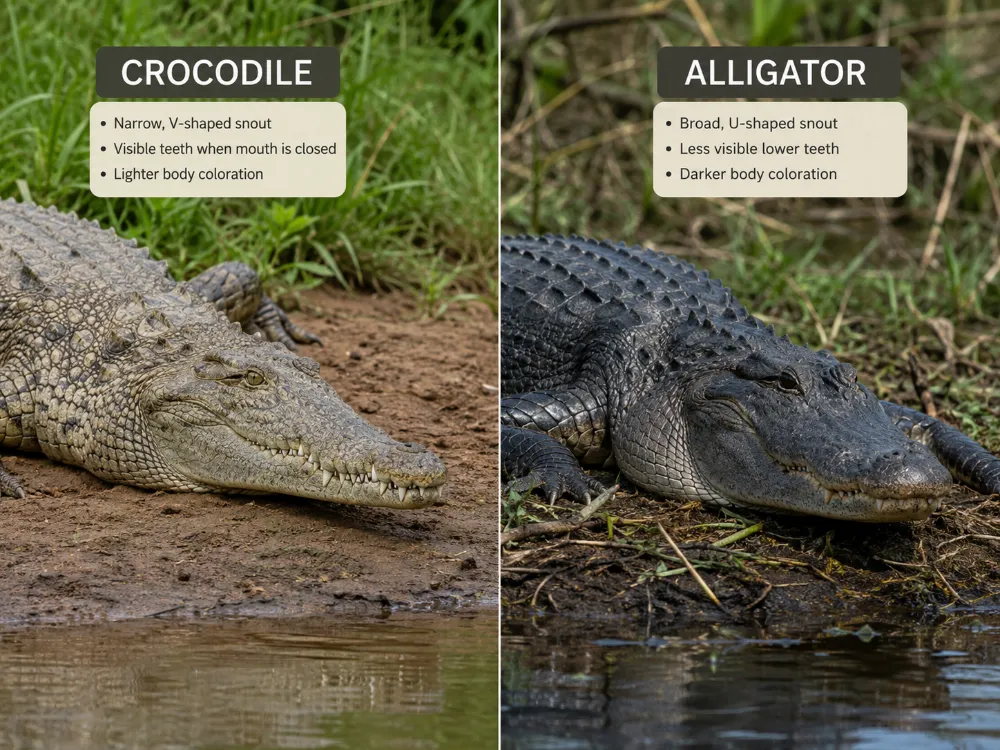
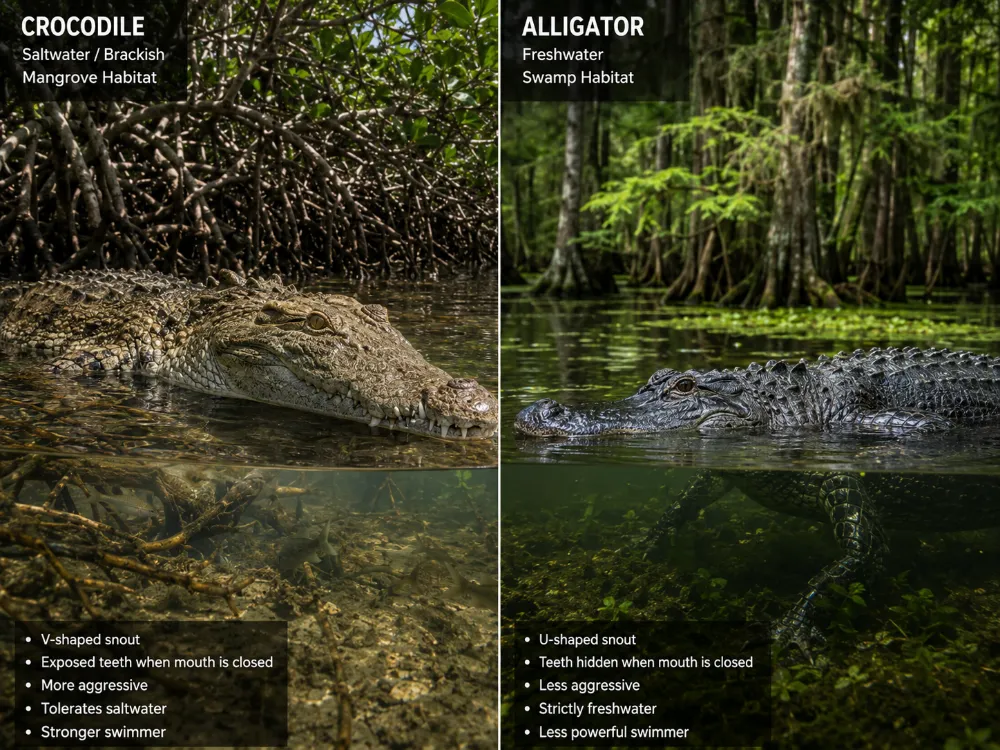
The easiest way to tell a croc from an alligator is to look at the snout, teeth, and habitat. Crocs usually have a narrower, more pointed snout, lighter color, and visible upper and lower teeth when the mouth is closed. Alligators usually have a broader U-shaped snout, darker body color, and lower teeth that stay mostly hidden when the mouth is shut. They are close relatives, but they are not the same animal.
People often shorten crocodile to croc, so “croc vs alligator” means the same basic comparison as “crocodile vs alligator.” The two animals look similar because both are crocodilians, with armored bodies, strong tails, powerful jaws, and eyes and nostrils placed high on the head for life in and around water.
In this guide, you will learn the clearest differences between crocs and alligators, how to identify them quickly, and why people mix them up so often.
Quick comparison table
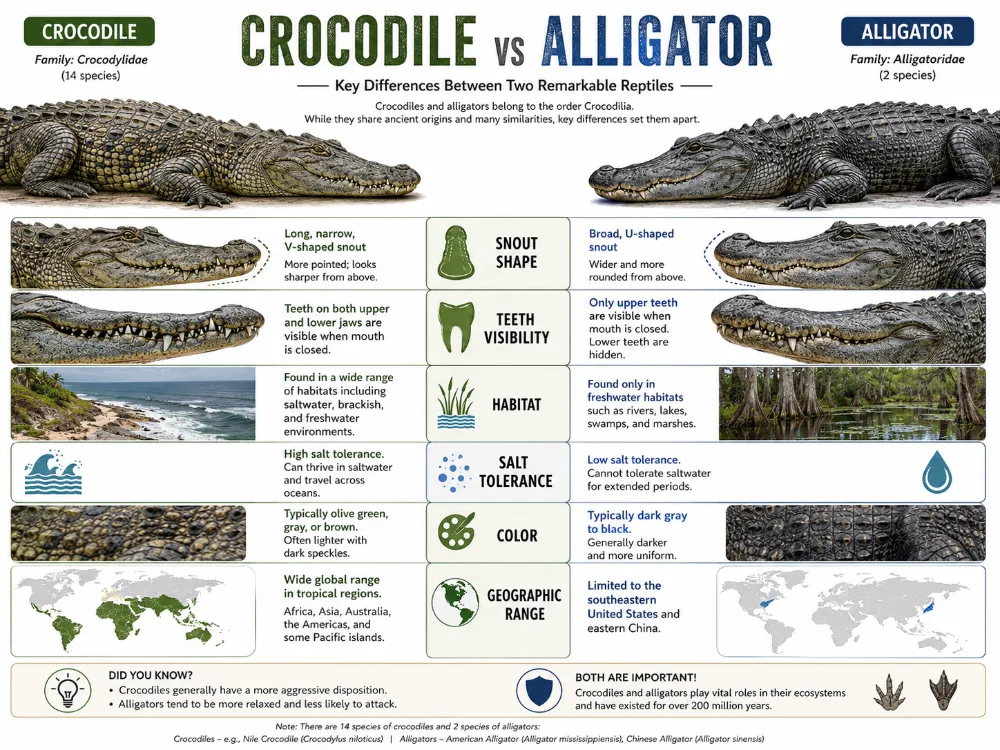
| Feature | Croc | Alligator |
|---|---|---|
| Snout shape | Narrower and more pointed, often V-shaped | Broader and rounder, often U-shaped |
| Teeth when mouth is closed | Upper and lower teeth often visible | Lower teeth usually hidden |
| Color | Often olive, tan, or gray-brown | Often darker gray to black |
| Salt tolerance | Better adapted to brackish and salty water | Mainly freshwater |
| Main range | Africa, Asia, Australia, and the Americas | Mainly southeastern United States and eastern China |
| Typical size | Includes the largest living crocodilians | Large, but usually smaller than the biggest crocs overall |
| Typical reputation | Often more defensive or aggressive | Often less aggressive, though still dangerous |
They belong to different families
Crocs and alligators are both crocodilians, but they do not belong to the same family. Crocs belong to the family Crocodylidae, while alligators belong to Alligatoridae.
That family difference helps explain why they share the same general body plan but still differ in head shape, jaw structure, habitat preference, and overall behavior. They are close relatives, not just two names for the same reptile.
So when people say “croc vs alligator,” they are comparing two related but distinct branches of the crocodilian world.
Snout shape is one of the fastest clues
If you need a quick field mark, start with the snout. Crocs usually have a narrower, more pointed snout. In many species, the front of the head looks more V-shaped.
Alligators usually have a broader, heavier, more rounded snout. Their head often looks wider and more blunt, especially in large adults.
This difference is one of the easiest to notice, especially in side-by-side comparisons or clear photographs.
Teeth look different when the mouth is closed
Another classic difference is the way the teeth show when the jaws are shut. In crocs, both the upper and lower teeth are often visible because the upper and lower jaws are closer in width. One of the most famous clues is the large fourth tooth on the lower jaw, which often remains visible.
In alligators, the upper jaw is wider than the lower jaw, so the lower teeth usually fit inside and stay mostly hidden when the mouth is closed.
If you see obvious interlocking teeth even with the mouth shut, you are more likely looking at a croc.
Crocs usually look lighter in color
Color is not the best clue by itself, but it can still help. Crocs are often lighter overall, with olive, tan, dusty green, or gray-brown tones. In bright light, some species can look surprisingly pale.
Alligators are often darker, commonly deep gray or nearly black. This darker tone can make them look heavier and more solid in the water.
Because both groups vary by age, mud, water, and sunlight, color works best when combined with snout shape and teeth.
Habitat is a major difference
Alligators are mainly freshwater animals. They are commonly found in swamps, rivers, marshes, ponds, lakes, and other slow-moving freshwater habitats. The American alligator is especially associated with southeastern wetlands.
Crocs handle salt better and are more likely to use brackish water, estuaries, mangroves, coastal lagoons, and river mouths. Some species are especially comfortable in coastal environments.
This difference comes from better salt-handling adaptations in crocs, which allows them to live in places where alligators are usually less common.
Range helps identify them too
Alligators have a much smaller modern range. Today, the best-known living alligators are the American alligator and the Chinese alligator. That means alligators are mainly associated with the southeastern United States and a limited range in China.
Crocs are much more widespread. Different species occur in Africa, Asia, Australia, and the Americas, especially in tropical and subtropical regions.
So if you are talking about a large crocodilian in Africa or Australia, it is a croc, not an alligator.
Which one is bigger?
Alligators can become very large, especially big male American alligators, but crocs include the largest living crocodilian species. The saltwater crocodile is generally considered the largest living crocodilian, and the Nile crocodile can also become enormous.
This means crocs usually win the overall size comparison when you look at the biggest species in each group. Even so, a large alligator is still a massive and powerful reptile.
So the best summary is that both can be huge, but the largest crocs are usually bigger than the largest alligators.
Behavior is not exactly the same
Crocs are often described as more defensive or aggressive overall, especially the large species most associated with serious attacks. Saltwater crocodiles and Nile crocodiles are especially famous for this reputation.
Alligators can also be dangerous and should never be treated casually, but American alligators are often considered somewhat less aggressive toward humans than the most dangerous large croc species.
That said, no large crocodilian should ever be treated as safe. Nesting season, territory, food conditioning, and proximity all matter.
Why they look so similar in the first place
People confuse crocs and alligators because both are built around the same crocodilian body plan. They both have armored skin, powerful tails, long jaws, semiaquatic habits, and eyes and nostrils placed high on the head.
From far away, the differences in snout shape and teeth can be hard to notice. Popular culture also makes the confusion worse by using “croc” or “alligator” loosely for any large reptile in the water.
Once you learn the head and tooth clues, however, the difference becomes much easier to see.
How to tell them apart quickly
If you want a fast identification guide, use these clues together:
Croc: narrower pointed snout, visible upper and lower teeth, lighter color, better salt tolerance, wider global range
Alligator: broader U-shaped snout, lower teeth mostly hidden, darker color, mostly freshwater, much smaller natural range
No single clue is perfect every time, but this combination is usually very reliable.
Which one is more dangerous to humans?
In general, crocs are considered more dangerous overall because the group includes some of the most feared crocodilian species in the world. Large crocs in major tropical river systems and coastal estuaries can be especially risky.
Alligators are still powerful predators and can seriously injure or kill humans under the wrong circumstances. The idea that alligators are harmless is completely false.
The safest rule is simple: give both groups distance, never feed them, and never assume a still animal is a safe animal.
Final takeaway
The main difference between a croc and an alligator comes down to snout shape, teeth, habitat, range, and overall appearance. Crocs usually have a narrower pointed snout, visible teeth when the mouth is closed, lighter color, and better adaptation to brackish or salty water. Alligators usually have a broader U-shaped snout, darker body color, and lower teeth that stay mostly hidden when the mouth is closed. They are closely related, but once you know the key clues, they are much easier to tell apart.
FAQs
Is a croc the same as an alligator?
No. A croc and an alligator are related crocodilians, but they belong to different families and differ in snout shape, teeth, habitat, and range.
Which is bigger, a croc or an alligator?
Both can be very large, but the biggest crocs are usually larger than the biggest alligators.
How can I tell a croc from an alligator fast?
Look at the snout and teeth. A pointed snout with visible teeth usually suggests a croc, while a broad U-shaped snout with hidden lower teeth usually suggests an alligator.
Which is more dangerous, a croc or an alligator?
Crocs are generally considered more dangerous overall, especially the largest species, but both can be very dangerous.