The short answer is that a chipmunk is a type of squirrel, but not every squirrel is a chipmunk. In everyday language, people usually compare chipmunks with the larger tree squirrels they see in parks and yards. Chipmunks are smaller, striped, more ground-oriented, and famous for cheek pouches and quick darting movement. Typical squirrels are usually larger, longer-tailed, less striped, and more often seen climbing trees.
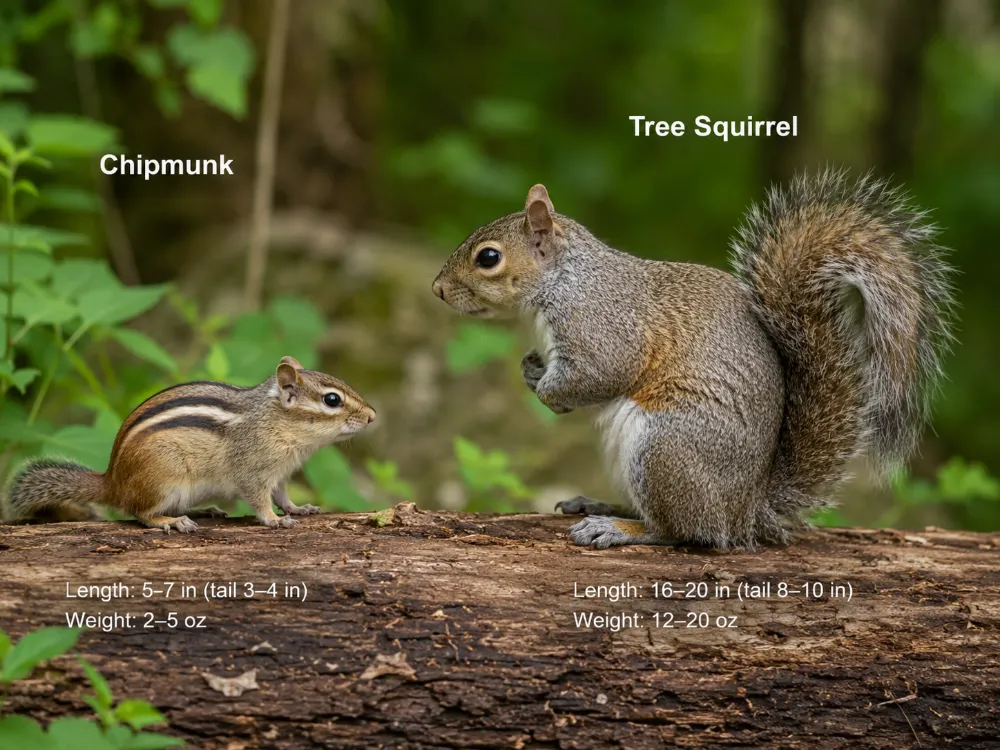
People often confuse chipmunks and squirrels because both belong to the squirrel family and share the same basic rodent look: small body, bushy tail, rounded ears, and fast movement. At a glance, especially from a distance, a small squirrel on the ground can look chipmunk-like, and a chipmunk near a tree can look squirrel-like.
In this guide, you will learn how chipmunks and squirrels differ in body shape, stripes, behavior, habitat, diet, and daily lifestyle, plus the fastest ways to tell them apart correctly.
Quick comparison table
| Feature | Chipmunk | Squirrel |
|---|---|---|
| Basic meaning | A small ground-oriented squirrel with stripes | A broad group that includes tree squirrels, ground squirrels, flying squirrels, and chipmunks |
| Everyday comparison | Usually the small striped animal in yards or woods | Usually the larger tree squirrel people see climbing trunks and branches |
| Body size | Smaller and lighter | Usually larger and longer-bodied |
| Back pattern | Distinct dark and light stripes | Usually plain gray, brown, black, or reddish without strong back stripes |
| Tail | Smaller and less fluffy | Longer, fuller, and bushier |
| Main lifestyle | Often ground-based and burrow-using | Often tree-climbing and branch-using, depending on species |
| Cheek pouches | Very obvious when carrying food | Not used in the same obvious pouch-carrying way |
| Best quick clue | Small size, stripes, ground movement | Bigger body, bushier tail, tree-focused movement |
A chipmunk is actually a squirrel
This is the most important idea in the whole comparison. A chipmunk is not outside the squirrel group. It belongs to the squirrel family, Sciuridae, just like tree squirrels, ground squirrels, and flying squirrels.
That means the phrase “chipmunk vs squirrel” is a little misleading in strict biology. It is really comparing a chipmunk with the larger everyday squirrels people usually mean when they say squirrel. In ordinary speech, the comparison still makes sense because the two animals look and behave differently enough to stand out.
So the most accurate statement is simple: all chipmunks are squirrels, but not all squirrels are chipmunks.
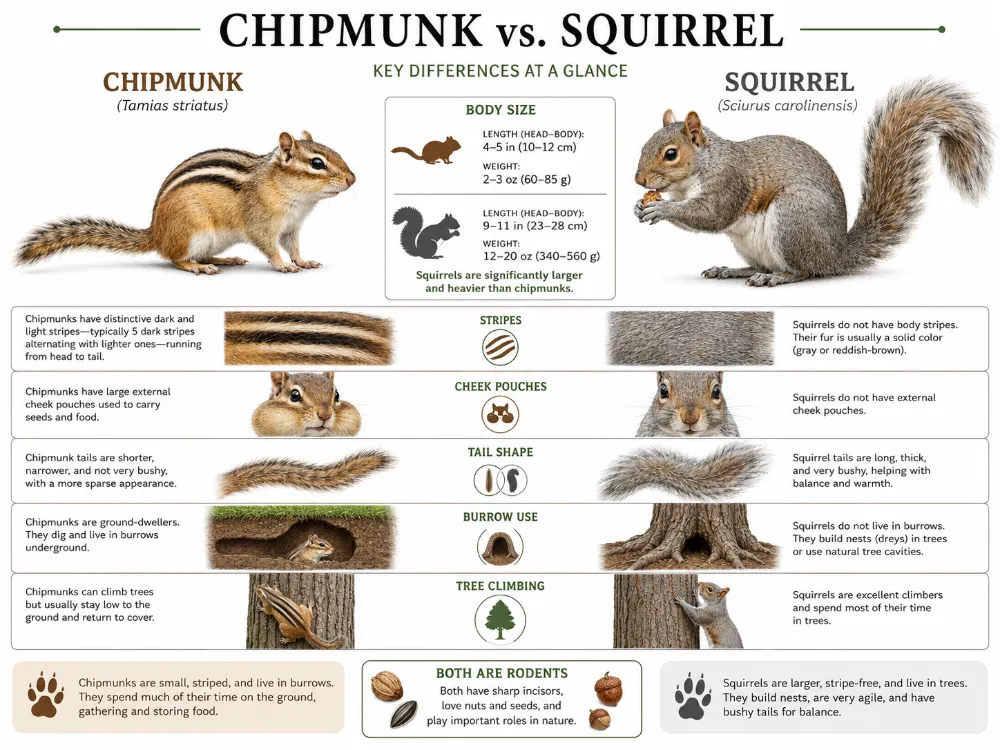
Chipmunks are usually much smaller
One of the easiest differences is body size. Chipmunks are usually much smaller than the squirrels most people notice in parks, yards, and city trees. They often look compact, low to the ground, and quick in movement.
Typical tree squirrels are usually larger, with a longer body, fuller tail, and more obvious climbing frame. Even when a squirrel is sitting still, it often looks heavier and longer than a chipmunk.
If the animal looks very small and almost tiny compared with a common backyard squirrel, chipmunk becomes the more likely answer.
Stripes are one of the best clues
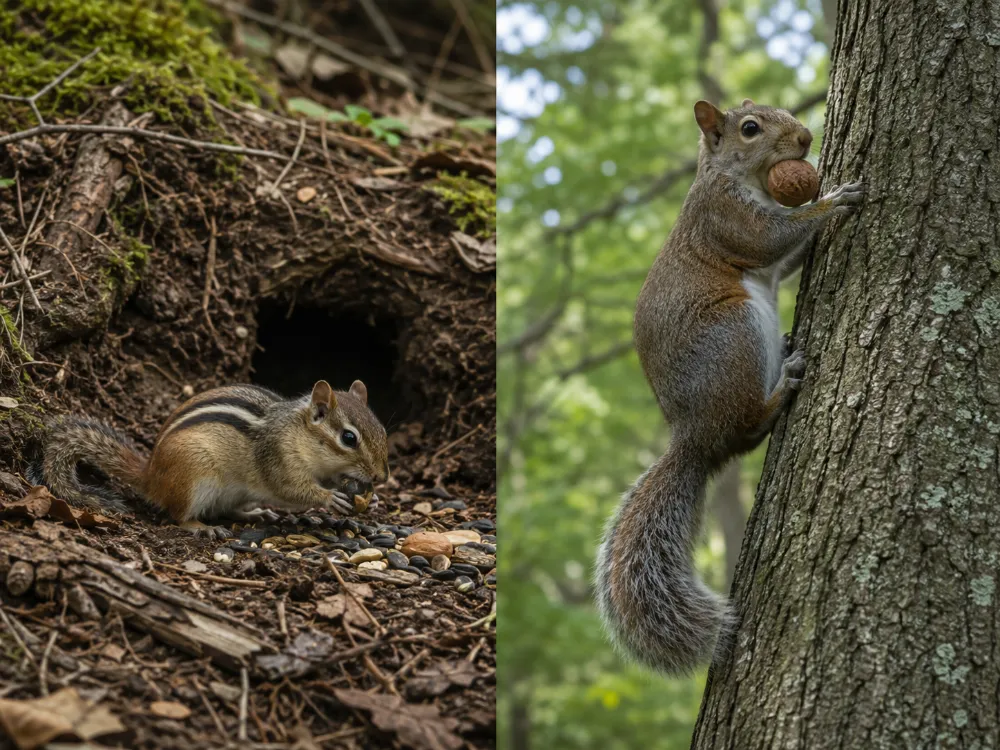
Chipmunks are famous for the dark and light stripes running along the back and often onto the head. This striped pattern is one of the strongest visual clues in the entire comparison.
Most of the squirrels people compare with chipmunks do not have these strong back stripes. Tree squirrels are more often gray, brown, reddish, black, or mixed in color, but usually without the clear striped pattern that makes a chipmunk so recognizable.
If the animal has bold stripes on the back, it is almost certainly a chipmunk rather than a typical tree squirrel.
Squirrels usually have bushier tails
Tail shape is another helpful clue. Chipmunks do have tails, but they are usually smaller, thinner, and less dramatically fluffy than those of many squirrels.
Tree squirrels are famous for their large bushy tails. The tail often looks almost as visually important as the body itself and helps create the classic squirrel silhouette people recognize instantly.
If the tail looks very full, long, and plush, squirrel becomes more likely. If the tail is smaller and less showy, chipmunk becomes more likely.
Chipmunks spend more time on the ground
Chipmunks are often strongly associated with the ground. They run across rocks, logs, gardens, leaf litter, and yard edges, often disappearing into holes, brush, or burrow entrances. Their movement is quick, low, and darting.
Many common squirrels, especially tree squirrels, spend much more time climbing trunks, jumping between branches, and moving above ground level. They are often seen perched on limbs, racing up bark, or carrying food into trees.
If the animal seems to live its life mostly at ground level, chipmunk is often the better guess. If it spends a lot of time in trees, squirrel is often the better guess.
Chipmunks use cheek pouches more obviously
One of the classic chipmunk traits is the use of cheek pouches. Chipmunks can stuff seeds, nuts, and other food into these expandable pouches and then carry the food away to storage sites. When full, the cheeks can look dramatically swollen.
Squirrels also gather and transport food, but they do not usually create the same unmistakable “stuffed cheeks” look that chipmunks are famous for in everyday observation.
If you see a tiny striped animal with bulging cheeks rushing away from a feeder or seed source, that is a very strong chipmunk clue.
Chipmunks often live in burrows
Chipmunks commonly use burrows, tunnels, and underground shelters. These systems give them places to sleep, hide, raise young, and store food. This burrow-centered lifestyle is one reason they are so often seen dashing into holes or disappearing under roots and stones.
Many tree squirrels usually depend more on tree cavities, nests of leaves and twigs, or sheltered places above ground. Some ground squirrels also use burrows, which is one reason the squirrel family is so diverse, but the everyday chipmunk image is strongly tied to burrow use.
So if the animal repeatedly disappears into the ground, chipmunk becomes especially likely.
Squirrels are often more obvious tree climbers
Tree squirrels are built for climbing. Their long tail helps with balance, and their body posture often looks perfectly suited for trunks, branches, and leaps through the canopy. This is why people so often notice squirrels high in trees.
Chipmunks can climb and may scramble onto logs, stumps, low branches, rocks, or even bird feeders, but they usually do not define their daily life around the trees in the same way. Their center of activity is often much closer to the ground.
If the animal is confidently racing through branches, it is much more likely to be a squirrel than a chipmunk.
Movement style feels different
Chipmunks often move in short, fast, nervous bursts. They may freeze, flick, dart, stop again, and then vanish almost instantly into cover. Their motion often looks like a rapid sequence of decisions.
Tree squirrels can also move quickly, but they often look more flowing and spring-loaded, especially when climbing or jumping. Their body and tail work together in a smoother, more balanced way than the chipmunk’s quick ground dashes.
If the movement feels tiny, low, and rapid like a little striped arrow, think chipmunk. If it feels bigger, springier, and more branch-oriented, think squirrel.
Color can help, but stripes matter more
Chipmunks are often brownish with contrasting stripes, and that combination makes them fairly easy to recognize. Tree squirrels, however, vary widely by species and region. They may be gray, red, brown, black, or mixed in color.
Because squirrel color varies so much, color alone is less reliable than pattern and body shape. A reddish squirrel is still usually a squirrel if it lacks chipmunk stripes and has the larger tail and tree-climbing style.
So if you are unsure, trust the stripes and tail more than the background coat color.
Diet overlaps, but the feeding style can differ
Both chipmunks and squirrels eat nuts, seeds, berries, fruits, and other plant material, and both can be opportunistic. Depending on the species and season, both may also eat insects, eggs, or other small food items.
The difference is often in how they gather and store food. Chipmunks are especially famous for carrying food in cheek pouches and caching it in burrows. Tree squirrels are more often seen holding food in their front paws and eating it while sitting upright on the ground or on a branch.
So the menu may overlap, but the feeding style often looks different in real life.
Chipmunks often sound different too
Chipmunks can make sharp, quick calls, chipping sounds, and alarm notes that match their small, high-alert lifestyle. Their vocalizations often sound tight, rapid, and high-pitched.
Squirrels also vocalize and can be surprisingly noisy, especially when scolding, warning, or chasing rivals. Their calls vary by species, but many common tree squirrels produce harsher chatter, barks, or repetitive scolding sounds.
The exact sound depends on the species, but chipmunks often give a smaller, sharper acoustic impression than the average tree squirrel.
Habitat overlap causes confusion
Chipmunks and squirrels can live in many of the same broad environments, including woods, parks, yards, and suburban neighborhoods. That overlap is one reason people mix them up. A backyard with trees, shrubs, bird feeders, and ground cover may easily support both.
The difference is how they use that space. Chipmunks usually stay closer to the ground, brush, logs, rocks, and burrow sites. Tree squirrels use trunks, branches, fences, roofs, and overhead routes much more often.
So the same yard can hold both animals, but each one occupies it differently.
Ground squirrels make the comparison trickier
One reason the topic can be confusing is that not all squirrels are tree squirrels. Ground squirrels also exist, and some of them can look more chipmunk-like in lifestyle than people expect. This is part of why the phrase “chipmunk vs squirrel” is not perfectly precise in biology.
Even so, in everyday conversation people usually mean chipmunk versus tree squirrel, and in that comparison the differences are much clearer. The chipmunk is smaller, striped, and more likely to vanish into a burrow, while the tree squirrel is larger, bushier-tailed, and more likely to run up a trunk.
So the common comparison still works well, even if the full squirrel family is more complicated.
Why people confuse them so often
People confuse chipmunks and squirrels because they are close relatives with the same general rodent shape. Both have quick movements, pointed faces, small ears, and tails, and both may appear around bird feeders, gardens, and forest edges.
The confusion is strongest when the animal is seen only briefly. A chipmunk moving fast at the base of a tree may be called a small squirrel, and a small squirrel on the ground may be called a chipmunk by someone who did not notice the stripes.
Once you focus on stripes, tail size, and whether the animal uses trees or burrows more, the difference becomes much easier to see.
How to tell them apart quickly
If you need a fast identification guide, use these clues together:
Chipmunk: smaller body, dark and light stripes, less fluffy tail, ground-based darting movement, obvious cheek pouches, burrow use
Squirrel: larger body, usually no back stripes, bushier tail, strong tree-climbing behavior, branch-jumping lifestyle
No single clue is perfect in every situation, but this combination is usually very reliable.
Which one is more likely to raid bird feeders?
Both can raid bird feeders, and both are clever enough to take advantage of easy food. Chipmunks often collect fallen seed or rush up to feeding areas and then carry food away in their cheek pouches. Squirrels often climb the feeder itself, sit upright, and eat on the spot or carry larger pieces away.
So the better question is not whether they visit feeders, but how they use them. A striped animal stuffing its cheeks is likely a chipmunk. A larger bushy-tailed climber hanging from the feeder is likely a squirrel.
In many yards, both may appear within the same hour.
Final takeaway
The main difference between a chipmunk and a squirrel is that a chipmunk is a small striped squirrel adapted for ground living, burrow use, and cheek-pouch food carrying, while the squirrels people usually compare it with are larger, bushier-tailed, and more strongly adapted for tree climbing. Biologically, a chipmunk is still a squirrel, but in everyday life it looks and behaves differently enough to stand apart. Once you check the stripes, tail, and lifestyle, the distinction becomes very clear.
FAQs
Is a chipmunk a squirrel?
Yes. A chipmunk belongs to the squirrel family.
What is the main difference between a chipmunk and a squirrel?
In everyday comparison, chipmunks are smaller, striped, and more ground-based, while typical squirrels are larger, bushier-tailed, and more tree-oriented.
How can I tell a chipmunk from a squirrel fast?
Look for stripes and tail size. A striped animal with a smaller tail is usually a chipmunk, while a larger animal with a big bushy tail is usually a squirrel.
Do chipmunks climb trees like squirrels?
Chipmunks can climb, but they usually spend much more time on the ground and in burrows than tree squirrels do.