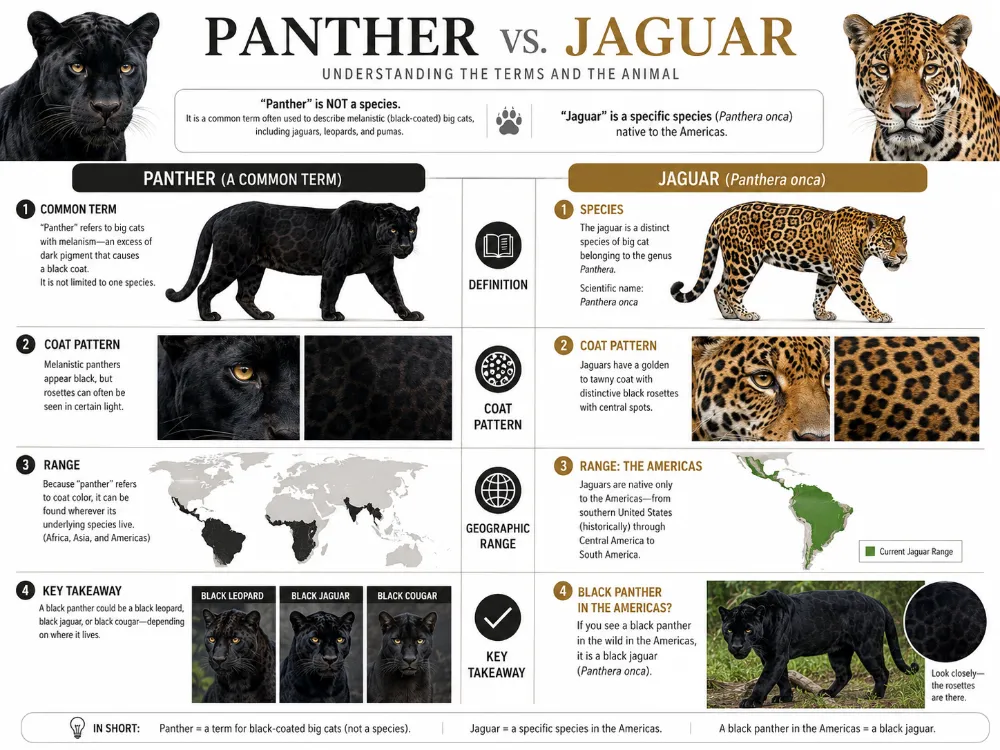
The short answer is that a jaguar is a real species, while a panther is usually not a separate species at all. In everyday English, panther often means a large dark-colored big cat, especially a black jaguar in the Americas or a black leopard in Africa and Asia. A jaguar, by contrast, is a specific spotted big cat species from the Americas. So the main difference is that jaguar is biologically precise, while panther is often a vague common name.
People use the word panther in many different ways, which is why the topic gets confusing. Sometimes it means a black big cat. Sometimes it means a leopard. Sometimes it is used loosely for any powerful cat in the genus Panthera. In wildlife biology, however, a jaguar is always a jaguar.
In this guide, you will learn what “panther” really means, how it relates to jaguars, when a panther can actually be a jaguar, and how to tell the difference between a vague label and a real species name.
Quick comparison table
| Feature | Panther | Jaguar |
|---|---|---|
| Scientific precision | Usually a vague common name | A specific species, Panthera onca |
| What it usually means | Often a black big cat, especially a melanistic jaguar or leopard | A large spotted cat native to the Americas |
| Is it a separate species? | Usually no | Yes |
| Color | Often used for black-coated individuals | Usually golden with black rosettes, but can also be black |
| Range | Depends on what animal the word refers to | Central and South America, with limited northern range remnants |
| Best quick clue | Ask which species the speaker actually means | Stocky build, broad head, rosettes often with central dots |
| Important fact | A black panther in the Americas is often a jaguar | A black jaguar is often called a black panther |
What is a jaguar?
A jaguar is a real big cat species in the genus Panthera. Its scientific name is Panthera onca. Jaguars are native to the Americas and are especially associated with tropical forests, wetlands, rivers, and dense cover in Central and South America.
The jaguar is the largest big cat in the Americas. It is strongly built, broad-headed, and famous for powerful jaws and a stocky muscular body. Most jaguars are golden or tan with dark rosettes, and those rosettes often contain one or more small black dots inside them.
So when you say jaguar, you are naming a real and specific animal species, not just describing a color or a style of cat.
What is a panther?
The word panther is much less precise. In everyday use, it often refers to a large dark big cat, especially one that looks black. In many cases, this animal is not a separate species. It is simply a melanistic individual of another species.
In the Americas, a black panther is often a black jaguar. In Africa or Asia, a black panther is often a black leopard. In older or looser language, panther may also be used for big cats in general, especially in non-technical writing.
This is why the word causes confusion. Jaguar is exact. Panther is often not.
A panther is usually a color description, not a species name
In modern everyday wildlife language, panther often works more like a description than a scientific identity. It tells you that the cat may be dark or black-looking, but it does not tell you which species it belongs to unless you know the region.
For example, if someone says they saw a panther, the next question should be: What kind of panther? If they are in Brazil, the answer may be a black jaguar. If they are in India, it may be a black leopard.
So the term panther often needs more explanation before it becomes biologically useful.
A black jaguar is often called a black panther
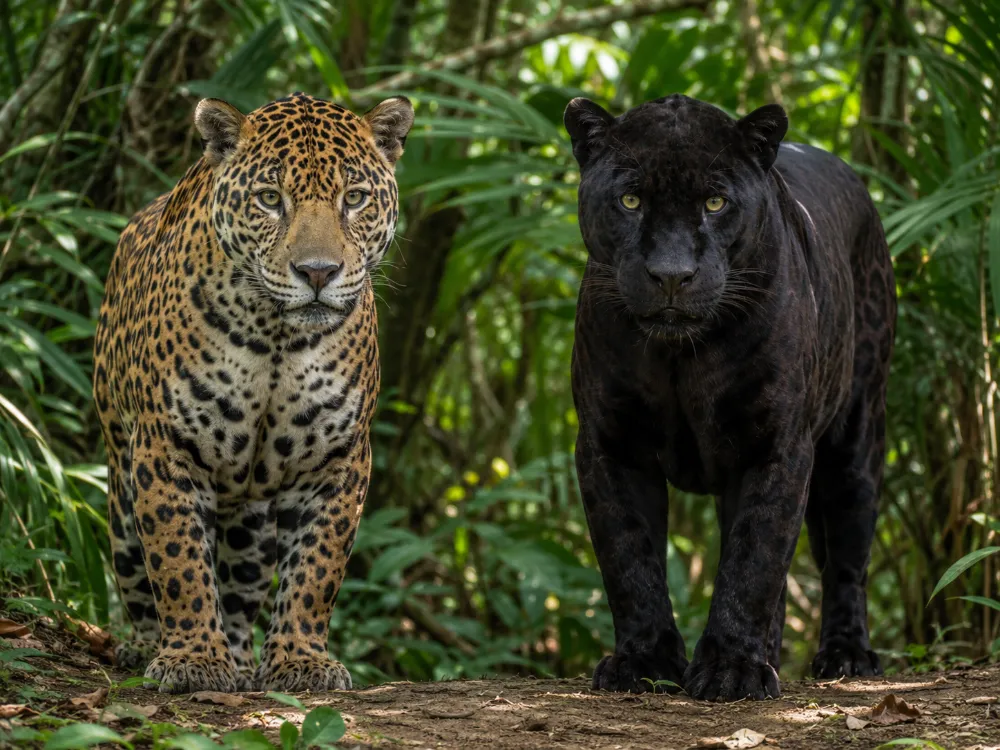
This is the most important link between the two terms. A jaguar can occur in a melanistic form, meaning the coat looks very dark or nearly black because of increased dark pigment. When this happens, many people call the animal a black panther.
That means a black panther in the Americas is very often not a separate mysterious cat. It is a jaguar with melanism. In strong light, the rosettes are often still faintly visible beneath the dark coat.
So in some situations, panther and jaguar can refer to the same individual animal, but only because the jaguar is black.
Not every panther is a jaguar
This is the other half of the story. Not all panthers are jaguars. In Africa and much of Asia, the animal people call a black panther is usually a leopard, not a jaguar. Jaguars do not naturally occur there.
That is why location matters so much. The word panther by itself is incomplete. The environment and continent often tell you what species is actually being described.
So while a panther can be a jaguar, it can also be something else entirely depending on where the animal lives.
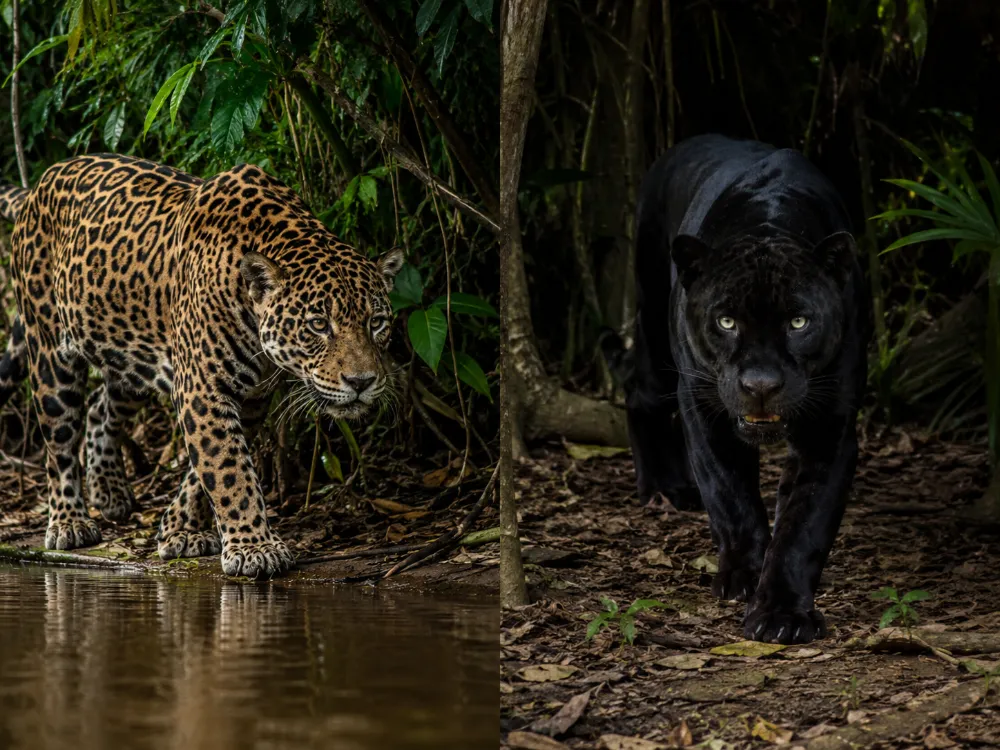
Jaguars usually have rosettes, panthers may hide them
Most jaguars have a golden or tan coat marked with black rosettes. These rosettes are larger than a leopard’s and often contain small black dots inside. This is one of the classic jaguar field marks.
When a jaguar is melanistic, the coat may look almost completely black from a distance. That is when people call it a black panther. Even then, the hidden jaguar pattern is often still there. In the right angle of light, the rosettes can usually be seen faintly under the dark coat.
So the panther look does not erase the jaguar pattern. It only makes it harder to see.
Jaguars have a very specific body shape
One way to cut through the language confusion is to focus on structure instead of color. Jaguars usually have a stocky, muscular body, a broad head, a powerful jawline, and a compact, heavy look. They often seem denser and more forceful than leopards.
If the panther in question is actually a jaguar, those structural traits still remain. Even a black jaguar usually looks like a jaguar in body form, not just like a generic black cat.
This is why experienced observers look at head shape, body mass, and rosette structure instead of trusting the word panther alone.
Range is one of the best clues
Geography makes the answer much easier. Jaguars live in the Americas, especially from Mexico south through Central and South America, with strongest populations in places such as the Amazon and the Pantanal.
So if someone sees a black panther in Brazil, Peru, or Belize, the animal may well be a jaguar. If the same term is used in Sri Lanka or Kenya, it almost certainly means a leopard instead.
In other words, a jaguar is tied to a real geographic range, while panther depends on context.
Why the word panther became so confusing
The confusion exists because common names do not always follow strict zoological rules. Over time, people used panther in folklore, storytelling, hunting talk, and popular media for large impressive cats, especially dark ones. The word became emotional and dramatic rather than precise.
Scientific naming works differently. Science prefers exact species names such as jaguar, leopard, lion, or tiger. The word panther may still appear in general language, but it does not always tell the reader enough.
That is why a sentence using panther often needs more explanation than a sentence using jaguar.
Panther can also mean something even broader
In some older or looser contexts, panther has been used for large cats in the genus Panthera more generally. That can include lions, tigers, leopards, and jaguars in a very broad sense. However, this use is not the clearest choice for modern wildlife education.
For an animal article, it is better to use exact species names whenever possible. Otherwise, readers may assume panther means a species when it often does not.
So while the word has historical depth, it is often too broad to be the best scientific label.
Behavior does not change just because the jaguar is black
A black jaguar is still a jaguar in behavior, ecology, and anatomy. It still hunts like a jaguar, still uses similar habitats, and still carries the same broad-headed, heavily muscled body shape. The major change is coat color, not identity.
This is an important point because people sometimes imagine a black panther as a mysterious separate animal with different powers or habits. In reality, melanism changes appearance, not species membership.
So a black panther jaguar is still behaving like a jaguar, not like a completely different cat.
Jaguars are more strongly associated with water
Jaguars are especially famous for comfort around water. They often live in river systems, wetlands, swamps, and tropical forests, and they may swim readily. This is one of the classic jaguar traits.
If the animal called a panther is actually a jaguar, it may show those same preferences. In the Americas, a black panther seen near water-rich tropical habitat may well be a melanistic jaguar.
This helps remind us again that species identity matters more than the common nickname.
Jaguar versus panther is really a precision problem
Unlike comparisons such as lion versus tiger, this topic is not simply one species against another. It is often a comparison between a precise species name and an imprecise common term.
Jaguar tells you exactly what animal you are discussing. Panther often leaves open questions about species, color form, and location. That is why the most accurate wildlife writing prefers jaguar whenever the animal truly is a jaguar.
So the real lesson here is not just about cats. It is also about the value of clear naming.
How to tell whether a “panther” is really a jaguar
If you hear the word panther, ask three questions. Where is the animal from? Is it black or just a large cat being described dramatically? Does the body look stocky and broad-headed like a jaguar?
If the animal is in the Americas and especially if it is black, then it may indeed be a jaguar. If it is in Africa or Asia, it is much more likely to be a leopard. If the speaker is just using panther loosely, the word may not be enough to identify the species at all.
This is why geography and structure are more useful than the word itself.
Why black jaguars still show pattern in the light
Melanism does not remove the underlying coat pattern. It overlays the coat with heavy dark pigment. That is why black jaguars often still show ghost-like rosettes when sunlight hits the fur at the right angle.
This hidden pattern is one of the most fascinating things about so-called black panthers. They look solid black from far away, but up close the jaguar design is still present beneath the darkness.
So even the black coat quietly reveals that the animal is still a patterned jaguar underneath.
Why people are fascinated by panthers
The word panther carries mystery. It sounds secretive, dramatic, and powerful. A black cat slipping through forest shadow naturally invites stories, and people are often drawn to names that feel legendary.
Jaguars, on the other hand, carry scientific and regional identity. They are powerful in a different way: more exact, more ecological, and more rooted in the real natural history of the Americas.
So the emotional appeal of panther and the biological clarity of jaguar often collide in the public imagination.
How to tell them apart quickly
If you need a fast identification guide, use these clues together:
Jaguar: real species, broad head, muscular stocky build, rosettes often with central dots, native to the Americas
Panther: usually a vague common term, often meaning a black jaguar or black leopard depending on location
If the word panther appears by itself, do not treat it as the final answer. Ask what species it actually refers to.
Final takeaway
The main difference between a panther and a jaguar is that a jaguar is a real species, while panther is usually a broad common term rather than a separate scientific animal. In the Americas, a black panther is often a melanistic jaguar, which means the two can sometimes refer to the same individual. However, not every panther is a jaguar, because the word may also refer to a black leopard in Africa or Asia. For clear animal writing, jaguar is the precise term, while panther usually needs explanation.
FAQs
Is a panther the same as a jaguar?
Not always. A jaguar is a real species, while panther is often a vague common term. In the Americas, a black panther is often a black jaguar.
Is a black panther a jaguar?
Sometimes. In the Americas, a black panther is often a melanistic jaguar. In Africa or Asia, it is usually a melanistic leopard.
How can I tell if a panther is really a jaguar?
Look at the location, body shape, and pattern. A stocky broad-headed black cat in the Americas may be a jaguar.
Why is the word panther confusing?
Because it is often used as a common name for dark big cats rather than as a precise scientific species name.