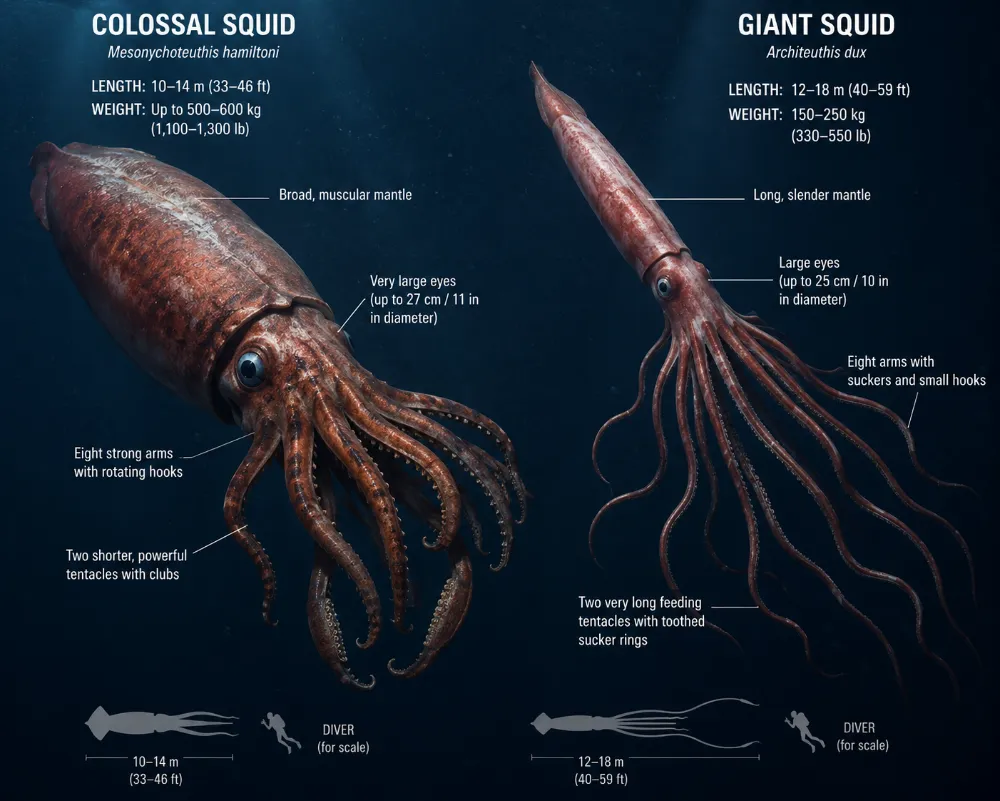
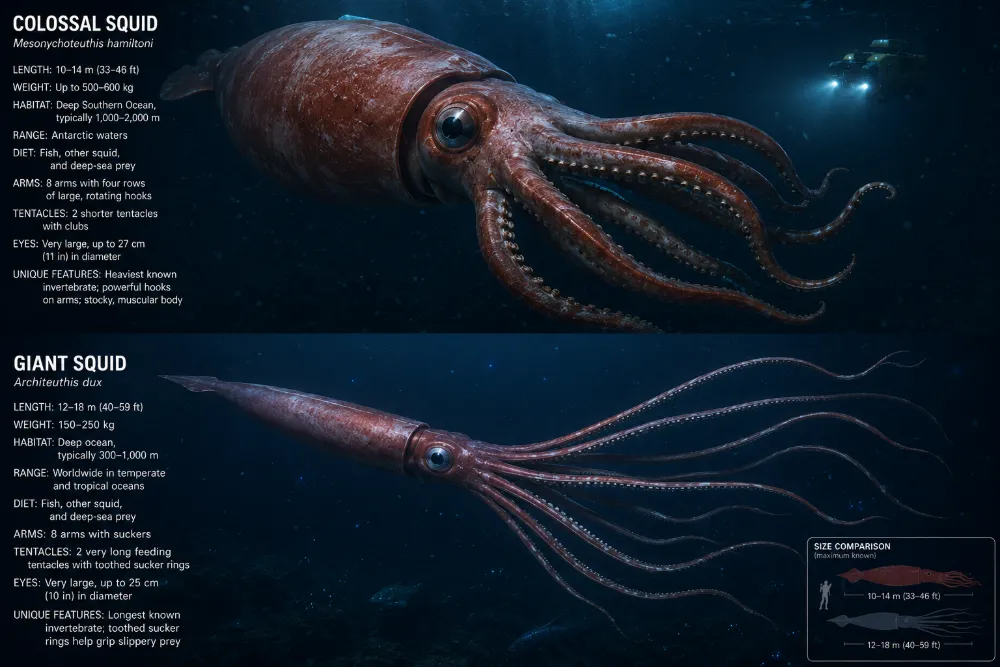
The colossal squid and giant squid are different deep-sea animals. The giant squid is usually longer because of its extremely long feeding tentacles, while the colossal squid is heavier, bulkier, and more muscular. Giant squid belong to the genus Architeuthis, while the colossal squid is Mesonychoteuthis hamiltoni. The quickest difference: giant squid are the longer “legendary tentacle” squid; colossal squid are the heavier, stronger Antarctic giants.
Quick Comparison Table
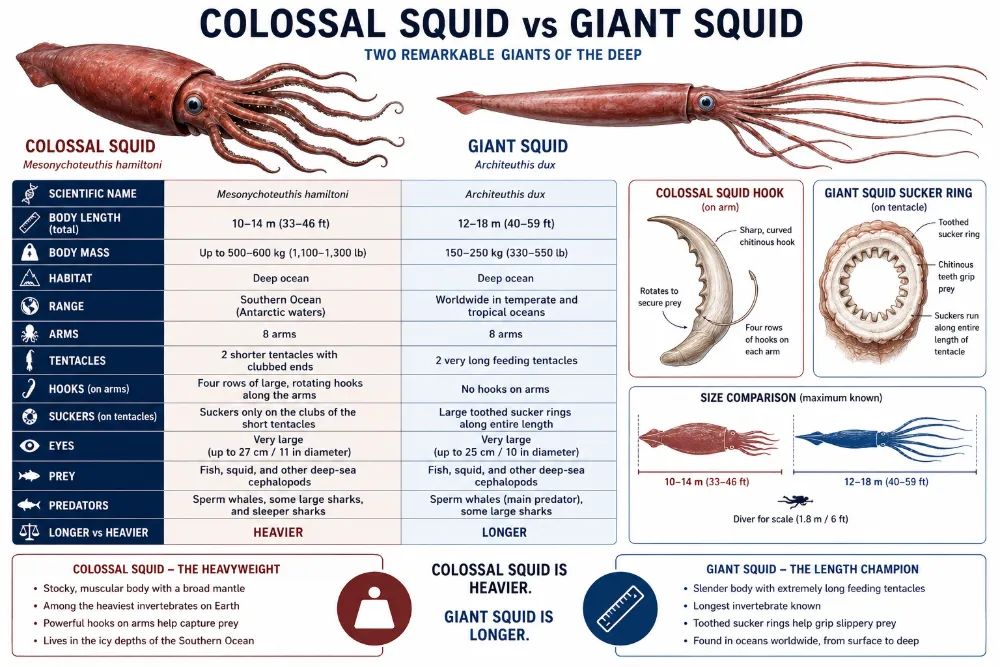
| Feature | Colossal Squid | Giant Squid |
|---|---|---|
| Scientific name | Mesonychoteuthis hamiltoni | Architeuthis dux |
| Animal group | Cephalopod, squid, family Cranchiidae | Cephalopod, squid, family Architeuthidae |
| Best known for | Being the heaviest known squid and one of the heaviest invertebrates | Extreme total length and legendary deep-sea reputation |
| Body shape | Shorter, broader, heavier, more muscular | Longer, slimmer, more streamlined |
| Typical size impression | Massive body with shorter but powerful arms and tentacles | Long body with extremely long feeding tentacles |
| Weight | Heavier; large specimens can weigh hundreds of kilograms | Lighter than colossal squid at similar total length |
| Arms and tentacles | Equipped with hooks as well as suckers | Mainly suckers with toothed sucker rings |
| Eyes | Extremely large, among the largest known animal eyes | Also extremely large, adapted to deep-sea darkness |
| Main habitat | Cold Southern Ocean around Antarctica | Deep oceans worldwide, in many temperate and subtropical regions |
| Main predator | Sperm whale, likely sleeper sharks and other deep-sea predators | Sperm whale and other large deep-diving predators |
| Which is bigger? | Heavier and bulkier | Usually longer overall |
What Is a Colossal Squid?
The colossal squid is a huge deep-sea squid with the scientific name Mesonychoteuthis hamiltoni. It lives mainly in the cold waters of the Southern Ocean around Antarctica. It is often described as the heaviest known squid and one of the most massive living invertebrates on Earth.
The colossal squid has a broad mantle, thick arms, powerful tentacles, large fins, a strong beak, and enormous eyes. Its body is not simply a longer version of a giant squid. It is built more like a heavyweight deep-sea predator, with a compact but extremely massive form.
One of its most important features is the presence of hooks on its arms and tentacles. These hooks help separate it from the giant squid and suggest a powerful prey-gripping strategy in the dark, cold depths of the Antarctic ocean.
What Is a Giant Squid?
The giant squid is the famous deep-sea squid known scientifically as Architeuthis dux. It is one of the longest known invertebrates, mainly because of its extremely long feeding tentacles. For centuries, dead giant squid washing ashore or being found in sperm whale stomachs helped inspire sea monster legends.
Giant squid have long, torpedo-shaped bodies, large eyes, eight arms, and two very long feeding tentacles. These tentacles allow them to strike prey from a distance. Their suckers have hard, tooth-like rings that help grip fish and other squid.
Unlike the colossal squid, the giant squid is not restricted to Antarctic waters. It has a much wider distribution in deep oceans around the world, although it is rarely seen alive because it lives far below the surface.
The Main Difference Between Colossal Squid and Giant Squid
The main difference is body design. The giant squid is usually longer, but the colossal squid is heavier and more robust. This means “bigger” depends on what you are measuring.
If you mean total length from body to tentacle tips, the giant squid is often considered longer. If you mean mass, body bulk, and muscular strength, the colossal squid is the larger animal.
A simple rule is: giant squid are built for length and reach; colossal squid are built for mass and power.
Which Is Bigger?
The giant squid can reach greater total length because its feeding tentacles are extremely long. These tentacles may make the animal look longer than the colossal squid when measured from the end of the mantle to the tips of the tentacles.
The colossal squid, however, has a heavier body. Its mantle is wider, its arms are thicker, and its overall build is more massive. Large colossal squid specimens can weigh far more than giant squid specimens of similar total length.
So the fairest answer is: the giant squid is usually longer, but the colossal squid is heavier.
Body Shape and Anatomy
The giant squid has a long, narrow body and extremely long tentacles. Its shape is streamlined, which may help it move through deep water and extend its feeding tentacles toward prey.
The colossal squid has a broader mantle and a more powerful body. Its arms and tentacles are shorter in proportion but thicker and more heavily armed. It looks more compact, muscular, and heavy-bodied than the giant squid.
Both animals have the basic squid body plan: a mantle, head, eight arms, two feeding tentacles, fins, eyes, a beak, and a siphon for jet propulsion. But their proportions are very different.
Arms, Tentacles, Hooks, and Suckers
Both species have eight arms and two longer feeding tentacles. This is a standard squid feature. The difference is in the weapons attached to those limbs.
The giant squid uses suckers lined with hard, toothed rings. These suckers help it seize prey and hold on in the darkness of the deep ocean. Scars from giant squid suckers are sometimes found on sperm whales, showing that these animals interact with each other in the deep sea.
The colossal squid has suckers too, but it is especially famous for its hooks. Some of these hooks can rotate, helping the squid grip struggling prey. This makes the colossal squid look more heavily armed than the giant squid.
Eyes: Why Both Squid Have Giant Eyes
Both colossal squid and giant squid have enormous eyes. In the deep ocean, sunlight is absent or extremely weak, so large eyes help detect faint light, movement, and possibly the bioluminescent signals of prey or predators.
Large eyes may also help these squid detect the movement of sperm whales. When a huge predator moves through deep water, it can disturb small glowing organisms, creating faint flashes or trails of light. Large eyes may help a squid notice these signals early enough to react.
The colossal squid is often credited with having some of the largest eyes known in the animal kingdom. Giant squid eyes are also enormous and among the most impressive visual organs in the deep sea.
Habitat and Range
The colossal squid is strongly associated with the Southern Ocean around Antarctica. It lives in cold, deep waters where few humans ever observe living animals directly. Much of what scientists know comes from specimens caught by fishing vessels or remains found in predator stomachs.
The giant squid has a broader range. It occurs in deep oceans around the world, including the Atlantic, Pacific, and Indian Oceans. It is usually associated with deep slopes, canyons, and open ocean depths where prey is available.
This geographic difference is important. If a huge squid is found in Antarctic waters, the colossal squid is a possibility. If a huge squid is found in many other deep ocean regions, it is more likely to be a giant squid.
Depth and Deep-Sea Life
Both species live in the deep sea, but exact depth preferences are difficult to define because observations are rare. Giant squid have been filmed alive in deep water, but they are still among the least commonly observed large animals on Earth.
Colossal squid are even more mysterious. For a long time, most knowledge came from dead or dying individuals, beaks in sperm whale stomachs, and specimens recovered from Antarctic fishing operations. Recent live footage of a juvenile colossal squid has helped confirm more about its natural appearance, but adults remain extremely difficult to study.
The deep sea makes research challenging because of pressure, darkness, cold temperatures, distance from shore, and the rarity of encounters.
Diet and Hunting Style
Giant squid likely feed on deep-sea fish and other squid. Their long feeding tentacles may allow them to grab prey from a distance. Their large eyes help them detect prey in dim light, and their suckers help hold struggling animals.
Colossal squid are thought to eat fish and other deep-sea animals, including Antarctic toothfish and other prey available in Southern Ocean depths. Their hooks suggest a strong gripping strategy, possibly useful for holding large, slippery prey.
Because both species are rarely observed hunting in the wild, scientists must infer much of their feeding behavior from anatomy, stomach contents, predator remains, and rare video evidence.
Predators: Do Sperm Whales Eat Them?
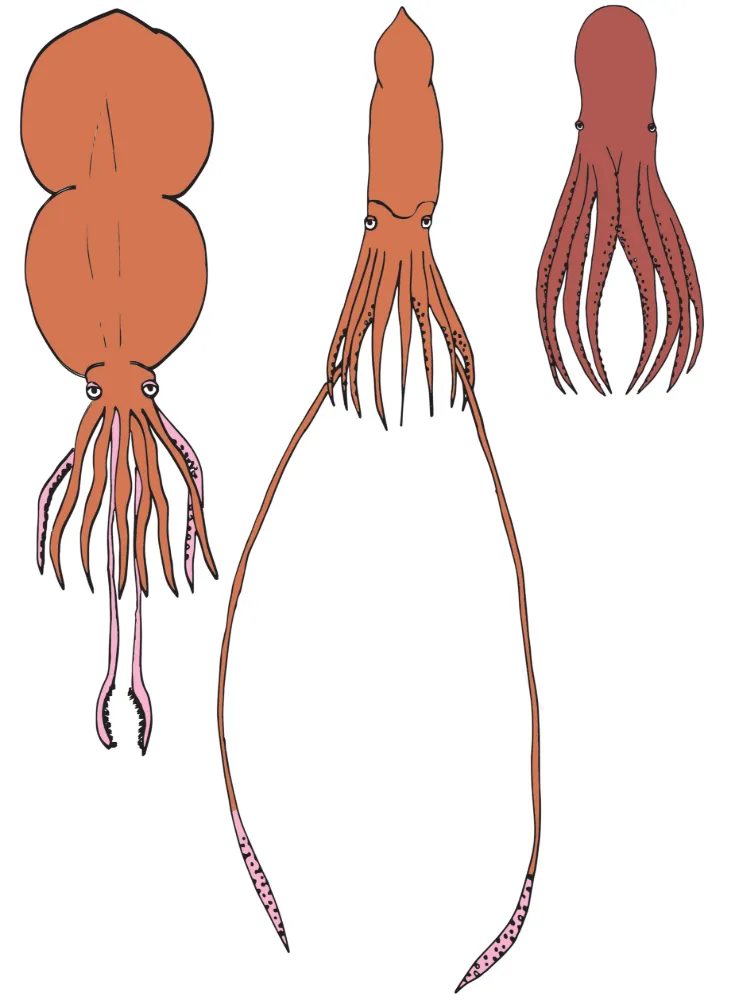
Yes. Sperm whales are major predators of both giant squid and colossal squid. Evidence comes from squid beaks found in sperm whale stomachs and sucker scars on whale skin.
This does not mean squid usually “fight and eat” sperm whales. The whale is the predator, and the squid is usually the prey. However, a large squid can resist capture with arms, tentacles, suckers, hooks, and a powerful body.
The deep-sea encounters between sperm whales and giant squid are among the most famous predator-prey relationships in the ocean. Colossal squid may be even more physically formidable because of their mass and hooks, but sperm whales remain the larger and more dominant predators.
Do Colossal Squid or Giant Squid Attack Humans?
There is no good evidence that either colossal squid or giant squid actively hunts humans. These animals live far below the surface, far outside normal human swimming or diving environments.
Most human contact with them occurs when dead specimens wash ashore, are caught by fishing vessels, or are studied in museums and laboratories. Their terrifying reputation comes more from size, mystery, and old sea monster legends than from real attacks on people.
They are powerful wild predators, but they are not shallow-water man-eaters.
Intelligence and Behavior
Squid are cephalopods, a group known for complex nervous systems and advanced behavior compared with many invertebrates. However, giant squid and colossal squid are much harder to study than shallow-water octopuses or cuttlefish.
We should be careful not to overstate what is known. These squid likely have sophisticated sensory systems and hunting behaviors, but direct observations are rare. Scientists still do not fully understand their social behavior, reproduction, migration, or daily activity patterns.
Their mystery is part of what makes them scientifically fascinating. They are not mythological monsters, but they are still among the least understood large animals alive today.
Reproduction and Life Cycle
Very little is known about the reproduction of both colossal squid and giant squid. Like other squid, they hatch from eggs and grow through juvenile stages into adults, but the details of mating, egg laying, growth rate, and lifespan remain uncertain.
Giant squid larvae and juveniles are rarely encountered. Colossal squid juveniles are also seldom seen, although recent deep-sea footage of a young colossal squid has added new information.
Many squid species grow quickly and live relatively short lives compared with large vertebrates. Whether these giant deep-sea squid follow the same general pattern is still an active area of research.
Conservation Status and Human Impact
Neither the giant squid nor the colossal squid is commonly seen, so population estimates are difficult. Their deep-sea habitat makes them hard to count. Scientists often rely on strandings, bycatch, sperm whale stomach contents, and rare observations.
Potential threats include deep-sea fishing, climate change, ocean warming, changes in prey distribution, pollution, and ecosystem shifts. However, because so little is known about their populations, it is difficult to measure the exact level of risk.
Protecting deep-sea ecosystems matters because animals like these are part of complex food webs that connect squid, fish, whales, sharks, and many smaller organisms.
Common Myths About Colossal Squid and Giant Squid
Myth: They are the same animal
This is false. The colossal squid and giant squid are different species from different squid families. They have different body shapes, ranges, and limb structures.
Myth: The giant squid is always the biggest squid
This depends on measurement. The giant squid is often longer, but the colossal squid is heavier and more massive.
Myth: Colossal squid eat sperm whales
This is false. Sperm whales eat squid. A colossal squid may resist capture, but it is not a predator of adult sperm whales.
Myth: Giant squid regularly attack ships
This is a sea monster legend. Giant squid live in deep water and do not normally interact with ships at the surface.
Myth: Scientists know almost everything about them now
This is false. Both species remain difficult to study, and many parts of their life history are still poorly understood.
Simple Identification Checklist
| Question | Likely Colossal Squid | Likely Giant Squid |
|---|---|---|
| Is it heavier and bulkier? | Yes | Usually no |
| Is it extremely long because of feeding tentacles? | Less so | Yes |
| Does it have hooks on arms and tentacles? | Yes | No, mainly toothed sucker rings |
| Where is it found? | Southern Ocean around Antarctica | Deep oceans worldwide |
| Body shape | Broad, heavy, muscular | Long, slender, streamlined |
| Best quick description | The heaviest squid | The longest famous squid |
Final Verdict: Colossal Squid vs Giant Squid
The colossal squid and giant squid are both extraordinary deep-sea cephalopods, but they are not the same animal. The giant squid is usually longer, with a slender body and extremely long feeding tentacles. The colossal squid is heavier, broader, more muscular, and armed with hooks on its arms and tentacles.
If you measure length, the giant squid often wins. If you measure weight, bulk, and power, the colossal squid is the true heavyweight. Both species remain mysterious because they live in deep, dark ocean habitats that humans rarely explore directly.
FAQs About Colossal Squid and Giant Squid
Is a colossal squid the same as a giant squid?
No. The colossal squid is Mesonychoteuthis hamiltoni, while the giant squid is Architeuthis dux. They are different species with different body shapes, ranges, and hunting structures.
Which is bigger, the colossal squid or the giant squid?
The giant squid is usually longer overall because of its very long tentacles. The colossal squid is heavier and bulkier, making it the larger squid by mass.
Which squid is heavier?
The colossal squid is heavier. It has a broader mantle, thicker arms, and a more massive body than the giant squid.
Which squid is longer?
The giant squid is usually longer when total length is measured from the body to the tips of the feeding tentacles.
Do colossal squid have hooks?
Yes. Colossal squid have hooks on their arms and tentacles, including rotating hooks that help grip prey.
Do giant squid have hooks?
Giant squid do not have the same heavy hooks as colossal squid. They use suckers with hard, tooth-like rings to hold prey.
Where do colossal squid live?
Colossal squid live mainly in the cold Southern Ocean around Antarctica.
Where do giant squid live?
Giant squid live in deep oceans around the world, including parts of the Atlantic, Pacific, and Indian Oceans.
Do sperm whales eat giant squid?
Yes. Sperm whales are major predators of giant squid. Squid beaks found in whale stomachs provide strong evidence of this relationship.
Do sperm whales eat colossal squid?
Yes. Sperm whales also eat colossal squid, especially in Southern Ocean ecosystems.
Can a colossal squid kill a sperm whale?
There is no good evidence that colossal squid kill adult sperm whales. They may resist with hooks and arms, but sperm whales are the predators in this relationship.
Are giant squid dangerous to humans?
Giant squid are not known to hunt humans. They live in deep water and are rarely encountered alive.
Are colossal squid dangerous to humans?
Colossal squid are powerful predators, but they live in deep Antarctic waters and are not a normal danger to people.
Why are these squid so hard to study?
They live in deep, dark, high-pressure ocean environments and are rarely encountered alive. Most scientific information comes from specimens, predator stomach contents, rare videos, and occasional bycatch.