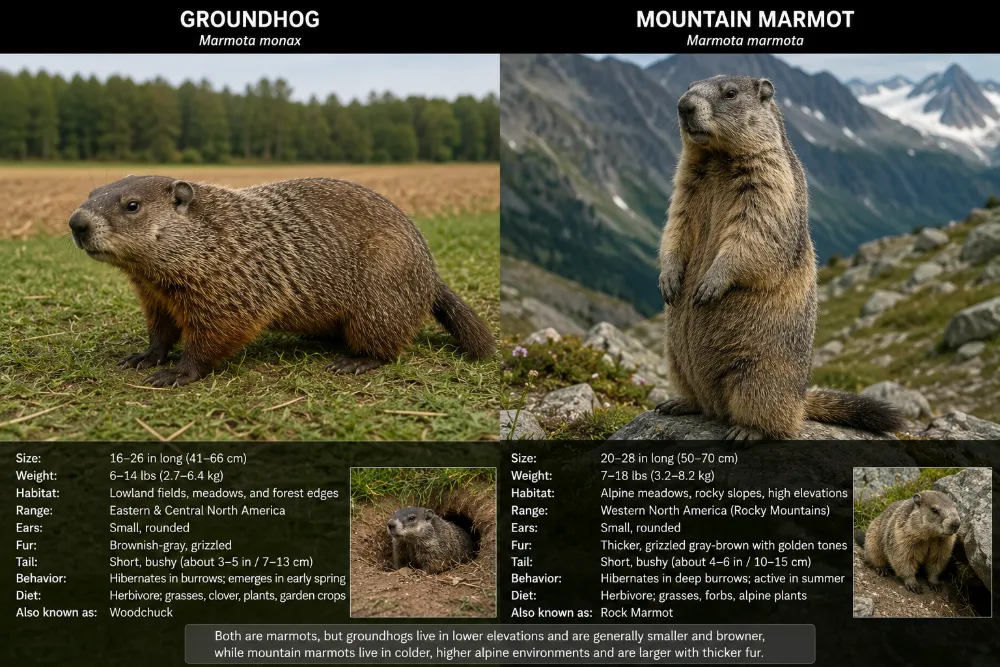
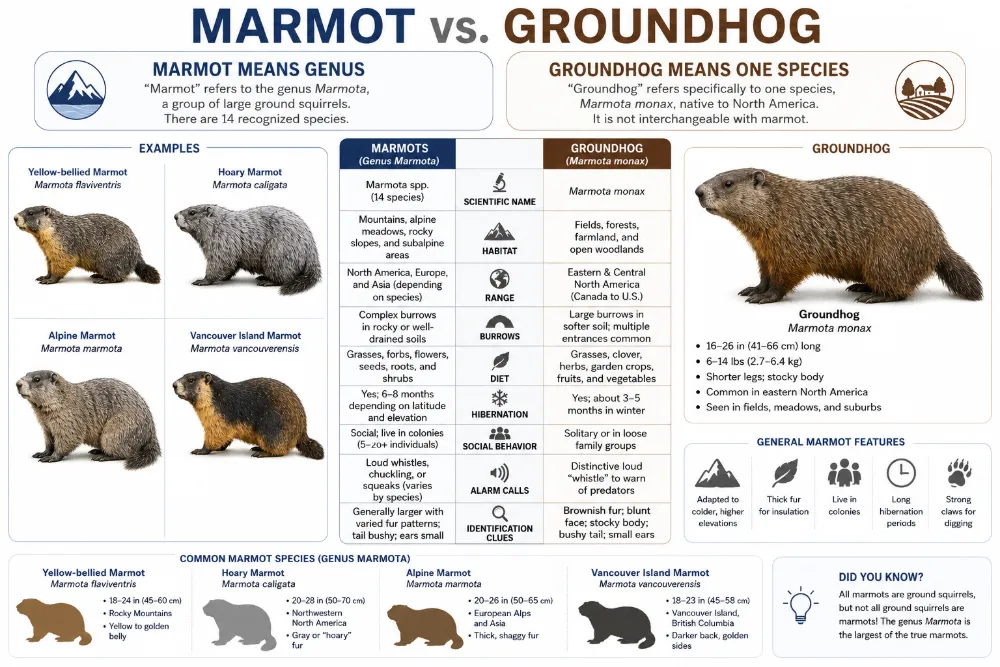
A groundhog is a type of marmot, but not all marmots are groundhogs. “Marmot” refers to a group of large ground squirrels in the genus Marmota. The groundhog, also called the woodchuck, is one species: Marmota monax. Groundhogs usually live in lowlands, fields, forest edges, and suburban areas, while many other marmots live in alpine meadows, rocky mountains, and colder high-elevation habitats.
Quick Comparison Table
| Feature | Marmot | Groundhog |
|---|---|---|
| Meaning | A group of large ground squirrels in the genus Marmota | One marmot species, Marmota monax |
| Other common names | Depends on species: alpine marmot, yellow-bellied marmot, hoary marmot, etc. | Woodchuck, whistle-pig, land beaver |
| Scientific group | Genus Marmota, family Sciuridae | Marmota monax, family Sciuridae |
| Relationship | Broader category | A specific type of marmot |
| Typical habitat | Often alpine meadows, rocky slopes, tundra, grasslands, mountain regions | Fields, meadows, forest edges, farms, roadsides, suburban yards |
| Native range | North America, Europe, and Asia, depending on species | Eastern and central North America, extending into parts of Canada and Alaska |
| Social behavior | Many species are social and live in colonies | Usually more solitary than many alpine marmots |
| Burrows | Often complex burrow systems in open or rocky habitats | Deep burrows in soil near fields, gardens, sheds, banks, and edges |
| Hibernation | Most species hibernate deeply | Deep hibernator, famous for spring emergence |
| Best identification clue | Large ground squirrel, often in mountain or open-country habitat | Brown, chunky marmot in lowland fields or suburban edges |
What Is a Marmot?
A marmot is a large ground-dwelling squirrel in the genus Marmota. Marmots belong to the squirrel family, Sciuridae, which means they are related to tree squirrels, ground squirrels, chipmunks, prairie dogs, and flying squirrels. Unlike tree squirrels, marmots are heavy-bodied burrowing animals that spend much of their lives on or below the ground.
There are several marmot species across North America, Europe, and Asia. Examples include the yellow-bellied marmot, hoary marmot, alpine marmot, Himalayan marmot, bobak marmot, and groundhog. Many marmots live in cold, open, high-elevation places such as alpine meadows, rocky slopes, and mountain grasslands.
Marmots are well known for their burrows, loud alarm calls, herbivorous diet, and long hibernation. In many mountain ecosystems, they are important prey for eagles, foxes, coyotes, wolves, bears, and other predators.
What Is a Groundhog?
A groundhog is one specific marmot species with the scientific name Marmota monax. It is also called a woodchuck, whistle-pig, or land beaver. The groundhog is native to North America and is especially common in fields, meadows, farmland, woodland edges, roadsides, parks, and suburban yards.
Groundhogs are chunky, brownish-gray rodents with short ears, strong claws, a short bushy tail, and powerful digging ability. They are built for burrowing rather than climbing. Their bodies are compact and muscular, and their legs are strong enough to move soil while excavating tunnels.
Unlike many alpine marmots, groundhogs are often seen near human-modified landscapes. They may dig under sheds, decks, barns, fences, gardens, and field edges. This makes them one of the marmot species most familiar to people.
The Main Difference Between Marmot and Groundhog
The main difference is that “marmot” is the broader group, while “groundhog” is one species within that group. In other words, every groundhog is a marmot, but not every marmot is a groundhog.
This is similar to saying that every robin is a bird, but not every bird is a robin. “Marmot” describes the genus. “Groundhog” describes one member of that genus.
For quick identification, habitat is often helpful. If the animal is a chunky brown marmot in a lowland field or suburban yard in eastern North America, it is probably a groundhog. If it is in a high mountain meadow, rocky slope, or alpine area, it may be another marmot species.
Taxonomy and Scientific Classification
Groundhogs and other marmots are rodents. More specifically, they are large ground squirrels. Their classification places them in the family Sciuridae and the genus Marmota.
| Classification Level | Marmots | Groundhog |
|---|---|---|
| Kingdom | Animalia | Animalia |
| Class | Mammalia | Mammalia |
| Order | Rodentia | Rodentia |
| Family | Sciuridae | Sciuridae |
| Genus | Marmota | Marmota |
| Species | Several species | Marmota monax |
This classification explains why the terms are often confused. A groundhog is not “similar to a marmot” in a loose sense. It is biologically a marmot.
Habitat Differences
Many marmots are mountain animals. Species such as the yellow-bellied marmot, hoary marmot, alpine marmot, and Himalayan marmot often live in open, rocky, high-elevation habitats. These places provide open sightlines for spotting predators, rocks for shelter, and vegetation for grazing.
Groundhogs are more strongly associated with lower elevations and softer soils. They prefer fields, pastures, meadows, woodland borders, roadsides, orchards, and suburban edges. They need soil deep enough for burrowing and vegetation close enough for feeding.
This difference is one of the easiest ways to separate a groundhog from many other marmots. A marmot sunning itself on a boulder in a high mountain meadow is probably not a groundhog. A marmot eating clover beside a barn or garden in eastern North America probably is.
Range and Distribution
Marmots as a group have a wide distribution across the Northern Hemisphere. Different species live in North America, Europe, and Asia. Some are adapted to alpine regions, some to steppe grasslands, and some to tundra-like environments.
The groundhog is native to North America. It is especially widespread in the eastern and central United States and much of Canada. It also occurs in parts of Alaska and northern regions where suitable habitat exists.
Because groundhogs tolerate human-altered landscapes, they are often seen more frequently by people than many mountain marmots. A person may never encounter an alpine marmot in the wild, but may see a groundhog regularly along roadsides, lawns, farms, and parks.
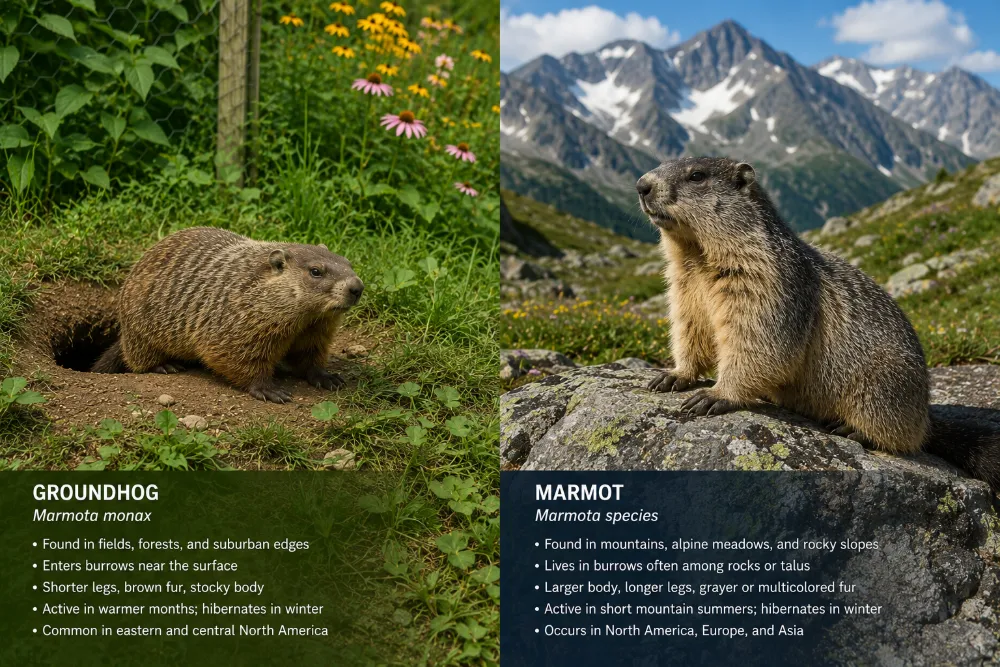
Size and Appearance
Marmots are generally large, heavy-bodied ground squirrels. Most have short legs, small rounded ears, dense fur, strong claws, and a relatively short tail compared with tree squirrels. Their bodies are built for digging, grazing, and storing fat before hibernation.
Groundhogs are medium to large marmots. They usually have grizzled brown, gray-brown, or reddish-brown fur, a blunt face, small ears, and a short bushy tail. Their legs are short, but their claws are strong and well suited for digging.
Other marmots can look different depending on species. A hoary marmot may appear more silver-gray and mountain-adapted. A yellow-bellied marmot often has a yellowish or rusty underside. An alpine marmot may look stocky and brown-gray with a thick coat suited to cold mountain climates.
Social Behavior
Many marmot species are social. Alpine marmots and some North American mountain marmots may live in colonies or family groups. Social living helps with predator detection because individuals can give alarm calls when danger appears.
Groundhogs are usually more solitary. Adults often maintain their own burrow systems and may tolerate other groundhogs only in certain seasons or under favorable conditions. During the breeding season, males may move between female territories, but groundhogs do not usually form large colonies like some other marmots.
This is an important behavioral difference. If you see several marmots living close together in a mountain meadow, they may be a more social marmot species. If you see one animal alone near a field burrow, it may be a groundhog.
Burrows and Digging
Both marmots and groundhogs are excellent diggers. Their burrows provide protection from predators, shelter from weather, places to raise young, and safe chambers for hibernation.
Groundhog burrows can be extensive. A burrow may have multiple entrances, sleeping chambers, escape tunnels, and separate areas for waste. Groundhogs often dig burrows under field edges, banks, sheds, decks, stone walls, and brushy borders. Their digging can move large amounts of soil.
Other marmots also dig complex burrows, but the structure depends on habitat. Alpine marmots may build burrows in mountain meadows or near rocks. Hoary marmots may use rocky talus areas and burrows near boulders. In all cases, burrows are central to marmot survival.
Diet and Feeding Habits
Marmots are mostly herbivores. They eat grasses, leaves, flowers, stems, seeds, roots, and other plant material. Some may occasionally eat insects or other small food items, but plants form the main diet.
Groundhogs feed on grasses, clover, dandelions, alfalfa, garden vegetables, fruits, leaves, and agricultural crops. This is why they are sometimes considered pests by gardeners and farmers. A hungry groundhog can damage beans, peas, lettuce, carrots, squash, and other garden plants.
Because marmots hibernate, feeding during the active season is extremely important. They must build enough fat reserves to survive months underground without eating.
Hibernation
Hibernation is one of the most important similarities between groundhogs and other marmots. Most marmots are deep hibernators. During hibernation, their body temperature drops, metabolism slows, breathing becomes much slower, and heart rate decreases dramatically.
Groundhogs are famous for hibernation because of Groundhog Day, but the biological reality is more impressive than the folklore. They spend winter underground in a hibernation chamber and emerge when seasonal conditions begin to change.
Mountain marmots also rely heavily on hibernation. In cold alpine environments, the active season can be short. Marmots must feed, breed, raise young, and store fat within a limited warm period before returning to their burrows for winter.
Alarm Calls and Communication
Marmots are famous for loud alarm calls. Many species whistle, chirp, scream, or bark when they detect predators. These calls warn other marmots and may also signal that the predator has been seen.
The groundhog is sometimes called a “whistle-pig” because it can produce a sharp whistle-like alarm call. When threatened, a groundhog may run to its burrow, stand upright to watch danger, chatter its teeth, or give warning calls.
Social marmots often rely heavily on alarm communication because group members benefit from shared vigilance. Solitary groundhogs also use alarm calls, but their social system is generally less colony-based than many alpine marmots.
Predators and Defense
Marmots and groundhogs are prey animals. Their predators include foxes, coyotes, wolves, bobcats, lynx, eagles, hawks, bears, badgers, snakes, and domestic dogs, depending on region and habitat.
Their main defense is early detection and rapid retreat into burrows. Open habitats help them see predators, while burrows provide immediate safety. Many marmots sit upright on their hind legs to scan the surroundings.
Groundhogs can defend themselves with sharp incisors and claws if cornered, but they usually prefer escape. Their burrow entrances are often close to feeding areas so they can disappear quickly when threatened.
Reproduction and Young
Marmots generally reproduce after emerging from hibernation. Mating often occurs in spring, and young are born in burrows. Litter size varies by species, habitat, food availability, and maternal condition.
Groundhogs usually mate in late winter or early spring after hibernation. Females give birth in underground nesting chambers. The young are born blind and helpless, then remain in the burrow until they are old enough to emerge and begin feeding above ground.
In social marmot species, family structure may be more complex, with young remaining near adults longer. Groundhog young usually disperse as they mature and begin establishing their own burrows.
Groundhog Day and Animal Biology
Groundhog Day has made the groundhog culturally famous in North America. According to folklore, if a groundhog sees its shadow on February 2, winter will continue; if not, spring will come early.
From a zoological point of view, groundhog emergence is not a magical weather forecast. It is tied to seasonal rhythms, temperature, daylight, fat reserves, reproductive timing, and local conditions. Males may emerge earlier than females as the breeding season approaches.
Groundhog Day is culturally interesting, but real groundhog biology is about hibernation, energy conservation, reproduction, and seasonal survival.
Are Groundhogs Dangerous?
Groundhogs are not usually dangerous to people. They are shy animals that prefer to flee into burrows when disturbed. However, like any wild mammal, they may bite if trapped, handled, cornered, or threatened.
The bigger concern is usually property damage. Groundhog burrows can undermine garden beds, shed foundations, fence lines, and sometimes farm equipment areas. They can also damage crops and ornamental plants.
People should not handle wild groundhogs. If a groundhog behaves strangely, appears sick, or enters a risky area, local wildlife professionals or animal control authorities should be contacted.
Are Marmots Dangerous?
Most marmots are not dangerous if left alone. They are wild rodents with strong teeth and claws, but they generally avoid humans. In parks and mountain areas, marmots may become bold if people feed them, which is unhealthy for both animals and visitors.
Feeding marmots can change their behavior, increase disease risk, attract predators, and make them dependent on human food. Human snacks are not appropriate for marmots and can harm their digestive systems.
The safest approach is to observe marmots from a distance, never feed them, and avoid blocking their path to burrows.
Ecological Role
Marmots and groundhogs play important ecological roles. Their burrows aerate soil, move nutrients, create shelter for other animals, and influence plant communities. Old burrows may be used by rabbits, skunks, foxes, snakes, insects, and other small animals.
As herbivores, marmots shape vegetation through grazing. As prey, they support predators in both lowland and mountain ecosystems. Their seasonal hibernation also makes them important examples of mammalian energy conservation.
Although groundhogs can frustrate gardeners, they are not simply pests. They are native wildlife with a natural role in the landscape.
Common Myths About Marmots and Groundhogs
Myth: A groundhog is not a marmot
This is false. A groundhog is a marmot. It is one species in the genus Marmota.
Myth: Marmots only live in mountains
This is partly false. Many marmots are mountain animals, but the groundhog is a lowland marmot that often lives in fields, farms, and suburban edges.
Myth: Groundhogs eat wood
This is false. The name woodchuck does not mean the animal eats or throws wood. Groundhogs mainly eat plants such as grasses, clover, leaves, and garden crops.
Myth: Groundhogs predict the weather
This is folklore, not biology. Groundhog emergence is related to seasonal behavior and hibernation, not supernatural weather forecasting.
Myth: Marmots are just big prairie dogs
This is false. Marmots and prairie dogs are both ground squirrels, but they belong to different genera and have different body shapes, habitats, and social systems.
Simple Identification Checklist
| Question | Likely Groundhog | Likely Other Marmot |
|---|---|---|
| Where is it found? | Lowland field, farm, yard, roadside, forest edge | Mountain meadow, rocky slope, alpine or tundra-like habitat |
| Region? | Eastern or central North America, parts of Canada and Alaska | Western North America, Europe, Asia, or alpine regions depending on species |
| Social behavior? | Often solitary | Many species more social or colony-living |
| Body color? | Usually grizzled brown or gray-brown | Varies: yellow-bellied, hoary, alpine brown-gray, and others |
| Burrow location? | Soil banks, gardens, sheds, field edges | Open meadows, rocky areas, mountain slopes |
| Best quick rule | A lowland North American marmot | A marmot species other than groundhog |
Final Verdict: Marmot vs Groundhog
The difference between a marmot and a groundhog is mostly a matter of category. Marmots are a group of large ground squirrels in the genus Marmota. The groundhog is one species within that group, known scientifically as Marmota monax.
Groundhogs are lowland marmots that often live near fields, farms, forest edges, and suburban yards. Many other marmots are mountain or open-country animals that live in alpine meadows, rocky slopes, tundra, or steppe habitats. The fastest rule is simple: all groundhogs are marmots, but not all marmots are groundhogs.
FAQs About Marmots and Groundhogs
Is a groundhog a marmot?
Yes. A groundhog is a marmot. It is one species in the genus Marmota, with the scientific name Marmota monax.
Are marmots and groundhogs the same animal?
Not exactly. A groundhog is one type of marmot, but “marmot” also includes many other species, such as yellow-bellied marmots, alpine marmots, and hoary marmots.
What is another name for a groundhog?
A groundhog is also called a woodchuck, whistle-pig, or land beaver. These names all refer to the same species, Marmota monax.
Why is a groundhog called a woodchuck?
The name woodchuck does not mean the animal throws or eats wood. It likely comes from an older Indigenous-language-based name that was later changed in English pronunciation.
Do marmots and groundhogs hibernate?
Yes. Groundhogs and most other marmots are deep hibernators. They spend the cold season underground and survive using stored body fat.
Where do groundhogs live?
Groundhogs live in North America, especially in fields, meadows, woodland edges, farms, roadsides, parks, and suburban areas with diggable soil.
Where do other marmots live?
Many other marmots live in mountain meadows, rocky slopes, alpine habitats, tundra-like regions, or open grasslands across North America, Europe, and Asia.
Are groundhogs social animals?
Groundhogs are usually more solitary than many other marmot species. They often live alone in their own burrow systems except during breeding and early family life.
What do marmots eat?
Marmots mainly eat plants, including grasses, leaves, flowers, stems, seeds, roots, and other vegetation. Groundhogs may also eat garden crops and agricultural plants.
Are groundhogs dangerous to humans?
Groundhogs are usually not dangerous and prefer to escape. However, they can bite if cornered or handled. They should be observed from a distance and not treated as pets.
Are marmots rodents?
Yes. Marmots are rodents. They belong to the squirrel family, which also includes tree squirrels, ground squirrels, chipmunks, and prairie dogs.
How can I tell a marmot from a prairie dog?
Marmots are generally larger, heavier, and more hibernation-focused. Prairie dogs are smaller, more slender, and highly social ground squirrels that live in large colonies called towns.