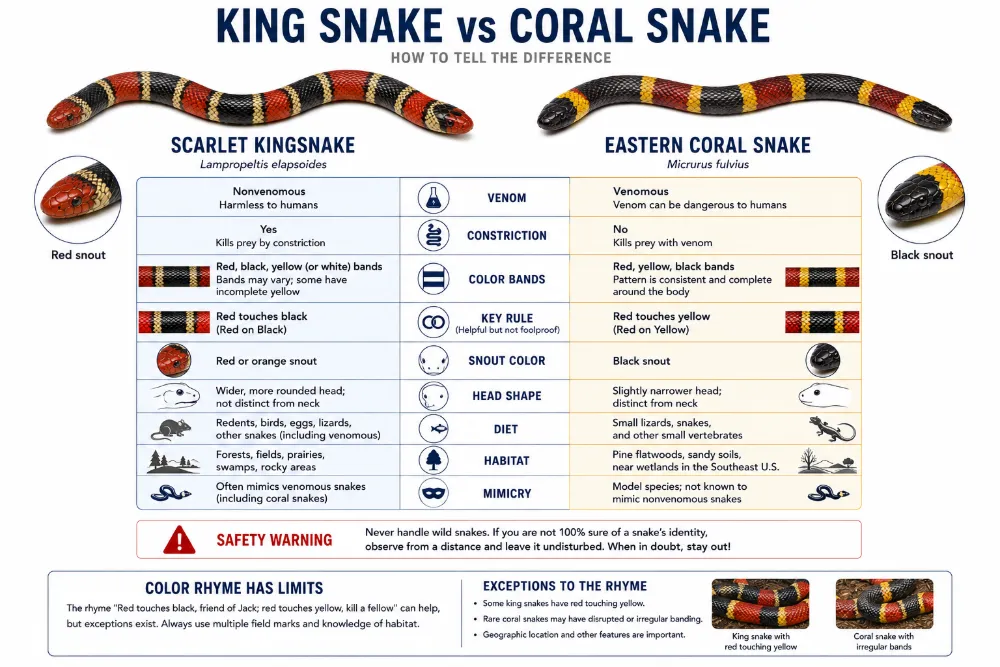
King snakes and coral snakes can look similar, but they are very different animals. King snakes are nonvenomous constrictors, while coral snakes are venomous elapids with medically significant neurotoxic venom. In much of the United States, coral snakes often have red bands touching yellow bands, while scarlet kingsnakes have red bands touching black bands. However, color rhymes are not universal, so never handle a snake unless you are completely sure.
Quick Comparison Table
| Feature | King Snake | Coral Snake |
|---|---|---|
| Common meaning | Nonvenomous snakes in the genus Lampropeltis | Venomous elapid snakes in several genera, including Micrurus in the Americas |
| Venom | Nonvenomous | Venomous |
| Hunting method | Constriction | Venom delivered through small fixed fangs |
| Typical U.S. look-alike | Scarlet kingsnake | Eastern/harlequin coral snake or Texas coral snake |
| Band pattern in many U.S. examples | Red touches black; yellow or white bands separate black bands | Red touches yellow; black snout often visible in eastern coral snakes |
| Body shape | Usually smooth, shiny, and moderately slender | Usually slender with smooth scales and a small, rounded head |
| Head appearance | Often more visible neck transition, depending on species | Head often not much wider than neck |
| Diet | Rodents, lizards, birds, eggs, and other snakes | Small snakes, lizards, frogs, and other small animals |
| Defense | May vibrate tail, musk, bite, or mimic venomous snakes | May hide head, curl tail, flee, or bite if handled |
| Human safety | Generally harmless if left alone | Never handle; seek emergency care after a suspected bite |
| Best rule | Helpful animals that control rodents and other snakes | Beautiful but venomous snakes that should be observed only from a distance |
What Is a King Snake?
A king snake is a nonvenomous snake in the genus Lampropeltis. King snakes are found mainly in North America and are famous for their smooth, glossy scales, strong constriction, and ability to eat other snakes. Their name “king snake” refers partly to this snake-eating behavior, because they can prey on other snake species, including some venomous snakes.
King snakes are not one single species. The group includes California kingsnakes, eastern kingsnakes, speckled kingsnakes, desert kingsnakes, black kingsnakes, and scarlet kingsnakes. Some are black and white, some are speckled, some are banded, and some closely resemble coral snakes.
The king snake most often compared with coral snakes is the scarlet kingsnake, Lampropeltis elapsoides. It has red, black, and yellow or white bands, which can make it look dangerously similar to a coral snake at first glance.
What Is a Coral Snake?
A coral snake is a venomous elapid snake. Elapids are the same broad venomous snake family that includes cobras, mambas, kraits, and sea snakes. In the United States, coral snakes include species such as the eastern or harlequin coral snake, the Texas coral snake, and the Arizona coral snake.
Coral snakes are usually slender, secretive, and brightly colored. Many have red, yellow, and black banding, although patterns vary by species and region. Their venom is primarily neurotoxic, meaning it can affect the nervous system. A serious bite can interfere with muscle control and breathing if not treated properly.
Coral snakes are not aggressive animals. They usually avoid people and spend much of their time hidden under leaf litter, logs, soil, or ground cover. Most risk occurs when people try to pick them up, kill them, or handle them.
The Main Difference Between King Snakes and Coral Snakes
The main difference is venom. King snakes are nonvenomous constrictors. Coral snakes are venomous elapids. A king snake kills prey by wrapping around it and squeezing. A coral snake uses venom to subdue small prey.
Another major difference is ecological role. King snakes often eat rodents, lizards, eggs, birds, and other snakes. Coral snakes specialize more on small snakes, lizards, and other small vertebrates.
For people, the safety difference is critical. A king snake bite may hurt but is not venomous. A coral snake bite can be a medical emergency. If there is any doubt, do not touch the snake.
Color Bands: The Famous Red, Yellow, and Black Pattern
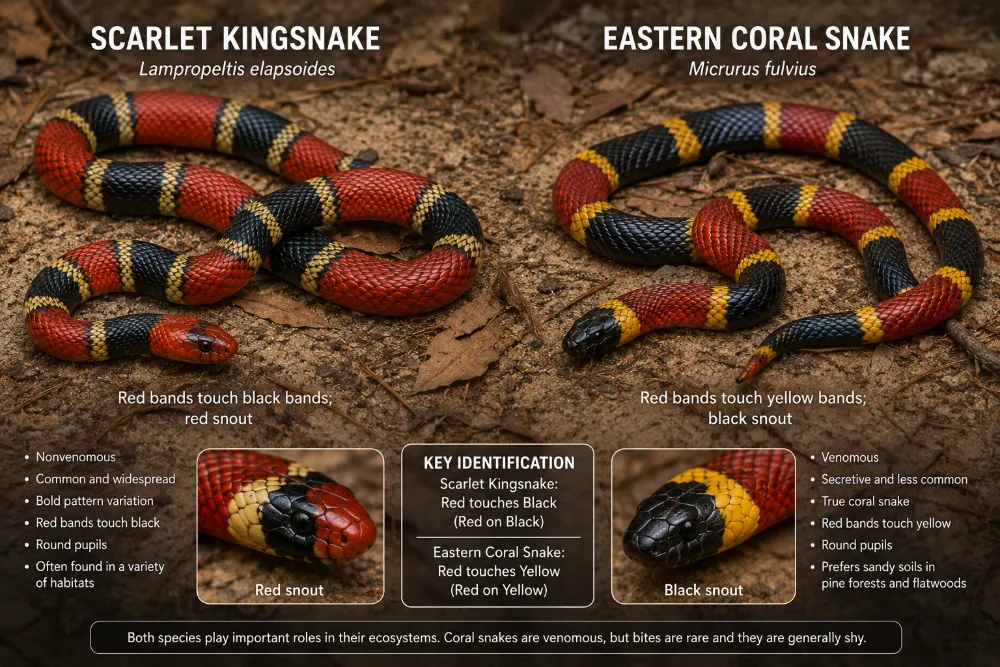
In much of the southeastern and south-central United States, people use the color pattern to help separate scarlet kingsnakes from coral snakes. Scarlet kingsnakes usually have red bands touching black bands. Coral snakes often have red bands touching yellow bands.
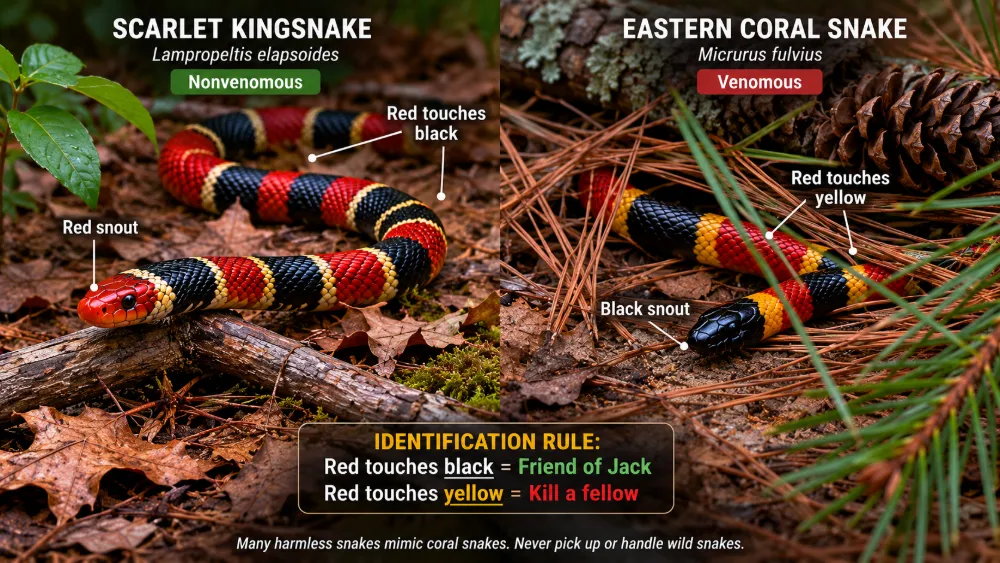
This is the source of the old rhyme: “Red touch yellow, kill a fellow; red touch black, friend of Jack.” The rhyme can be useful for some native U.S. species, especially when comparing eastern coral snakes and scarlet kingsnakes.
However, the rhyme is not a universal snake-identification tool. It may fail outside the United States, with unusual color forms, faded individuals, escaped exotic snakes, or species that do not follow the same pattern. A safer rule is: if you are not completely sure, leave the snake alone.
Why the Rhyme Can Be Dangerous
The color rhyme is popular because it is simple, but nature is not always simple. Not all coral snakes around the world follow the same red-yellow-black pattern. Some coral snakes have different banding, reduced bands, darker coloration, or unusual regional variation.
Also, not all king snakes look like coral snakes. Many king snakes are black, brown, white, speckled, striped, or banded in ways that have nothing to do with the coral snake pattern.
For an animal website, the best advice is to present the rhyme as a limited clue, not as a guarantee. It can help with certain U.S. look-alikes, but it should never encourage people to handle snakes.
Scarlet Kingsnake vs Eastern Coral Snake
The scarlet kingsnake and eastern coral snake are the classic look-alike pair. Both may have red, black, and yellow or white rings. Both are relatively slender. Both may occur in parts of the southeastern United States.
The scarlet kingsnake is nonvenomous. Its red and yellow bands are usually separated by black bands, so red touches black. The snout is often red, and the body is smooth and shiny.
The eastern coral snake is venomous. Its red bands usually touch yellow bands, and the snout is commonly black. Its head is small and rounded, and the neck is not strongly distinct from the body. Because both snakes can be secretive and quick to hide, identification should be made from a safe distance only.
Body Shape and Head Shape
Many venomous pit vipers have broad triangular heads, but coral snakes do not follow that familiar rule. Coral snakes often have small, rounded heads that are not much wider than the neck. This is one reason head shape is not a reliable way to rule out danger.
King snakes also have relatively smooth, rounded heads, although the head may be slightly more distinct depending on the species. They have smooth shiny scales and a muscular body suited for constriction.
Because both can have narrow heads and smooth bodies, color pattern, range, and expert identification are more useful than head shape alone.
Venom vs Constriction
King snakes are constrictors. When they capture prey, they coil around it and use muscular pressure to stop the prey from breathing effectively. They then swallow it whole. King snakes are especially famous for eating other snakes and for having some resistance to the venom of certain pit vipers.
Coral snakes are venomous. They have fixed fangs and use venom to subdue prey. Unlike rattlesnakes or vipers, coral snakes do not have long folding fangs. Their fangs are relatively small, but their venom can still be medically serious.
This difference explains why handling a coral snake is risky even if the snake looks small or calm. A small venomous snake can still deliver a dangerous bite.
Diet and Hunting Behavior
King snakes are active predators with a broad diet. They may eat mice, rats, lizards, birds, eggs, frogs, and other snakes. Their ability to prey on rodents and venomous snakes makes them valuable members of many ecosystems.
Coral snakes often eat other small snakes, including blind snakes and other burrowing species. They may also eat lizards, frogs, and small amphibians. Their slender bodies help them move through leaf litter, loose soil, and hidden spaces where small prey animals live.
Both snakes are predators, but they use very different tools: king snakes rely on strength and constriction, while coral snakes rely on venom.
Habitat and Range
King snakes live in a wide variety of habitats, depending on species. They can be found in forests, fields, deserts, grasslands, wetlands, scrublands, farms, and suburban edges. Some are highly adaptable and may live near human structures if food and shelter are available.
Coral snakes are usually more secretive and habitat-specific. In the United States, they may live in pine forests, hardwood hammocks, sandy soils, brushy areas, leaf litter, and dry or moist woodland habitats depending on species. They often stay hidden underground or under cover.
Range matters for identification. A red, yellow, and black snake outside the range of native coral snakes may be a different species entirely, including a nonvenomous snake or an escaped exotic pet.
Behavior Around Humans
King snakes are generally harmless to humans. If threatened, they may vibrate the tail, release musk, coil defensively, or bite. A bite from a king snake can be startling and may break the skin, but it is not venomous.
Coral snakes are also not aggressive, but they are dangerous to handle. They usually try to escape or hide rather than bite. However, if grabbed, stepped on, or restrained, they may bite defensively.
The safest behavior around both snakes is the same: observe from a distance, do not pick them up, and let them move away. Most snakebite accidents happen when people try to handle or kill snakes.
Mimicry: Why King Snakes Look Like Coral Snakes
Scarlet kingsnakes are often described as coral snake mimics. Their bright red, black, and yellow or white bands may help protect them from predators that avoid venomous coral snakes.
This is an example of mimicry, where a harmless or less dangerous species resembles a more dangerous one. Predators that have learned to avoid coral snake colors may also avoid similarly colored kingsnakes.
However, mimicry is not perfect. The band order, head color, body shape, and local species all matter. The resemblance is close enough to confuse predators—and people.
Are King Snakes Immune to Coral Snake Venom?
King snakes are known for resistance to the venom of some snakes, especially certain pit vipers. This helps them prey on snakes that would be dangerous to many other predators.
However, resistance is not the same as complete immunity to every venom from every venomous snake. Coral snake venom is different from rattlesnake or copperhead venom, and the details can vary among species.
It is best to say that king snakes have impressive resistance to some snake venoms, but they should not be described as magically immune to all venom.
Do Coral Snakes Bite or Chew?
Older descriptions sometimes say coral snakes must “chew” to deliver venom. This can be misleading. Coral snakes have small fixed fangs, and their bite mechanics differ from vipers, but they do not need a long dramatic chewing session to be dangerous.
A coral snake bite may initially cause little pain or swelling compared with some viper bites, but serious symptoms can develop later. This delayed danger is one reason every suspected coral snake bite should be treated as urgent.
Never assume a bite is harmless because it does not hurt much at first.
What to Do If You See One
If you see a king snake or coral snake, leave it alone. Most snakes do not want contact with people and will move away if given space. Do not try to pick it up, trap it, kill it, or pose for photos with it.
If the snake is outdoors and not inside a living space, the best option is often to let it pass. If it is inside a home, school, workplace, or other risky area, contact local wildlife control, animal control, or a trained snake removal professional.
Keep pets and children away until the snake has left or a professional has handled the situation.
What to Do After a Possible Coral Snake Bite
A suspected coral snake bite is a medical emergency. Call emergency services or go to an emergency department immediately. Do not wait for symptoms to appear.
Move away from the snake. Stay calm and still. Remove rings, watches, or tight clothing near the bite area before swelling begins. If possible, take a photo of the snake from a safe distance, but do not try to catch or kill it.
Do not cut the wound, suck out venom, apply ice, use alcohol, use electric shock, or apply a tourniquet. These old methods can make injuries worse. Emergency medical care and antivenom, when indicated, are the proper treatment.
Ecological Importance
King snakes help ecosystems by controlling rodents, lizards, and other snakes. Because they may eat venomous snakes, people sometimes appreciate them as natural snake-control animals. However, they should still be left wild and not relocated without proper knowledge.
Coral snakes also play an important ecological role. They control populations of small snakes, lizards, and amphibians. Their presence is part of a healthy native ecosystem, even though they are venomous.
Both snakes deserve respect. One is harmless to people; the other is dangerous if handled. Neither should be killed out of fear.
Common Myths About King Snakes and Coral Snakes
Myth: All red, yellow, and black snakes are coral snakes
This is false. Several nonvenomous snakes, including scarlet kingsnakes and scarlet snakes, may have similar colors.
Myth: The color rhyme works everywhere
This is false. The rhyme may help with some U.S. species, but it does not work worldwide and can fail with unusual color patterns.
Myth: Coral snakes are aggressive
This is false. Coral snakes are usually secretive and avoid people. Bites are most likely when someone handles or restrains the snake.
Myth: King snakes are dangerous because they look like coral snakes
This is false. King snakes are nonvenomous. Their resemblance to coral snakes is a form of protective mimicry.
Myth: A coral snake bite is safe if there is no immediate pain
This is dangerous and false. Coral snake bites may not cause dramatic early pain, but serious symptoms can develop later. Seek emergency care immediately.
Simple Identification Checklist
| Question | Likely King Snake | Likely Coral Snake |
|---|---|---|
| Is it venomous? | No | Yes |
| Common U.S. band clue | Red often touches black in scarlet kingsnakes | Red often touches yellow in U.S. coral snakes |
| Snout color in eastern U.S. look-alikes | Often red in scarlet kingsnakes | Often black in eastern coral snakes |
| Hunting method | Constriction | Venom |
| Temperament | Defensive if handled, but nonvenomous | Secretive, but medically dangerous if it bites |
| Safe action | Observe and leave alone | Observe from a distance and never handle |
Final Verdict: King Snake vs Coral Snake
King snakes and coral snakes are a classic example of harmless mimic versus venomous model. King snakes are nonvenomous constrictors, and many are beneficial predators of rodents and other snakes. Coral snakes are venomous elapids with neurotoxic venom and should never be handled.
In many U.S. look-alike cases, scarlet kingsnakes have red bands touching black, while coral snakes have red bands touching yellow. But this pattern rule is limited, not universal. The safest conclusion is simple: admire brightly banded snakes from a distance, keep children and pets away, and let experts handle identification when safety matters.
FAQs About King Snakes and Coral Snakes
Is a king snake the same as a coral snake?
No. A king snake is a nonvenomous constrictor, while a coral snake is a venomous elapid. Some king snakes mimic coral snakes, but they are not the same animal.
Are king snakes venomous?
No. King snakes are nonvenomous. They kill prey by constriction and are generally harmless to people if left alone.
Are coral snakes venomous?
Yes. Coral snakes are venomous and can deliver medically serious neurotoxic venom. A suspected bite requires emergency medical care.
What is the color rhyme for coral snakes and king snakes?
The common U.S. rhyme is “red touch yellow, kill a fellow; red touch black, friend of Jack.” It can help with some U.S. species but should not be used worldwide or as the only identification method.
Why is the coral snake rhyme not always reliable?
It is not reliable worldwide because many coral snakes outside the United States have different patterns. Unusual color forms and escaped exotic snakes can also make the rhyme unsafe.
How can you tell a scarlet kingsnake from a coral snake?
In many southeastern U.S. examples, scarlet kingsnakes have red bands touching black bands and often a red snout. Eastern coral snakes often have red bands touching yellow bands and a black snout.
Do king snakes eat venomous snakes?
Yes, some king snakes eat other snakes, including venomous species such as rattlesnakes. They have resistance to some snake venoms, especially pit viper venom.
Do coral snakes chase people?
No. Coral snakes are secretive and usually avoid people. Most bites happen when a person handles, steps on, or restrains the snake.
What should I do if I find a coral snake in my yard?
Stay away, keep pets and children away, and let the snake leave if it is outdoors. If it is in a dangerous location, contact a trained wildlife or snake removal professional.
What should I do after a possible coral snake bite?
Seek emergency medical care immediately. Do not cut the wound, suck venom, use ice, drink alcohol, apply a tourniquet, or try to catch the snake.