The short answer is that a locust is a kind of grasshopper, but not every grasshopper is a locust. The word locust is usually used for certain grasshopper species that can change behavior and body traits when population density rises, shifting from a solitary form into a swarming, migratory form. So the main difference is not that they are two separate insect worlds, but that some grasshoppers can become locusts under the right conditions.
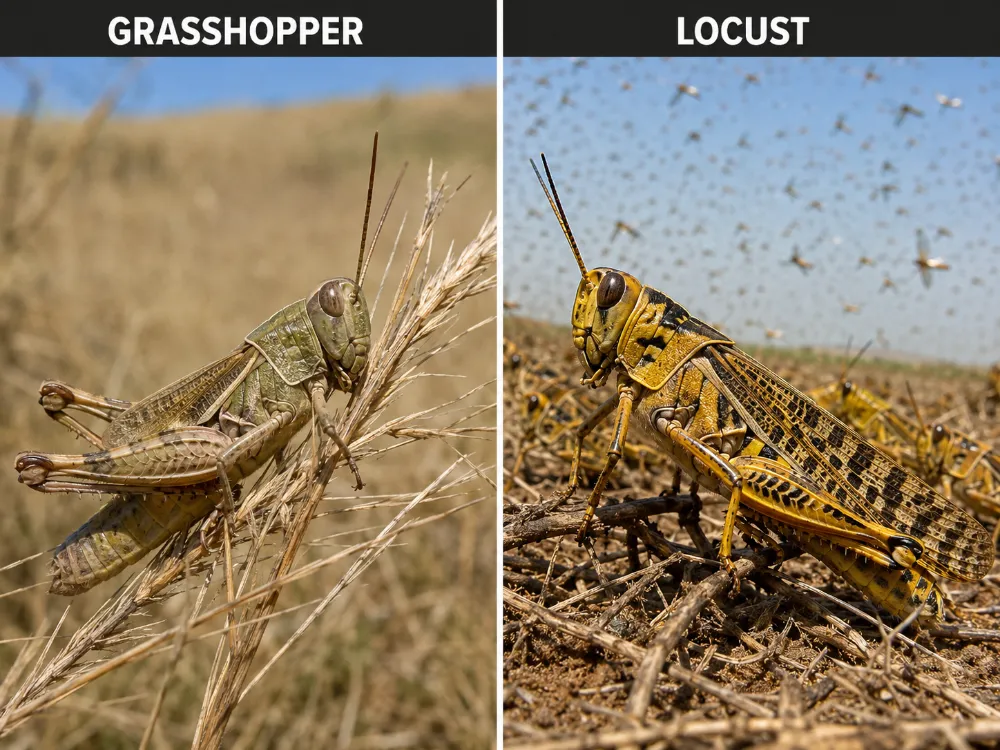
People often talk about locusts and grasshoppers as if they are completely different insects. That idea makes sense at first because a quiet grasshopper in a field seems nothing like a huge flying locust swarm. In biology, however, the relationship is much closer.
In this guide, you will learn what makes a locust different from an ordinary grasshopper, how swarming happens, why only some species become locusts, and how to tell the two apart in a more accurate way.
Quick comparison table
| Feature | Locust | Grasshopper |
|---|---|---|
| Basic meaning | A grasshopper capable of phase change and swarming | A broad group of jumping plant-eating insects |
| Scientific status | Not a separate major insect group from grasshoppers | Broad common term for many related species |
| Swarming ability | Yes, in locust-forming species | Usually no large coordinated swarming phase |
| Behavioral phases | Can shift between solitary and gregarious phases | Usually remains in ordinary non-swarming behavior |
| Appearance | May change color, body proportions, and behavior with crowding | Usually keeps a more stable appearance and behavior |
| Ecological reputation | Can become major agricultural pest in swarms | Usually local herbivore, sometimes a pest but not classic locust-scale swarmer |
| Important fact | All locusts are grasshoppers | Not all grasshoppers are locusts |
| Best quick clue | Swarming phase and density-driven transformation | Ordinary non-swarming grasshopper lifestyle |
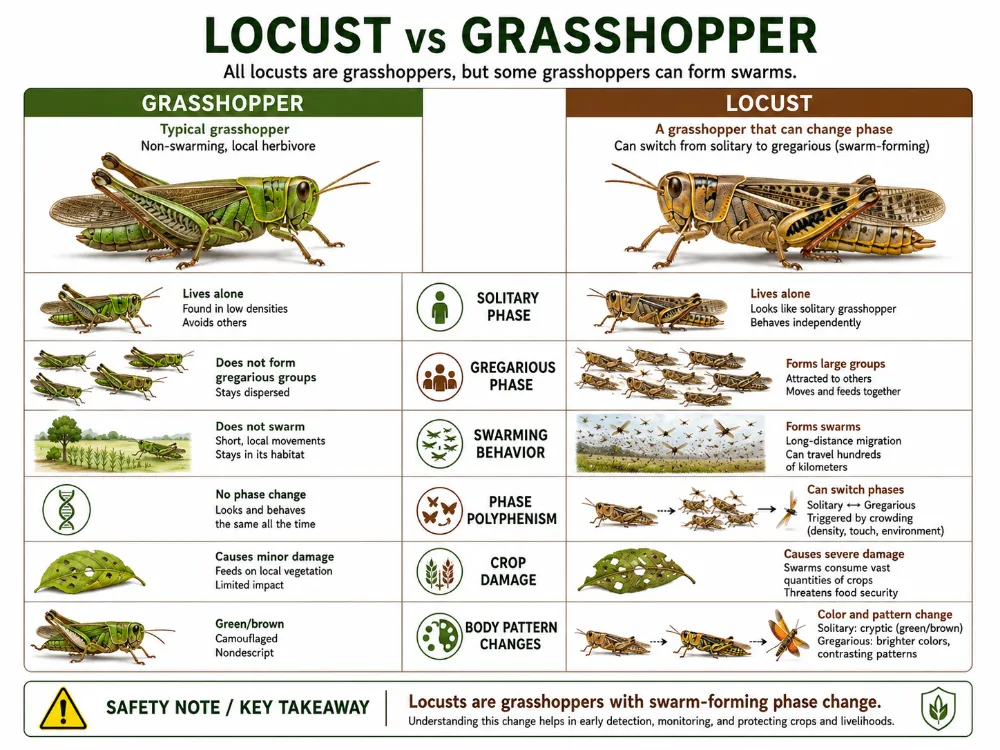
All locusts are grasshoppers, but not all grasshoppers are locusts
This is the single most important idea in the whole comparison. A locust is not a completely separate type of insect outside the grasshopper group. A locust is a grasshopper, but specifically one of the species capable of switching into a swarming phase.
That means the word grasshopper is broader, while locust is narrower. The locust label is usually used when a certain grasshopper species has the biological ability to become gregarious, mobile, and swarm-forming under crowded conditions.
So the real difference is not about two unrelated insects. It is about ordinary grasshopper life versus special phase-changing grasshopper life.
What is a grasshopper?
A grasshopper is a jumping insect in a large group of plant-eating orthopterans known for strong hind legs, chewing mouthparts, and life on grasses, herbs, crops, and other vegetation. Grasshoppers are common in fields, meadows, grasslands, roadsides, and many warm open habitats.
Most grasshoppers live relatively ordinary insect lives. They feed, grow, mate, and remain more or less local to the habitat around them. Some may become numerous, and some can damage crops, but they do not necessarily transform into huge migratory swarms.
So when people picture a typical grasshopper, they are usually thinking of the broader and more common non-locust condition.
What is a locust?
A locust is a grasshopper species with a remarkable biological ability called phase polyphenism. This means the insect can exist in different forms depending on environmental conditions, especially population density.
When numbers are low, the insect may behave like a fairly ordinary solitary grasshopper. When crowding increases and individuals constantly contact one another, hormonal and neurological changes can push the population into a gregarious phase. In that phase, the insects become more active, more social, more mobile, and capable of forming marching bands and massive flying swarms.
That is why a locust is best understood not just as a species name in casual language, but as a grasshopper with a swarm-capable life strategy.
The biggest difference is swarming behavior
The most dramatic difference between locusts and ordinary grasshoppers is swarming. Typical grasshoppers do not form the giant coordinated migratory swarms that locusts are famous for. They may gather locally if conditions are good, but they do not usually show the same large-scale collective behavior.
Locusts, in their gregarious phase, can form enormous groups that travel together and feed heavily as they move. These swarms are the reason locusts are so feared in agriculture and history. A quiet plant-eater becomes part of a moving mass of hungry insects.
So if the image in your mind is a cloud of insects stripping fields, you are thinking of locust behavior, not the ordinary life of most grasshoppers.
Locusts can change phase, ordinary grasshoppers usually do not
Locust biology is famous because the same species can behave in two very different ways. In the solitary phase, locust individuals may avoid one another, stay more scattered, and look more like ordinary grasshoppers. In the gregarious phase, they are attracted to one another and begin acting like a coordinated population.
This transformation is not just social. It can also involve changes in color, body proportions, movement, appetite, and nervous system activity. The insect may look and behave differently depending on which phase it is in.
Most grasshoppers do not show this extreme density-driven transformation. That is what makes locusts so biologically unusual.
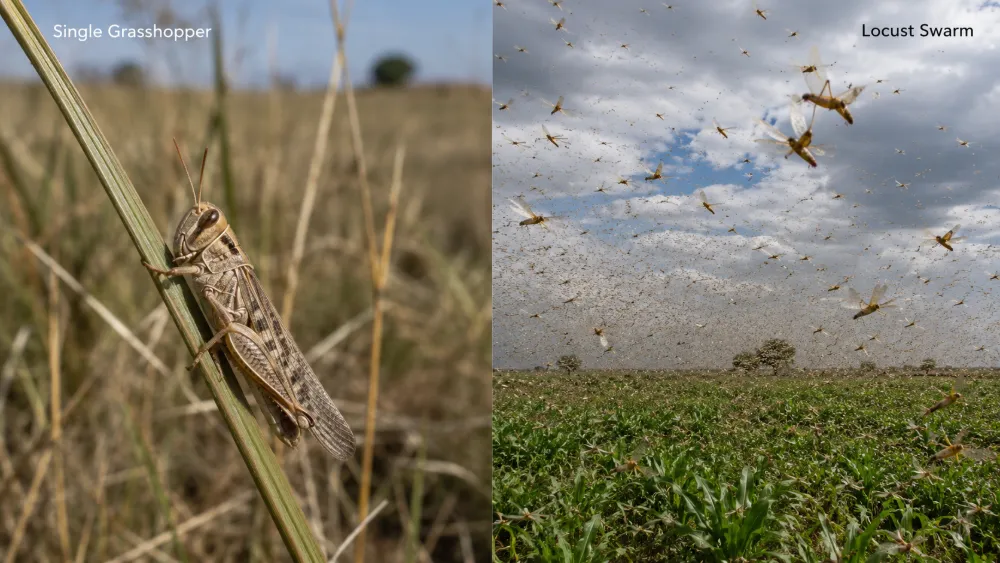
Locusts are famous for phase polyphenism
Phase polyphenism means one species can show very different physical and behavioral forms under different environmental conditions. In locusts, rising density is one of the key triggers. Frequent contact, especially around the hind legs in some well-studied species, helps set off the shift toward gregarious behavior.
This is one of the most fascinating examples of environmental influence on insect form and behavior. The insect is not becoming a different species. It is expressing a different mode of life from the same underlying species.
That is why the locust versus grasshopper question is really about transformation, not just identity.
Color and body form can change in locusts
Many locust species show visible changes between solitary and gregarious phases. The exact pattern varies by species and life stage, but crowded locusts may become more strongly patterned, more conspicuous, or different in coloration from their solitary counterparts. Young locusts in marching groups can also look different from isolated individuals.
Ordinary grasshoppers may vary in color too, of course, but they usually do not undergo the same famous crowd-triggered shift that makes locust phases so distinctive.
So appearance can change in locusts for a biological reason tied to density, not just age or normal individual variation.
Locust nymphs march, adults swarm
Locust life becomes especially dramatic in the gregarious phase. Juveniles, often called hoppers or nymphs, cannot yet fly. Instead, they may gather into dense marching bands that move across the ground and consume vegetation as they go.
When they mature into adults, they gain wings and can take to the air in swarms. This makes the threat much more mobile and much harder to manage. The problem shifts from a local marching front to a fast-moving airborne population.
Ordinary grasshopper nymphs and adults generally do not create this same large-scale organized pattern of ground bands followed by aerial swarms.
Locusts can become major agricultural pests
Although some ordinary grasshoppers can damage crops, locusts have a much more extreme reputation because of their swarming ability. A swarm can consume enormous amounts of vegetation and move across wide areas, affecting farms, pastures, and natural plant communities.
This is why locust outbreaks have had such a strong place in human history, agriculture, and culture. They are not just insects eating plants. They are plant-eating insects acting in overwhelming numbers.
So while both locusts and grasshoppers are herbivores, locusts become a regional or even international concern when they enter swarm phase.
Most grasshoppers never become locusts
This is another key point. The average grasshopper species cannot simply “turn into a locust.” Only certain species have the biology needed for true locust phase change and swarming. That ability is special, not normal for the whole grasshopper world.
So if you see a random grasshopper in a field, it is not correct to assume it is a locust waiting to swarm. Most grasshoppers remain just what they are: local plant-eating jumping insects.
This helps clear up one of the most common misunderstandings around the topic.
Grasshoppers are usually local, locusts can become migratory
Ordinary grasshoppers usually live and feed within a more limited range. They may move around locally, but they are not famous for continent-scale or region-wide mass movement. Their daily life is tied more closely to immediate habitat.
Locusts in swarm phase can become highly mobile. Adult swarms may travel great distances when winds and conditions allow. This ability turns a local population boom into a much broader ecological and agricultural event.
So mobility is another major difference between ordinary grasshopper life and true locust outbreaks.
Both eat plants, but locust impact is different
Both locusts and grasshoppers are herbivores. They feed on grasses, leaves, crops, and other plant material. In that basic sense, they belong to the same general feeding world.
The difference is scale and intensity. A normal grasshopper population may nibble and feed as part of ordinary ecosystem life. A locust swarm can strip vegetation with a force that becomes economically and ecologically severe.
So the diet itself is not the real dividing line. The dividing line is what happens when numbers and behavior shift dramatically.
Habitat and climate matter a lot in locust outbreaks
Locust outbreaks do not happen randomly. Weather, rainfall, vegetation growth, and breeding success all matter. Good rains can create flushes of plant growth that help populations rise. If crowding then increases in the right places, the conditions for gregarious phase development can strengthen.
This means locust behavior is tied closely to environmental conditions. A locust species may spend long periods behaving quietly and then erupt into a major outbreak when conditions line up.
Ordinary grasshopper populations are also affected by climate and habitat, but they do not usually show the same famous crowd-driven transformation.
Locusts and grasshoppers can look similar when solitary
This is one reason the topic confuses people. A locust in its solitary phase may look very much like an ordinary grasshopper. If you saw it alone in a quiet habitat, you might never guess it belonged to a species capable of swarming later.
That means the difference is not always visible from one single insect at one single moment. Sometimes the real difference is hidden in the species’ potential and in the current population conditions.
So the locust identity is partly about what the species can do under pressure, not just what one isolated individual looks like.
The words are biological, but also historical
The word locust has a strong historical and cultural weight because of famous outbreaks, crop losses, and dramatic written accounts. The word grasshopper feels more ordinary and local. That emotional contrast can make them seem farther apart than they are biologically.
In reality, the locust story sits inside the grasshopper story. The famous swarming insect is part of the broader grasshopper world, not outside it.
This is why the comparison is so interesting. It mixes ordinary insect biology with one of the most dramatic transformations seen in land ecosystems.
Why people confuse them so often
People confuse locusts and grasshoppers because locusts really are grasshoppers, and many illustrations or articles show only the swarm phase without explaining the broader relationship. A person learns that locusts are devastating swarm insects and grasshoppers are common field insects, then naturally assumes they must be completely different animals.
The truth is more subtle. A locust is a special kind of grasshopper with a special crowd-response system. Once that idea becomes clear, the whole topic makes much more sense.
So the confusion comes from language, scale, and the dramatic contrast between ordinary and outbreak behavior.
How to tell them apart quickly
If you need a fast practical rule, use this one:
Grasshopper: the broad general group, usually local, non-swarming, ordinary jumping herbivore
Locust: a swarm-capable grasshopper species, especially when showing gregarious behavior, marching bands, or migratory swarms
If the insect is part of a density-driven marching or swarming population, locust becomes the right word. If it is simply an ordinary grasshopper in the field, grasshopper is usually the better term.
Which one is more dangerous?
For people directly, neither is dangerous in the way a stinging or venomous animal is dangerous. Locusts do not matter because they attack humans. They matter because they can devastate vegetation, especially crops and pasture, when they appear in swarms.
Ordinary grasshoppers may become local pests, but they usually do not create the same level of large-scale agricultural crisis. So the danger difference is really about food systems and plant damage, not personal physical threat.
In simple terms, locusts are more dangerous economically and ecologically because of swarm behavior.
Final takeaway
The main difference between a locust and a grasshopper is that a locust is a grasshopper species capable of changing from a solitary form into a gregarious swarming form when population density rises. Most grasshoppers never do this. So all locusts are grasshoppers, but only some grasshoppers are locusts. The real dividing line is not ordinary body plan alone, but the ability to undergo phase change and form destructive migratory swarms.
FAQs
Is a locust a grasshopper?
Yes. A locust is a kind of grasshopper.
What is the main difference between a locust and a grasshopper?
The main difference is that locusts are grasshopper species that can switch into a swarming gregarious phase, while most grasshoppers do not.
Can any grasshopper become a locust?
No. Only certain species have the biology needed for true locust phase change and swarming.
Why are locusts so much more destructive than ordinary grasshoppers?
Because locusts can gather in huge numbers, march as juveniles, swarm as adults, and consume vegetation on a very large scale.