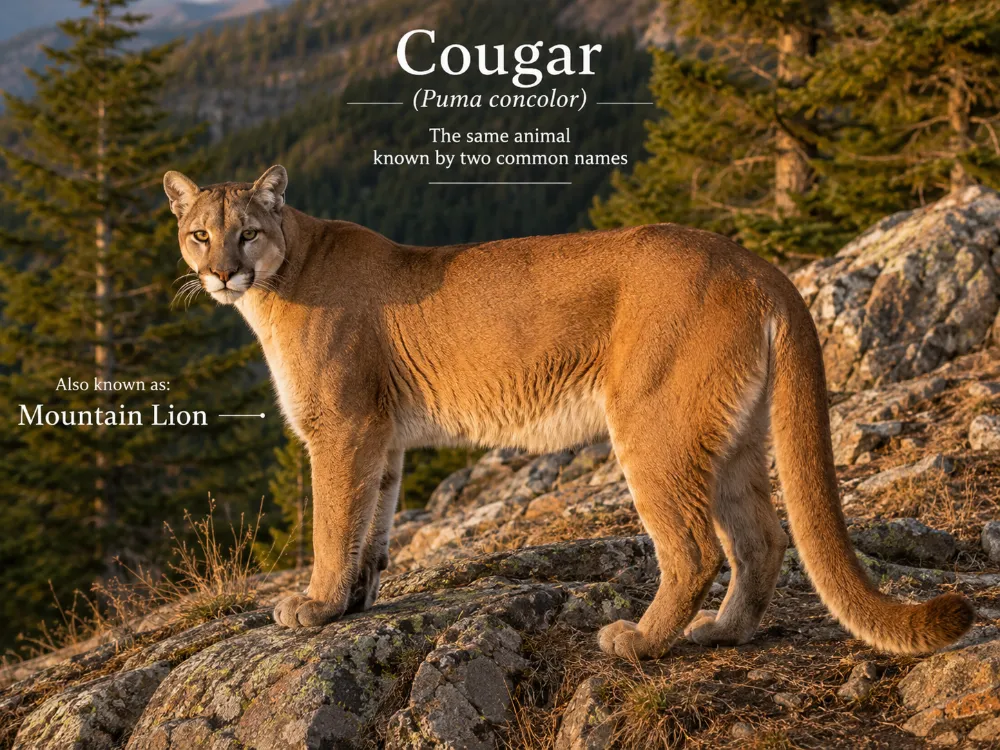
A cougar and a mountain lion are the same animal. Both names refer to the species Puma concolor, a large wild cat native to the Americas. “Mountain lion” is commonly used in the western United States, while “cougar” is widely used in many other regions. The animal may also be called puma, panther, catamount, painter, or Florida panther, depending on location.
| Comparison Point | Cougar | Mountain Lion | Key Answer |
|---|---|---|---|
| Scientific name | Puma concolor | Puma concolor | They are the same species. |
| Animal group | Wild cat in the Felidae family | Wild cat in the Felidae family | Both are large cats, but not “big cats” in the roaring-cat sense. |
| Main difference | Name often used in Canada, parts of the U.S., and general English | Name often used in the western United States | The difference is regional language, not biology. |
| Other names | Puma, panther, catamount, painter | Puma, panther, cougar, catamount | This species has more common names than almost any other mammal. |
| Size | About 5–9 feet long including tail | About 5–9 feet long including tail | Males are usually larger than females. |
| Weight | Females often 65–100 lb; males often 115–180 lb | Same range | Some large males can exceed typical averages. |
| Color | Tawny, grayish, reddish, or sandy brown | Same color range | The coat may vary by age, region, and lighting. |
| Habitat | Forests, mountains, deserts, wetlands, grasslands | Same habitats | They are highly adaptable predators. |
| Diet | Deer, elk calves, smaller mammals, birds, livestock in some areas | Same diet | Deer are often the most important prey. |
| Range | Western North America, Florida, Central America, South America | Same species range | The name changes by region, not the cat. |
Are Cougars and Mountain Lions the Same Animal?
Yes. Cougars and mountain lions are the same animal. The scientific name is Puma concolor. This species is a large, powerful, solitary wild cat found from parts of North America through Central America and into South America.
The confusion comes from common names. In one region, people may say “mountain lion.” In another region, they may say “cougar.” In scientific writing, “puma” or Puma concolor is often used to avoid confusion. All of these names can refer to the same species.
So if someone asks “Who would win, a cougar or a mountain lion?” the answer is simple: it would be the same animal fighting itself. There is no species-level difference between them.
Why Does One Cat Have So Many Names?
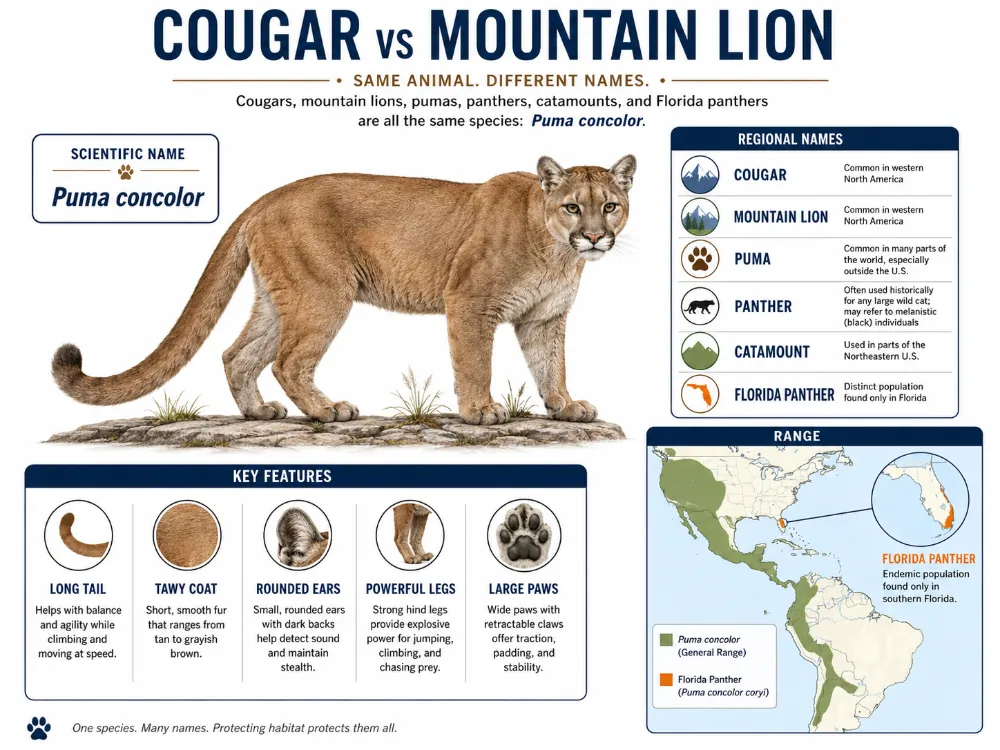
The cougar has many names because it has one of the widest ranges of any wild mammal in the Americas. It lives across many landscapes, languages, cultures, and historical regions. As people encountered the animal in different places, they gave it different local names.
Common names include:
Cougar: A widely used common name in English.
Mountain lion: Common in the western United States, especially in mountainous regions.
Puma: Often used in scientific and international contexts.
Panther: Used regionally, especially in “Florida panther.”
Catamount: An older name meaning “cat of the mountain.”
Painter: A regional folk name in parts of North America.
The name “mountain lion” can be misleading because this animal does not live only in mountains and is not a true lion. The name likely reflects its large size, tawny coat, and mountainous habitat in parts of its range.
Cougar vs Mountain Lion Name by Region
The difference between “cougar” and “mountain lion” is mostly geographic. In western U.S. states such as Colorado, Utah, Montana, Wyoming, Arizona, and California, “mountain lion” is very common. In many broader wildlife discussions, “cougar” is also widely understood.
In South America, the name “puma” is especially common. In Florida, the remaining population is usually called the Florida panther, even though it is still part of the same species. In older eastern North American language, “catamount” was once common.
| Name | Where It Is Commonly Used | Meaning |
|---|---|---|
| Cougar | General English, Canada, parts of the United States | Common name for Puma concolor |
| Mountain lion | Western United States | Regional name for the same cat |
| Puma | Scientific, international, and Latin American usage | Genus name and common name |
| Panther | Florida and some regional usage | Local name, not a separate black panther species |
| Catamount | Older eastern North American usage | Traditional name meaning mountain cat |
Scientific Classification
The cougar or mountain lion belongs to the cat family, Felidae. Its scientific name is Puma concolor. The word “concolor” means “one color,” referring to the adult cat’s mostly plain coat without strong spots or stripes.
| Category | Classification |
|---|---|
| Kingdom | Animalia |
| Phylum | Chordata |
| Class | Mammalia |
| Order | Carnivora |
| Family | Felidae |
| Genus | Puma |
| Species | Puma concolor |
Although it is large, the cougar is not classified with the roaring big cats such as lions, tigers, leopards, and jaguars. Those cats belong to the genus Panthera. Cougars belong to the genus Puma, and they purr rather than roar.
Is a Cougar a Big Cat?
In everyday language, many people call the cougar a big cat because it is large, muscular, and powerful. In a casual sense, that is understandable. However, in a stricter zoological sense, “big cats” often refers to members of the genus Panthera, such as lions, tigers, jaguars, leopards, and snow leopards.
Cougars are large wild cats, but they are not roaring cats. They cannot roar like a lion or tiger. Instead, they can purr, growl, hiss, scream, chirp, and make other vocalizations. Their famous scream is one reason they have a mysterious reputation in many regions.
Size and Appearance
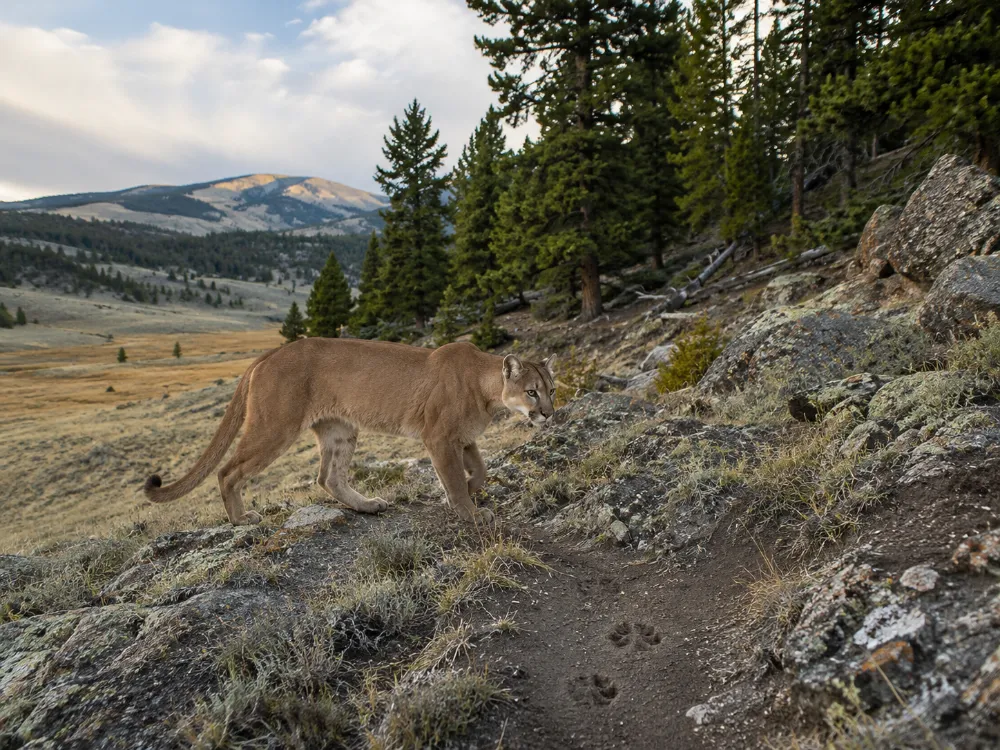
Cougars are long-bodied, muscular cats with small rounded heads, powerful shoulders, long hind legs, and very long tails. The tail helps with balance when climbing, jumping, running, and moving across rocky terrain.
Adult coat color is usually tawny, sandy, grayish, or reddish brown. The underside is lighter, and the tip of the tail is often dark. Young kittens are born with spots and blue eyes, but the spots fade as they mature.
Typical measurements include:
Body length: About 3.25 to 5.25 feet, not including the tail.
Tail length: About 2 to 3 feet.
Total length: Often about 5 to 9 feet from nose to tail tip.
Female weight: Commonly about 65 to 100 pounds.
Male weight: Commonly about 115 to 180 pounds.
Males are usually larger than females. Large males in prey-rich areas may exceed average weights, while smaller individuals in harsher habitats may be lighter.
Habitat and Range
The cougar is one of the most adaptable wild cats in the world. It can live in forests, mountains, deserts, wetlands, scrublands, grasslands, and rugged canyons. It does not need only mountains, despite the name “mountain lion.”
Its historical range once covered much of North and South America. Today, stable populations remain across much of western North America and large parts of Central and South America. In the eastern United States, most historical cougar populations were eliminated, although the Florida panther survives as a rare and protected population.
Cougars need large territories with enough prey, cover, and space to avoid people. They are most successful in landscapes where they can stalk prey, move quietly, and find secure resting areas.
Diet and Hunting Style
Cougars are carnivores and ambush predators. They rely on stealth, patience, and explosive power rather than long-distance chasing. A cougar usually stalks quietly, gets close to prey, and then attacks with a sudden burst of speed.
Common prey includes:
Deer
Elk calves
Bighorn sheep
Wild pigs in some areas
Rabbits and hares
Raccoons
Porcupines
Rodents
Birds
Occasionally livestock or pets near human settlements
Deer are often the most important prey, especially in North America. After making a kill, a cougar may drag the carcass to cover and feed on it for several days. It may cover the remains with leaves, dirt, grass, or snow to hide it from scavengers.
Behavior and Lifestyle
Cougars are usually solitary. Adult males and females maintain territories, and adults generally meet only for mating. A female raises her kittens alone, teaching them to hunt and survive before they disperse.
They are most active at dawn, dusk, and night, but they can move during the day, especially in quiet areas. Their secretive behavior makes them difficult to observe, even where they are relatively common.
Important behavioral traits include:
Solitary lifestyle
Large home ranges
Strong territorial behavior
Excellent climbing ability
Powerful jumping ability
Quiet stalking movement
Avoidance of humans in most situations
Cougars are not usually aggressive toward people. Most avoid human contact. However, they are large predators, and rare dangerous encounters can happen, especially if the animal is surprised, cornered, starving, young and inexperienced, or attracted by pets or livestock.
Cougar vs Mountain Lion vs Puma
Cougar, mountain lion, and puma all refer to the same animal. The name “puma” is often preferred in scientific and international contexts because it matches the genus name, Puma.
| Name | Same Species? | Best Use |
|---|---|---|
| Cougar | Yes | Common English name |
| Mountain lion | Yes | Common regional name in western North America |
| Puma | Yes | Scientific and international name |
| Florida panther | Yes, a regional population of the same species | Used for the rare Florida population |
| Black panther | No, not a cougar name in normal zoological use | Usually refers to melanistic leopards or jaguars |
When writing for a general audience, “cougar” and “mountain lion” are both correct. When writing scientifically, Puma concolor is the clearest term.
Is a Florida Panther the Same as a Cougar?
The Florida panther is a regional population of Puma concolor. It is not a separate kind of black panther. Florida panthers are tawny-colored cats, like other cougars, and they live mainly in southern Florida.
The Florida panther is important because it represents the last breeding cougar population in the eastern United States. It has faced severe habitat loss, road mortality, genetic bottlenecks, and conflict with human development.
In simple terms, all Florida panthers are cougars, but not all cougars are Florida panthers. “Florida panther” is a regional name for a specific population.
Is a Panther the Same as a Cougar?
The word “panther” can be confusing because it means different things in different places. In Florida, “panther” usually refers to the Florida panther, which is a cougar. In other contexts, “black panther” usually means a melanistic leopard in Africa or Asia, or a melanistic jaguar in the Americas.
There is no confirmed normal population of truly black cougars. Reports of “black panthers” in North America are often misidentifications, folklore, shadows, domestic cats, bobcats, or distant animals seen in poor light.
Cougar vs Mountain Lion Tracks
Because cougars and mountain lions are the same species, their tracks are identical. A cougar track is large, rounded, and usually shows four toes. Claw marks are usually absent because cats retract their claws when walking.
Typical cougar track features include:
Rounded overall shape
Four toes
Large central pad
No obvious claw marks in most tracks
Asymmetrical toe arrangement
Tracks often larger than bobcat tracks
Dog tracks often show claw marks and are more oval. Cougar tracks tend to look rounder and cleaner. However, track identification can be difficult in mud, snow, or loose soil.
Cougar vs Mountain Lion Sounds
Cougars do not roar. Instead, they produce a range of sounds, including hisses, growls, chirps, purrs, whistles, and screams. The scream is especially famous and can sound surprisingly human-like.
Because “cougar” and “mountain lion” are the same animal, there is no difference in vocalization. A mountain lion scream is a cougar scream. A cougar growl is a mountain lion growl.
Vocalizations may be used during mating, territorial encounters, mother-kitten communication, or conflict. However, cougars are usually quiet animals and rely more on scent marking, body language, and movement than frequent calling.
Are Cougars Dangerous to Humans?
Cougars are powerful predators, but attacks on humans are rare. Most cougars avoid people. Problems are more likely when cougars become accustomed to human areas, lose fear, encounter unattended pets, or are surprised at close range.
In cougar country, sensible precautions include:
Do not feed deer or wildlife near homes.
Keep pets indoors or supervised, especially at dawn and dusk.
Do not leave pet food outside.
Keep children close on trails.
Make noise when hiking in dense cover.
Do not approach a cougar kitten.
Never run from a cougar.
If you encounter a cougar, stay calm, face the animal, make yourself look larger, speak firmly, back away slowly, and give it room to leave. Do not crouch or turn your back. If a cougar acts aggressively, fight back and protect your head and neck.
Ecological Role
Cougars are important top predators. By hunting deer and other prey, they can influence prey behavior, movement, and population structure. Their kills also provide food for scavengers such as foxes, coyotes, bears, ravens, eagles, beetles, and many smaller organisms.
As large predators, cougars help shape ecosystems. Their presence can affect where deer feed, how long deer stay in open areas, and how other carnivores use the landscape. This does not mean cougars “control” nature in a simple way, but they are an important part of healthy predator-prey systems.
Conservation Status
Cougars are not globally extinct or close to extinction, but their status varies greatly by region. In some western areas, they remain widespread. In other places, they have lost large parts of their historical range. The Florida panther population is especially vulnerable because it is restricted to a limited habitat area.
Main threats include:
Habitat loss
Road collisions
Conflict with livestock and pets
Illegal killing
Fragmented populations
Loss of genetic diversity in isolated groups
Conservation requires large connected habitats, safe wildlife corridors, responsible livestock protection, public education, and careful management based on local ecology.
Common Myths About Cougars and Mountain Lions
Because the species has many names and a secretive lifestyle, myths are common. Some people think cougars and mountain lions are different animals. Others believe mountain lions are always found only in mountains, or that every large black cat in North America is a black panther.
Common myths include:
Myth: Cougars and mountain lions are different species.
Fact: They are the same species, Puma concolor.Myth: Mountain lions only live in mountains.
Fact: They can live in forests, deserts, wetlands, and many other habitats.Myth: Cougars can roar like lions.
Fact: They cannot roar, but they can purr, hiss, growl, and scream.Myth: Florida panthers are black.
Fact: Florida panthers are tawny cougars, not black panthers.Myth: Cougars are always dangerous to people.
Fact: They are powerful predators, but attacks on humans are rare.
How to Tell a Cougar From Other Wild Cats
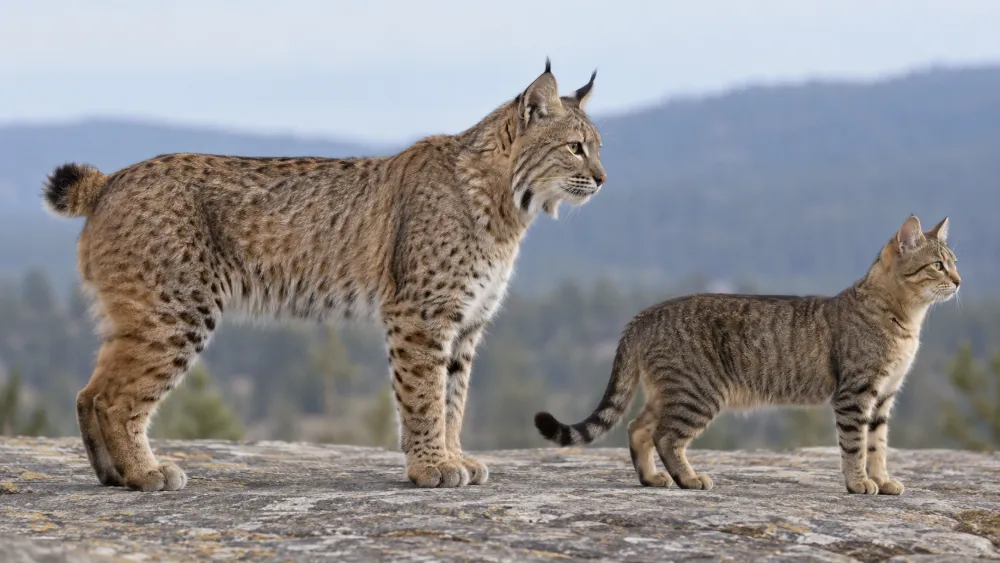
Cougars can be confused with bobcats, lynx, jaguars, or even large domestic cats at a distance. The easiest field clues are body size, tail length, coat pattern, and overall shape.
| Animal | How It Differs From a Cougar |
|---|---|
| Bobcat | Much smaller, short bobbed tail, spotted coat, tufted ears in some individuals |
| Canada lynx | Short tail, long ear tufts, very large feet, grayish coat, northern habitat |
| Jaguar | Heavier body, spotted rosettes, massive head, found mainly farther south |
| Domestic cat | Much smaller, shorter stride, more variable coat colors and patterns |
| African lion | Different species, males have manes, lives naturally in Africa and parts of India |
A cougar’s long tail is one of the best visual clues. Bobcats and lynx have short tails, while a cougar’s tail may be nearly one-third of its total length.
Final Takeaway
Cougar and mountain lion are two names for the same animal: Puma concolor. The difference is regional language, not biology. The same cat may also be called puma, panther, catamount, or painter depending on where people live.
This wild cat is a solitary, adaptable predator with a long body, powerful legs, tawny coat, and long balancing tail. It can live in mountains, forests, deserts, wetlands, and grasslands. It is not a true lion, and it does not roar, but it is one of the most impressive predators in the Americas.
So when comparing cougar vs mountain lion, the simplest answer is the most accurate: they are the same species, just known by different names.
FAQs About Cougar vs Mountain Lion
Are cougars and mountain lions the same?
Yes. Cougars and mountain lions are the same species, Puma concolor. The difference is only the common name used in different regions.
Why are cougars called mountain lions?
They are called mountain lions because they are large tawny cats often found in mountainous areas, especially in the western United States. However, they are not true lions and do not live only in mountains.
Is a puma the same as a cougar?
Yes. Puma, cougar, and mountain lion all refer to the same animal. “Puma” is often used in scientific and international contexts.
Is a Florida panther a cougar?
Yes. The Florida panther is a regional population of Puma concolor. It is a type of cougar found in southern Florida.
Is a black panther a cougar?
Usually no. The term “black panther” typically refers to a melanistic leopard or jaguar. There is no confirmed normal population of truly black cougars.
Can mountain lions roar?
No. Mountain lions cannot roar like lions or tigers. They can purr, hiss, growl, chirp, whistle, and scream.
Are cougars dangerous?
Cougars are powerful predators, but they usually avoid people. Attacks on humans are rare. The risk is lower when people keep pets supervised, avoid feeding wildlife, and act correctly during encounters.
What do cougars eat?
Cougars mainly eat deer, but they also hunt elk calves, rabbits, raccoons, porcupines, birds, rodents, and other animals. In some areas, they may occasionally prey on livestock or pets.
Where do mountain lions live?
Mountain lions live in many habitats, including mountains, forests, deserts, grasslands, wetlands, and scrublands. They are found in parts of North America, Central America, and South America.
How big is a cougar?
An adult cougar may be about 5 to 9 feet long including the tail. Females often weigh about 65 to 100 pounds, while males often weigh about 115 to 180 pounds.
What is the difference between a cougar and a bobcat?
A cougar is much larger and has a long tail. A bobcat is smaller, has a short bobbed tail, and often has a spotted coat. Their tracks, body shape, and behavior are also different.
Why does the cougar have so many names?
The cougar has many names because it lives across a huge range in the Americas. Different cultures and regions developed different names, including cougar, mountain lion, puma, panther, catamount, and painter.