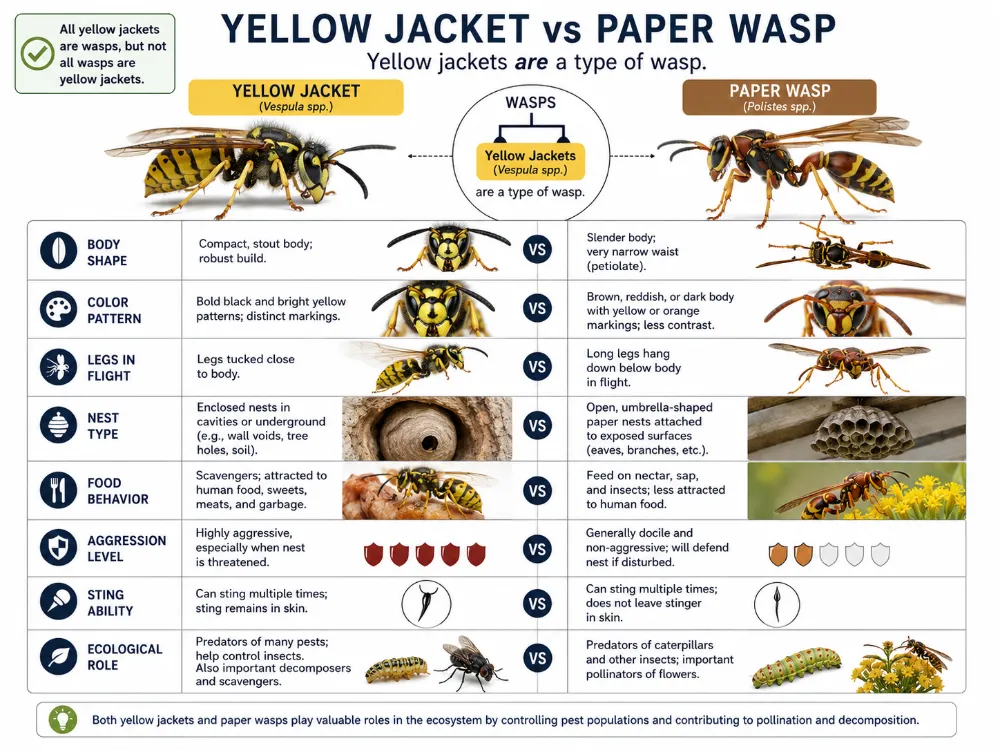
A yellow jacket is a type of wasp, so the real comparison is usually yellow jacket vs other common wasps, especially paper wasps. Yellow jackets are usually stockier, bright black-and-yellow, highly social, and more likely to scavenge around food and defend hidden nests. Paper wasps are usually slimmer, longer-legged, less aggressive, and often build open umbrella-shaped nests under eaves.

| Feature | Yellow Jacket | Common Wasp / Paper Wasp | Quick Identification Tip |
|---|---|---|---|
| Classification | A type of social wasp | “Wasp” is a broad group; paper wasps are one common comparison | All yellow jackets are wasps, but not all wasps are yellow jackets. |
| Body shape | Compact, stocky, smooth-bodied | Often slimmer with a more obvious narrow waist | Yellow jackets look shorter and more muscular. |
| Color | Usually bold black and yellow | Often brown, reddish, black, yellow, or mixed | Yellow jackets often have sharper black-yellow banding. |
| Legs in flight | Legs usually held closer to the body | Paper wasps often let long legs dangle | Dangling legs often suggest paper wasp. |
| Nest type | Enclosed paper nest, often underground or in wall cavities | Paper wasps build open comb nests under eaves or branches | Hidden entrance usually suggests yellow jacket. |
| Colony size | Can be large, with many workers | Paper wasp colonies are usually smaller | Heavy traffic from a hole may indicate yellow jackets. |
| Food behavior | Strongly attracted to meat, sweets, trash, and picnic food | Often hunts insects and visits flowers; less aggressive around human food | Wasps harassing soda or meat are often yellow jackets. |
| Aggression | More defensive, especially near nests | Paper wasps are usually less aggressive unless the nest is disturbed | Do not approach hidden nests or swarming workers. |
| Sting | Can sting multiple times | Most wasps can also sting multiple times | Unlike honey bees, wasps usually do not lose the stinger. |
| Ecological role | Predator, scavenger, and occasional pollinator | Many wasps control pest insects and may pollinate flowers | Wasps are not just pests; they are part of the ecosystem. |
Are Wasps and Yellow Jackets the Same?
Yes and no. A yellow jacket is a wasp, but “wasp” is a much broader word. The wasp group includes many kinds of insects, such as paper wasps, mud daubers, potter wasps, cicada killers, hornets, parasitoid wasps, and yellow jackets.
In everyday speech, people often say “wasp” when they mean a paper wasp or another slender stinging wasp. That is why “wasp vs yellow jacket” usually means “paper wasp vs yellow jacket” or “ordinary wasp vs yellow jacket.”
The simplest answer is this:
Yellow jacket: A specific type of social wasp.
Wasp: A broad category that includes yellow jackets and many other species.
Paper wasp: A common wasp often confused with yellow jackets.
Scientific Classification
Yellow jackets belong to the insect order Hymenoptera, the same order that includes ants, bees, sawflies, and other wasps. Many yellow jackets belong to the genera Vespula and Dolichovespula.
| Category | Yellow Jacket | Paper Wasp |
|---|---|---|
| Order | Hymenoptera | Hymenoptera |
| Family | Vespidae | Vespidae |
| Common genera | Vespula, Dolichovespula | Polistes and related genera |
| Social structure | Social colony with queen, workers, and males | Social colony, usually smaller and more open |
| Main confusion | Often mistaken for bees or paper wasps | Often called simply “wasps” by homeowners |
Because both yellow jackets and paper wasps are in the wasp family Vespidae, they share some traits. Both have narrow waists, chewing mouthparts, paper-like nests made from wood fibers, and female workers that can sting. Their differences become clearer when you look at body shape, nest location, food behavior, and colony defense.
Appearance: How to Tell Them Apart
Yellow jackets are usually compact, smooth, and strongly marked in black and yellow. They often look more “bee-like” than paper wasps because their bodies are shorter and stockier. However, unlike honey bees, yellow jackets are not fuzzy and do not carry pollen baskets on their hind legs.
Paper wasps are usually longer and more slender. Their narrow waist is often more obvious, and their long legs may hang down when they fly. Their color can vary by species, but many are brownish, reddish, black, yellow, or a mixture of these colors.
Key appearance clues include:
Yellow jackets: Stockier body, bold black-yellow markings, shorter-looking legs, fast direct flight.
Paper wasps: Slim body, longer waist, long dangling legs, slower and more floating flight.
Bees: Usually fuzzier, more pollen-focused, less shiny than most wasps.
Nest Differences
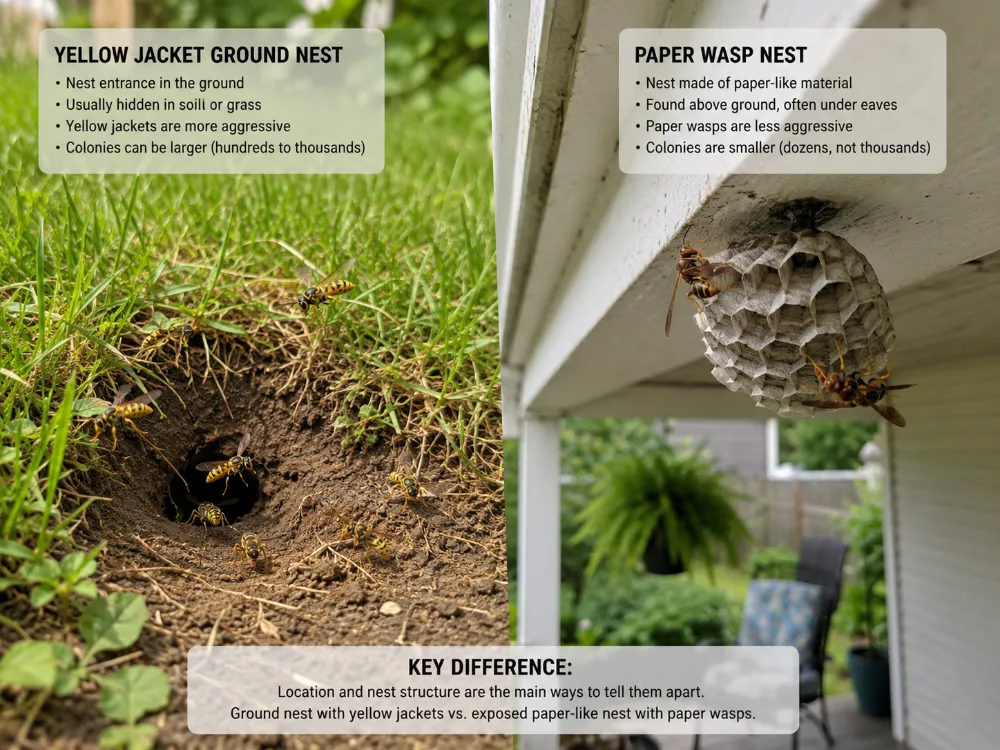
Nests are one of the best ways to tell yellow jackets from paper wasps. Yellow jackets usually build enclosed paper nests. Many species nest underground in old rodent burrows, soil cavities, or hidden spaces. Others may nest inside walls, attics, tree hollows, or dense vegetation.
Paper wasps usually build open comb nests. These nests look like small gray umbrellas or exposed honeycomb clusters. They are often found under eaves, porch ceilings, deck railings, branches, outdoor furniture, or sheds.
| Nest Feature | Yellow Jacket | Paper Wasp |
|---|---|---|
| Visibility | Often hidden | Often visible |
| Structure | Enclosed papery nest | Open comb nest |
| Common location | Ground holes, walls, tree cavities, enclosed spaces | Eaves, porch ceilings, branches, sheltered surfaces |
| Entrance | Usually one main entrance hole | Open cells visible from below |
| Human risk | Higher when nests are hidden and accidentally disturbed | Usually easier to notice and avoid |
A hidden nest entrance with many fast-moving black-and-yellow insects flying in and out is often a yellow jacket colony. An exposed nest with visible hexagonal cells and several long-legged wasps is more likely a paper wasp nest.
Behavior Around People
Yellow jackets are often more noticeable around people because they scavenge. In late summer and fall, they may investigate soda cans, fruit, meat, sandwiches, pet food, garbage cans, and picnic tables. This behavior is one reason people experience yellow jackets as more aggressive.
Paper wasps are usually less interested in human food. They may visit flowers or hunt caterpillars and other insects. They can sting if their nest is disturbed, but they are often less confrontational away from the nest.
Common yellow jacket behavior around people includes:
Flying around sweet drinks
Landing on meat or barbecue food
Entering trash cans
Investigating fallen fruit
Defending underground or wall nests strongly
Becoming more noticeable in late summer and fall
If a wasp is repeatedly bothering your food, drink, or trash, it is more likely to be a yellow jacket than a paper wasp.
Which Is More Aggressive?
Yellow jackets are generally more defensive and more likely to sting in groups, especially when their nest is disturbed. This does not mean they are “evil” or always looking to attack. They are social insects defending a colony with larvae, workers, and a queen.
The danger is that yellow jacket nests are often hidden. A person mowing a lawn, moving firewood, trimming shrubs, or stepping near a ground nest may disturb the colony without seeing it. Workers may then rush out to defend the nest.
Paper wasps can also sting, but they are usually less aggressive unless someone gets close to the nest, shakes the structure, or tries to remove it. A paper wasp nest under a rarely used roof edge may cause little trouble, while a nest above a doorway can become a problem.
Sting Differences
Both yellow jackets and many other wasps can sting more than once. Unlike honey bees, they usually do not leave the stinger behind after one sting. The sting is a defensive weapon, mostly used to protect the nest or defend the insect when trapped.
A typical sting may cause:
Sharp pain
Redness
Swelling
Itching
Warmth around the sting site
Most local sting reactions are painful but not life-threatening. However, some people can have a severe allergic reaction. Emergency warning signs include trouble breathing, swelling of the lips or throat, dizziness, fainting, widespread hives, vomiting, or confusion. These signs require immediate emergency medical care.
Multiple stings can also be dangerous, especially for children, older adults, small pets, or anyone with a known venom allergy.
Diet and Ecological Role
Yellow jackets and other wasps are often disliked because of stings, but they play important ecological roles. Adult wasps may feed on sugary liquids such as nectar, fruit juice, or honeydew, while workers hunt insects or scavenge protein to feed the developing larvae.
Yellow jackets can help control other insects, but they also scavenge human food and garbage. Paper wasps are important predators of caterpillars and other soft-bodied insects. Many solitary wasps hunt spiders, beetle larvae, flies, or other insects.
Ecological benefits of wasps include:
Natural pest control
Food for birds, mammals, reptiles, and other insects
Pollination by some adult wasps
Nutrient recycling through scavenging
Balancing insect populations in gardens and wild habitats
From an ecological point of view, wasps are not simply pests. Problems usually arise when nests are too close to people, pets, doors, playgrounds, or outdoor eating areas.
Yellow Jacket vs Bee
Yellow jackets are often mistaken for bees because they are similar in size and have black-and-yellow markings. However, bees and yellow jackets have different body textures, diets, and behavior.
| Feature | Yellow Jacket | Bee |
|---|---|---|
| Body texture | Smooth and shiny | Usually fuzzier |
| Food focus | Insects, meat, sweets, garbage, nectar | Nectar and pollen |
| Sting | Can sting multiple times | Honey bees usually sting once; many other bees rarely sting |
| Human food | Often attracted to picnic food and trash | Usually less interested in meat and garbage |
| Pollination role | Some pollination, but not as specialized | Major pollinators for many flowering plants |
If the insect is smooth, shiny, black-and-yellow, and aggressively inspecting your soda or sandwich, it is more likely a yellow jacket than a bee.
Yellow Jacket vs Hornet
Hornets are also wasps. In many regions, “hornet” is used for larger social wasps that build aerial enclosed nests, while “yellow jacket” is often used for smaller social wasps, many of which nest underground or in enclosed cavities. However, common names can be confusing.
The bald-faced hornet, for example, is not a true hornet in the strictest sense. It is closely related to yellow jackets and belongs to the genus Dolichovespula. It is black and white, builds large aerial paper nests, and can defend its nest aggressively.
In simple terms:
Yellow jacket: Usually smaller, often black and yellow, often hidden or ground-nesting.
Hornet: Usually larger, often builds aerial enclosed nests, also a social wasp.
Paper wasp: Slender, long-legged, open comb nest.
Seasonal Activity
Yellow jacket colonies usually begin with a queen in spring. The queen starts a small nest and raises the first workers. As summer progresses, the worker population grows, and the colony becomes more active.
Yellow jackets often become most noticeable in late summer and fall. At that time, colonies are larger, natural food patterns change, and workers may become more attracted to sugary foods, meat, and human trash.
Paper wasp colonies also grow during the warm season, but their colonies are usually smaller and easier to see. In many temperate regions, old nests are not reused the next year, although sheltered sites may attract new queens in future seasons.
Where You Are Most Likely to Find Yellow Jackets
Yellow jackets often nest in places where people do not immediately notice them. This hidden nesting habit increases accidental encounters.
Common yellow jacket nesting sites include:
Old rodent holes
Soil cavities
Wall voids
Attics
Tree hollows
Firewood piles
Dense shrubs
Under decks
Inside outdoor structures
Common paper wasp nesting sites include:
Under roof eaves
Porch ceilings
Deck railings
Sheds
Garages
Tree branches
Outdoor furniture
Window frames
How to Identify a Nest Safely
Do not put your face close to a nest entrance or poke a suspected nest. Watch from a safe distance and look at the insect traffic, nest shape, and location.
Safe observation tips include:
Stand far away and watch the flight path.
Look for repeated traffic into one hole or crack.
Do not block the entrance.
Do not spray randomly into wall voids.
Do not shine bright lights directly into a nest at close range.
Keep children and pets away from the area.
Call a professional if the nest is large, hidden, or near people.
If many insects are entering a ground hole or wall gap, assume the nest may be a yellow jacket colony and avoid disturbing it.
What to Do If Yellow Jackets Are Around Food
Yellow jackets often become a problem at picnics, barbecues, outdoor restaurants, and trash areas. They are attracted to sugar and protein, especially later in the season.
To reduce yellow jacket activity around food:
Keep drinks covered.
Use cups with lids outdoors.
Check cans and straws before drinking.
Cover meat and sweet foods.
Clean spills quickly.
Keep trash cans sealed.
Remove fallen fruit from yards.
Feed pets indoors when possible.
Do not swat at flying yellow jackets.
Swatting can increase defensive behavior. Calmly move away, cover the food, and remove attractants.
Should You Remove a Wasp or Yellow Jacket Nest?
Not every wasp nest needs removal. A small paper wasp nest far from doors, play areas, pets, and frequent human activity may be left alone if no one in the household is allergic and local conditions are safe. Wasps can help control garden pests.
Removal is more likely needed when:
The nest is near a doorway or walkway.
The nest is in a wall, attic, or ground hole near people.
Children or pets play nearby.
Someone in the household has a venom allergy.
The colony is large or highly defensive.
Workers are entering the house.
The nest is in a high-traffic outdoor dining area.
Yellow jacket nest removal is often riskier than paper wasp nest removal because nests may be hidden and colonies can be larger. Professional pest control is the safest choice for large, enclosed, underground, or wall nests.
Why You Should Not Seal an Active Wall Nest
If yellow jackets are nesting inside a wall, do not simply seal the entrance while the colony is active. Trapped workers may chew through interior walls or find another route into the living space. This can create a more serious problem inside the home.
Wall nests should be handled carefully. A professional can identify the nest location, choose the correct treatment, and reduce the chance of driving wasps indoors.
How to Prevent Yellow Jackets and Wasps Around the Home
Prevention focuses on reducing food attractants, sealing nest sites, and noticing small nests early in the season.
Helpful prevention steps include:
Seal cracks, gaps, and holes in exterior walls.
Repair damaged screens and vents.
Keep outdoor trash tightly closed.
Rinse recycling containers.
Pick up fallen fruit.
Clean grills after use.
Check eaves, sheds, and porch ceilings in spring.
Remove small paper wasp nests early if they are in unsafe locations.
Keep compost covered when possible.
Avoid leaving pet food outdoors.
Prevention is easiest before colonies become large. A small spring nest is much easier to manage than a large late-summer yellow jacket colony.
What to Do After a Sting
For a normal local sting reaction, move away from the area first. More workers may sting if the nest is nearby. Wash the area with soap and water, use a cold pack, and monitor swelling and pain.
General sting care may include:
Move to a safe location.
Wash the sting site.
Apply a cold compress.
Avoid scratching.
Use over-the-counter medication only as directed by a medical professional or product label.
Watch for allergic reaction signs.
Seek emergency medical help immediately if there is difficulty breathing, swelling of the throat or tongue, dizziness, fainting, widespread hives, chest tightness, confusion, or repeated vomiting. People with known severe sting allergies should follow their emergency allergy plan.
Are Yellow Jackets Useful?
Yes. Although yellow jackets can be dangerous near people, they are not useless insects. They hunt other insects, scavenge organic material, feed wildlife, and participate in natural food webs. Their larvae need protein, so workers capture flies, caterpillars, and other insects.
The problem is not that yellow jackets exist. The problem is when a large defensive colony is too close to human activity. In a wild meadow or forest edge, they are part of the ecosystem. In a school playground, attic, patio wall, or picnic area, they may become a safety concern.
Common Myths About Wasps and Yellow Jackets
Wasps are often misunderstood because people mostly notice them during unpleasant encounters. Several myths make identification and safety harder.
Myth: Yellow jackets are not wasps.
Fact: Yellow jackets are a type of wasp.Myth: All wasps are yellow jackets.
Fact: Wasps include many groups, such as paper wasps, mud daubers, hornets, and tiny parasitoid wasps.Myth: Wasps only exist to sting people.
Fact: Wasps hunt insects, scavenge, feed other animals, and sometimes pollinate plants.Myth: A visible open comb nest is always a yellow jacket nest.
Fact: Open umbrella-like nests are usually paper wasp nests.Myth: Sealing a wall entrance solves a yellow jacket problem.
Fact: Sealing an active nest can push wasps indoors.
Final Takeaway
The difference between wasps and yellow jackets is simple: yellow jackets are wasps, but “wasp” is a much larger category. When people compare wasps vs yellow jackets, they usually mean paper wasps vs yellow jackets.
Yellow jackets are usually stockier, more strongly black-and-yellow, more attracted to human food, and more defensive around hidden nests. Paper wasps are usually slimmer, longer-legged, less aggressive away from the nest, and easier to identify by their open comb nests.
The safest rule is to identify from a distance. If the nest is hidden, large, underground, inside a wall, or near people, treat it as a potential yellow jacket problem and consider professional help.
FAQs About Wasp vs Yellow Jacket
Is a yellow jacket a wasp?
Yes. A yellow jacket is a type of wasp. The word “wasp” includes yellow jackets, paper wasps, hornets, mud daubers, potter wasps, and many other related insects.
What is the main difference between a wasp and a yellow jacket?
The main difference is that “wasp” is a broad category, while “yellow jacket” refers to a specific type of social wasp. Compared with paper wasps, yellow jackets are usually stockier, more food-focused, and more defensive around nests.
How can I tell a yellow jacket from a paper wasp?
Yellow jackets are usually compact, black-and-yellow, and often nest underground or in enclosed spaces. Paper wasps are usually slimmer, have long dangling legs, and build open comb nests under eaves or branches.
Are yellow jackets more aggressive than wasps?
Yellow jackets are generally more defensive than paper wasps, especially near their nests. However, many wasps can sting if handled, trapped, or if their nest is disturbed.
Do yellow jackets sting or bite?
Yellow jackets can sting and may also use their jaws to bite or grip. The sting is the main cause of pain and allergic reactions in people.
Can yellow jackets sting more than once?
Yes. Yellow jackets can sting multiple times because they usually do not lose the stinger after one sting. Many other wasps can also sting more than once.
Do paper wasps sting?
Yes. Paper wasps can sting, especially when their nest is disturbed. They are often less aggressive than yellow jackets, but they should still be respected.
Are yellow jackets bees?
No. Yellow jackets are wasps, not bees. They are smoother and shinier than many bees, do not collect pollen the same way honey bees do, and are often more attracted to meat, sweets, and garbage.
Where do yellow jackets build nests?
Yellow jackets often nest underground in old rodent holes, inside wall cavities, tree hollows, attics, or other enclosed spaces. Some related species may build aerial enclosed nests.
Where do paper wasps build nests?
Paper wasps often build open comb nests under roof eaves, porch ceilings, deck railings, branches, sheds, garages, and other sheltered surfaces.
What attracts yellow jackets?
Yellow jackets are attracted to sweet drinks, fruit, meat, pet food, trash, barbecue leftovers, fallen fruit, and other food sources. They are especially noticeable around human food in late summer and fall.
Should I remove a yellow jacket nest myself?
Large, hidden, underground, or wall nests are risky and are usually best handled by professionals. Disturbing a yellow jacket nest can trigger multiple defensive stings.
Are wasps beneficial?
Yes. Many wasps help control pest insects, feed birds and other animals, and sometimes pollinate flowers. They become a problem mainly when nests are too close to people or pets.
What should I do if I am stung by a yellow jacket?
Move away from the area, wash the sting site, apply a cold compress, and monitor symptoms. Seek emergency medical help if you have trouble breathing, throat swelling, dizziness, widespread hives, fainting, or other signs of a severe allergic reaction.
Which is worse, a wasp or a yellow jacket?
It depends on the species and situation. Yellow jackets are often worse around homes and picnics because they scavenge food and defend hidden nests aggressively. Paper wasps are usually less troublesome unless their nest is disturbed.