Cranes and herons both have long legs, long necks, and wetland lifestyles, but they are not the same birds. Cranes belong to the family Gruidae and usually fly with their necks stretched straight out. Herons belong to the family Ardeidae and usually fly with their necks folded into an S-shape. Cranes are often more social, louder, and more omnivorous, while herons are stealthy fish-hunters that stalk prey in shallow water.
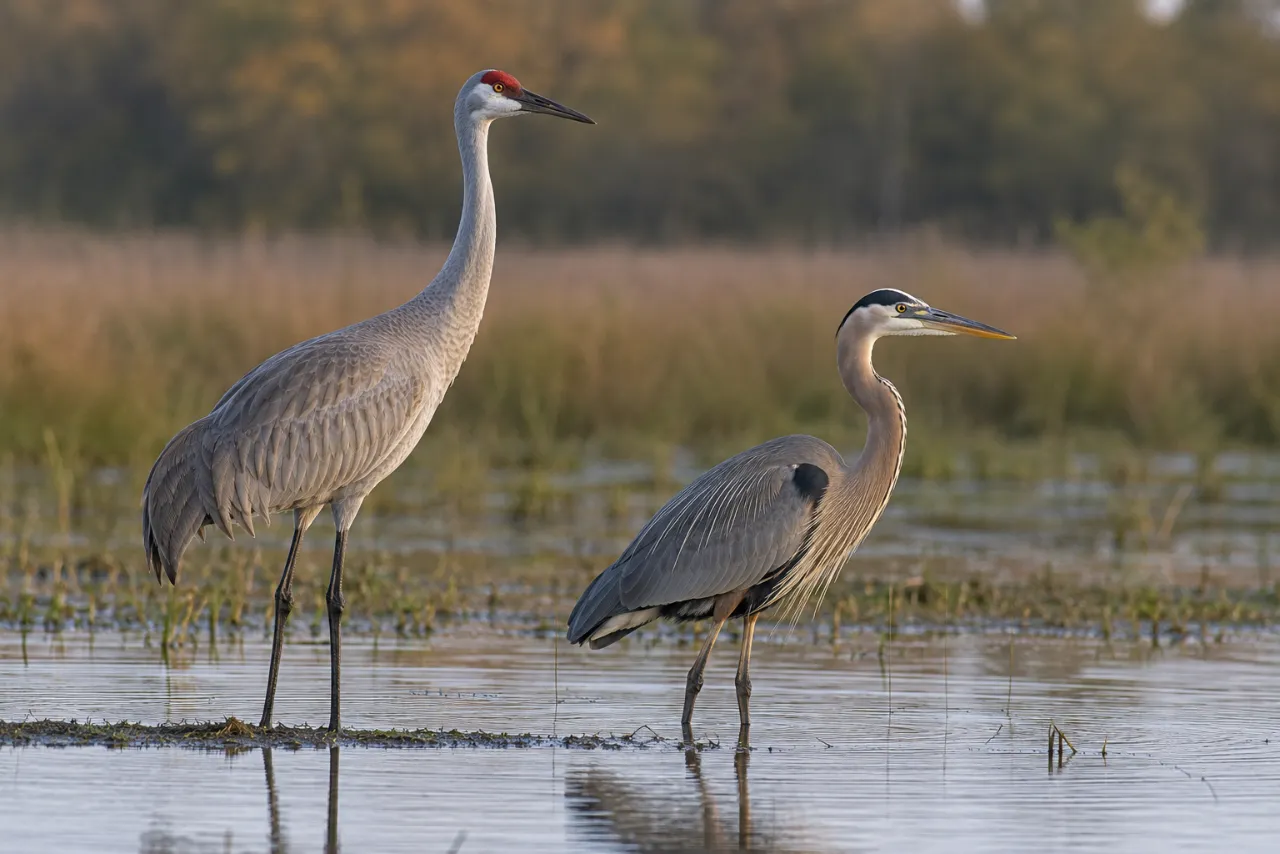
Crane vs Heron Quick Answer
The easiest way to tell a crane from a heron is to watch the bird in flight. A crane flies with its neck extended straight forward, while a heron usually flies with its neck pulled back in a curved S-shape. On the ground, cranes often look more upright, social, and open-country adapted. Herons usually look more solitary, patient, and predatory, standing still at the water’s edge before striking fish, frogs, or other aquatic prey.
Crane vs Heron Summary Table
| Feature | Crane | Heron |
|---|---|---|
| Family | Gruidae | Ardeidae |
| Bird group | Cranes | Herons, egrets, and bitterns |
| Flight posture | Neck stretched straight forward | Neck usually folded into an S-shape |
| Body posture | Often upright and tall | Often hunched, still, or crouched while hunting |
| Bill shape | Long, straight, usually less dagger-like | Long, sharp, dagger-like bill for spearing prey |
| Diet | Omnivorous: seeds, grains, roots, insects, amphibians, small animals | Mostly carnivorous: fish, frogs, insects, crustaceans, reptiles, small mammals |
| Feeding style | Walks and probes or picks food from land and shallow water | Stands still, stalks slowly, then strikes quickly |
| Social behavior | Often social, especially during migration and roosting | Often solitary while feeding, though many nest in colonies |
| Calls | Loud, bugling or trumpeting calls | Usually harsh croaks, squawks, or low calls |
| Courtship | Famous for dancing, leaping, bowing, and calling | Uses displays, plumes, bill movements, and nesting rituals |
| Typical habitat | Wetlands, marshes, grasslands, prairies, agricultural fields | Marshes, rivers, lakes, ponds, mangroves, shorelines, swamps |
| Quick identification clue | Neck straight in flight, loud calls, often in groups | Neck folded in flight, patient fish-hunting posture |
What Is a Crane?
A crane is a tall, long-legged bird in the family Gruidae. Cranes are known for their elegant posture, loud calls, long-distance migrations, and dramatic courtship dances. Many crane species live in wetlands, marshes, prairies, grasslands, and agricultural fields. Some are among the tallest flying birds in the world.
Cranes are usually omnivorous. They may eat seeds, grains, tubers, roots, berries, insects, worms, snails, frogs, small reptiles, and even small mammals. Their diet changes with season and habitat. Many cranes forage by walking slowly across open ground or shallow water, picking food from the surface or probing into mud and vegetation.
What Is a Heron?
A heron is a long-legged wading bird in the family Ardeidae. This family includes true herons, egrets, and bitterns. Herons are famous for their patient hunting style. They often stand motionless in shallow water, waiting for fish or frogs to come close, then strike with a sudden thrust of the bill.
Herons usually have long legs, long necks, broad wings, and sharp bills. Many species live near freshwater or coastal wetlands, including rivers, ponds, lakes, marshes, mangroves, mudflats, and swamps. Some species, such as the great blue heron, are large and highly visible, while others, such as bitterns, are secretive and camouflaged among reeds.
Quick Visual Difference
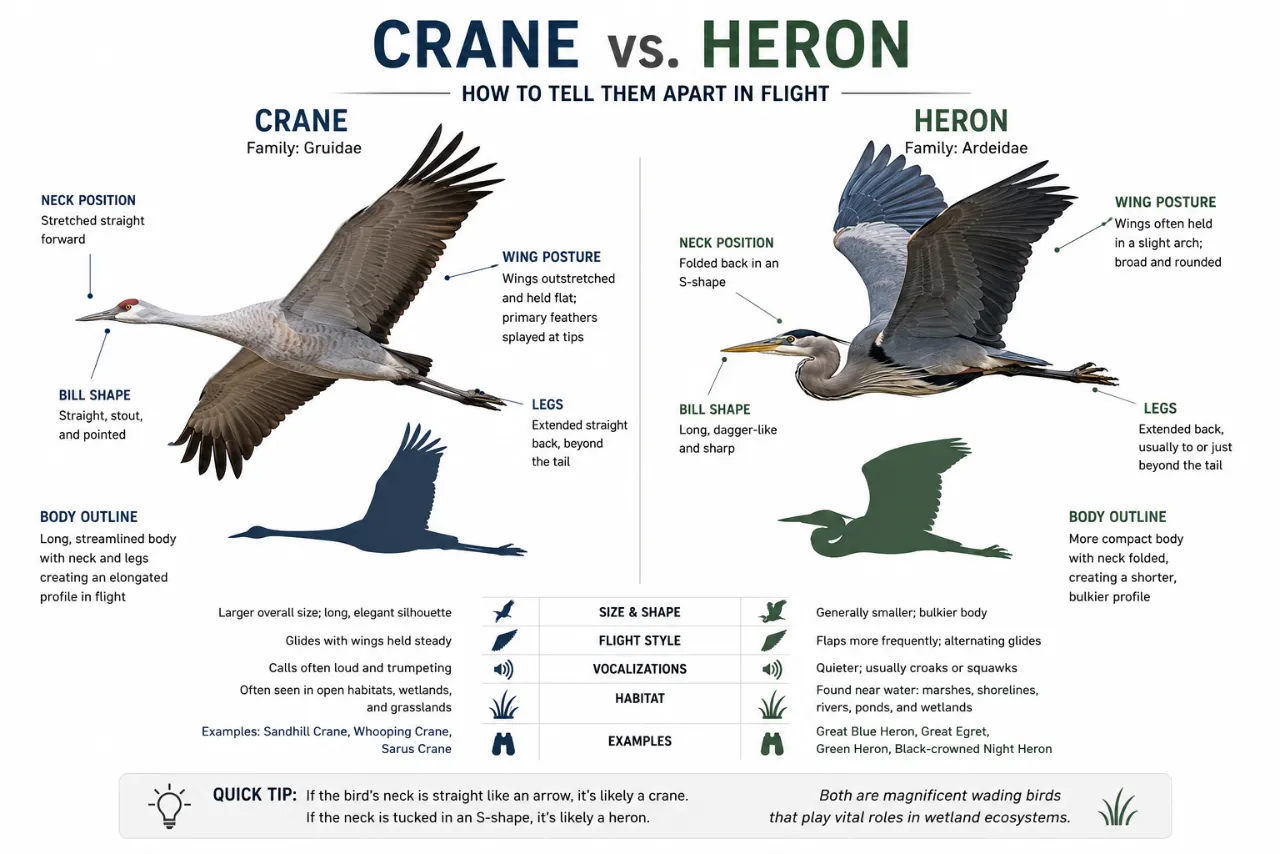
The most reliable quick clue is the neck in flight. Cranes fly with the neck extended straight forward and the legs trailing behind. Herons usually fly with the neck folded back, creating a curved, tucked-in shape between the head and shoulders.
Crane: long neck held straight in flight, long legs trailing behind, often seen in groups.
Heron: neck folded in flight, broad wings, slow wingbeats, often seen alone while hunting.
Crane: loud trumpeting or bugling calls, especially in flocks.
Heron: harsh croaks or squawks, often quieter and more solitary.
Flight Posture: The Best Identification Clue
If you only remember one difference, remember this: cranes fly with straight necks, herons fly with folded necks.
A flying crane looks stretched from head to tail. The neck points forward, the legs trail behind, and the body appears long and balanced. This creates a clean, extended silhouette. Migrating cranes may fly in lines or V-shaped formations, calling loudly as they travel.
A flying heron looks more compact at the front. Its long neck is bent backward into an S-shape, so the head appears closer to the body. The legs still trail behind, but the folded neck gives the bird a more rounded, hunched flight profile. This is often the fastest way to separate a heron from a crane, stork, or ibis.
Neck Shape and Posture on the Ground
Both birds have long necks, but they use them differently. Cranes often stand tall with the neck held upright or extended. Their posture looks alert, elegant, and open. They may walk through grasslands or wetlands with slow, deliberate steps.
Herons often hold the neck in a curved S-shape, especially while hunting. This coiled neck acts like a spring. When prey comes close, the heron can shoot its head forward very quickly. This hunting posture gives herons their classic still, patient appearance.
On land, a crane often looks like a tall walking bird. A heron often looks like a waiting hunter.
Bill Shape and Feeding Tools
Cranes usually have long, straight bills that are useful for picking, probing, and handling a wide variety of foods. Their bills are not usually as sharp and spear-like as a heron’s bill. This matches their varied diet, which may include both plant and animal material.
Herons have sharper, more dagger-like bills. Their bills are excellent tools for catching fish, frogs, crayfish, insects, snakes, and other small animals. Some herons spear prey, while others grasp it with the bill. The bill is a major part of their hunting strategy.
In simple terms, a crane’s bill is a general-purpose foraging tool, while a heron’s bill is a precision hunting weapon.
Diet and Feeding Behavior
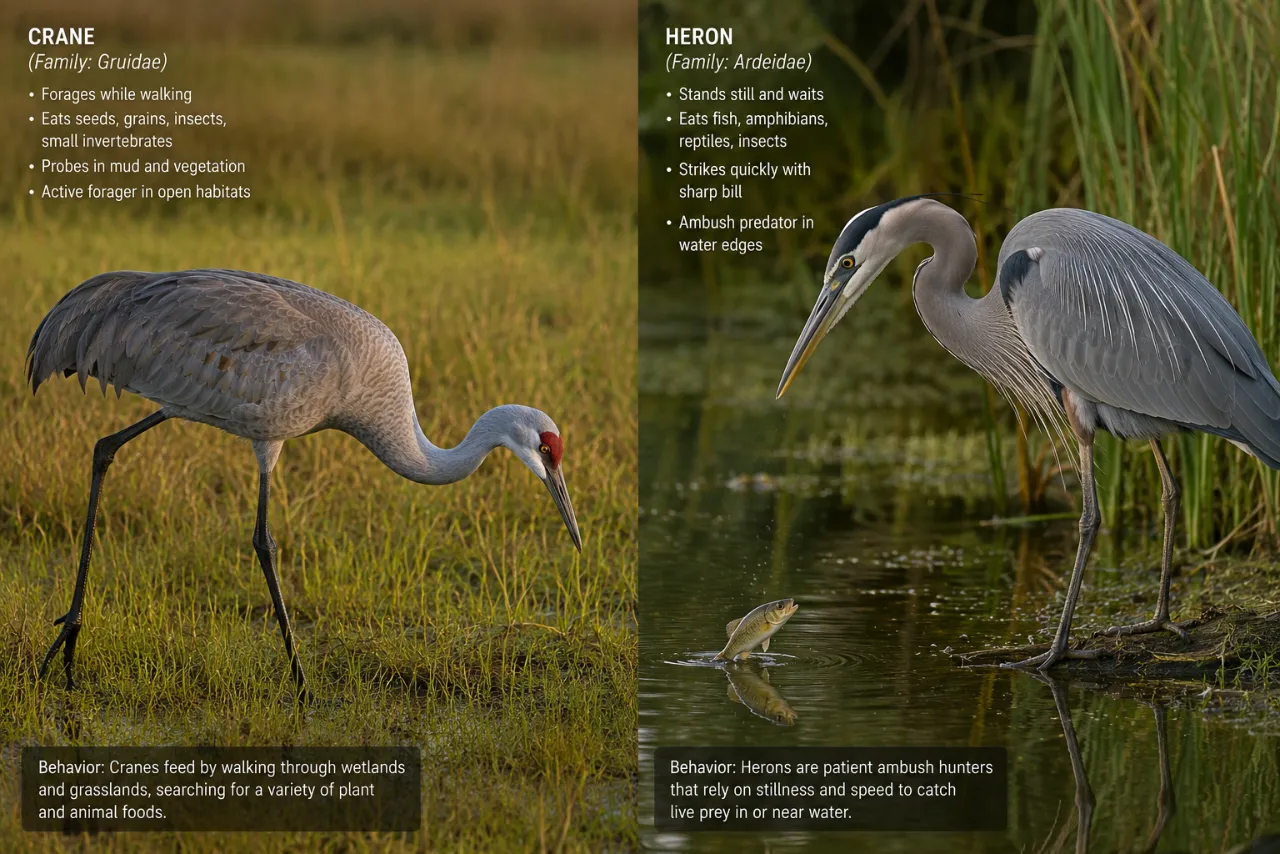
Cranes are usually omnivores. They may feed in marshes, fields, meadows, and shallow water. Depending on the species and season, they may eat grain, seeds, roots, aquatic plants, insects, snails, amphibians, reptiles, and small animals. Some cranes are often seen in agricultural fields after harvest, feeding on leftover grain.
Herons are more strongly predatory. They specialize in catching animals from water or wetland edges. Fish are a major food source for many heron species, but they also eat frogs, tadpoles, crabs, insects, lizards, snakes, small birds, and rodents. Their feeding style is usually based on patience, stealth, and a sudden strike.
A crane walks and searches. A heron waits and strikes.
Habitat Differences
Cranes are often associated with wetlands, but many species also use open grasslands, prairies, savannas, tundra, and farmland. They may nest in marshes or wet meadows, then feed in nearby fields or open landscapes. During migration, some cranes gather in large numbers at traditional stopover sites.
Herons are more tightly linked to water edges. They are common around ponds, lakes, rivers, marshes, swamps, mangroves, mudflats, and coastal wetlands. Many herons need shallow water where prey is visible and accessible. Some species also forage in fields or ditches, but they are usually most strongly associated with aquatic prey.
If the bird is walking through an open grain field with a flock, it may be a crane. If it is standing alone at the edge of a pond waiting for fish, it is more likely a heron.
Social Behavior
Cranes are often highly social at certain times of year. They may migrate in flocks, roost together in wetlands, and use loud calls to maintain contact. Many crane species form strong pair bonds, and their courtship dances are famous. These dances may include bowing, leaping, wing-flapping, tossing vegetation, and synchronized calling.
Herons are often solitary while feeding. A great blue heron or gray heron may defend a feeding area and avoid close neighbors. However, many herons nest in colonies called heronries or rookeries, where multiple pairs build nests in trees, shrubs, reeds, or other protected areas.
So cranes are often more visibly social in open areas, while herons may be solitary hunters but colonial nesters.
Calls and Sounds
Cranes are known for loud, resonant calls. Many species produce trumpeting or bugling sounds that can carry over long distances. These calls help pairs stay connected, flocks coordinate movement, and birds defend territories.
Heron calls are usually harsher and less musical. Many herons make croaks, squawks, grunts, or rough flight calls. Some are mostly quiet unless disturbed, flying, or near the nest. Their calls rarely have the musical, carrying quality of crane calls.
If you hear a loud, rolling trumpet from a group of long-legged birds, cranes are more likely. If you hear a harsh croak from a bird lifting off from a pond, it may be a heron.
Nesting and Young
Cranes often nest on the ground in wetlands or wet meadows, building nests from reeds, grasses, sedges, and other plant material. Many crane chicks are precocial, meaning they can walk soon after hatching. The parents guide them through feeding areas and protect them from danger.
Herons often nest in trees, shrubs, reeds, or colonies near water. Their nests are commonly made of sticks or reeds, depending on species and habitat. Heron chicks are more helpless at hatching and remain in the nest while parents bring food.
This difference reflects their lifestyles. Crane chicks follow parents on the ground, while heron chicks usually develop in nests above water or in vegetation.
Size Comparison
Size can help, but it is not always enough. Some cranes are very tall and can be much larger than many herons. For example, large crane species such as the sarus crane or whooping crane are taller than most herons.
However, some herons are also large. The great blue heron, gray heron, and goliath heron can look crane-like at first glance because they have long legs, long necks, and broad wings. Smaller cranes and large herons can overlap visually, especially from a distance.
Because of this overlap, flight posture and feeding behavior are usually more reliable than size alone.
Common Species People Confuse
Some birds are especially likely to be mistaken for one another. In North America, people often confuse sandhill cranes with great blue herons. Both are large gray birds with long legs and long necks, and both may be seen in wetlands. But in flight, the sandhill crane keeps its neck straight, while the great blue heron folds its neck.
In Europe and Asia, gray herons may be confused with cranes from a distance. Again, the folded neck in flight usually identifies the heron. In Africa, large herons and crowned cranes may share wetland habitats, but cranes usually show more upright posture, different head ornamentation, and more social behavior.
Crane vs Heron vs Stork
Storks are another long-legged bird group that people confuse with cranes and herons. Storks usually fly with their necks extended, like cranes, but they belong to a different family. Many storks have heavier bills, broader wings, and different feeding behavior.
A simple rule is:
Heron: neck folded in flight, dagger bill, fish-hunting posture.
Crane: neck straight in flight, loud calls, dancing, often omnivorous.
Stork: neck straight in flight, heavier bill, often soars on broad wings.
This rule is not perfect for every species, but it works well for many common field identifications.
Crane vs Heron vs Egret
Egrets are not separate from herons in the broad sense. They are members of the heron family, Ardeidae. Many egrets are white, slender, and elegant, with long necks and sharp bills. Like other herons, they usually fly with the neck folded.
If you see a white long-legged bird standing in shallow water and striking at fish, it may be an egret. If it flies away with the neck tucked back, that confirms it is heron-like rather than crane-like.
How to Identify One in a Photo
When looking at a photo, use several clues together:
Check the neck in flight: straight neck suggests crane; folded neck suggests heron.
Check the hunting posture: still, crouched, fish-stalking posture suggests heron.
Check the group: large flock in open wetlands or fields may suggest cranes.
Check the bill: sharp dagger-like bill suggests heron; straighter general-purpose bill suggests crane.
Check the sound: loud trumpeting calls suggest cranes; harsh croaks suggest herons.
Check the habitat: pond edge fishing suggests heron; open marsh or field foraging suggests crane.
Common Misidentifications
The most common mistake is calling any large gray wading bird a crane. Many “cranes” seen at backyard ponds are actually herons, especially great blue herons or gray herons. Herons are common around fish ponds, lakes, and drainage ditches, while cranes are often more associated with marshes, open wetlands, and migration routes.
Another mistake is relying only on color. Both cranes and herons can be gray, white, brown, black, or patterned depending on species. Color can support identification, but it should not be the only clue. Neck position, feeding style, and flight silhouette are more reliable.
Which Bird Is More Common Around Backyard Ponds?
In many places, a large bird standing at a backyard pond is more likely to be a heron than a crane. Herons are skilled fish hunters and may visit garden ponds, farm ponds, wetlands, and small lakes if prey is available. A great blue heron, for example, may stand still for long periods before striking fish.
Cranes may also visit open fields, wetlands, and shallow water, but they are less likely to behave like a pond-edge fish specialist. If the bird is repeatedly hunting fish in a small pond, heron is the better guess.
Conservation and Human Impact
Cranes and herons both depend on healthy wetlands, but their conservation situations vary by species. Some herons are common and adaptable, while others are threatened by wetland loss, pollution, disturbance, and habitat degradation. Because many herons feed high in aquatic food webs, water quality and prey availability matter greatly.
Many crane species are conservation concerns because they need large wetlands, safe migration routes, and undisturbed breeding areas. Some species have suffered from habitat loss, hunting, power-line collisions, poisoning, and human disturbance. Crane conservation often requires protecting breeding grounds, migration stopovers, and wintering habitats across multiple countries.
Wetland protection benefits both cranes and herons, along with fish, amphibians, insects, reptiles, and many other birds.
Final Comparison
Cranes and herons may look similar at first because both are tall, long-legged birds often seen near water. But they are easy to separate once you know the main clues. Cranes fly with the neck straight, call loudly, often gather in groups, and eat a wide range of plant and animal foods. Herons fly with the neck folded, hunt with a dagger-like bill, and often stand alone in shallow water waiting for prey.
If the bird is flying with a straight neck and calling in a flock, think crane. If it is standing motionless at the edge of water or flying with its neck tucked back, think heron.
Related Bird Comparisons
Heron vs Egret
Crane vs Stork
Stork vs Heron
Ibis vs Heron
Great Blue Heron vs Sandhill Crane
Flamingo vs Crane
FAQs About Crane vs Heron
Is a crane the same as a heron?
No. Cranes and herons are different types of birds. Cranes belong to the family Gruidae, while herons belong to the family Ardeidae. They may look similar because both have long legs and long necks, but they differ in flight posture, feeding behavior, calls, and social habits.
How can you tell a crane from a heron in flight?
A crane usually flies with its neck stretched straight forward. A heron usually flies with its neck folded back into an S-shape. This is one of the best and fastest identification clues.
Do cranes and herons eat the same food?
Not exactly. Cranes are usually omnivores and may eat seeds, grains, roots, insects, amphibians, and small animals. Herons are more strongly carnivorous and often eat fish, frogs, crustaceans, reptiles, and small mammals.
Are herons more solitary than cranes?
Herons are often solitary while feeding, although many nest in colonies. Cranes are often more social during migration, roosting, and pair displays. Some cranes gather in large flocks at important wetlands and fields.
Do cranes hunt fish like herons?
Cranes may eat aquatic animals, but they do not usually hunt fish in the same patient, spear-like way herons do. Herons are more specialized for standing still in shallow water and striking prey with a sharp bill.
Why do herons fly with their necks folded?
Herons have a specialized neck structure and hunting style that allow the neck to coil and strike quickly. In flight, they typically retract the neck, creating the classic folded-neck silhouette.
Which is bigger, a crane or a heron?
Many cranes are taller and heavier than most herons, but size overlaps. Large herons can look crane-like from a distance, so neck position in flight is usually a better clue than size alone.
Are egrets cranes or herons?
Egrets are herons. They belong to the heron family, Ardeidae. Many egrets are white and slender, and like other herons, they usually fly with their necks folded.