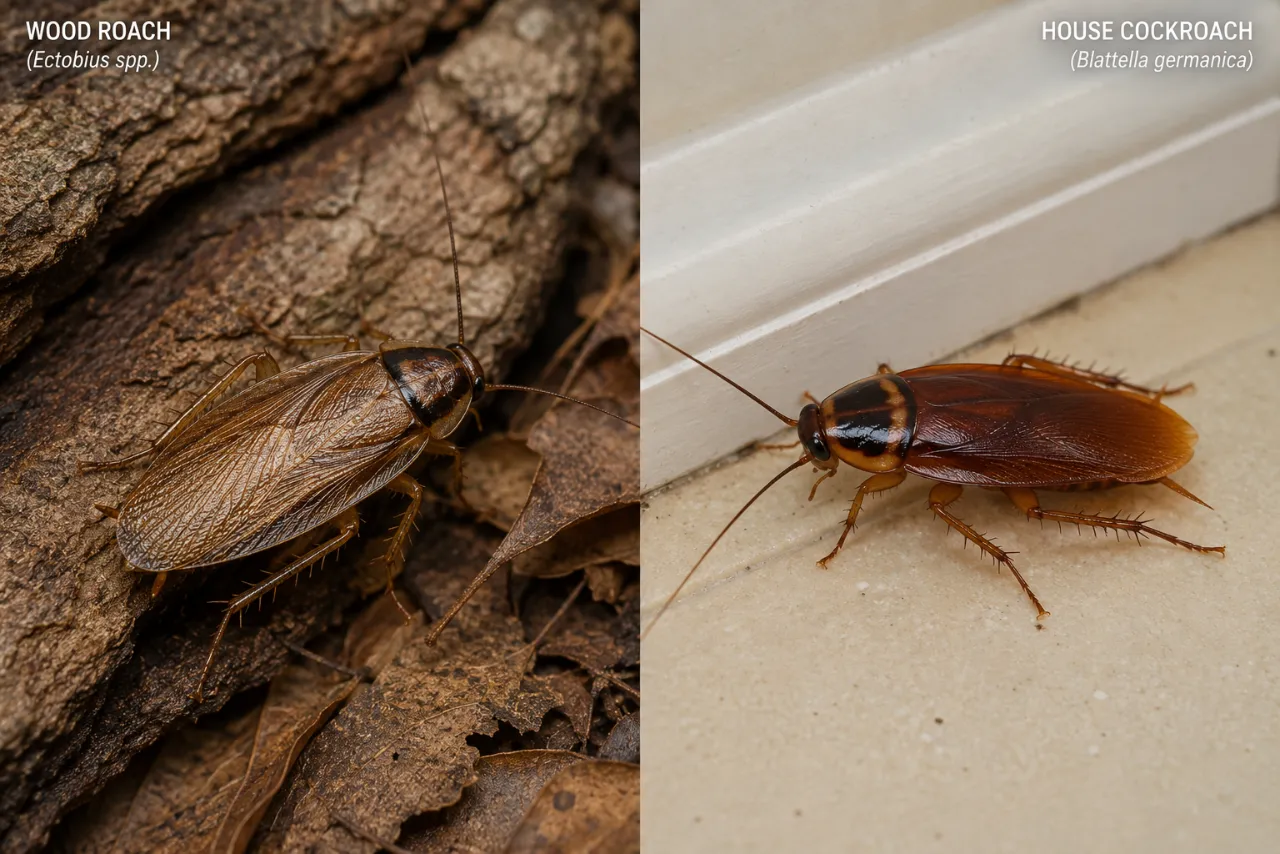
A wood roach is a type of cockroach, but it behaves very differently from common household pest cockroaches. Wood roaches usually live outdoors in leaf litter, wood piles, bark, logs, and forest edges. They may accidentally enter homes, especially males attracted to lights, but they usually do not breed indoors. Household cockroaches, such as German or American cockroaches, are more likely to infest kitchens, bathrooms, basements, and drains.
Wood Roach vs Cockroach Quick Answer
The biggest difference is infestation behavior. Wood roaches are outdoor cockroaches that usually wander indoors by accident and struggle to survive inside. Common household cockroaches actively live near people, hide in cracks, feed on indoor food sources, and reproduce inside buildings. If you see a roach flying toward porch lights or coming from firewood, it may be a wood roach. If you see many roaches at night in the kitchen, it is more likely a household pest species.
Wood Roach vs Cockroach Summary Table
| Feature | Wood Roach | Common Household Cockroach |
|---|---|---|
| Basic identity | A type of outdoor cockroach | A broad group that includes indoor pest species |
| Common examples | Pennsylvania wood roach and related Parcoblatta species | German, American, Oriental, brown-banded, and smoky brown cockroaches |
| Main habitat | Forests, wood piles, leaf litter, bark, logs, tree stumps, mulch | Kitchens, bathrooms, drains, basements, wall voids, pantries, warm cracks |
| Indoor infestation risk | Low; usually accidental indoors | Moderate to high depending on species |
| Breeds indoors? | Usually no | Yes, many pest species can reproduce indoors |
| Attracted to light? | Often yes, especially flying males | Many indoor pest roaches avoid light and hide in darkness |
| Time most often seen | Spring and summer, often near lights or firewood | Year-round indoors if infestation is established |
| Flight ability | Males often fly well; females may have shorter wings depending on species | Varies by species; some glide or fly, many mostly run |
| Food sources | Decaying plant matter, organic debris, wood-associated material | Food crumbs, grease, garbage, starches, pet food, organic waste |
| Best control method | Exclude from home, reduce lights, move wood piles, seal gaps | Sanitation, baiting, crack treatment, moisture control, professional pest management |
| Quick identification clue | Seen near lights, wood, mulch, logs, or windows; not usually in groups indoors | Seen repeatedly in kitchens, bathrooms, cabinets, appliances, or drains |
What Is a Wood Roach?
A wood roach is an outdoor cockroach that lives in natural wooded environments. In North America, people often use the name for species in the genus Parcoblatta, such as the Pennsylvania wood roach. These insects are part of the cockroach order, but they do not behave like the classic indoor pest roaches that infest kitchens and apartment buildings.
Wood roaches live in leaf litter, under bark, inside decaying logs, beneath loose wood, around stumps, in firewood piles, and in moist outdoor organic material. They help break down decaying plant matter and are part of the natural recycling system in forest ecosystems.
They sometimes enter homes by accident. A wood roach may come in with firewood, crawl through gaps around doors, or fly toward outdoor lights and then find its way inside. This can be alarming, but one or two wood roaches indoors usually does not mean a serious infestation.
What Is a Cockroach?
“Cockroach” is a broad term for insects in the order Blattodea. There are thousands of cockroach species in the world, and most do not live in houses. Many are outdoor decomposers that spend their lives in soil, leaves, rotting wood, caves, forests, or tropical habitats.
However, a few cockroach species have adapted very well to human buildings. These include German cockroaches, American cockroaches, Oriental cockroaches, brown-banded cockroaches, and smoky brown cockroaches. These species are the ones most people think of when they hear the word “cockroach.”
So the important point is this: all wood roaches are cockroaches, but not all cockroaches are indoor pests.
Quick Visual Difference
Wood roaches can look similar to some household cockroaches, especially American cockroaches or other brown roaches. The best identification method is to combine appearance with behavior and location.
Wood roach: usually found near wood piles, mulch, logs, trees, porch lights, windows, or outdoor entry points.
Household cockroach: usually found repeatedly in kitchens, bathrooms, cabinets, drains, appliances, or dark cracks.
Wood roach: often active in daylight or attracted to lights, especially males.
Household cockroach: usually hides from light and becomes active at night.
Wood roach: usually appears singly or in small numbers indoors.
Household cockroach: may appear in repeated sightings, with droppings, egg cases, or many individuals.
Body Shape and Appearance
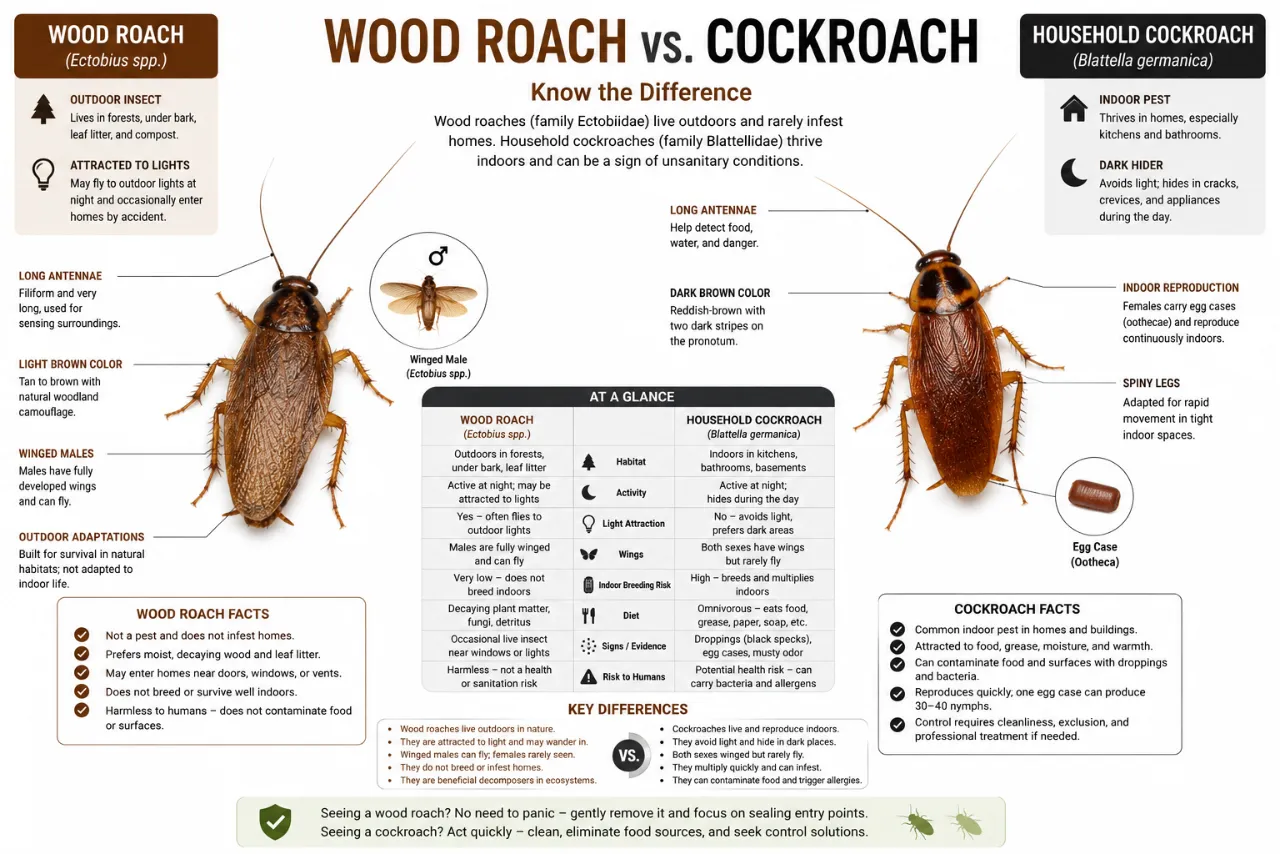
Wood roaches are usually brown, flattened, oval insects with long antennae and spiny legs. Adult males often have fully developed wings and can fly. Females of some species may have shorter wings and a more compact body. Their color is often tan to chestnut brown, sometimes with lighter edges or markings near the thorax.
Household cockroaches vary by species. German cockroaches are smaller and usually light brown with two dark stripes behind the head. American cockroaches are much larger and reddish-brown, often with a pale yellowish margin behind the head. Oriental cockroaches are darker, shinier, and less likely to fly. Brown-banded cockroaches are small and have pale bands across the wings or body.
Because color alone can be misleading, behavior is often more useful than appearance. A brown roach found in a wood pile is not the same problem as a brown roach running behind a refrigerator at night.
Habitat: Forest Floor vs Human Buildings
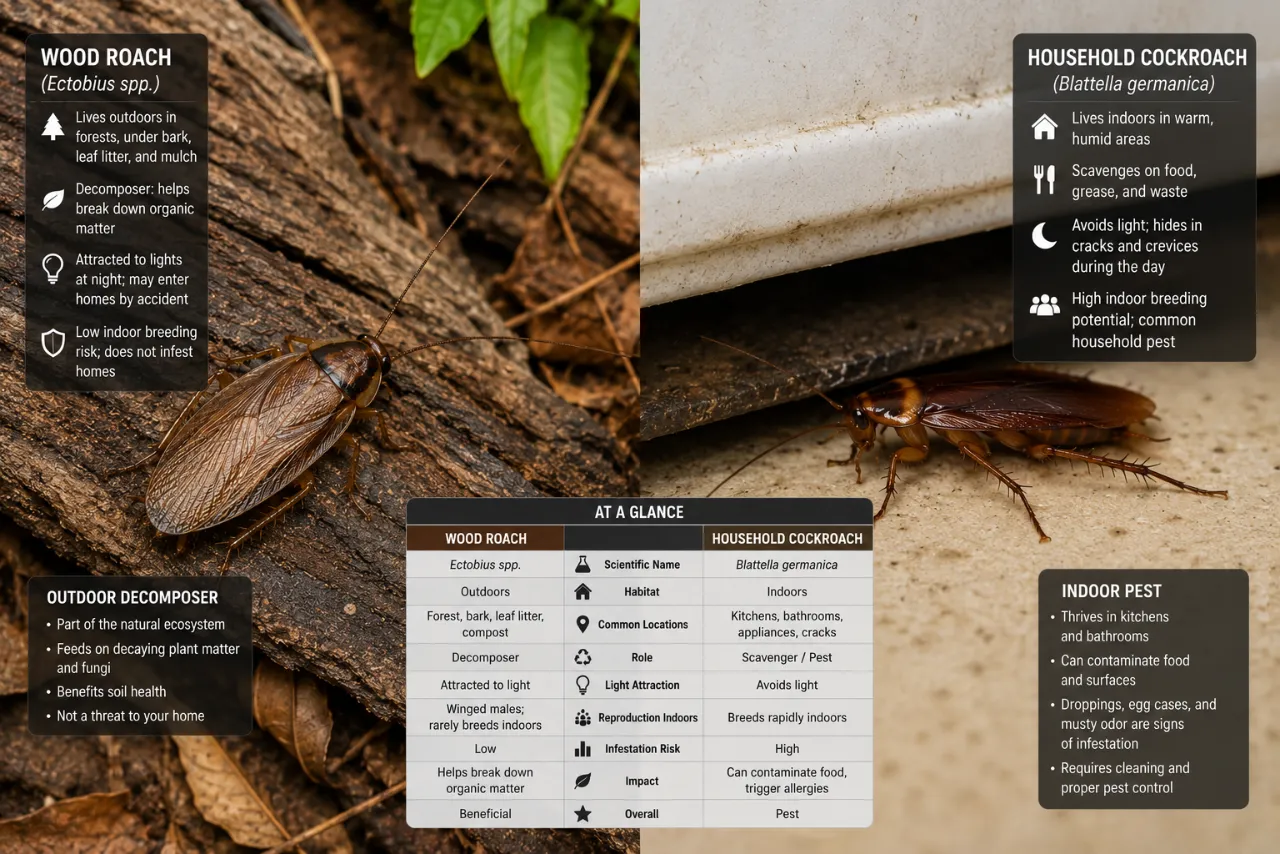
The natural home of a wood roach is outside. Wood roaches prefer damp, organic habitats with decaying wood, bark, leaves, mulch, and plant debris. They are common around wooded yards, cabins, forest edges, stacked firewood, and shaded landscapes with plenty of organic matter.
Household cockroaches prefer places where food, water, warmth, and hiding spaces are available. German cockroaches often live in kitchens, restaurants, apartments, and food-preparation areas. American cockroaches may live in sewers, drains, basements, crawl spaces, and boiler rooms. Oriental cockroaches often prefer cool, damp areas such as basements, utility spaces, and floor drains.
This habitat difference is the most important clue: wood roaches belong outdoors; pest cockroaches can build indoor populations.
Behavior: Light Attraction vs Light Avoidance
Wood roaches are often attracted to lights. This is especially true for adult males during warmer months. They may fly toward porch lights, windows, garage lights, or illuminated walls. As a result, homeowners may suddenly see wood roaches near doors or inside rooms with bright windows.
Many household cockroach species behave differently. German cockroaches, for example, are strongly associated with dark hiding places and usually run away when lights are turned on. Seeing roaches scatter at night in a kitchen is more typical of an indoor pest cockroach problem than a wood roach issue.
If the insect is flying near outdoor lights, it may be a wood roach. If it is hiding behind appliances, under sinks, or inside cabinets, it is more likely a household cockroach.
Do Wood Roaches Infest Homes?
Wood roaches usually do not infest homes in the same way German cockroaches do. They may enter houses, but indoor conditions are often too dry and unsuitable for them. They generally do not find the same natural food, moisture, and habitat they need to reproduce successfully indoors.
That said, repeated sightings can happen if there is a strong outdoor population close to the house. Firewood piles, mulch beds, leaf litter, rotting logs, damp crawl spaces, and exterior lights can all increase the chance of wood roaches entering accidentally.
One wood roach indoors is usually not a reason to panic. Repeated sightings near the kitchen, bathroom, or food storage areas require closer inspection to make sure the insects are not a true indoor pest species.
Do Household Cockroaches Infest Homes?
Yes. Some cockroach species are highly adapted to indoor life. German cockroaches are especially serious household pests because they reproduce quickly, hide well, and can develop large populations in kitchens, bathrooms, and apartment buildings.
Indoor cockroach infestations often leave signs beyond seeing one insect. These may include small dark droppings, shed skins, egg cases, unpleasant odor, roaches of different sizes, and repeated nighttime activity. The presence of young nymphs is especially important because it suggests breeding nearby.
If roaches are appearing repeatedly in food areas, near water sources, or inside cabinets, the situation should be treated as a possible infestation.
Diet and Feeding Differences
Wood roaches mostly feed on decaying organic matter. Outdoors, they help process fallen leaves, soft wood, bark, fungi, and plant debris. This makes them useful decomposers in woodland ecosystems.
Household cockroaches are much more opportunistic around human food. They may eat crumbs, grease, starches, sweets, meat residue, garbage, pet food, cardboard glue, soap residue, and many forms of organic waste. Their ability to survive on tiny food sources makes them difficult pests once established indoors.
A wood roach is mainly a forest recycler. A household cockroach is often a human-building scavenger.
Seasonal Patterns
Wood roach sightings often increase in spring and summer. Males may fly in search of mates and can be drawn to lights. People may also bring wood roaches indoors with firewood. Cabins, wooded homes, and houses near forests may see them more often during warm months.
Household cockroaches can be active year-round indoors. In heated buildings, species such as German cockroaches do not need warm outdoor weather to reproduce. If food and water are available, populations can continue through winter.
Season is another useful clue: a few roaches near porch lights in summer may be wood roaches; year-round kitchen activity suggests an indoor pest species.
Wood Roach vs German Cockroach
The German cockroach is one of the most important species to separate from wood roaches. German cockroaches are smaller, usually light brown, and have two dark parallel stripes on the shield-like area behind the head. They are strongly associated with indoor infestations and reproduce quickly.
Wood roaches are more associated with outdoor wood and lights. They are usually not found breeding behind refrigerators, under sinks, or in cabinets. German cockroaches, by contrast, often hide in cracks near warmth, moisture, and food.
If you see many small roaches in a kitchen at night, German cockroaches are a stronger possibility than wood roaches.
Wood Roach vs American Cockroach
American cockroaches are large, reddish-brown roaches often associated with sewers, basements, drains, crawl spaces, and damp utility areas. They may enter homes and can survive in buildings with suitable moisture and food.
Wood roaches may look somewhat similar because they are brown and winged, but they are more likely to be found near outdoor lights, firewood, mulch, or wooded areas. American cockroaches are more likely to appear around drains, floor openings, and damp interior spaces.
If the roach is large and found repeatedly in a basement or bathroom, it may not be a harmless wood roach.
How to Identify One in a Photo
When identifying a roach from a photo, look at both the insect and the setting. A single close-up image may not be enough, but these clues can help:
Check the location: on firewood, bark, mulch, or porch lights suggests wood roach.
Check the pattern: two dark stripes behind the head suggest German cockroach.
Check the color: very large reddish-brown body with yellowish thorax edge may suggest American cockroach.
Check the wings: flying males near lights may be wood roaches, but winged roaches are not always wood roaches.
Check the number: one or two wanderers suggests wood roach; many sightings indoors suggest infestation.
Check for nymphs: young roaches indoors suggest breeding and should be taken seriously.
Common Misidentifications
The most common mistake is assuming every roach inside a house is a dangerous infestation. Wood roaches can accidentally enter clean homes, especially homes near woods. They may look unpleasant, but they usually do not establish indoor colonies.
The opposite mistake is also possible: assuming every brown roach is just a wood roach. This can allow a real German cockroach or American cockroach infestation to grow unnoticed. Repeated sightings, small nymphs, droppings, egg cases, or roaches hiding in kitchen cracks should not be ignored.
The best approach is to identify the species, observe the location, and look for signs of reproduction.
Are Wood Roaches Dangerous?
Wood roaches are not dangerous in the way many people fear. They do not bite people in any meaningful way, do not attack pets, and usually do not damage household structures. Their main problem is nuisance entry.
However, any insect that comes from outdoors can carry dirt or microbes on its body, so it is still reasonable to remove them from living spaces. The important point is that wood roaches are usually not a sanitation problem at the same level as established indoor cockroach infestations.
Are Household Cockroaches Dangerous?
Household cockroaches can be more concerning. They may contaminate food surfaces, trigger allergies or asthma in sensitive people, and spread material from dirty areas to food-preparation zones. Their droppings, shed skins, and body fragments can become indoor allergens.
This does not mean every single cockroach sighting is a disaster, but repeated indoor activity should be taken seriously. Early control is easier than waiting until a population becomes large.
How to Keep Wood Roaches Out
Wood roach control is mostly about exclusion and outdoor habitat management. Since they usually come from outside, indoor spraying alone is not the best long-term solution.
Move firewood piles away from the house.
Store firewood off the ground when possible.
Reduce leaf litter, rotting wood, and heavy mulch next to the foundation.
Seal gaps around doors, windows, pipes, vents, and siding.
Use tight-fitting screens on windows and vents.
Reduce bright outdoor lights during peak activity or use less attractive lighting near doors.
Check firewood before bringing it indoors.
If a wood roach gets inside, it can usually be captured, vacuumed, or removed without major treatment.
How to Control Household Cockroaches
Household cockroach control requires a different approach. If the species is German cockroach or another indoor pest, the goal is to eliminate food, water, hiding places, and breeding sites.
Clean food crumbs, grease, and spills.
Store food in sealed containers.
Do not leave pet food out overnight.
Fix leaks and reduce moisture.
Seal cracks and crevices where roaches hide.
Use cockroach baits carefully according to label directions.
Avoid relying only on sprays, which may scatter roaches without solving the colony.
For heavy infestations, contact a professional pest-control service.
Correct identification matters because wood roaches and indoor pest roaches require different control strategies.
Ecological Role of Wood Roaches
Although people dislike seeing roaches indoors, wood roaches have a useful ecological role outdoors. They help break down dead plant material and recycle nutrients into the soil. They are also food for birds, reptiles, amphibians, spiders, small mammals, and other predators.
In a forest or wooded yard, wood roaches are not “dirty house pests.” They are part of the decomposer community. The goal is not to eliminate them from nature, but to keep them from wandering into human living spaces.
Final Comparison
A wood roach is technically a cockroach, but it is not the same problem as a German cockroach or other indoor pest species. Wood roaches live outdoors, feed on decaying organic matter, and usually enter homes by accident. Household cockroaches are more likely to hide, breed, and feed inside buildings.
If the roach appears near wood, mulch, outdoor lights, or windows in warm weather, it may be a wood roach. If roaches appear repeatedly in kitchens, bathrooms, cabinets, appliances, or drains, treat the situation as a possible household cockroach infestation.
Related Insect Comparisons
German Cockroach vs American Cockroach
Water Bug vs Cockroach
Palmetto Bug vs Cockroach
Asian Beetles vs Ladybugs
Ants vs Termites
Cricket vs Cockroach
FAQs About Wood Roach vs Cockroach
Is a wood roach a cockroach?
Yes. A wood roach is a type of cockroach, but it is usually an outdoor species. It does not behave like common indoor pest cockroaches such as German cockroaches.
Do wood roaches infest houses?
Wood roaches usually do not infest houses. They may wander indoors accidentally, especially from firewood, mulch, wooded yards, or outdoor lights, but they generally do not breed well inside homes.
How can I tell a wood roach from a regular cockroach?
Look at where it was found. A roach near firewood, bark, mulch, porch lights, or windows may be a wood roach. A roach hiding in kitchens, bathrooms, cabinets, drains, or appliances is more likely to be a household pest cockroach.
Why are wood roaches coming into my house?
They may be attracted to lights, entering through gaps, or coming in with firewood. Homes near wooded areas, heavy mulch, logs, or leaf litter are more likely to see them.
Are wood roaches harmful?
Wood roaches are mostly nuisance insects indoors. They do not usually bite, damage structures, or reproduce inside homes. However, they should still be removed from living spaces.
What does a German cockroach look like compared with a wood roach?
German cockroaches are small, light brown, and usually have two dark stripes behind the head. They are strongly associated with indoor infestations, especially in kitchens and bathrooms.
Should I spray for wood roaches?
Spraying indoors is usually not the best first step for wood roaches. Sealing entry points, moving firewood away from the house, reducing mulch near the foundation, and limiting outdoor light attraction are usually more effective.
When should I worry about cockroaches indoors?
You should investigate further if you see roaches repeatedly indoors, find small nymphs, notice droppings or egg cases, or see roaches in kitchens, bathrooms, cabinets, appliances, or drains.