Quick answer
Crayfish and crawfish are generally the same animal. Both names refer to freshwater crustaceans in the order Decapoda, most often belonging to groups such as Astacidae, Cambaridae, or Parastacidae. These animals have a hard exoskeleton, two large front claws, a segmented body, and a tail used for sudden backward movement.
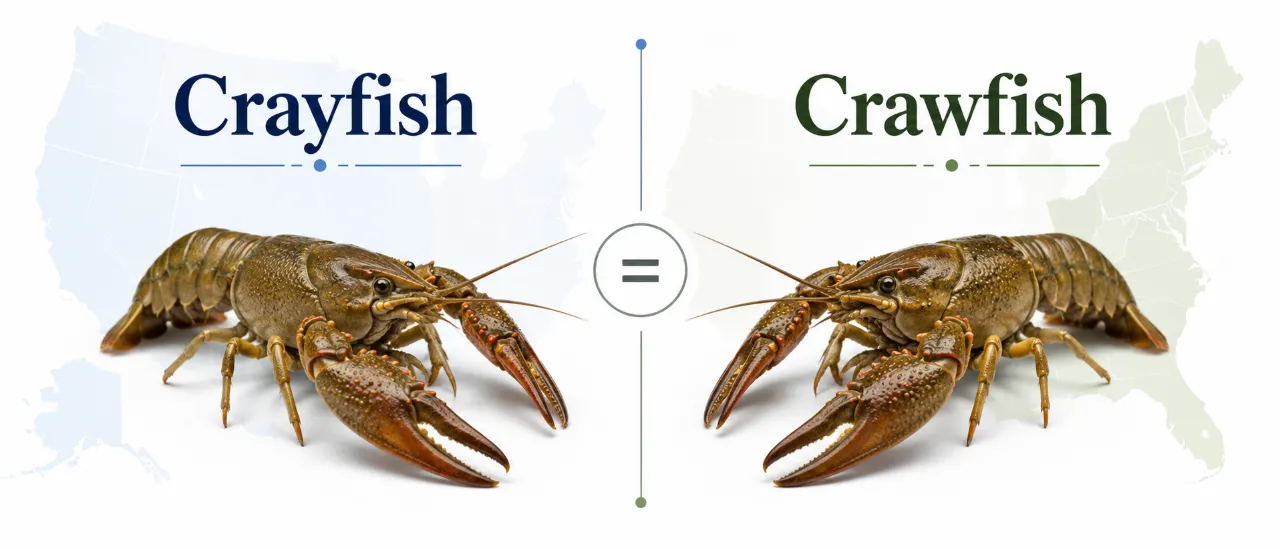
The main difference is word choice. “Crayfish” is widely used in scientific and general English, while “crawfish” is especially common in the southern United States. In Louisiana, where these animals are culturally and commercially important, “crawfish” is the preferred everyday term.
Summary table
| Feature | Crayfish | Crawfish |
|---|---|---|
| Meaning | A common name for freshwater crayfish-like crustaceans | A regional common name for the same animal |
| Biological difference | Generally none | Generally none |
| Common usage | Scientific writing, northern U.S., international English | Southern U.S., especially Louisiana |
| Habitat | Freshwater streams, rivers, lakes, ponds, wetlands, and burrows | Same habitats |
| Diet | Omnivorous: plants, algae, detritus, small animals, and carrion | Same diet |
| Appearance | Miniature lobster-like body with claws and a tail fan | Same appearance |
| Other names | Freshwater crayfish | Crawdad, mudbug |
Why crayfish and crawfish are usually the same animal
The words “crayfish” and “crawfish” usually describe the same type of freshwater crustacean. The animals themselves are not separated by the name people use. A crawfish in Louisiana and a crayfish in a biology textbook may belong to similar or closely related groups, depending on the species.
There are hundreds of crayfish species worldwide. Many live in North America, where species diversity is especially high. Others are found in Europe, Australia, New Zealand, South America, Madagascar, and parts of Asia. The exact species depends on the region, but the general body plan is similar: a tough shell, jointed legs, large claws, stalked eyes, and a muscular abdomen.
Where the names are used
In everyday English, the difference between “crayfish” and “crawfish” is mostly geographic. “Crayfish” is often used in scientific contexts and in many northern or western regions. “Crawfish” is strongly associated with the southern United States, especially Louisiana, Texas, Mississippi, Alabama, and nearby areas.
The word “crawdad” is another common informal name, especially in parts of the United States. “Mudbug” is also used, particularly where these animals are found in muddy wetlands, ditches, or flooded fields. These names are cultural and regional rather than biological.
One important caution is that “crayfish” can mean different things in different countries. In some places, especially in casual seafood language, “crayfish” may refer to marine spiny lobsters rather than freshwater crayfish. For a scientific animal article, it is usually best to specify “freshwater crayfish” when clarity matters.
How to identify a crayfish or crawfish
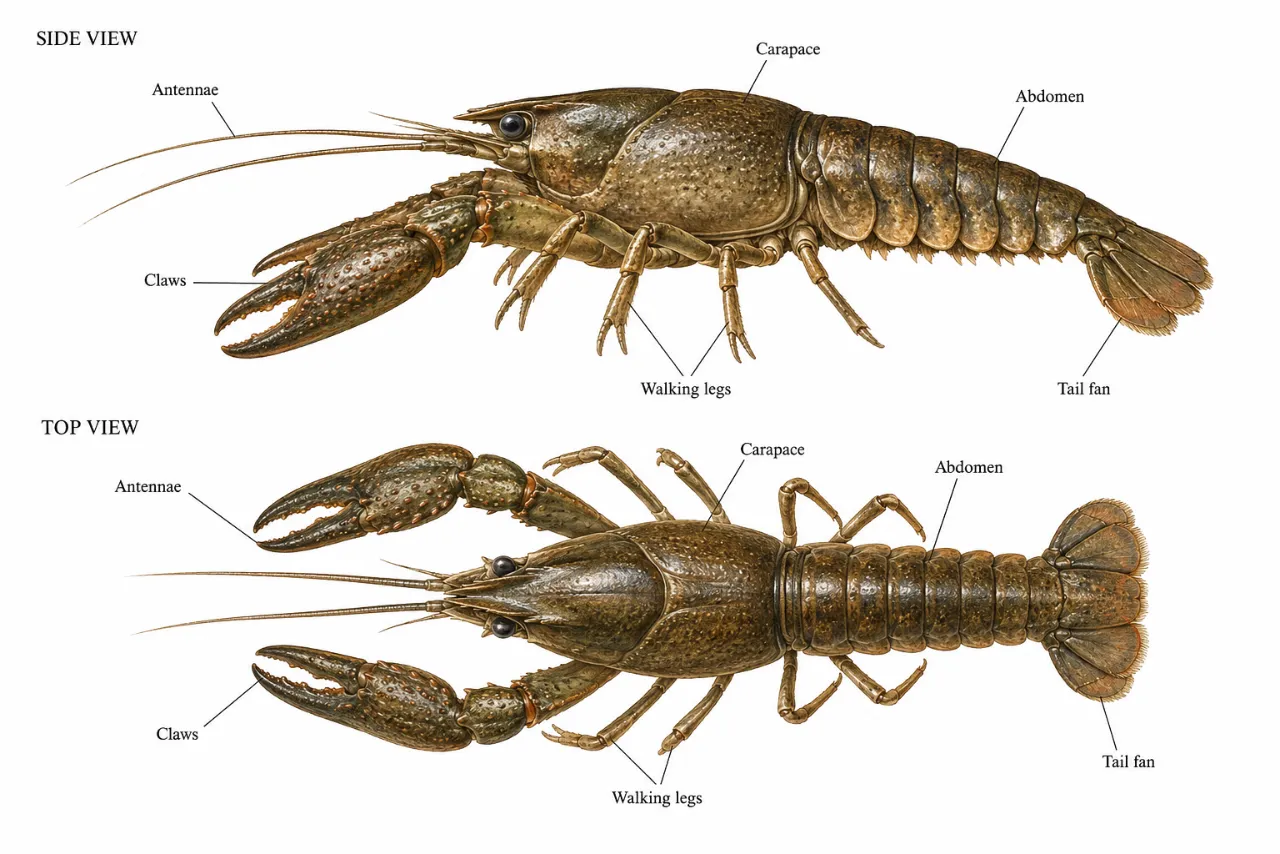
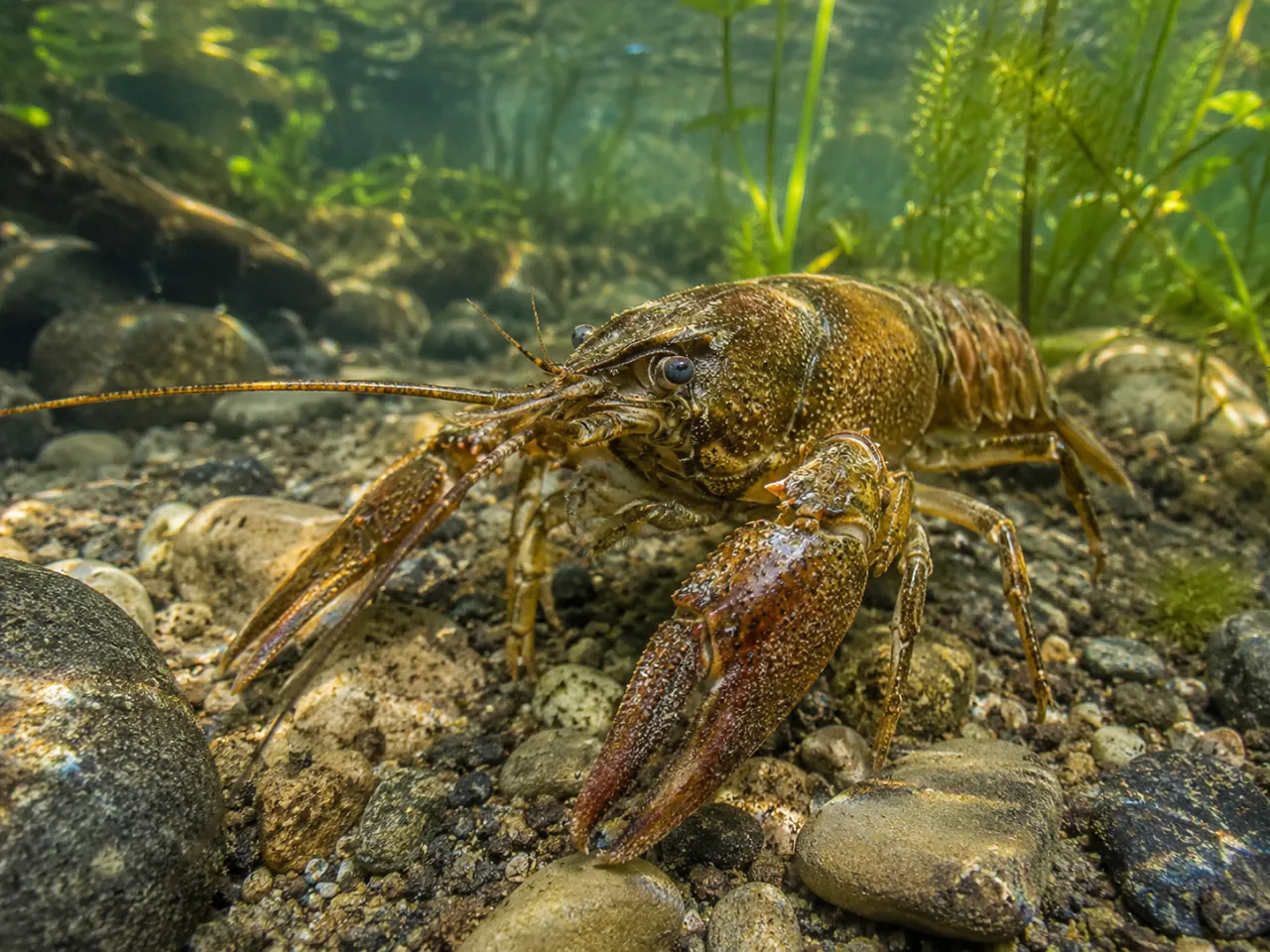
A crayfish or crawfish looks like a small freshwater lobster. It has a cephalothorax, which is the fused head and chest region, and a segmented abdomen that ends in a fan-shaped tail. Most species have two noticeable front claws, also called chelae, which they use for defense, feeding, digging, and social interactions.
The body is covered by a hard exoskeleton. Because the shell does not grow with the animal, crayfish must molt. During molting, the old exoskeleton is shed and a new, soft shell underneath expands and hardens. Freshly molted crayfish are vulnerable because their new shell has not fully hardened.
Color varies widely. Many species are brown, olive, red, gray, blue, orange, or patterned. Color can depend on species, age, habitat, diet, genetics, and environmental conditions. Bright blue crayfish are especially eye-catching, but not all blue individuals belong to the same species.
Where crayfish and crawfish live
Crayfish are primarily freshwater animals. They commonly live in streams, rivers, ponds, lakes, wetlands, swamps, rice fields, roadside ditches, and temporary pools. Some species prefer clear, rocky streams, while others are adapted to muddy water, slow-moving wetlands, or underground burrows.
Burrowing species can survive in places that dry out seasonally. They dig tunnels into moist soil and may plug the entrance with mud. These burrows help them stay damp, avoid predators, and survive changing water levels. In many wetland ecosystems, crayfish burrows also create small shelter spaces used by other organisms.
Water quality is important for many species, but tolerance varies. Some crayfish are sensitive to pollution and habitat disturbance, while others are more adaptable. In general, stable freshwater habitats with shelter, oxygen, and food support healthier populations.
What crayfish and crawfish eat
Crayfish are omnivores. In many species, their diet includes algae, aquatic plants, fallen leaves, decaying organic matter, insect larvae, worms, snails, small fish, fish eggs, and carrion. They are often described as opportunistic feeders because they eat what is available and suitable for their size.
They play an important ecological role as both consumers and recyclers. By feeding on decaying plant and animal matter, they help move nutrients through freshwater ecosystems. At the same time, they are prey for fish, turtles, snakes, birds, raccoons, otters, and many other animals.
Although crayfish can catch small animals, they are not simply aggressive hunters. Much of their feeding is scavenging or grazing. Their strong claws help them handle food, tear soft material, and defend themselves from competitors.
Behavior and defense
Crayfish are usually most active at night or in low-light conditions, although this varies by species and habitat. During the day, many hide under rocks, logs, vegetation, roots, or inside burrows. Shelter is important because crayfish are vulnerable to predators, especially after molting.
When threatened, a crayfish may raise its claws, spread its body, and face the danger. If it needs to escape quickly, it can snap its abdomen and tail fan to shoot backward through the water. This sudden movement is one of its most effective escape behaviors.
Crayfish also use body posture and claw displays during conflicts with each other. Larger claws may help an individual win access to shelter, food, or mates. However, behavior differs among species, and not all crayfish are equally aggressive.
Reproduction and life cycle
Crayfish reproduce by mating, after which the female carries fertilized eggs attached to the underside of her abdomen. The eggs are usually protected under the tail until they hatch. After hatching, young crayfish may remain attached to the mother for a short period before becoming independent.
The number of eggs varies widely by species and female size. Some may carry dozens of eggs, while larger species may carry hundreds. Young crayfish grow by molting repeatedly, and growth rate depends on food, temperature, water quality, and species.
Many crayfish live for a few years, but lifespan varies. Some small species may have shorter lives, while larger or slower-growing species can live longer under suitable conditions.
Why crayfish matter in ecosystems
Crayfish are important freshwater animals because they connect many parts of the food web. They eat plants, algae, detritus, and small animals, while also serving as prey for larger predators. Their feeding and digging can influence water clarity, plant growth, sediment movement, and nutrient cycling.
In some ecosystems, native crayfish help maintain ecological balance. However, introduced crayfish species can become invasive. When moved outside their natural range, some crayfish may outcompete native species, damage aquatic vegetation, spread disease, or alter freshwater habitats.
This is why crayfish should never be released into the wild from aquariums, bait buckets, classrooms, or backyard ponds. A species that seems harmless in one place can cause serious ecological problems in another.
Crayfish, crawfish, crawdad, and lobster: what is the difference?
Crayfish, crawfish, and crawdad usually refer to the same freshwater animal. Lobsters are different animals, although they are related as decapod crustaceans. True lobsters are marine animals and generally much larger than most freshwater crayfish.
The confusion comes from appearance. Crayfish look like miniature lobsters because both have claws, segmented bodies, antennae, and hard exoskeletons. However, their habitats, evolutionary lineages, and ecological roles are not identical.
In simple terms, a crawfish is usually a crayfish, but a crayfish is not a true lobster. When writing for a general audience, “freshwater crayfish” is often the clearest term.
Common myths about crayfish vs crawfish
One common myth is that crayfish and crawfish are different species. In most everyday usage, they are not. The name difference is mainly regional.
Another myth is that crawfish only live in muddy water. Some species do live in muddy wetlands or burrows, but many crayfish live in clear streams, rocky creeks, or well-oxygenated lakes. Habitat depends on the species.
A third myth is that all crayfish are safe to move between waterways. This is false. Moving crayfish can spread invasive species, parasites, and diseases. Local rules should always be followed, especially for bait use, aquariums, and live seafood.
Final takeaway
Crayfish and crawfish are generally two names for the same freshwater crustacean. The difference is mostly regional language, not anatomy or biology. “Crayfish” is common in scientific and general English, while “crawfish” is widely used in the southern United States, especially Louisiana.
These animals are much more than miniature lobsters. They are important freshwater omnivores, burrowers, prey animals, nutrient recyclers, and ecosystem engineers. Whether you call them crayfish, crawfish, crawdads, or mudbugs, they are fascinating crustaceans with a major role in freshwater life.
FAQs
Are crayfish and crawfish exactly the same?
In most cases, yes. “Crayfish” and “crawfish” are generally different common names for the same type of freshwater crustacean. The difference is usually regional wording rather than a biological distinction.
Why do some people say crawfish instead of crayfish?
“Crawfish” is especially common in the southern United States, particularly Louisiana, where these animals are important in local food culture and wetlands. “Crayfish” is more common in scientific writing and many other English-speaking regions.
Are crayfish baby lobsters?
No. Crayfish are not baby lobsters. They are separate freshwater crustaceans that resemble small lobsters. True lobsters are marine animals, while crayfish usually live in freshwater habitats such as streams, ponds, wetlands, and burrows.