Quick answer
Doves and pigeons are closely related birds in the family Columbidae. In everyday English, “dove” often suggests a smaller, gentler-looking bird, while “pigeon” usually refers to a larger, heavier-bodied bird. However, this is not a strict biological division. Many species could reasonably be called either, depending on region, tradition, or common usage.
The best simple answer is this: all pigeons and doves belong to the same bird family, and the difference between the two names is mostly cultural rather than scientific. A city pigeon, for example, is descended from the rock dove, which shows how flexible these names can be.
Summary table
| Feature | Dove | Pigeon |
|---|---|---|
| Scientific group | Family Columbidae | Family Columbidae |
| Strict biological difference | Generally none | Generally none |
| Typical size | Often smaller and more delicate-looking | Often larger and stockier |
| Common image | Peaceful, graceful, symbolic bird | Urban, sturdy, adaptable bird |
| Body shape | Usually slim to medium-bodied | Usually medium to heavy-bodied |
| Habitat | Woodlands, farms, deserts, gardens, cities, and islands | Cities, cliffs, forests, farms, islands, and open land |
| Diet | Mostly seeds, grains, fruits, and plant material | Mostly seeds, grains, fruits, and plant material |
| Example | Mourning dove, Eurasian collared dove, white-winged dove | Rock pigeon, wood pigeon, band-tailed pigeon |
Why the names dove and pigeon overlap
The words “dove” and “pigeon” are common names, not precise scientific categories. Both refer to birds in the same family, Columbidae. This family includes hundreds of species found across much of the world, from tropical forests and islands to farmlands, deserts, mountains, and major cities.
In many species, the name depends more on tradition than anatomy. Smaller species with soft colors and slender bodies are often called doves. Larger species with heavier bodies are often called pigeons. But there are many exceptions. Some birds called doves are fairly large, and some birds called pigeons can look elegant and delicate.
The rock dove is one of the clearest examples of this overlap. The familiar feral pigeon seen in cities around the world descends from the rock dove. In everyday language, people usually call it a pigeon, but its original common name includes “dove.”
Size and appearance
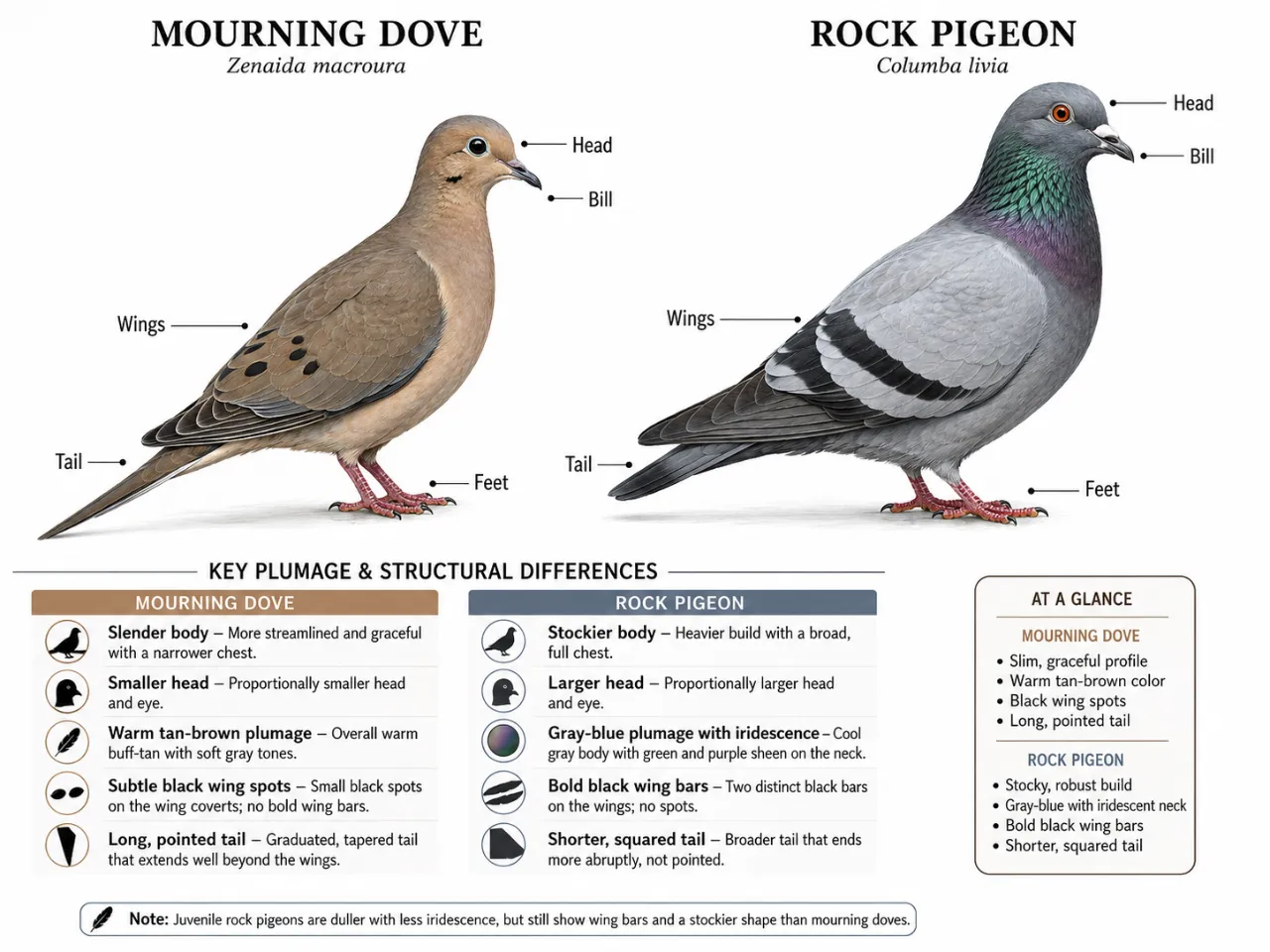
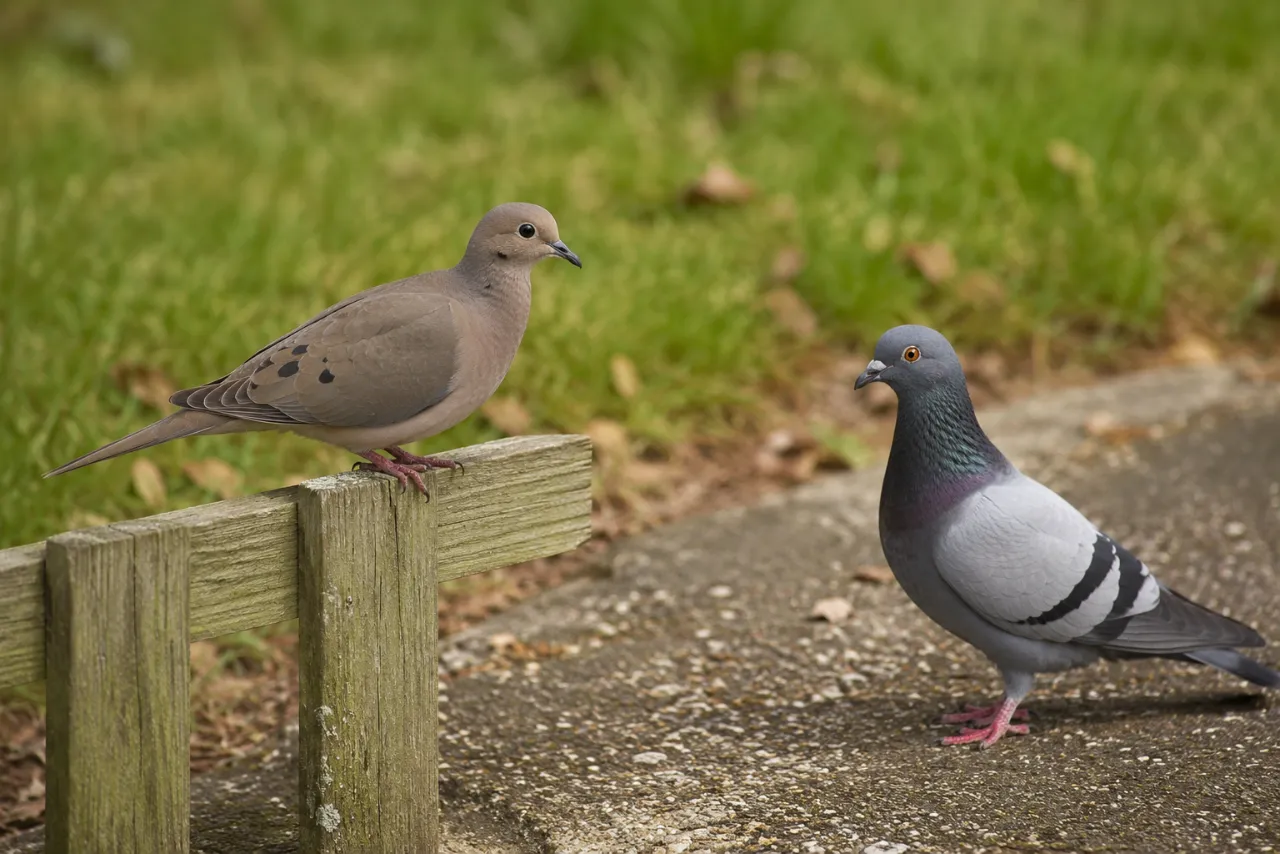
Doves are generally imagined as smaller and more slender than pigeons. Many have smooth gray, tan, brown, or pale plumage, with rounded heads and relatively soft-looking features. Mourning doves, for example, have long pointed tails, slim bodies, and a gentle gray-brown color pattern.
Pigeons are often stockier, with a deeper chest, shorter neck, and stronger body. City pigeons usually have rounded bodies, short legs, and a powerful flight style. Many have iridescent feathers on the neck, especially in green, purple, or bronze tones.
Still, size alone is not always reliable. Some pigeons are quite graceful, and some doves are robust. Because common names are inconsistent, identification should consider species, location, body shape, behavior, and field marks together.
Habitat and distribution
Doves and pigeons are highly adaptable birds. Different species live in forests, grasslands, deserts, wetlands, rocky cliffs, farms, gardens, suburbs, islands, and cities. Their success comes partly from their flexible diet and strong flight ability.
Urban pigeons are especially famous because they thrive around human buildings. Tall buildings can mimic rocky cliff habitats, giving pigeons safe ledges for nesting and resting. Food scraps, grains, and open spaces also help them survive in cities.
Many doves are more commonly associated with open countryside, woodland edges, scrubland, or backyard habitats. However, this depends on the species. Eurasian collared doves and mourning doves, for example, often live very close to people.
Diet and feeding behavior
Most doves and pigeons eat mainly seeds, grains, fruits, and other plant material. Some species also consume small invertebrates occasionally, but plant foods usually make up most of the diet. Their short bills are well suited for picking up seeds and small fruits.
Unlike many birds, pigeons and doves can drink by sucking water directly. Many birds take water into the bill and tilt the head back to swallow, but pigeons and doves can keep the bill lowered while drawing water in. This is one of their distinctive feeding-related traits.
Fruit-eating pigeons in tropical forests can be important seed dispersers. By eating fruit and moving through the landscape, they may help plants spread to new areas. In this way, some species play a meaningful role in forest regeneration.
Voice and communication
Doves and pigeons are known for low, soft vocalizations. Many species make cooing sounds rather than sharp songs. These calls are used for courtship, territory, pair bonding, and communication between individuals.
A mourning dove’s call is often described as a soft, mournful coo. City pigeons make deeper, rolling coos, especially during courtship. Males may puff up, bow, turn, and coo to attract females or defend a small space.
Some species also communicate with wing sounds. Mourning doves, for example, can produce a noticeable whistling sound during takeoff. This sound may help alert nearby birds to danger, although the exact function can vary by situation.
Reproduction and nesting
Doves and pigeons usually form pairs, at least for a breeding attempt, and both parents often help care for the young. Many species build simple nests made of twigs, stems, or plant material. These nests can look surprisingly loose compared with the nests of many songbirds.
One of the most interesting traits of this bird family is crop milk. Both male and female pigeons and doves can produce a nutritious secretion from the crop, a pouch in the digestive tract. The parents feed this substance to their chicks, also called squabs, during the early part of development.
Many species lay one or two eggs per clutch. The young are usually helpless at hatching and depend heavily on parental care. In favorable conditions, some species may breed multiple times in a year.
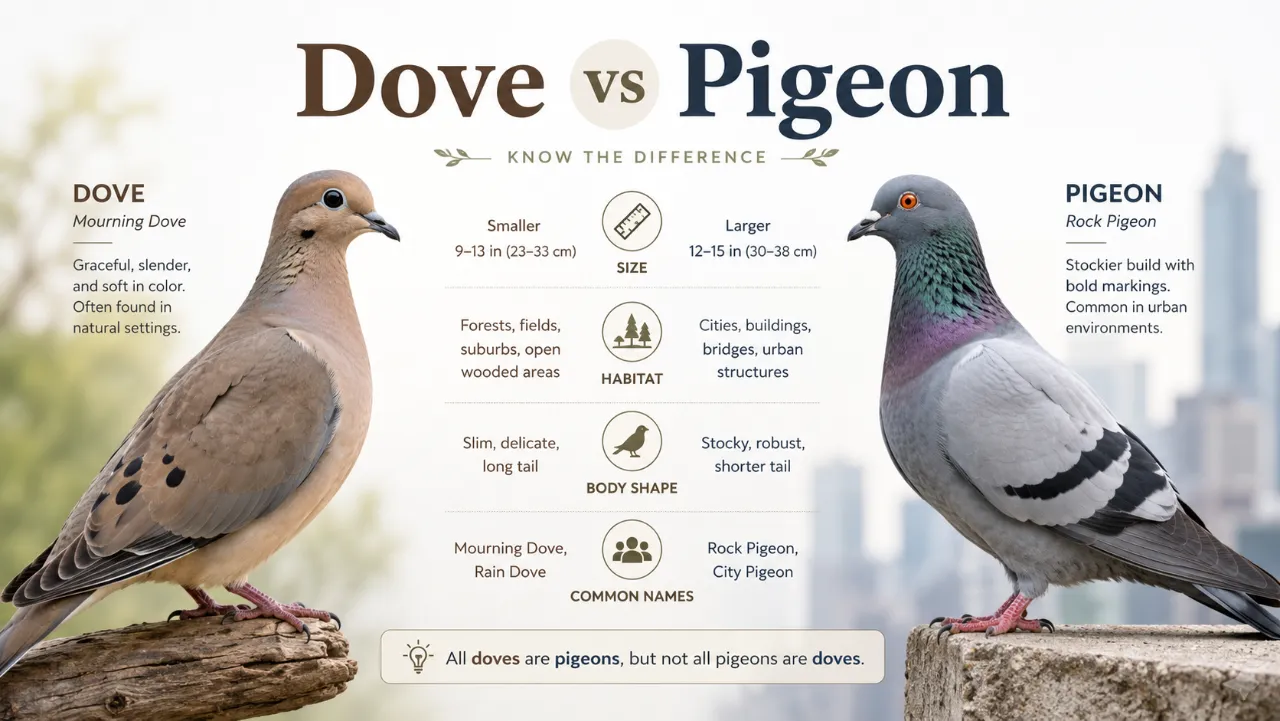
How to tell common doves and pigeons apart
When trying to identify a dove or pigeon, start with size and shape. A slender bird with a long pointed tail is more likely to be called a dove, especially in North America. A stocky bird with a rounded body and shorter tail is more likely to be called a pigeon.
Next, look at location. In cities, parks, train stations, and building ledges, the bird is often a rock pigeon or feral pigeon. In open yards, telephone wires, desert edges, and fields, a slim gray-brown bird may be a mourning dove or another dove species.
Color pattern can also help. Rock pigeons often show gray bodies, dark wing bars, and iridescent neck feathers, although feral individuals vary widely in color. Mourning doves usually have soft brown-gray plumage, black spots on the wings, and a long tapered tail.
Are city pigeons actually doves?
Yes, in a biological sense, the common city pigeon is closely connected to the rock dove. The domestic and feral pigeons seen in cities are descended from rock doves, a species that originally nested on cliffs and rocky habitats.
This is why the phrase “dove vs pigeon” can be misleading. The city pigeon is often called a pigeon in daily speech, but its wild ancestor is widely known as the rock dove. The difference is not a deep biological split; it is mostly a naming tradition.
Over time, domestic pigeons were bred for food, messages, racing, display, and companionship. Feral pigeons are descendants of domestic birds that adapted to life in human-built environments.
Do all dove and pigeon species look the same?
No. The Columbidae family is highly diverse. Some species are small and delicate, while others are large, colorful, and striking. Tropical fruit doves may have bright green, yellow, purple, or orange plumage. Crowned pigeons, found in New Guinea and nearby areas, are large birds with impressive crests.
Some island species evolved with unusual sizes, colors, and behaviors. The extinct dodo was also part of the broader pigeon and dove lineage, although it looked very different from the birds most people imagine today.
This diversity is a reminder that “dove” and “pigeon” are broad common names. They do not fully describe the wide variety of species within the family.
Why doves and pigeons matter
Doves and pigeons are ecologically important in many habitats. Seed-eating species can influence plant communities, while fruit-eating species may help disperse seeds. They also serve as prey for hawks, falcons, owls, snakes, mammals, and other predators.
These birds are also important to humans. Doves are widely used as symbols of peace, love, purity, and hope. Pigeons have a long history with people as messenger birds, racing birds, domestic animals, and urban wildlife.
At the same time, some pigeon populations can create challenges in cities, especially when large numbers gather in one place. Responsible urban wildlife management focuses on sanitation, building design, and reducing artificial food sources rather than treating the birds as simply pests.
Final takeaway
Doves and pigeons are not separated by a clear scientific boundary. They are both members of the family Columbidae, and the names overlap. In general, “dove” is often used for smaller, gentler-looking species, while “pigeon” is often used for larger, stockier species. But there are many exceptions.
The most accurate way to understand the difference is simple: dove and pigeon are common names shaped by language, culture, size, and tradition. Biologically, they are close relatives with similar bodies, diets, nesting habits, and ecological roles.
FAQs
Are doves and pigeons the same bird?
Doves and pigeons are not always the exact same species, but they belong to the same bird family, Columbidae. The words often overlap, and there is no strict scientific rule that separates all doves from all pigeons.
Why is a pigeon sometimes called a rock dove?
The common city pigeon descends from the rock dove. “Rock dove” is the wild species name, while “pigeon” is the common everyday name often used for domestic and feral forms of the same species.
Are doves cleaner or more peaceful than pigeons?
Not biologically. Doves and pigeons have similar anatomy and behavior. The idea that doves are more peaceful comes mostly from human symbolism, while pigeons are often judged by their visibility in cities.