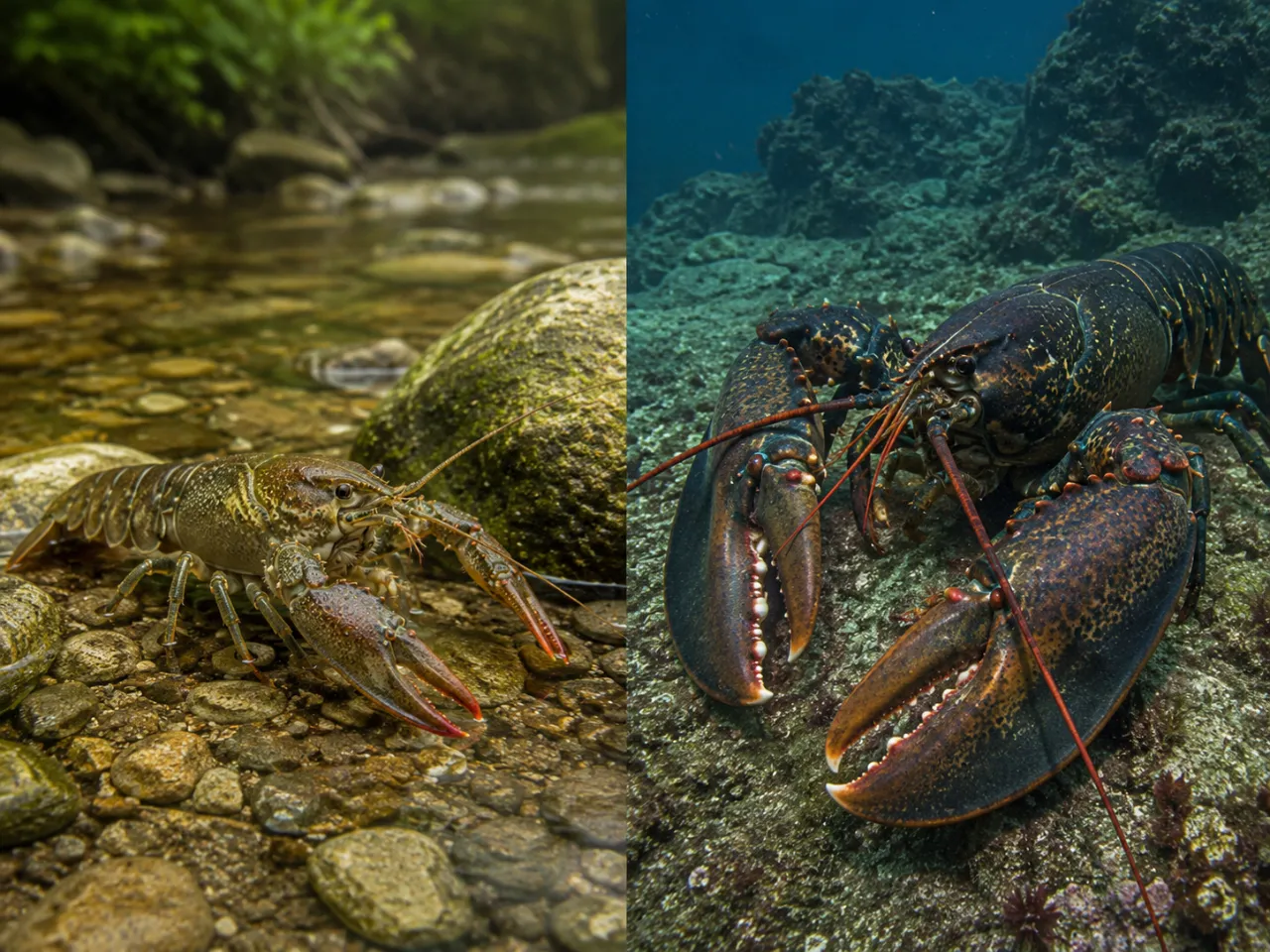
Crayfish and lobsters are both clawed decapod crustaceans, but they are not the same animal. Crayfish are usually small freshwater crustaceans found in rivers, streams, lakes, swamps, and burrows. Lobsters are usually larger marine crustaceans found in oceans, rocky reefs, and coastal seafloors. The easiest difference is habitat: crayfish live mostly in freshwater, while true lobsters live in saltwater.
Crayfish vs Lobster Quick Answer
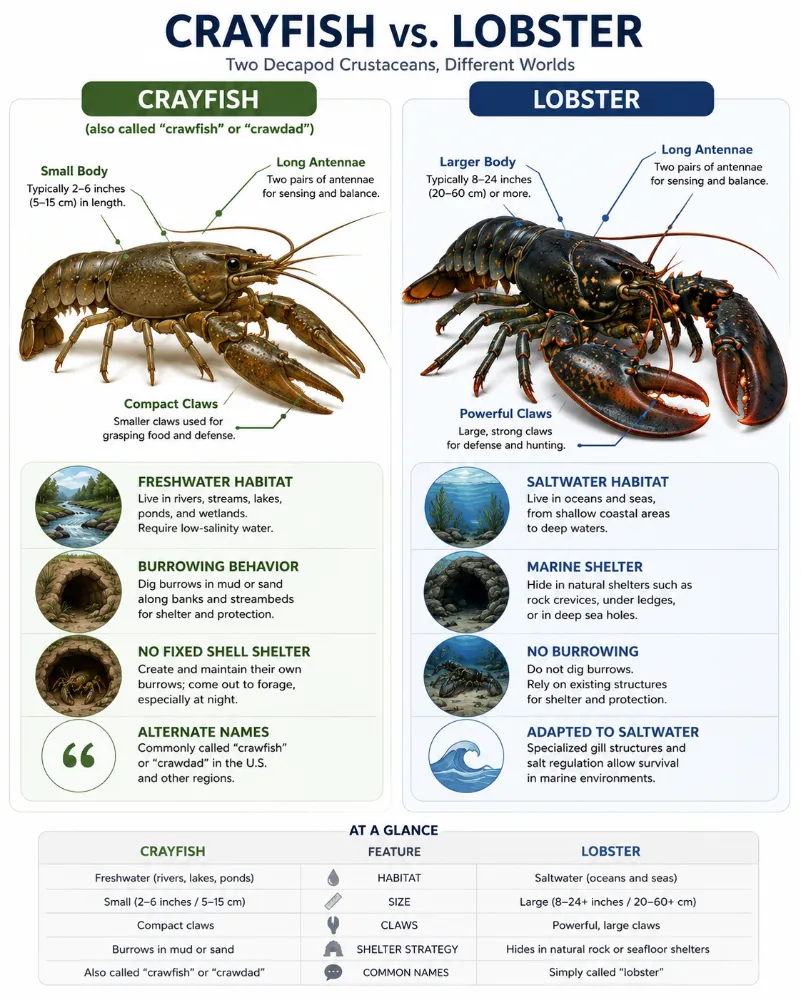
The main difference between a crayfish and a lobster is where they live and how large they grow. Crayfish are mostly freshwater animals, usually much smaller, and often live under rocks, logs, vegetation, or in mud burrows. Lobsters are marine animals, usually larger, and live on rocky or sandy ocean bottoms. Both have segmented bodies, antennae, walking legs, claws, and hard exoskeletons, but lobsters are generally heavier, longer-lived, and more ocean-adapted.
Crayfish vs Lobster Summary Table
| Feature | Crayfish | Lobster |
|---|---|---|
| Animal group | Freshwater decapod crustacean | Mostly marine decapod crustacean |
| Other names | Crawfish, crawdad, freshwater lobster in some regions | Clawed lobster, marine lobster; some unrelated groups are also called lobsters |
| Main habitat | Freshwater rivers, streams, lakes, ponds, wetlands, burrows | Saltwater oceans, rocky reefs, sandy bottoms, coastal shelves |
| Typical size | Usually small, often a few inches long | Usually much larger, often more than a foot long in common species |
| Body shape | Compact, narrow, lobster-like but smaller | Longer, heavier, more robust body |
| Claws | Usually present and proportionally strong, but smaller | Large claws in true clawed lobsters; absent in spiny lobsters |
| Water type | Freshwater | Saltwater |
| Diet | Omnivore: plants, algae, insects, detritus, small animals, carrion | Omnivore/scavenger: mollusks, worms, fish, crabs, carrion, algae, small animals |
| Behavior | Often hides, burrows, scavenges, and defends small shelters | Often shelters in crevices, forages at night, and uses claws defensively |
| Freshwater aquarium use | Common in aquariums, but may eat plants or small tank mates | Not a freshwater aquarium animal; marine care is specialized |
| Culinary use | Common in boils, étouffée, soups, and regional freshwater cuisine | Common in seafood dishes, steamed lobster, lobster rolls, bisque, and grilled dishes |
| Quick clue | Small “mini lobster” in freshwater | Large ocean crustacean, usually heavier and more robust |
What Is a Crayfish?
A crayfish is a freshwater crustacean that looks like a small lobster. Crayfish are also called crawfish, crawdads, mudbugs, or freshwater lobsters in different regions. They belong to several groups of freshwater decapod crustaceans and are found on multiple continents.
Crayfish have a hard exoskeleton, segmented body, long antennae, five pairs of walking legs, and a pair of claws. They breathe with gills and need moist or aquatic environments to survive. Most species live in freshwater, including streams, rivers, lakes, ponds, wetlands, ditches, and swamps. Some species spend much of their lives in burrows and may be found far from open water as long as the burrow stays moist.
Crayfish are important freshwater animals. They eat algae, aquatic plants, dead leaves, insect larvae, small fish, snails, worms, carrion, and organic debris. They also become food for fish, birds, turtles, raccoons, otters, frogs, and many other predators.
What Is a Lobster?
A lobster is a marine crustacean, most famously represented by clawed lobsters such as the American lobster and European lobster. These true lobsters live in saltwater and are known for their large claws, long bodies, strong tails, and importance in seafood cuisine.
Like crayfish, lobsters are decapods, meaning they have ten legs. A typical clawed lobster has two large front claws, eight additional walking legs, a segmented abdomen, long antennae, and a hard exoskeleton. Lobsters molt as they grow, shedding the old shell and forming a larger new one.
The word “lobster” can be confusing because several marine crustaceans are called lobsters. True clawed lobsters have large claws. Spiny lobsters have long antennae but lack the large front claws of true lobsters. Slipper lobsters are flattened and also different. In a crayfish vs lobster comparison, most people are thinking of crayfish compared with true clawed lobsters.
Quick Visual Difference
Crayfish often look like miniature lobsters, but size and habitat give them away. A crayfish is usually small enough to fit in a hand and is found in freshwater. A lobster is usually much larger and is found in the ocean.
-
Crayfish: small, freshwater, often found under rocks, logs, vegetation, or in mud burrows.
-
Lobster: larger, marine, often found on rocky seafloors, reefs, ledges, or coastal bottoms.
-
Crayfish: compact body and small claws compared with a lobster.
-
Lobster: heavier body, stronger tail, and usually larger claws in true clawed lobsters.
Habitat: Freshwater vs Saltwater
Habitat is the best and simplest difference. Crayfish live mostly in freshwater. You can find them in creeks, rivers, lakes, ponds, marshes, swamps, rice fields, and roadside ditches. Some species dig deep burrows in wet soil and survive in areas that dry out seasonally.
Lobsters live in saltwater. True clawed lobsters usually live on ocean floors, often in rocky areas where they can hide in crevices or shelters. They may also use sandy or muddy bottoms depending on species and life stage.
If the animal is in a freshwater stream, it is almost certainly a crayfish. If it is on the ocean floor, it is probably a lobster or another marine crustacean.
Size Differences
Most crayfish are much smaller than lobsters. Many adult crayfish are only a few inches long. Some large freshwater crayfish species can grow much bigger than average, but most are still smaller than common marine lobsters.
Lobsters are generally larger and heavier. A mature American lobster or European lobster can be much longer and more massive than a typical crayfish. Lobsters also tend to have larger claws and a more powerful tail.
The size difference is one reason crayfish are sometimes called “mini lobsters.” They share a similar body plan, but they are usually built on a much smaller scale.
Body Shape and Anatomy
Crayfish and lobsters have similar basic anatomy because both are decapod crustaceans. They have a hard outer shell, jointed legs, claws, antennae, compound eyes, a segmented abdomen, and a tail fan.
Crayfish usually have a smaller, more compact body. Their claws can be impressive for their size, but they are usually not as massive as those of large clawed lobsters. Their bodies are adapted for freshwater hiding, burrowing, crawling, and scavenging.
Lobsters usually have a more robust marine body. True clawed lobsters often have one larger crushing claw and one sharper cutting claw. Their tails are strong and can snap powerfully to help them escape backward through the water.
Claws and Defense
Both crayfish and clawed lobsters use claws for defense, feeding, territorial disputes, and handling food. A crayfish may raise its claws when threatened, pinch predators, or back into a shelter with claws facing outward.
True lobsters often have larger and more specialized claws. In many clawed lobsters, one claw is heavier and used for crushing, while the other is slimmer and sharper for cutting or gripping. This gives lobsters a strong advantage when handling hard-shelled prey or defending themselves.
However, not all animals called lobsters have big claws. Spiny lobsters, for example, do not have the large front claws of true lobsters. They rely more on spines, antennae, sheltering behavior, and quick movement.
Antennae and Sensory Abilities
Both crayfish and lobsters have long antennae that help them sense their environment. These antennae detect touch, chemicals, water movement, and obstacles. In dark or murky habitats, antennae are extremely important.
Crayfish use their antennae while exploring streams, burrows, vegetation, and hiding spots. Lobsters use theirs while moving along the ocean floor, finding food, recognizing shelters, and detecting danger.
Spiny lobsters are especially famous for long, thick antennae, while true clawed lobsters combine antennae with large claws.
Color Differences
Crayfish come in many colors. Wild crayfish may be brown, olive, tan, reddish, gray, blue, black, or mottled, depending on species, habitat, age, and genetics. Aquarium crayfish may be selectively bred for bright blue, orange, white, or red coloration.
Lobsters are also not always bright red in life. Many live lobsters are dark greenish-brown, blue-black, olive, or mottled. They usually turn red when cooked because heat changes the pigments in the shell. Rare lobsters may be blue, orange, yellow, split-colored, or albino-like due to unusual pigment genetics.
Color alone is not a reliable way to identify crayfish versus lobster. Habitat, size, and body structure are more useful.
Diet and Feeding Behavior
Crayfish are opportunistic omnivores. They eat algae, aquatic plants, dead leaves, insect larvae, worms, snails, small fish, eggs, detritus, and carrion. In aquariums, they may eat leftover food, plants, dead fish, or even slow tank mates if given the chance.
Lobsters are also opportunistic feeders. They eat mollusks, worms, sea urchins, crabs, fish, carrion, algae, and other bottom-dwelling animals. They are often active at night, leaving shelters to forage on the seafloor.
Both animals are flexible feeders, but crayfish are part of freshwater food webs, while lobsters are part of marine food webs.
Behavior and Movement
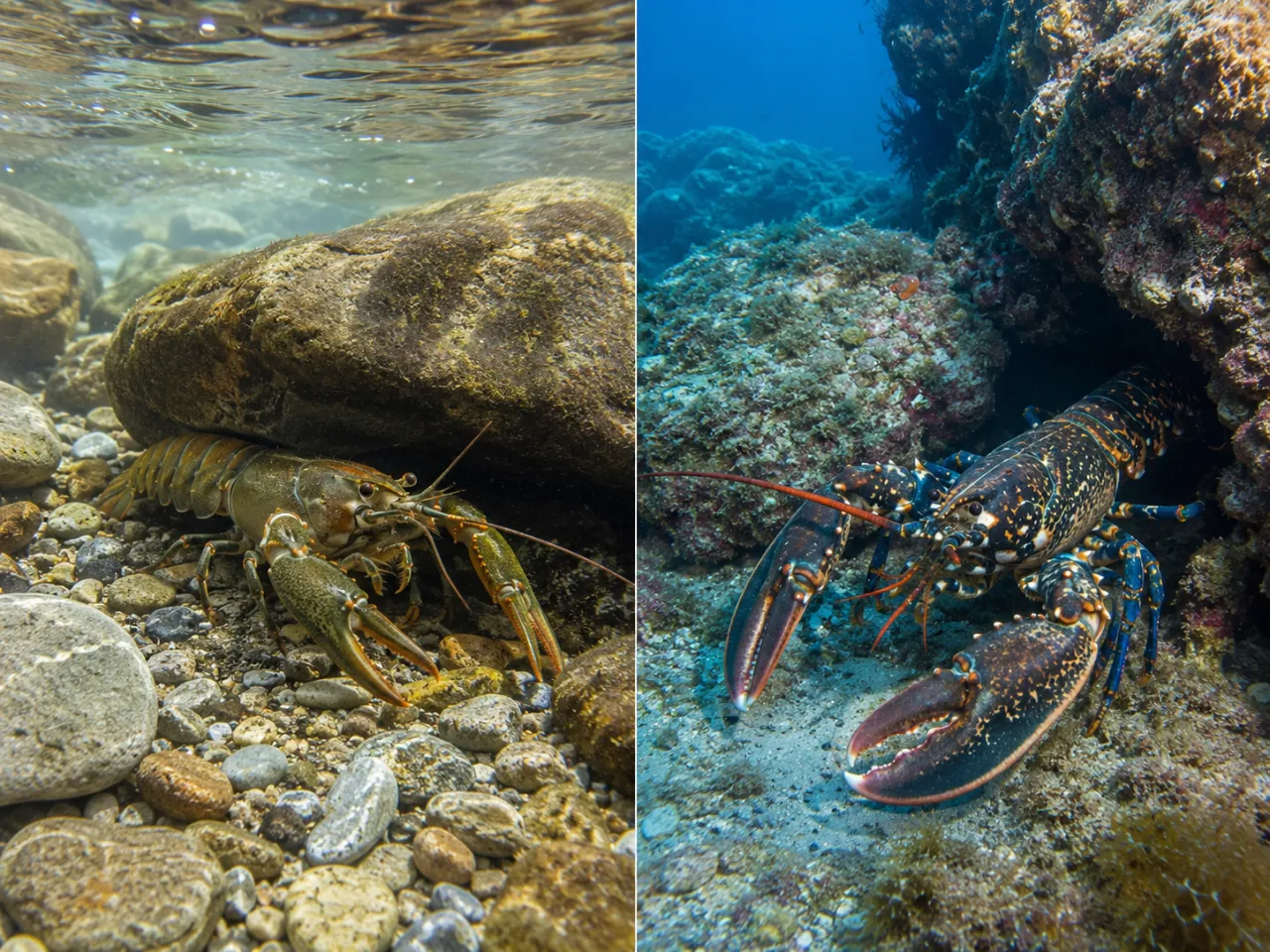
Crayfish usually crawl along the bottom, hide under rocks, dig burrows, and use their tails for sudden backward escape movements. They may be territorial and will often defend shelters from other crayfish.
Lobsters also crawl on the seafloor and hide in shelters. They may use their tails to shoot backward quickly when threatened. Larger lobsters can be territorial, especially around good shelters and food.
Both are more active in low light or at night, though behavior varies by species and habitat. Both rely heavily on cover because many predators eat them.
Burrowing and Shelter
Many crayfish are excellent burrowers. Some live under rocks or logs, while others build mud chimneys and deep burrows that reach groundwater. Burrowing helps them avoid predators, survive drought, escape temperature extremes, and reproduce safely.
Lobsters usually do not build mud burrows in the same way. They often shelter in rock crevices, ledges, reef gaps, or spaces under boulders. A lobster may use the same shelter repeatedly and defend it from rivals.
Crayfish are often freshwater diggers. Lobsters are often marine shelter-users.
Molting and Growth
Crayfish and lobsters both grow by molting. Because their hard exoskeleton cannot expand, they must shed it and form a new, larger shell. After molting, the animal is soft and vulnerable until the new shell hardens.
Young crayfish molt frequently as they grow. Adults molt less often. Lobsters also molt repeatedly, and large lobsters may molt less frequently as they age. Molting is risky because the animal is vulnerable to predators, injury, and cannibalism during the soft-shell stage.
Molting also allows lost limbs to regenerate gradually. A crayfish or lobster that loses a claw may regrow it over several molts, though the new claw may be smaller at first.
Life Span
Many crayfish have relatively short lives compared with lobsters. Some species live only a few years, although life span varies widely. Larger or cold-water species may live longer than small warm-water species.
Lobsters can be long-lived, especially true clawed lobsters in cold marine environments. Some may live for decades if they avoid predators, disease, fishing, and environmental stress.
In general, lobsters tend to live longer and grow larger than most crayfish.
Reproduction and Young
Female crayfish carry eggs under the abdomen, attached to swimmerets. After hatching, young crayfish may remain attached to the mother for a short period before becoming independent. This maternal carrying behavior helps protect the eggs and newly hatched young.
Female clawed lobsters also carry eggs under the tail until they hatch. Lobster larvae then enter the plankton, drifting in the water column before settling to the seafloor as juveniles. This marine larval stage is very different from the life of many freshwater crayfish.
Crayfish young often begin life close to the bottom and mother. Lobster larvae often begin life as tiny drifting planktonic animals.
Crayfish vs Lobster Taste
Crayfish and lobster are both eaten by humans, but they are used differently in cuisine. Crayfish meat is usually smaller in quantity and often has a mild, sweet, slightly earthy flavor influenced by freshwater habitat and seasoning. Crayfish are often boiled with spices, potatoes, corn, sausage, and vegetables in regional dishes.
Lobster meat is usually larger, firmer, and sweeter, especially from the tail and claws of true lobsters. It is often steamed, boiled, grilled, baked, or used in lobster rolls, bisque, pasta, and seafood platters.
Taste depends on species, freshness, diet, cooking method, and seasoning. Biologically, the difference reflects size, habitat, and muscle structure more than a simple “better or worse” answer.
Crayfish, Crawfish, and Crawdad: Are They the Same?
Yes, in most everyday usage, crayfish, crawfish, and crawdad refer to the same type of freshwater crustacean. The preferred word depends on region.
-
Crayfish: common in scientific and general English usage.
-
Crawfish: especially common in parts of the southern United States and culinary contexts.
-
Crawdad: common in some regional speech, especially inland areas.
These names may sound different, but they usually refer to the same freshwater animal.
Are Crayfish Baby Lobsters?
No. Crayfish are not baby lobsters. They are their own freshwater crustaceans. They may look like small lobsters because they share a similar decapod body plan, but a crayfish does not grow into a lobster.
A baby lobster is a juvenile lobster. It starts life as a marine larva and eventually settles onto the ocean floor. A crayfish starts life in freshwater and remains a crayfish throughout its life.
The confusion comes from appearance, not life cycle.
Are Crayfish and Lobsters Closely Related?
Crayfish and clawed lobsters are related decapod crustaceans and share many anatomical traits. They both have claws, long bodies, segmented abdomens, antennae, and hard exoskeletons.
However, they are not interchangeable. Crayfish are freshwater animals with lineages adapted to rivers, streams, lakes, wetlands, and burrows. Lobsters are marine animals adapted to ocean habitats.
They are like cousins within the larger crustacean family tree, not the same animal at different ages.
Crayfish vs Lobster vs Shrimp
Crayfish, lobsters, and shrimp are all decapod crustaceans, but they differ in body shape, habitat, and lifestyle.
| Animal | Main Habitat | Body Type | Quick Clue |
|---|---|---|---|
| Crayfish | Freshwater | Small lobster-like body with claws | Mini lobster in rivers, streams, lakes, or burrows |
| Lobster | Saltwater | Large marine body, often with big claws | Large ocean crustacean with powerful claws |
| Shrimp | Freshwater or saltwater depending on species | Slender curved body, usually smaller claws | More delicate body and swimming lifestyle |
Crayfish vs Spiny Lobster
Spiny lobsters are marine crustaceans often called lobsters, but they are not the same as true clawed lobsters. They usually lack the large front claws seen in American or European lobsters. Instead, they have long spiny antennae and a tough, armored body.
A crayfish may look more like a small clawed lobster than a spiny lobster because crayfish have front claws. However, crayfish live in freshwater, while spiny lobsters live in the ocean.
If the animal has very long spiny antennae and no big claws, it is more likely a spiny lobster than a crayfish or true clawed lobster.
Crayfish in Aquariums
Crayfish are sometimes kept in freshwater aquariums. They can be fascinating animals because they dig, climb, explore, molt, and interact with their surroundings. However, they are not always peaceful community-tank animals.
Many crayfish may eat live plants, catch slow fish, attack shrimp, fight with other crayfish, or rearrange decorations. They also need good water quality, hiding places, stable temperature, minerals for shell health, and secure lids because some can climb or escape.
A crayfish is best kept with careful planning, not added casually to a peaceful fish tank.
Lobsters in Aquariums
True marine lobsters are much harder to keep than common freshwater crayfish. They require saltwater systems, high water quality, appropriate hiding spaces, careful feeding, and enough room. Many grow large and may be aggressive toward tank mates.
Some marine aquariums keep spiny lobsters or reef lobsters, but these animals still require specialized care. They may hide during the day and become active at night.
For most hobbyists, crayfish are far more practical than lobsters, but both require responsible care.
Ecological Role of Crayfish
Crayfish are ecosystem engineers in freshwater habitats. They break down dead leaves, recycle nutrients, graze algae, stir sediment, dig burrows, and provide food for many predators. Their activities can shape aquatic plant communities and stream-bottom habitats.
However, introduced crayfish can become invasive. In places where non-native crayfish are released, they may outcompete native crayfish, spread disease, damage aquatic vegetation, reduce amphibian eggs, and alter entire freshwater ecosystems.
This is why aquarium crayfish should never be released into the wild.
Ecological Role of Lobsters
Lobsters are important bottom-dwelling predators and scavengers in marine ecosystems. They help recycle carrion, feed on invertebrates, and become prey for fish, seals, octopuses, and humans.
Lobsters also influence seafloor communities by feeding on shellfish, worms, crabs, and other animals. Their shelters and movements are part of rocky reef and coastal bottom ecosystems.
Because lobsters are economically valuable, their populations are closely linked to fisheries, coastal management, and marine conservation.
Conservation and Human Impact
Crayfish face threats from habitat loss, water pollution, stream modification, invasive species, disease, and overharvesting in some areas. Many crayfish species have small ranges, making them vulnerable if their local streams or wetlands are damaged.
Lobsters face different pressures, including fishing, warming oceans, disease, habitat changes, and shifts in marine food webs. Some lobster fisheries are carefully managed, while others may be vulnerable to environmental change.
Both animals show how freshwater and marine ecosystems depend on clean water, healthy habitats, and responsible human management.
Common Misidentifications
One common mistake is thinking crayfish are baby lobsters. They are not. They are separate freshwater animals.
Another mistake is calling any lobster-like freshwater animal a lobster. In most cases, a small lobster-like animal in freshwater is a crayfish.
A third mistake is assuming every lobster has large claws. True clawed lobsters do, but spiny lobsters and slipper lobsters do not have the same front claws.
How to Identify One in a Photo
When looking at a photo, use several clues together:
-
Check the habitat: freshwater stream, pond, or mud burrow suggests crayfish; ocean floor suggests lobster.
-
Check the size: small hand-sized crustacean suggests crayfish; large heavy crustacean suggests lobster.
-
Check the claws: big claws can occur in both, but lobster claws are usually much larger in true lobsters.
-
Check the antennae: extremely long spiny antennae with no big claws may suggest spiny lobster.
-
Check the body: crayfish are often compact; lobsters are usually longer and more robust.
-
Check the setting: seafood market, rocky ocean bottom, or marine tank usually suggests lobster.
Which Is Bigger?
Lobsters are usually much bigger than crayfish. A typical crayfish is small, while a mature clawed lobster can be large enough to provide substantial tail and claw meat. Some exceptional crayfish species can become very large, but most everyday crayfish are still smaller than common marine lobsters.
So in general comparison, lobster wins for size, weight, and total body mass.
Which Has Stronger Claws?
True clawed lobsters usually have stronger claws because they are larger animals with more massive front appendages. Their claws can crush shells, hold prey, and defend shelters.
Crayfish claws are strong for their size and can deliver a painful pinch, but they are usually much smaller. In a proportional sense, crayfish are impressive, but in absolute force, a large lobster has the advantage.
Which Is More Aggressive?
Both crayfish and lobsters can be territorial. Crayfish often fight over shelters, food, and mates. In aquariums, they may pinch fish, other crayfish, or invertebrates if space and hiding places are limited.
Lobsters also defend shelters and can be aggressive toward rivals. Large lobsters may use claws to push, grasp, or fight. Aggression depends on species, size, sex, season, food availability, and space.
Neither animal is “mean.” Their behavior is about survival, territory, and competition.
Which Is Better to Eat?
This depends on taste, culture, and cooking style. Lobster generally provides more meat per individual and is often considered a luxury seafood. Crayfish are smaller but can be extremely flavorful, especially when cooked in seasoned boils or regional dishes.
Lobster meat is often sweet, firm, and rich. Crayfish meat is usually milder, smaller, and often enjoyed with strong spices and sauces.
Biologically, they are different animals; culinarily, both can be highly valued.
Final Comparison
Crayfish and lobsters look similar because they are both decapod crustaceans with claws, antennae, hard shells, and segmented tails. The difference is that crayfish are mostly freshwater animals, usually small, compact, and common in streams, lakes, wetlands, and burrows. Lobsters are mostly marine animals, usually larger, heavier, and associated with ocean floors and coastal habitats.
If the animal looks like a tiny lobster in a creek or pond, it is probably a crayfish. If it is a large clawed crustacean from the ocean, it is probably a lobster. They may look like close relatives, but they live in very different worlds.
Related Animal Comparisons
-
Lobster vs Crab
-
Crayfish vs Crawfish
-
Shrimp vs Prawn
-
Crab vs Crayfish
-
Spiny Lobster vs Maine Lobster
-
Crawfish vs Shrimp
FAQs About Crayfish vs Lobster
Is a crayfish a lobster?
No. A crayfish is a freshwater decapod crustacean, while a lobster is usually a marine decapod crustacean. They look similar, but they are different animals.
Are crayfish baby lobsters?
No. Crayfish are not baby lobsters. A crayfish remains a crayfish throughout its life, and a baby lobster is a juvenile marine lobster.
What is the main difference between crayfish and lobster?
The main difference is habitat. Crayfish live mostly in freshwater, while lobsters live in saltwater oceans. Lobsters are also usually much larger.
Do crayfish and lobsters both have claws?
Many crayfish and true clawed lobsters have claws. However, some animals called lobsters, such as spiny lobsters, do not have the large front claws of true lobsters.
Which is bigger, crayfish or lobster?
Lobsters are usually much bigger than crayfish. Most crayfish are only a few inches long, while many adult lobsters grow much larger and heavier.
Can crayfish live in saltwater?
Most crayfish are freshwater animals and cannot live long-term in saltwater. They are adapted to rivers, lakes, ponds, wetlands, and moist burrows.
Can lobsters live in freshwater?
True lobsters are marine animals and do not live in freshwater. They are adapted to saltwater ocean habitats.
Do crayfish taste like lobster?
Crayfish can taste somewhat similar to lobster because both are crustaceans, but crayfish meat is smaller and may have a slightly different freshwater flavor. Cooking style and seasoning strongly affect taste.
Are crawfish and crayfish the same?
Yes. Crayfish, crawfish, and crawdad usually refer to the same type of freshwater crustacean. The preferred name depends on region.
Can you keep crayfish as pets?
Yes, some crayfish are kept in freshwater aquariums. However, they may eat plants, attack small tank mates, escape from tanks, and require good water quality, hiding places, and proper care.