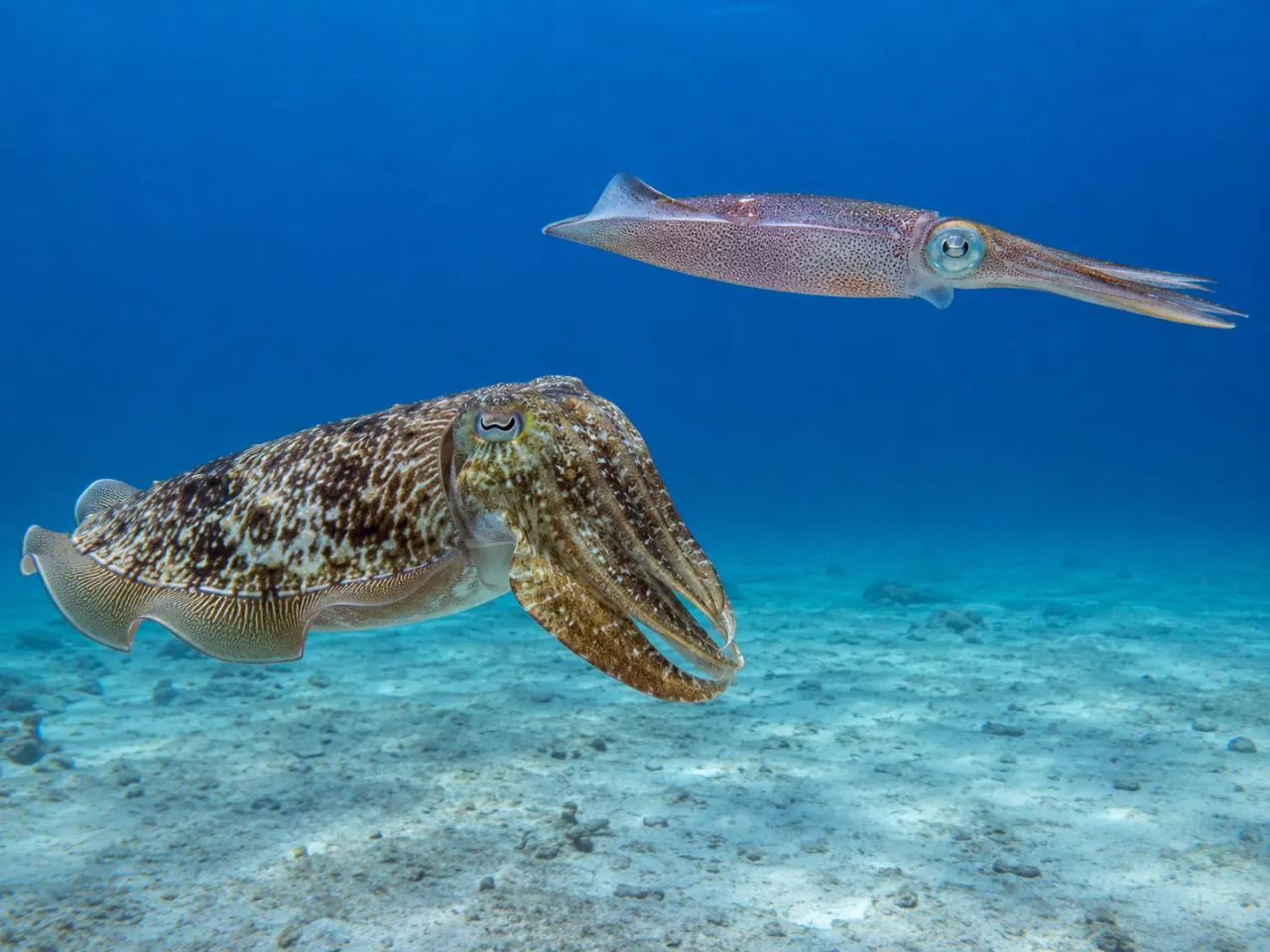
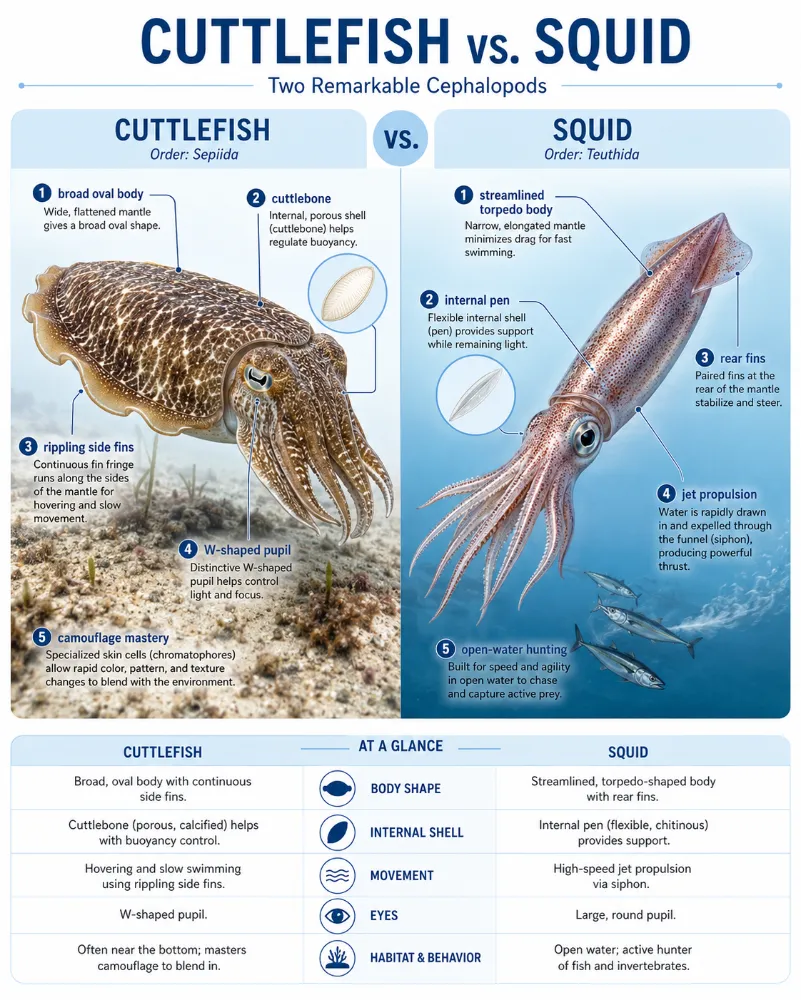
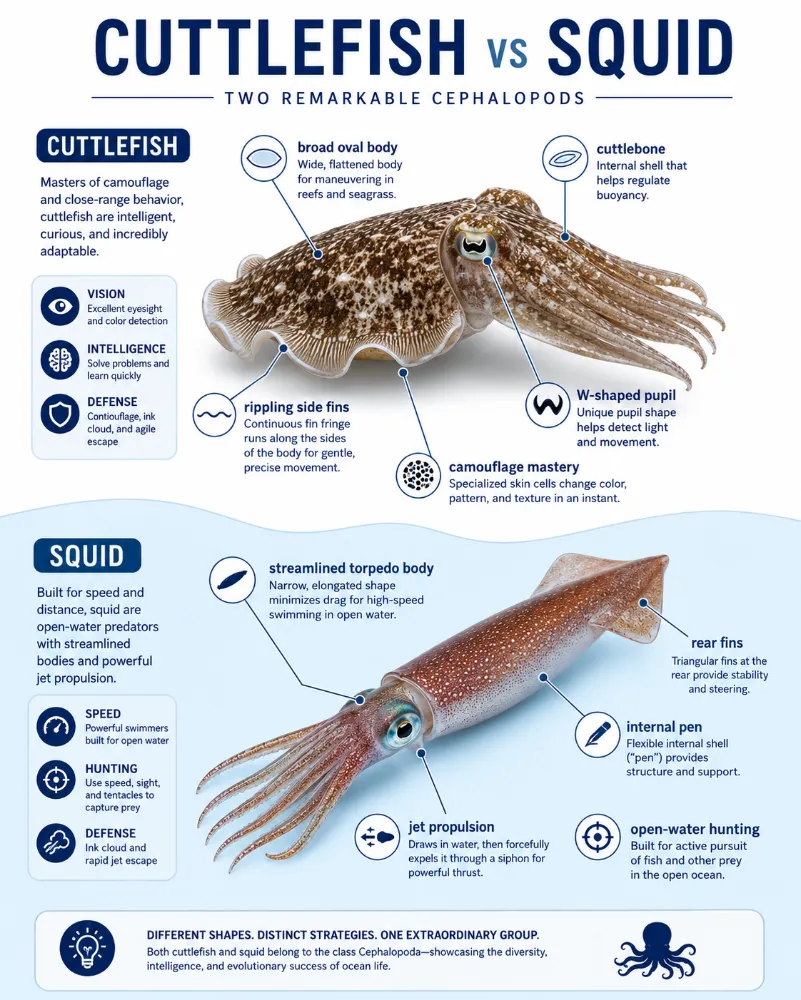
Cuttlefish and squid are both cephalopods, but they are not the same animal. A cuttlefish usually has a broad, oval body, a wavy fin around the mantle, and a chalky internal cuttlebone for buoyancy. A squid usually has a longer torpedo-shaped body, faster jet-propelled swimming, and a thin internal pen instead of a cuttlebone. Cuttlefish are often masters of close-range camouflage, while squid are generally faster open-water hunters.
Cuttlefish vs Squid Quick Answer
The easiest way to tell a cuttlefish from a squid is to look at body shape and movement. Cuttlefish look broader, flatter, and more oval, with a fin running along the sides of the body. They often hover near the seafloor and change color dramatically. Squid look longer, slimmer, and more streamlined, with fins often near the rear of the body. They are usually faster swimmers and are more commonly seen in open water.
Cuttlefish vs Squid Summary Table
| Feature | Cuttlefish | Squid |
|---|---|---|
| Animal group | Cephalopod mollusk | Cephalopod mollusk |
| Main classification | Usually order Sepiida | Several squid groups, often called teuthids |
| Body shape | Broad, oval, somewhat flattened | Long, narrow, torpedo-shaped |
| Internal support | Has a cuttlebone | Has a thin internal pen or gladius |
| Swimming style | Slow hovering, fin undulation, short jet bursts | Fast jet propulsion and active swimming |
| Fins | Long, wavy fins along the mantle sides | Usually triangular, arrow-like, or terminal fins near the rear |
| Camouflage | Extremely advanced color, texture, and pattern change | Also changes color, but many species emphasize speed and schooling |
| Eyes | Often have distinctive W-shaped pupils | Usually large eyes, often rounder in appearance |
| Habitat | Often coastal, reef, sandy, seagrass, or seafloor habitats | Many live in open ocean, deep sea, coastal waters, or schooling habitats |
| Hunting style | Ambush, stalking, camouflage-based hunting | Fast pursuit, schooling, ambush, or deep-sea hunting depending on species |
| Arms and tentacles | Eight arms and two feeding tentacles | Eight arms and two feeding tentacles |
| Best quick clue | Broad body plus cuttlebone and rippling side fins | Long streamlined body plus fast swimming and rear fins |
What Is a Cuttlefish?
A cuttlefish is a cephalopod mollusk closely related to squid, octopuses, and nautiluses. Despite the name, a cuttlefish is not a fish. It is an invertebrate with a soft body, large eyes, eight arms, two feeding tentacles, a beak-like mouth, ink, and a highly developed nervous system.
Cuttlefish are best known for their extraordinary camouflage. They can change color, pattern, brightness, and even skin texture with remarkable speed. This helps them hide from predators, communicate with other cuttlefish, confuse prey, and perform courtship displays.
The most distinctive feature of a cuttlefish is the cuttlebone. This is a porous internal structure made mostly of calcium carbonate. It helps the animal control buoyancy, allowing it to hover above the seafloor with great precision.
What Is a Squid?
A squid is also a cephalopod mollusk, but it usually has a more streamlined body than a cuttlefish. Squid are built for speed, jet propulsion, and active hunting. Many species live in open water, where fast movement and group behavior can be more important than sitting still on the seafloor.
Squid have eight arms and two longer feeding tentacles. They use these tentacles to seize prey, then pull it toward the beak. Squid may eat fish, shrimp, krill, other squid, and various marine animals depending on species and habitat.
Instead of a cuttlebone, squid usually have a thin internal support structure called a pen or gladius. This is lighter and more flexible than a cuttlebone, helping maintain the squid’s long, streamlined shape.
Quick Visual Difference
At a glance, cuttlefish look wider and flatter, while squid look longer and faster. Cuttlefish often move with a gentle rippling motion from the fins along their sides. Squid usually swim with a more streamlined, arrow-like body and can accelerate quickly using jet propulsion.
Cuttlefish: broad oval body, wavy side fins, cuttlebone, excellent camouflage, often near the seafloor.
Squid: long torpedo-shaped body, rear fins, internal pen, fast swimming, often open-water hunting.
Cuttlefish: looks like a hovering color-changing hunter.
Squid: looks like a fast-moving underwater dart.
Body Shape: Oval vs Torpedo-Shaped
Body shape is one of the easiest differences. Cuttlefish have a broad, flattened, oval mantle. Their bodies look compact and somewhat rounded from above. This shape helps them hover, maneuver slowly, and blend into sandy, rocky, or reef habitats.
Squid usually have a long, narrow, streamlined mantle. Their bodies are shaped more like torpedoes or arrows. This design reduces drag and helps squid move quickly through the water.
In simple terms, the cuttlefish is built for control and camouflage, while the squid is built more for speed and active swimming.
Cuttlebone vs Pen
The cuttlebone is the most important anatomical difference. A cuttlefish has a thick, chalky, chambered internal structure called a cuttlebone. By adjusting gas and fluid inside the cuttlebone, the cuttlefish can fine-tune its buoyancy and hover with precision.
A squid does not have a cuttlebone. Instead, most squid have a thin, flexible internal structure called a pen or gladius. It supports the body but does not provide the same buoyancy control as a cuttlebone.
This difference explains much of their lifestyle. Cuttlefish are excellent hoverers and slow-motion hunters. Squid are generally better at fast, streamlined movement.
Fins and Swimming Style
Cuttlefish have fins running along the sides of the mantle. These fins ripple like waves, allowing the animal to move gently forward, backward, upward, or downward. This is useful for careful positioning near the seafloor or reef.
Squid often have fins near the rear of the body, though fin shape varies widely among species. These fins help with steering and stability, while powerful jet propulsion provides speed. Squid draw water into the mantle cavity and force it out through the siphon, propelling themselves backward or steering rapidly.
Cuttlefish can also use jet propulsion, but squid are usually more specialized for fast jet-powered swimming.
Camouflage and Color Change
Both cuttlefish and squid can change color, but cuttlefish are especially famous for camouflage. Their skin contains specialized cells such as chromatophores, iridophores, and leucophores that allow rapid changes in color, reflectivity, and pattern.
Cuttlefish can imitate sand, rocks, coral, seaweed, shadows, and disruptive patterns. Some can also raise small skin bumps called papillae to change texture. This makes them among the greatest camouflage artists in the animal kingdom.
Squid also change color for camouflage, communication, mating, and schooling signals. However, many squid rely more heavily on speed, group behavior, and open-water movement than on detailed seafloor mimicry.
Eyes and Vision
Cuttlefish often have distinctive W-shaped pupils. Their eyes are large and highly developed, giving them excellent vision for detecting prey, predators, patterns, contrast, and movement. Vision is central to how they hunt and camouflage.
Squid also have large, advanced eyes. Some deep-sea squid have enormous eyes adapted to detecting faint light in dark water. The giant squid and colossal squid are famous for having some of the largest eyes in the animal kingdom.
Both animals depend heavily on vision, but cuttlefish are especially linked to visual camouflage and fine pattern matching.
Arms, Tentacles, and Feeding
Both cuttlefish and squid have eight arms and two feeding tentacles. The arms are shorter and usually lined with suckers. The tentacles are longer and can shoot forward to grab prey.
Cuttlefish often stalk prey slowly, approach carefully, and then fire the two tentacles outward in a sudden strike. They commonly eat shrimp, crabs, small fish, and other small marine animals.
Squid also use their two tentacles to seize prey, but many species hunt more actively. Some chase fish or krill in groups. Others ambush prey in deeper water. Once the prey is captured, the arms help hold it while the beak bites and tears food into pieces.
Hunting Strategy
Cuttlefish are often ambush or stalking predators. They may hide against the seafloor, slowly approach prey, hypnotically pulse patterns across their skin, and then strike suddenly with their tentacles. Their hunting style depends on patience, camouflage, and accuracy.
Squid are often more active hunters. Many species swim through open water, pursue prey, or hunt in groups. Some squid move in schools, which helps them find prey and avoid predators. Deep-sea squid may use different strategies, including ambush, bioluminescence, or stealth in dark water.
The cuttlefish is more like a silent visual trickster. The squid is more like a fast marine hunter.
Habitat Differences
Cuttlefish are commonly found in coastal waters, sandy bottoms, seagrass beds, reefs, rocky areas, and continental shelf habitats. They often stay near the seafloor where camouflage is useful.
Squid occupy a wider range of habitats. Some live near coasts, some live in open ocean, and many live in deep-sea environments. Squid can be found from shallow waters to extreme depths, depending on species.
If a cephalopod is hovering over sand and changing texture to match the bottom, it is likely a cuttlefish. If it is swimming quickly in open water with a torpedo-shaped body, it is likely a squid.
Intelligence and Learning
Cuttlefish and squid are both intelligent invertebrates. They have large nervous systems, advanced senses, flexible behavior, and impressive hunting ability. However, cuttlefish are especially studied for learning, memory, camouflage decisions, and visual problem-solving.
Cuttlefish can learn from experience, remember prey choices, adjust hunting tactics, and use complex visual displays. Their ability to choose camouflage patterns based on background shows advanced sensory processing.
Squid are also behaviorally complex. Many coordinate in groups, communicate with skin patterns, and respond quickly to changing conditions. Some squid use rapid color flashes during courtship or conflict.
Communication and Displays
Cuttlefish communicate with body patterns, color changes, arm postures, and movement. During courtship or rivalry, males may display dramatic stripes, dark arms, bright patterns, or split-body signals. Some cuttlefish can show one pattern on one side of the body and a different signal on the other side.
Squid also use color and pattern displays. In schooling squid, rapid flashes can signal alarm, mating readiness, aggression, or coordination. Some species produce striking displays during breeding aggregations.
Both animals communicate with their skin, but cuttlefish are especially famous for slow, precise, high-contrast visual displays.
Ink Defense
Both cuttlefish and squid can release ink. Ink can confuse predators, create a dark cloud, or produce a decoy-like shape that distracts an attacker while the animal escapes.
Cuttlefish may release ink and then use camouflage or quick movement to disappear. Squid often release ink while jetting away rapidly. The exact defense strategy depends on species, predator, and environment.
Ink is not just “black smoke.” It is a chemical and visual defense that helps cephalopods survive attacks from fish, marine mammals, birds, and other predators.
Predators
Cuttlefish are eaten by fish, sharks, dolphins, seals, seabirds, and larger cephalopods. Their camouflage helps them avoid detection, but they remain important prey in many coastal food webs.
Squid are major prey for many ocean predators. Fish, seabirds, seals, dolphins, sperm whales, sharks, tuna, and other squid all eat squid. Deep-sea squid are especially important in the diets of sperm whales and other deep-diving predators.
Because squid are often abundant and widely distributed, they form a major link between small marine animals and larger predators.
Life Span and Reproduction
Many cuttlefish and squid live relatively short lives compared with mammals. Some species live only one or two years. They grow quickly, mature rapidly, reproduce, and often die soon afterward. This life strategy is common among many cephalopods.
Cuttlefish lay eggs that are often attached to plants, rocks, shells, or other structures. The eggs may be darkened with ink-like material. Young cuttlefish hatch as miniature versions of adults and must hunt almost immediately.
Squid reproduction varies by species. Some gather in large spawning groups. Some attach egg masses to the seafloor, while others release eggs into open water or gelatinous masses. Many squid produce large numbers of eggs because survival in the ocean is uncertain.
Are Cuttlefish and Squid Related?
Yes. Cuttlefish and squid are both cephalopods, which means they belong to the same broader mollusk class as octopuses and nautiluses. They are more closely related to each other than either is to clams, snails, or oysters.
They share many cephalopod traits: arms, tentacles, large eyes, ink, beaks, advanced nervous systems, and color-changing skin. However, their body designs and lifestyles have evolved in different directions.
Cuttlefish evolved toward hovering, buoyancy control, camouflage, and precise seafloor hunting. Squid evolved more toward speed, open-water movement, schooling, and active pursuit.
Cuttlefish vs Squid vs Octopus
Cuttlefish, squid, and octopuses are all cephalopods, but they are easy to separate once you know the basic body plan.
| Animal | Arms and Tentacles | Body Shape | Main Clue |
|---|---|---|---|
| Cuttlefish | Eight arms and two tentacles | Broad, oval, flattened body | Cuttlebone and rippling side fins |
| Squid | Eight arms and two tentacles | Long, torpedo-shaped body | Fast swimmer with internal pen |
| Octopus | Eight arms, no feeding tentacles | Soft rounded body, no rigid internal shell | Eight arms only and crawling behavior |
The fastest clue is tentacles and body shape. Squid and cuttlefish have two long feeding tentacles. Octopuses do not.
Are Cuttlefish More Intelligent Than Squid?
It is difficult to rank intelligence across cephalopods because intelligence depends on the problem being solved. Cuttlefish are especially impressive at camouflage, visual decision-making, and flexible hunting. Squid are impressive at fast responses, schooling behavior, open-water survival, and visual communication.
Cuttlefish often appear more “thoughtful” because they hover, inspect surroundings, and change patterns slowly and dramatically. Squid may seem more reactive because they move quickly and often live in open water. Both are intelligent in ways suited to their lifestyles.
The better answer is not that one is simply smarter, but that each has a different kind of cephalopod intelligence.
Which Is Faster?
Squid are usually faster. Their streamlined bodies, powerful mantles, and jet propulsion allow rapid movement through open water. Many squid are built for quick escape and active pursuit.
Cuttlefish can move quickly in short bursts, but they are generally slower and more controlled. Their side fins allow precise hovering and delicate movement rather than sustained speed.
If speed is the question, squid usually win. If precision camouflage and hovering control are the question, cuttlefish are exceptional.
Which Is Better at Camouflage?
Cuttlefish are generally considered among the best camouflage animals on Earth. They can change color, pattern, contrast, and texture with extraordinary precision. Some can disappear against sand, gravel, coral, or seaweed backgrounds within seconds.
Squid also change color and can be visually spectacular, but many species rely more on speed, schooling, and open-water behavior. Some deep-sea squid use transparency, darkness, or bioluminescence rather than seafloor camouflage.
For detailed background matching, cuttlefish usually have the advantage.
Can Cuttlefish and Squid Be Kept in Aquariums?
Some cuttlefish and squid have been kept in public aquariums and research facilities, but they are difficult animals to care for. They need excellent water quality, appropriate live or prepared food, careful tank design, and expert handling. Many species are short-lived and sensitive to stress.
Cuttlefish are more commonly displayed than squid because they can be easier to observe in controlled environments. Squid are often harder to keep because many are active swimmers that need space and may injure themselves against tank walls.
These are not beginner aquarium animals. They are specialized marine invertebrates requiring expert care.
Common Misidentifications
One common mistake is calling every ten-armed cephalopod a squid. Cuttlefish also have eight arms and two tentacles, but their broad body and cuttlebone make them different.
Another mistake is thinking cuttlefish are fish. They are not fish at all. They are mollusks, related to octopuses and squid.
A third mistake is assuming squid and cuttlefish are just small versions of each other. Their internal structures, movement, habitats, and behavior are different enough that they should be treated as separate cephalopod groups.
How to Identify One in a Photo
When looking at a photo, use several clues together:
Check body shape: broad and oval suggests cuttlefish; long and torpedo-shaped suggests squid.
Check fins: long rippling side fins suggest cuttlefish; rear fins suggest squid.
Check eyes: W-shaped pupils often suggest cuttlefish.
Check behavior: hovering over sand suggests cuttlefish; fast swimming in open water suggests squid.
Check internal shell if visible: cuttlebone means cuttlefish; pen means squid.
Check habitat: reef, seagrass, or sandy bottom often suggests cuttlefish; open water often suggests squid.
Ecological Importance
Cuttlefish and squid are important predators and prey in marine ecosystems. They eat fish, crustaceans, mollusks, and other small animals, helping control prey populations. At the same time, they feed many larger predators, including fish, seabirds, sharks, dolphins, seals, and whales.
Squid are especially important in open-ocean food webs because many species are abundant and fast-growing. Cuttlefish are often important in coastal ecosystems where they connect seafloor habitats with larger predators.
Both animals show how intelligent and adaptable invertebrates can be.
Conservation and Human Impact
Many cuttlefish and squid species are harvested by humans for seafood. Some populations are heavily fished, while others are less well studied. Because many cephalopods grow quickly and have short life cycles, their populations can respond quickly to environmental change, but they can also fluctuate strongly.
Climate change, ocean warming, pollution, habitat damage, overfishing, and changes in predator-prey relationships can all affect cephalopods. Coastal cuttlefish may be especially vulnerable to habitat degradation in breeding and nursery areas.
Understanding squid and cuttlefish biology is important not only for seafood management, but also for marine ecosystem health.
Final Comparison
Cuttlefish and squid are close cephalopod relatives, but they follow different survival strategies. Cuttlefish are broad-bodied, highly controlled hoverers with a cuttlebone, rippling side fins, W-shaped pupils, and extraordinary camouflage. Squid are streamlined, fast-swimming hunters with an internal pen, rear fins, strong jet propulsion, and a more open-water lifestyle in many species.
If the animal looks wide, flat, slow-moving, and color-changing near the seafloor, think cuttlefish. If it looks long, narrow, fast, and torpedo-shaped, think squid.
Related Animal Comparisons
Squid vs Octopus
Octopus vs Cuttlefish
Giant Squid vs Colossal Squid
Nautilus vs Octopus
Cuttlefish vs Nautilus
Squid vs Calamari
FAQs About Cuttlefish vs Squid
Is a cuttlefish a squid?
No. Cuttlefish and squid are related cephalopods, but they are different animals. Cuttlefish have a cuttlebone and a broad oval body, while squid usually have a long streamlined body and an internal pen.
What is the main difference between cuttlefish and squid?
The main difference is body structure. Cuttlefish have a broad body and a cuttlebone for buoyancy. Squid have a long torpedo-shaped body and a thin internal pen for support.
Do cuttlefish and squid both have tentacles?
Yes. Both have eight arms and two longer feeding tentacles. The tentacles are used to grab prey and pull it toward the arms and beak.
Which is faster, cuttlefish or squid?
Squid are usually faster. Their streamlined bodies and strong jet propulsion make them better suited for rapid open-water swimming.
Which is better at camouflage?
Cuttlefish are generally better at detailed camouflage. They can change color, pattern, brightness, and sometimes skin texture to match their surroundings.
Do squid have cuttlebones?
No. Squid usually have a thin internal pen or gladius. Cuttlefish have a thicker, chalky cuttlebone used for buoyancy control.
Are cuttlefish and squid intelligent?
Yes. Both are intelligent invertebrates with advanced nervous systems, strong vision, flexible behavior, and complex hunting or communication abilities.
Are cuttlefish fish?
No. Despite the name, cuttlefish are not fish. They are cephalopod mollusks, related to squid, octopuses, and nautiluses.
Can cuttlefish and squid change color?
Yes. Both can change color using specialized skin cells. Cuttlefish are especially famous for rapid and detailed color, pattern, and texture changes.
Which lives deeper, cuttlefish or squid?
Many squid species live in deep ocean habitats, including the deep sea. Cuttlefish are more often associated with coastal and continental shelf habitats, though exact depth varies by species.