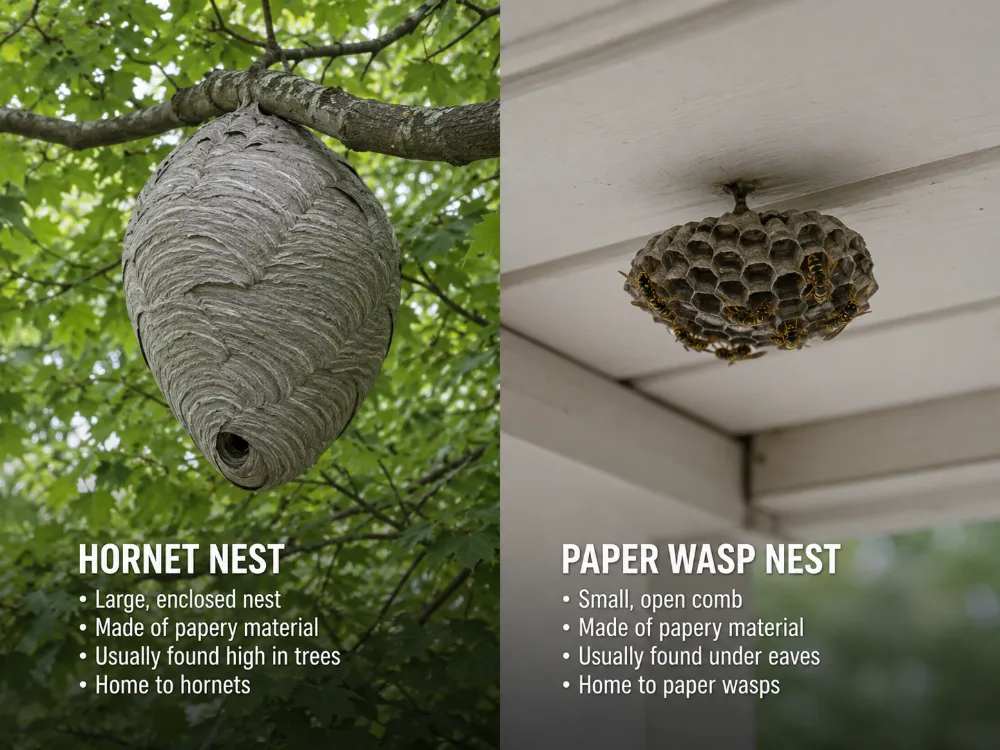
A hornet nest is a type of wasp nest because hornets are wasps. In everyday use, “hornet nest” usually means a large enclosed papery nest, often in a tree, shrub, attic, wall void, or under an eave. “Wasp nest” is broader and may include open paper wasp combs, underground yellow jacket nests, mud dauber tubes, or enclosed aerial nests. Nest shape and location are the best clues.
| Feature | Hornet Nest | Wasp Nest | Quick Identification Tip |
|---|---|---|---|
| Meaning | A nest made by hornets, which are a type of social wasp | A broad term for nests made by many wasps, including paper wasps, yellow jackets, hornets, and mud daubers | All hornet nests are wasp nests, but not all wasp nests are hornet nests. |
| Common shape | Large enclosed papery ball, oval, pear, or football shape | Can be open comb, enclosed paper shell, underground cavity, wall void, or mud tube | Shape tells you more than the word “wasp.” |
| Outer covering | Usually covered by a gray or tan paper envelope | Paper wasps have open cells; yellow jackets and hornets often have enclosed shells; mud daubers use mud | An enclosed gray shell suggests hornet or yellow jacket type. |
| Typical location | Trees, shrubs, roof edges, attics, wall voids, sheds, or protected high places | Depends on species: eaves, ground holes, walls, branches, attics, mud surfaces | Open eave combs are often paper wasps; ground holes often suggest yellow jackets. |
| Colony size | Often medium to large social colony | Ranges from one solitary wasp to thousands of social wasps | Heavy traffic means an active social nest. |
| Visibility | Often visible if aerial, hidden if inside walls or cavities | May be visible, hidden, underground, or attached to buildings | Do not assume a small entrance means a small nest. |
| Defensive behavior | Can be very defensive near the nest | Varies widely; paper wasps are often less aggressive, yellow jackets can be highly defensive | Any active social nest should be respected from a distance. |
| Best safety rule | Avoid disturbing it; call a professional if near people | Identify from a distance; avoid poking, spraying randomly, or sealing active wall nests | Location and activity level determine risk. |
Are Hornet Nests and Wasp Nests the Same?
Yes and no. A hornet nest is a wasp nest because hornets belong to the wasp group. However, “wasp nest” is a much broader term. It can describe nests made by hornets, yellow jackets, paper wasps, mud daubers, potter wasps, and many other wasp species.
The confusion comes from everyday language. Many people use “wasp nest” to mean a small open paper nest under an eave, while they use “hornet nest” to mean a larger enclosed nest hanging in a tree. In biology, hornets are simply one kind of wasp, but in home identification, nest shape and location are more helpful than the common name.
The simplest rule is:
Hornet nest: Usually an enclosed papery nest made by social hornets or hornet-like wasps.
Wasp nest: Any nest made by wasps, including open combs, enclosed paper nests, underground nests, wall nests, and mud tubes.
What Is a Hornet Nest?
A hornet nest is usually a social nest made from chewed wood fibers mixed with saliva. The result is a layered paper-like material. Many hornet nests are enclosed inside a protective outer envelope, with one or more entrance holes that workers use to fly in and out.
Hornet nests are often described as gray, tan, football-shaped, pear-shaped, or rounded. They may hang from tree branches, shrubs, rooflines, porch ceilings, or attic beams. Some hornets and hornet-like wasps may also nest inside cavities, wall voids, hollow trees, or other protected spaces.
Common hornet nest features include:
Gray or tan papery material
Layered outer envelope
Round, oval, pear-shaped, or football-like structure
One visible entrance hole in many cases
Active worker traffic during warm weather
Comb layers hidden inside the outer shell
What Is a Wasp Nest?
A wasp nest can look very different depending on the species. Some wasps build open paper combs. Some build enclosed paper nests. Some nest underground. Some use wall cavities. Some solitary wasps build mud tubes or clay-like cells.
This is why “wasp nest” is not specific enough for accurate identification. A small open comb under a porch and a hidden yellow jacket nest in the ground are both wasp nests, but they involve very different insects and different levels of risk.
Common types of wasp nests include:
Paper wasp nests: Open umbrella-like paper combs with visible hexagonal cells.
Yellow jacket nests: Enclosed paper nests, often underground, in walls, or hidden cavities.
Hornet nests: Larger enclosed paper nests, often aerial or in protected cavities.
Mud dauber nests: Small mud tubes or clay-like cells built by solitary wasps.
Potter wasp nests: Small pot-shaped mud nests.
Hornets Are Wasps, But Not All Wasps Are Hornets
The most important biological point is that hornets are a subgroup within the wasp world. They are not separate from wasps in the same way that cats are separate from dogs. Instead, hornets are wasps with particular body forms, social behavior, and nest-building habits.
In North America, common names can be especially confusing. The bald-faced hornet, for example, is commonly called a hornet, but it is actually a type of aerial yellow jacket. It still builds a large enclosed papery nest and behaves much like what most homeowners expect from a “hornet nest.”
For practical identification, focus on these questions:
Is the nest open or enclosed?
Is it above ground, underground, or inside a wall?
Are the cells visible?
Is there heavy worker traffic from one entrance?
Are the insects large, black-and-white, brown-and-yellow, or yellow-and-black?
Shape Differences
Nest shape is one of the best ways to tell hornet nests from other wasp nests. Hornet nests are usually enclosed. You normally cannot see the individual comb cells from outside because they are wrapped in a papery outer envelope.
Paper wasp nests are different. They are open and exposed, often shaped like a small umbrella or upside-down comb. You can usually see the hexagonal cells from below. These nests are common under eaves, porch ceilings, deck railings, shed roofs, and tree branches.
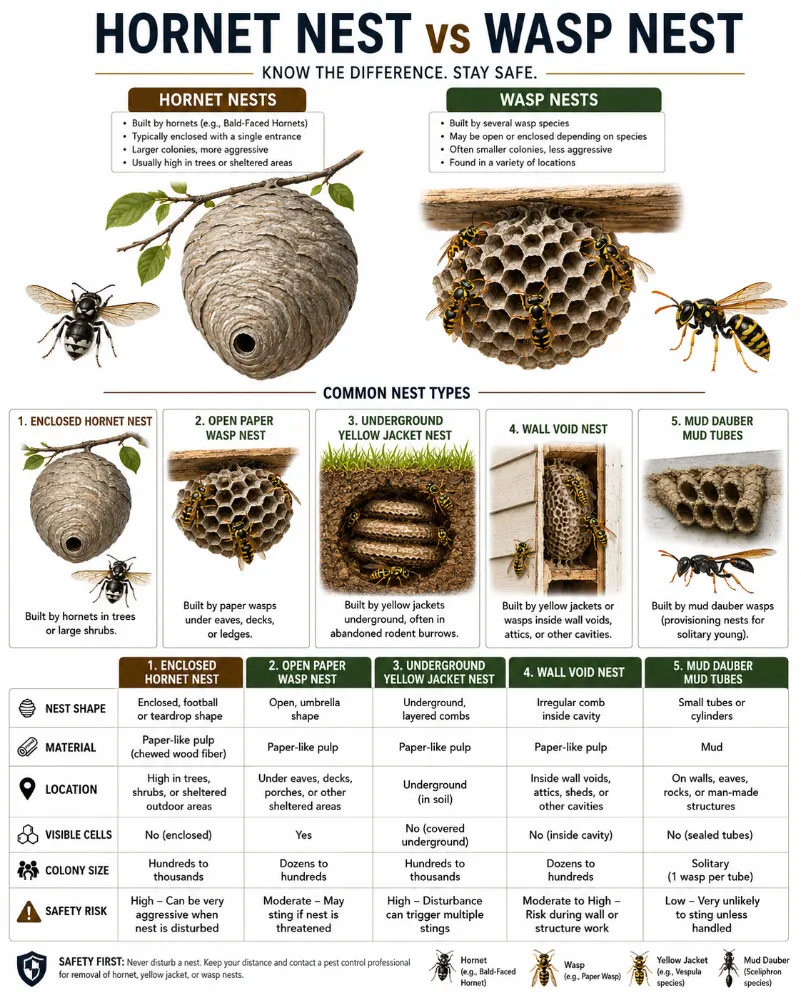
| Nest Type | Shape | Cells Visible? | Common Builder |
|---|---|---|---|
| Hornet nest | Large enclosed ball, oval, pear, or football shape | No, usually hidden inside | Hornets or hornet-like social wasps |
| Paper wasp nest | Open umbrella-like comb | Yes | Paper wasps |
| Yellow jacket nest | Enclosed paper nest, often hidden underground or in cavities | No, usually hidden | Yellow jackets |
| Mud dauber nest | Mud tubes, clay cells, or mud clumps | No typical paper cells | Solitary mud dauber wasps |
Material Differences
Hornets, yellow jackets, and paper wasps usually make nests from paper-like material. They scrape weathered wood, bark, plant fibers, or similar material, chew it with saliva, and form it into combs and nest walls.
The result can look like gray paper, thin cardboard, or layered papier-mache. A hornet nest often has visible swirling layers on the outside. A paper wasp nest has exposed comb cells and may be attached by a short stalk.
Mud daubers are different. They use wet mud to create tubes or cells. These nests are often found on walls, under bridges, inside sheds, under roof edges, or on sheltered surfaces. Mud dauber nests are not papery and usually do not contain a large social colony.
Location Differences
Nest location is another major clue. Hornet nests are often above ground, but they may also occur in protected cavities. Paper wasps usually build exposed combs under sheltered horizontal surfaces. Yellow jackets often nest underground, in wall voids, or in enclosed spaces.
| Location | Likely Nest Type | Notes |
|---|---|---|
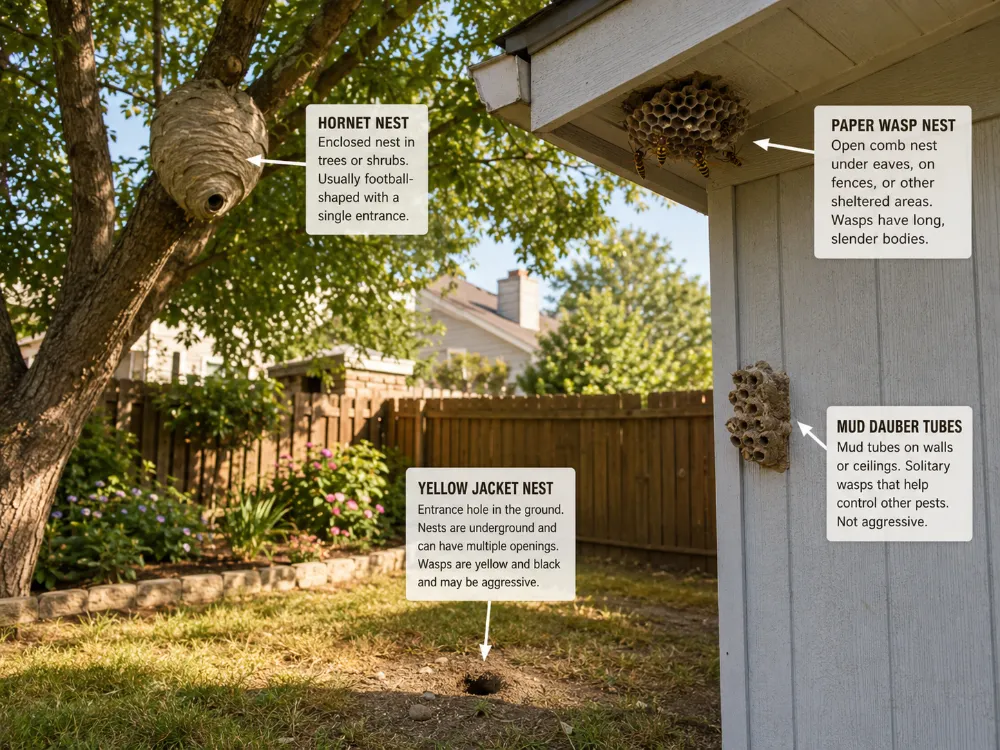
| Hanging from a tree branch | Hornet or aerial yellow jacket type | Often enclosed and football-shaped. |
| Under a roof eave with open cells visible | Paper wasp | Usually open umbrella-shaped comb. |
| Hole in the ground with many insects flying in and out | Yellow jacket | Can be highly defensive if disturbed. |
| In a wall crack or siding gap | Yellow jacket, hornet, or other cavity-nesting wasp | Do not seal an active entrance without proper treatment. |
| Mud tubes on a wall or beam | Mud dauber | Usually solitary and less aggressive. |
| Attic or shed interior | Hornet, paper wasp, yellow jacket, or mud dauber | Shape and activity level are needed for identification. |
Hornet Nest vs Paper Wasp Nest
This is one of the most common comparisons. A hornet nest is usually enclosed, larger, and more protective. A paper wasp nest is usually open, smaller, and shaped like an umbrella or exposed comb.
Paper wasp nests are often easier to recognize because the cells are visible. You may see wasps standing directly on the exposed comb. The nest may hang from a short stalk under a roof edge, porch ceiling, branch, or deck.
Hornet nests are usually more hidden internally. The comb layers are wrapped inside a papery shell. You may see only the outside envelope and the entrance hole.
Quick differences:
Hornet nest: Enclosed, layered, larger, often aerial, cells hidden.
Paper wasp nest: Open, umbrella-shaped, exposed cells, usually smaller.
Hornet Nest vs Yellow Jacket Nest
Hornet nests and yellow jacket nests can be more difficult to separate because both may be enclosed in a papery outer envelope. The biggest clue is often location.
Many yellow jackets nest underground in old rodent burrows, soil cavities, or hidden spaces. Others nest inside walls, attics, hollow trees, or enclosed aerial sites. Hornet-type nests are often above ground in trees, shrubs, eaves, or structures, though some species may use cavities.
Yellow jackets are also famous for scavenging human food, especially meat and sweets. They often become very noticeable around garbage cans, picnics, barbecues, and fallen fruit.
Quick differences:
Hornet nest: Often large, aerial, enclosed, and visible in trees or on structures.
Yellow jacket nest: Often hidden underground or inside walls, with heavy traffic at a hole or crack.
Hornet Nest vs Mud Dauber Nest
Mud dauber nests are very different from hornet nests. Mud daubers are usually solitary wasps, not large social colony builders. Their nests are made from mud rather than paper.
A mud dauber nest may look like small tubes, clay pipes, mud cells, or a rough mud patch attached to a wall, beam, ceiling, or sheltered outdoor surface. Inside the cells, the female may place paralyzed spiders or insects as food for her larvae.
Mud daubers are generally less aggressive than social hornets, paper wasps, or yellow jackets. They can sting, but they rarely defend nests in large groups because they do not have a large worker colony.
How Big Can Hornet Nests Get?
Hornet nests can become quite large by late summer or early fall. A young nest may begin small in spring, built by a queen starting the colony. As workers emerge and the colony grows, the nest expands layer by layer.
Some hornet-type nests may become the size of a football or larger. The final size depends on species, climate, food supply, nest location, and how long the colony remains active.
A large nest does not always mean the insects are more aggressive, but it usually means there are more workers that can defend it. More workers can mean a higher sting risk if the nest is disturbed.
How Big Can Wasp Nests Get?
Wasp nest size depends completely on the species. A paper wasp nest may remain relatively small, sometimes with only a few dozen to a few hundred cells. A yellow jacket nest can become much larger, especially if it is hidden in the ground, a wall, or a cavity.
Mud dauber nests may be small and solitary. Potter wasp nests may be tiny clay pots. Social wasp nests, by contrast, can contain many workers and expand throughout the warm season.
This is why size alone does not identify the nest. A small open nest under an eave may be paper wasps. A small ground hole with heavy traffic may hide a much larger yellow jacket nest underground.
Activity Around the Nest
Worker traffic is a useful clue. Social hornets, yellow jackets, and paper wasps have workers that fly in and out of the nest repeatedly. The more traffic you see, the more active the colony likely is.
Signs of an active social nest include:
Many insects flying in and out of the same entrance
Workers carrying prey, wood fibers, or food
Defensive insects hovering near the nest
Buzzing from inside a wall or attic
Insects appearing repeatedly in one indoor room
A nest with no activity may be old or abandoned, but be careful. Some nests appear quiet during cool weather or at certain times of day. Observe from a safe distance before assuming a nest is inactive.
Which Nest Is More Dangerous?
The most dangerous nest is not always the largest one. Risk depends on species, colony size, location, human traffic, and how easily the nest can be disturbed.
Yellow jacket nests can be especially risky because they are often hidden underground. A person may step on or mow over the entrance without seeing it. Hornet nests can also be dangerous if they are near doors, patios, windows, children’s play areas, or work zones.
Paper wasp nests are often less aggressive when left alone, but they can still sting if touched, shaken, or built near a high-traffic area.
Risk is higher when:
The nest is near a doorway, walkway, mailbox, patio, deck, or playground.
The nest is hidden in the ground or wall.
People or pets accidentally disturb the entrance.
Someone nearby has a known sting allergy.
The colony is large and active.
The insects are entering indoor living spaces.
Can Hornets and Wasps Sting More Than Once?
Yes. Most hornets and wasps can sting more than once because they usually do not lose the stinger after a single sting. This is different from honey bees, which often leave the stinger behind after stinging humans or other mammals.
Hornet and wasp stings can cause pain, redness, swelling, and itching. Some people may develop large local reactions. A smaller number may have severe allergic reactions, which can be life-threatening.
Emergency warning signs after a sting include:
Difficulty breathing
Swelling of the lips, tongue, face, or throat
Dizziness or fainting
Widespread hives
Chest tightness
Vomiting or severe weakness
Confusion or collapse
These signs require immediate emergency medical care.
How to Identify a Nest Safely
Never poke, shake, spray randomly, or stand directly under an active nest to identify it. Use distance, observation, and pattern recognition. Binoculars or a zoom camera can help you see details without approaching.
Safe identification steps include:
Observe from a safe distance.
Look at the nest shape: open comb, enclosed paper shell, mud tube, or hidden hole.
Watch the entrance pattern.
Note the location: tree, eave, wall, ground, attic, or shed.
Look for visible cells from below.
Keep children and pets away.
Avoid using loud tools or vibration near the nest.
Contact a professional if the nest is large, hidden, or close to people.
Why You Should Not Seal an Active Wall Nest
If wasps or hornets are entering a wall gap, do not simply seal the entrance while the colony is active. Trapped insects may search for another exit and can sometimes move into indoor rooms through gaps, lights, vents, or wall openings.
Wall nests need careful handling because the visible entrance may not show the full size or location of the nest. A professional can locate the activity, choose a safe strategy, and reduce the chance of driving insects into living spaces.
Should You Remove a Hornet Nest?
Not every hornet nest automatically requires removal. A nest high in a tree far from people may be left alone until the colony naturally dies out at the end of the season. Social wasp colonies in temperate climates usually decline when cold weather arrives, although new queens may overwinter elsewhere.
Removal is more important when the nest is:
Near a door, window, walkway, patio, or deck
Near children or pets
Inside a wall, attic, shed, or living space
Close to a workplace or public area
Large and highly active
Associated with repeated stings
Near someone with a sting allergy
Large hornet nests should usually be handled by trained pest professionals. Disturbing an active nest can trigger group defense.
Should You Remove a Wasp Nest?
The decision depends on the type of wasp, nest location, and risk. A small paper wasp nest in a remote corner of a garden shed may not be urgent if no one goes near it. A yellow jacket nest in the ground beside a walkway is a much higher risk.
Consider removal when:
The nest is in a high-traffic area.
Wasps are entering the house.
The nest is hidden underground or in a wall.
People have already been stung.
Pets or children are likely to disturb it.
The species is highly defensive.
For small open paper wasp nests, some homeowners may choose careful removal early in the season, but large or active nests are safer to leave to professionals.
Do Hornets Reuse Old Nests?
In many temperate regions, hornets and other social wasps do not reuse the same old nest the next year. The old colony usually dies off in cold weather, while new queens overwinter in protected places and start new nests in spring.
However, old nests can still matter. A sheltered area that attracted a nest once may attract another queen later. Old nests may also remain attached for months and can be mistaken for active nests.
Before removing an old nest, check for activity from a safe distance. If there is no traffic over time and the season is cold, it may be inactive. If insects are still flying in and out, treat it as active.
Do Wasps Reuse Old Nests?
Most social wasps do not reuse old paper nests in the same way honey bees may reuse comb spaces. Paper wasps, yellow jackets, and hornets usually start new colonies each year in temperate climates.
Solitary wasps are different. Mud dauber nests may remain on buildings after the adults are gone, and empty mud cells may be reused by other insects or spiders as shelter. Old mud nests can be scraped away when inactive.
Even if old wasp nests are not reused, the same building gaps, eaves, and sheltered corners may be attractive nesting sites year after year.
Seasonal Changes in Hornet and Wasp Nests
Hornet and wasp colonies usually begin small in spring. A queen starts a nest, lays eggs, and raises the first workers. Once workers mature, they expand the nest, gather food, feed larvae, and defend the colony.
By late summer and early fall, nests may be much larger. This is also when human encounters often increase because colonies have more workers and food needs change. Yellow jackets may become especially noticeable around sweets, meat, trash, and outdoor food.
Typical seasonal pattern:
Spring: Queen starts a small nest.
Early summer: Workers emerge and colony grows.
Late summer: Nest is larger and activity increases.
Fall: New queens and males may be produced; workers may become more noticeable.
Winter: Old colonies die in cold climates; new queens overwinter separately.
How Hornet and Wasp Nests Are Built
Many social wasps make paper from wood fibers. Workers scrape wood from fences, dead branches, bark, or weathered surfaces. They chew it with saliva and shape it into cells, layers, and outer envelopes.
Inside an enclosed hornet or yellow jacket nest, there are comb layers where larvae develop. The outside envelope protects the colony from weather, predators, and temperature changes.
Paper wasps use similar paper material but do not usually wrap the comb in a complete envelope. Their open-cell design makes the larvae visible from below.
Hornet Nest vs Bee Nest
Hornet nests are often confused with bee nests, but they are very different. Bees usually make wax combs, while hornets make paper-like nests from chewed wood fibers.
| Feature | Hornet Nest | Bee Nest |
|---|---|---|
| Main material | Paper-like wood fiber | Wax comb in many social bees |
| Outer look | Gray or tan papery shell | May be hidden in cavities; wax comb may be visible in open colonies |
| Food stored | Usually not honey storage like honey bees | Honey bees store honey and pollen |
| Common confusion | Large paper ball in tree or eave | Swarm cluster or cavity colony |
If the nest is made of gray paper and has an outer shell, it is more likely a hornet or wasp nest than a honey bee nest.
Hornet Nest vs Wasp Nest in Trees
A large papery nest hanging in a tree is often called a hornet nest. In some regions, it may be made by bald-faced hornets or related aerial yellow jackets. These nests are usually enclosed and may look like a gray football or teardrop.
Paper wasps may also build in trees, but their nests are usually smaller and open. If you can see exposed cells, it is more likely a paper wasp nest. If you see a closed gray shell with a single entrance, it is more likely a hornet-type nest.
Tree nests far from people may be left alone in many cases. Nests near walkways, patios, children’s areas, or work zones are more concerning.
Hornet Nest vs Wasp Nest Under Eaves
Under eaves, both paper wasps and hornet-like wasps may nest. The shape is the key. An open comb under an eave is usually a paper wasp nest. A closed papery ball or oval under an eave suggests a hornet or enclosed social wasp nest.
Paper wasp nests under eaves may remain small and visible. Hornet-type nests may grow larger and become more defensive as the colony expands.
If the nest is directly above a doorway, garage entrance, outdoor seating area, or children’s play space, it may require removal even if it is not very large.
Hornet Nest vs Wasp Nest in the Ground
A nest in the ground is usually not a typical hornet nest. It is more often a yellow jacket nest or another ground-nesting wasp. These nests can be dangerous because they are easy to disturb by accident.
Signs of a ground wasp nest include:
Repeated insect traffic into one hole
Wasps flying low over grass or soil
Activity near old rodent burrows
Stings after mowing, walking, or digging
Buzzing from the ground in severe cases
Ground nests should be treated with caution. Do not pour liquids into the hole, mow over it, step on it, or block the entrance casually.
Hornet Nest vs Wasp Nest in a Wall
A nest inside a wall can involve yellow jackets, hornets, or other cavity-nesting wasps. You may only see insects entering and leaving through a crack, vent, siding gap, or hole. The actual nest may be much larger than the visible entrance suggests.
Signs of a wall nest include:
Repeated insects entering the same wall gap
Buzzing sounds inside a wall
Wasps appearing indoors near windows or lights
Insects entering through vents or trim gaps
Activity increasing during warm parts of the day
Wall nests are best handled professionally. Sealing the entry hole while the nest is active can create indoor problems.
Are Hornet and Wasp Nests Beneficial?
Hornets and wasps can be beneficial in ecosystems. They hunt flies, caterpillars, beetle larvae, and other insects. They feed their larvae protein and may help reduce pest populations naturally. Some adults also visit flowers and may contribute to pollination.
However, the benefit does not mean every nest should remain near people. A wasp colony in a forest edge is part of the ecosystem. A large defensive nest beside a doorway may be a safety hazard.
Ecological benefits include:
Natural pest control
Food for birds, mammals, reptiles, and other insects
Pollination by some adult wasps
Nutrient recycling through scavenging
Support for natural food webs
How to Prevent Hornet and Wasp Nests Around the Home
Prevention is easiest before nests become large. In spring, queens search for protected places to start new colonies. Reducing access to sheltered gaps and removing small early nests in unsafe locations can help prevent larger problems later.
Prevention tips include:
Seal cracks around siding, vents, rooflines, and utility openings.
Repair damaged screens and attic vents.
Keep outdoor trash sealed.
Clean up fallen fruit.
Do not leave pet food outdoors.
Inspect eaves, sheds, decks, and porch ceilings in spring.
Keep wood piles and debris away from high-traffic areas.
Reduce outdoor food attractants in late summer and fall.
Prevention is especially useful for yellow jackets, which are attracted to food waste, sweet liquids, meat scraps, and hidden nesting cavities.
What Not to Do Around Hornet or Wasp Nests
Many stings happen when people disturb nests while trying to remove them without understanding the risk. Some actions can make a situation worse.
Avoid these mistakes:
Do not poke or shake the nest.
Do not throw objects at it.
Do not stand directly under an active aerial nest.
Do not mow over a suspected ground nest.
Do not seal an active wall nest entrance.
Do not use fire.
Do not use a pressure washer.
Do not spray randomly into walls or vents.
Do not let children or pets investigate the nest.
If the nest is active, large, hidden, or near people, professional help is usually the safest option.
What to Do After a Sting
If you are stung near a nest, move away calmly but quickly. More wasps or hornets may sting if you remain near the colony. Once safe, wash the sting site with soap and water and apply a cold compress.
For a normal local reaction, pain, redness, and swelling are common. Avoid scratching the area. Follow medical advice or product labels for any over-the-counter medication.
Seek emergency help immediately if you experience:
Trouble breathing
Throat, tongue, lip, or facial swelling
Widespread hives
Fainting or dizziness
Chest tightness
Repeated vomiting
Confusion
Multiple stings with severe symptoms
Common Myths About Hornet and Wasp Nests
Hornets and wasps are often feared, so myths are common. Accurate identification helps people respond safely and avoid unnecessary panic.
Myth: Hornets are not wasps.
Fact: Hornets are a type of wasp.Myth: All wasp nests look the same.
Fact: Wasp nests can be open combs, enclosed paper shells, underground nests, wall nests, or mud tubes.Myth: A small entrance means a small nest.
Fact: A small ground hole or wall gap may lead to a large hidden colony.Myth: All wasps are aggressive all the time.
Fact: Many wasps are calm away from the nest, but social colonies defend nests strongly.Myth: Sealing the entrance solves a wall nest problem.
Fact: It can trap insects and push them indoors.
Final Takeaway
A hornet nest is a type of wasp nest, but “wasp nest” can mean many different structures. The best identification clues are shape, material, location, and insect activity.
Hornet nests are usually enclosed, papery, and round, oval, or football-shaped. Paper wasp nests are usually open, umbrella-like combs with visible cells. Yellow jacket nests are often enclosed and may be underground, in walls, or hidden cavities. Mud dauber nests are made of mud, not paper.
The safest rule is to observe from a distance. If the nest is large, hidden, underground, inside a wall, or near people and pets, do not disturb it. Professional removal is usually the safest choice for active social wasp or hornet nests.
FAQs About Hornet Nest vs Wasp Nest
Is a hornet nest a wasp nest?
Yes. Hornets are a type of wasp, so a hornet nest is technically a wasp nest. However, not all wasp nests are hornet nests.
What is the main difference between a hornet nest and a wasp nest?
A hornet nest is usually an enclosed papery nest made by hornets or hornet-like social wasps. A wasp nest is a broader term that can include open paper wasp combs, underground yellow jacket nests, mud dauber tubes, and enclosed hornet nests.
What does a hornet nest look like?
A hornet nest often looks like a gray or tan papery ball, oval, pear, or football-shaped structure. The comb cells are usually hidden inside an outer paper envelope.
What does a paper wasp nest look like?
A paper wasp nest usually looks like an open umbrella-shaped comb with visible hexagonal cells. It is often found under eaves, porch ceilings, branches, deck railings, or shed roofs.
What does a yellow jacket nest look like?
A yellow jacket nest is often hidden underground, in a wall void, or inside a cavity. It may have an enclosed paper structure inside, but from outside you may only see workers entering and leaving a hole.
Are hornet nests always in trees?
No. Hornet nests may be in trees, shrubs, attics, wall voids, sheds, rooflines, or under eaves. Some are visible, while others are hidden in cavities.
Are wasp nests always under eaves?
No. Some wasps nest under eaves, but others nest underground, in walls, in hollow trees, in mud cells, or inside sheltered structures.
Which is more dangerous, a hornet nest or a wasp nest?
It depends on the species and location. A hidden yellow jacket nest near a walkway may be more dangerous than a high hornet nest far from people. Any active social nest near humans or pets should be treated carefully.
Can hornets sting more than once?
Yes. Hornets can usually sting more than once because they do not typically lose the stinger after one sting.
Can wasps sting more than once?
Yes. Most wasps can sting multiple times. This includes paper wasps, yellow jackets, hornets, and many other social wasps.
Should I remove an old hornet nest?
If the nest is inactive, removal is usually less urgent. Many old nests are not reused. However, check for activity from a safe distance before touching or removing it.
Do hornets reuse the same nest every year?
In many temperate regions, hornets do not reuse the same old nest the next year. New queens usually start new nests in spring.
Should I remove a wasp nest myself?
Small open paper wasp nests may sometimes be managed early in the season, but large, hidden, underground, wall, or highly active nests are safer for professionals to handle.
Why should I not seal an active wall nest?
Sealing an active wall nest can trap wasps or hornets inside and may force them to find another exit into the home. Wall nests should be handled carefully.
Are hornets and wasps beneficial?
Yes. Hornets and wasps hunt many insects and play roles in natural food webs. They become a problem mainly when nests are too close to people, pets, doors, or high-traffic areas.