The short answer is that a tortoise is a type of turtle, but not every turtle is a tortoise. Tortoises are land-dwelling turtles with heavy domed shells and sturdy elephant-like feet, while many other turtles live in freshwater or the sea and have flatter shells and feet or flippers adapted for swimming. So the difference is mainly about habitat, body shape, and lifestyle rather than two completely unrelated animal groups.
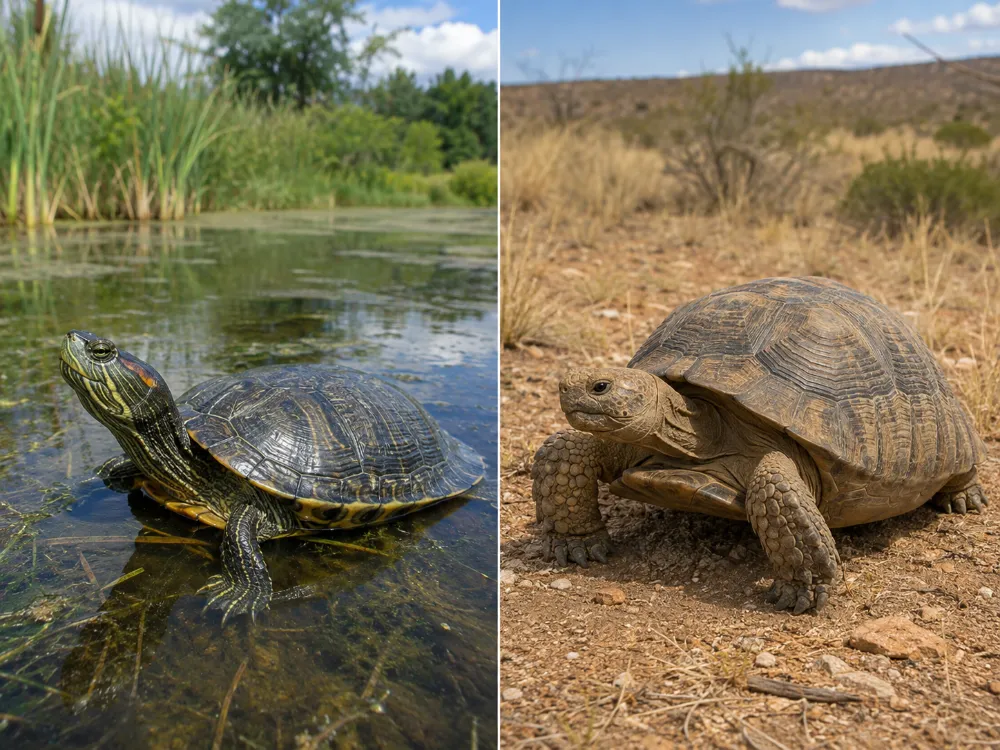
People often use the words turtle and tortoise as if they mean the same thing, but in biology they are not identical. A tortoise belongs inside the broader turtle group, yet it has its own very recognizable body design and way of life.
In this guide, you will learn how turtles and tortoises differ in habitat, feet, shell shape, diet, movement, and behavior, plus the fastest ways to identify them correctly.
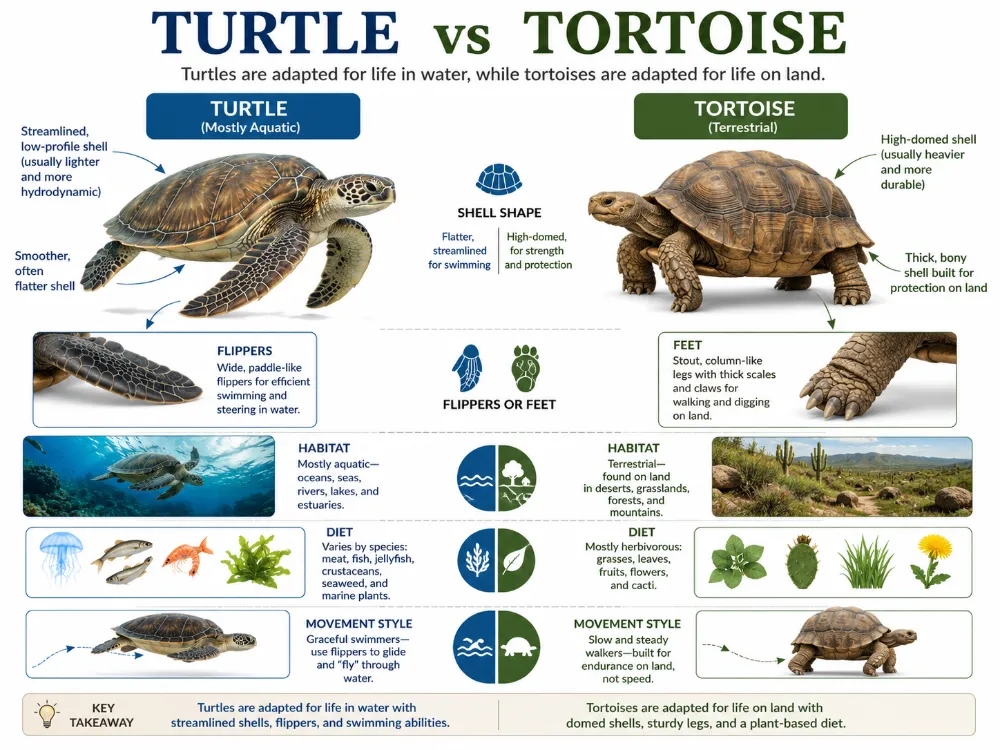
Quick comparison table
| Feature | Turtle | Tortoise |
|---|---|---|
| Basic meaning | Broad group that includes many aquatic and semi-aquatic species | A land-dwelling type of turtle |
| Main habitat | Freshwater, marine, or mixed depending on species | Mainly terrestrial |
| Feet | Often webbed feet or flippers for swimming | Stout, elephant-like feet for walking on land |
| Shell shape | Often flatter and lighter for swimming | Usually higher-domed and heavier |
| Movement | Usually better swimmers | Usually better walkers on land |
| Diet | Often varied; may be omnivorous, herbivorous, or carnivorous | Often mainly herbivorous |
| Best quick clue | Webbed feet or flippers, flatter shell | Rounder shell, thick legs, land lifestyle |
| Important fact | Some turtles live on land, but the group is broad | All tortoises are turtles |
What is a turtle?
The word turtle is a broad term for reptiles in the order Testudines. This group includes sea turtles, freshwater turtles, terrapins in some language traditions, and tortoises. All of these animals share the same basic body plan: a shell, a beak instead of teeth, and a body built around that shell structure.
In everyday English, people often use “turtle” for animals that spend a lot of time in water. That common usage is practical, but biologically the word is broader than that.
This is why the sentence “all tortoises are turtles” is correct, even though many people do not realize it at first.
What is a tortoise?
A tortoise is a land-dwelling member of the turtle group. Tortoises are especially adapted for life on land, which is why they usually have sturdy legs, rounded shells, and a slower, more deliberate walking style.
They are not built like swimmers. Instead, their body is designed for supporting weight on land, walking over dry ground, and feeding mostly on terrestrial vegetation.
So when people imagine a slow shell-backed reptile crossing a dry landscape, they are usually thinking of a tortoise rather than a typical aquatic turtle.
All tortoises are turtles, but not all turtles are tortoises
This is the most important concept in the whole comparison. The turtle group is the larger category. Tortoises belong inside that category as one specialized branch adapted for terrestrial life.
That means comparing turtle and tortoise is not quite like comparing cat and dog. It is more like comparing “bird” and “eagle.” One word is broad, and the other refers to one particular kind within it.
Once you understand that, the relationship between the two terms becomes much easier to remember.
Habitat is one of the biggest differences
Many turtles live in water for much or most of their lives. Depending on the species, they may live in ponds, rivers, marshes, lakes, swamps, estuaries, or the open ocean. Some come onto land mainly to bask, nest, or move between water bodies.
Tortoises are mainly land animals. They live in dry grasslands, scrublands, deserts, forests, and other terrestrial habitats depending on the species. They do not depend on a pond, river, or sea as their main living space in the way many turtles do.
If the animal spends most of its life in water, it is usually not a tortoise.
The feet and legs are one of the fastest clues
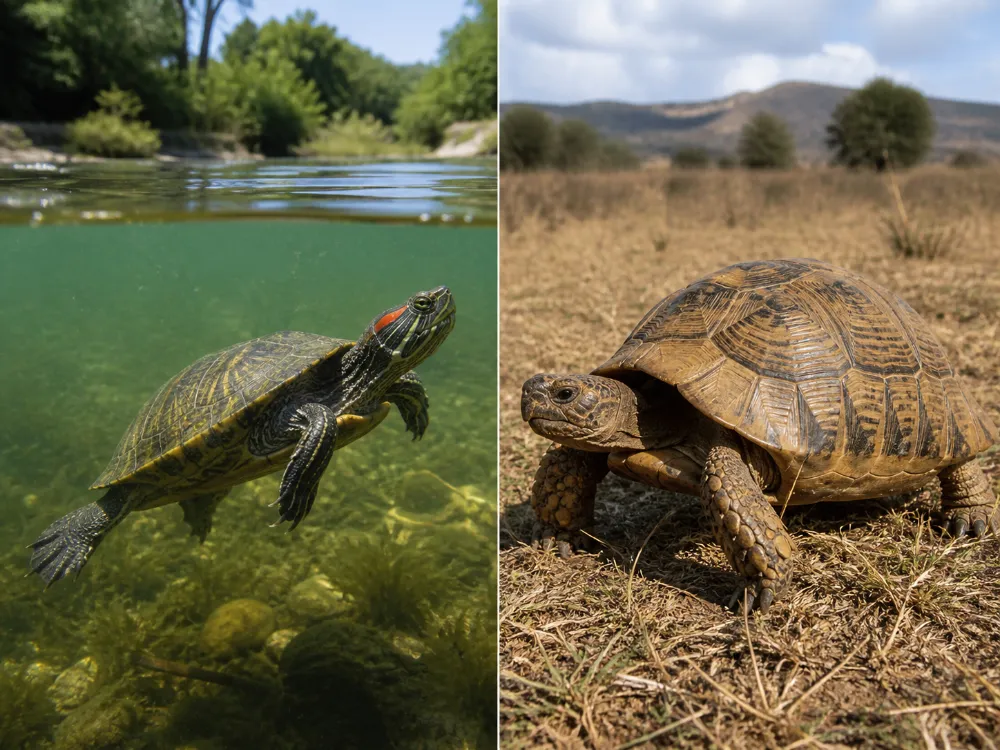
If you want to tell them apart quickly, look at the limbs. Many turtles have webbed feet or paddle-like limbs that help them move through water. Sea turtles go even further and have large flippers built for powerful swimming.
Tortoises have thick, sturdy, column-like legs with blunt, strong feet designed for walking on land. People often describe them as elephant-like, and that is a helpful image because they are built to bear weight rather than push through water efficiently.
If the animal has flippers or obvious webbing, it is not a tortoise. If it has heavy land-walking feet, tortoise becomes much more likely.
Shell shape is usually different
Tortoises usually have a high-domed, rounded shell. This shape helps protect the body on land and fits a slower, weight-bearing lifestyle. The shell often looks sturdy, heavy, and strongly arched.
Many turtles, especially aquatic ones, have flatter, lighter, and more streamlined shells. This helps reduce resistance in water and makes swimming easier. A flatter shell is usually better for moving through ponds, rivers, or the sea than a tall domed shell would be.
So if the shell looks very round and raised, think tortoise. If it looks flatter and more streamlined, think aquatic turtle.
Tortoises are better built for walking
Tortoises are terrestrial walkers. Their whole body is designed for steady movement across land, sometimes over rocky, grassy, or dry ground. They usually move slowly, but they are often more capable walkers than people expect.
Many turtles can move on land too, especially when nesting or basking, but their body is often much better adapted for water than for long land travel. A freshwater turtle may be clumsy on land compared with a tortoise.
This difference reflects the basic rule of the whole comparison: tortoises are land specialists, while turtles as a broader group include many water specialists.
Turtles are usually better swimmers
Aquatic turtles are usually far better swimmers than tortoises. Their flatter shell, lighter build, and webbed feet or flippers help them move efficiently in water. Some freshwater turtles are agile swimmers, and sea turtles are especially specialized for long-distance ocean travel.
Tortoises are not built for this kind of movement. They may survive brief contact with shallow water, but they are generally poor swimmers and can be at serious risk if placed in water too deep for them to manage safely.
This is one reason it is so important not to assume all shelled reptiles need the same type of care.
Diet often differs too
Many tortoises are mainly herbivorous. They often feed on grasses, leaves, flowers, weeds, and other plant material. Their diet matches a land-based lifestyle where vegetation is the main resource.
Turtles as a broader group are much more varied. Some are herbivores, some are omnivores, and some are strongly carnivorous. Depending on the species, a turtle may eat aquatic plants, insects, fish, snails, crustaceans, carrion, or mixed foods.
So if the question is which group is more consistently plant-eating, tortoises usually fit that description better.
Tortoises often live in drier environments
Many tortoises are associated with dry or semi-dry habitats such as scrub, grassland, or even desert-like regions. Their body shape and lifestyle are suited to these places, especially where shade, burrows, and seasonal plant growth matter.
Many turtles, by contrast, are linked with ponds, marshes, riverbanks, swamps, and coastlines. Water is much more central to their daily activity.
This environmental difference is often one of the easiest ways to understand why their bodies are so different.
Lifespan can be impressive in both, but tortoises are famous for longevity
Many turtles can live a long time, but tortoises are especially famous for extreme longevity. Large tortoise species in particular have become symbols of long life because some individuals can survive for many decades and, in some cases, well over a century.
This does not mean all tortoises automatically outlive all turtles, because lifespan varies by species, care, and environment. Still, tortoises have a stronger cultural reputation for exceptional old age.
That reputation is rooted in real biology, even if people sometimes exaggerate it.
Behavior can feel different
Tortoises often seem calm, deliberate, and steady. Their movement is usually slow, grounded, and land-focused. They often spend time grazing, basking, resting, or moving predictably through familiar territory.
Many aquatic turtles feel more alert and reactive, especially around water. A pond turtle may slide off a log into the water quickly when disturbed. Sea turtles are powerful swimmers but usually appear differently behaved because so much of their life happens in the ocean.
So even their everyday behavior often reflects whether they are built mainly for land or water.
Why people confuse them so often
People confuse turtles and tortoises because both have shells, scaled skin, beaks, and a broadly similar reptile shape. In cartoons, children’s books, and casual conversation, the two are often treated as if they are interchangeable.
The confusion is also reinforced by language. In some places, “turtle” is used very broadly in everyday speech, while “tortoise” is used only when the land-dwelling difference is especially obvious.
Once you learn the habitat and limb clues, however, the difference becomes much easier to understand.
How to tell them apart quickly
If you need a fast identification guide, use these clues together:
Turtle: often aquatic or semi-aquatic, flatter shell, webbed feet or flippers, stronger swimmer
Tortoise: land-dwelling, high-domed shell, thick elephant-like feet, stronger walker
No single clue is perfect for every species, but this combination works very well in most cases.
What about terrapins?
The word terrapin adds another layer of confusion. In some English-speaking traditions, terrapin is used for certain small aquatic or semi-aquatic turtles, especially those living in freshwater or brackish environments. It is not usually used for tortoises.
This means the basic pattern still holds. Tortoises are the land specialists, while turtles and terrapins are more often associated with water depending on the naming system being used.
So if you encounter the word terrapin, it usually belongs on the aquatic side of the comparison, not the tortoise side.
Which one is better as a pet?
There is no universal answer, because both turtles and tortoises have very specific care needs. Aquatic turtles need proper water quality, filtration, basking areas, lighting, and species-appropriate diets. Tortoises need dry land enclosures, correct temperature gradients, ultraviolet lighting, and safe plant-based diets in many species.
The most important point is that they should not be treated as interchangeable pets. A tortoise cannot be cared for like a pond turtle, and a turtle cannot be managed like a dry-land grazer.
From a welfare perspective, correct identification matters a great deal.
Final takeaway
The main difference between a turtle and a tortoise is that a tortoise is a land-dwelling type of turtle, while the broader turtle group includes many aquatic and semi-aquatic species. Tortoises usually have high-domed shells, thick elephant-like feet, and a mainly terrestrial lifestyle. Many turtles usually have flatter shells, webbed feet or flippers, and stronger swimming ability. They are related, but once you check habitat, shell shape, and limbs, they are much easier to tell apart.
FAQs
Is a tortoise a turtle?
Yes. A tortoise is a type of turtle.
What is the main difference between a turtle and a tortoise?
The main difference is lifestyle and body design. Tortoises live on land and have sturdy feet, while many turtles live in water and have webbed feet or flippers.
Can tortoises swim like turtles?
No. Tortoises are generally poor swimmers compared with aquatic turtles and can be at risk in deep water.
How can I tell a turtle from a tortoise fast?
Look at the feet and shell. Webbed feet or flippers and a flatter shell suggest a turtle, while thick land-walking feet and a domed shell suggest a tortoise.